Canadians should be concerned about camera surveillance

A new report by the Surveillance Camera Awareness Network (SCAN) at Queen’s University shows that Canadians believe surveillance cameras promote safety, but their perceptions don’t match the actual evidence. The first of its kind in Canada, A Report on Camera Surveillance in Canada will be used as background to help structure new federal surveillance legislation.

“There is little or no evidence that surveillance deters crime,” says David Lyon, coordinator of the report and director of the school’s new Surveillance Studies Centre. “Media such as TV police shows and crime stoppers promote the perception that cameras are more important than they really are.”

The report looks at the rapid growth of surveillance in Canadian society based on studies about:

  • The lack of Canadian legislation addressing public camera surveillance
  • Camera surveillance as big business
  • An exploration of camera operators
  • Research on public opinions about camera surveillance
  • Camera surveillance as one of the legacies of hosting the Olympic Games
  • Camera surveillance in Ottawa taxicabs
  • Camera surveillance in shopping malls

“The public should be concerned,” adds Professor Lyon. “Surveillance technology is constantly changing. Closed-circuit television does not accurately describe it anymore; now surveillance footage is increasingly digitized and free to flow online. What stops are in place to prevent it from falling into the wrong hands? We need to question the social ethics of surveillance footage as well as establish legal limits on how the footage can be used.”

(The Surveillance Camera Awareness Network at the Queen’s Surveillance Centre completed the report with funding from the Office of the Privacy Commissioner and the Social Sciences and Humanities Research Council of Canada. The report is the topic of a surveillance workshop on January 15 and 16, 2010 at Queen’s University).

Press Release from Queen’s University.

Contact: Jeff Drake
jeff.drake@queensu.ca
613-533-2877
Queen’s University

Olympic surveillance legacies

David Loukidelis, the Information and Privacy Commissioner of British Columbia, speaking today at The Surveillance Games workshop, has made it quite clear that his office does not want the Winter Games to leave a legacy of securitization in the city or indeed, fear (as the Assistant Federal Privacy Commissioner, Chantal Bernier, put it), in the consciousness of its residents. In particular he argued that the 600 (yes, 600) cameras that are being installed at the Olympic venues and beyond should not be allowed to remain after the games. I hope that his office is able to deliver on this view, but I doubt that it will. As Kevin Haggerty and Phil Boyle have noted, security architecture is now an actual deliverable of the Olympics, and as many other researchers have shown, such architecture, including in particular CCTV but also adjusted local or national laws on the thematic and spatial limits of protest and freedom of expression (which, as Michael Vonn of the BCCLA and Chris Shaw, a leading anti-games activist, are describing at this very moment in the conference, are themselves often illegal and unconstitutional) tends not only to persist but to act as a kind of Trojan Horse for an expanded surveillance. And as Vonn’s group has also shown – the city is building a permanent CCTV control centre as part of the security architecture for the Games, and you don’t do that for cameras that are going to be removed.

The Surveillance Games

I’ll be off the next few days at ‘The Surveillance Games’ conference in Vancouver.

Coincidentally, the local police have recently announce that they will be buying the same kind of sonic weapons we saw being used against protestors at the Pittsburgh G8 meeting. Except they want us to call them ‘megaphones’ and claim they won’t use them aggressively*. I think we still need to call a weapon a weapon. Just think, with such rebranding the police could get over their recent little problem with tasers too: just call them ‘joy-buzzers’ (just with a whole lot more ‘joy’...). The urban arms race that such mega-events always spark off as manufacturers push their latest toys to anxious governments, of course just adds another layer of bitter irony to the fact that Canada also intends to ignore its own call for global truce during the Games… it seems that you don’t even need the actual gesture for gesture politics these days.

*Even if these devices were just megaphones, this purchase would in any case be rather ironic given that Vancouver city has banned protestors from using any amplification devices by amending their bylaws in July 2009.

Call for Papers: 4th Surveillance & Society Conference, 2010

A GLOBAL SURVEILLANCE SOCIETY?

THE FOURTH BIANNUAL SURVEILLANCE & SOCIETY CONFERENCE

Supported by the LIVING IN SURVEILLANCE SOCIETIES (LISS) COST Action, and the SURVEILLANCE STUDIES NETWORK

City University London, UK

April 13 – 15, 2010

CALL FOR PAPERS

OVERVIEW

Surveillance has become a ubiquitous feature of living in the global north, with citizens routinely monitored by a range of sophisticated technologies. Increasing levels of surveillance are typically justified and legitimated by threats of terrorism, fear of crime and disorder, as info/entertainment tools for the curious and through discourses emphasizing public and private service improvement. In spite of this, little is known about the effect of surveillance on individuals, society, the democratic polity, nation states in the developed and developing world, and the evolving nature of humanity.

THEMES

This conference calls for papers which examine the many facets of surveillance and globality. In particular, we welcome papers which address:

  • Living in the surveillance age
  • Surveillance, difference and discrimination
  • Attitudes and experiences of the watcher and watched
  • The development and diffusion of surveillance technologies
  • Surveillance technology in practice
  • The political economy of surveillance
  • The business of surveillance
  • The surveillance of consumers and workers
  • Public policy, regulation and surveillance
  • The philosophy of surveillance and philosophical perspectives on surveillance
  • Surveillance, intelligence and war
  • Surveillance, sovereignty and the nation state
  • Surveillance and the production of space

FEES AND GENERAL INFORMATION

This is a non-residential conference and participants will need to make their own arrangements for accommodation (we will provide advice for this in due course). The Conference will be held in and around the Oliver Thompson Lecture Theatre and Foyer, City University London, UK. London is a powerful, global city at the sharp end of surveillance processes, protocols and debates and thus provides delegates with an apt cultural context for the exploration of the above themes.

The conference web site will be up and running from early October 2009 providing full details of the emerging conference programme (i.e. schedule, plenary speakers etc.), maps, accommodation advice, evening dinner information, payment details and an electronic registration form.

The Conference Fee is £200 per person, which includes attendance, refreshments, lunch and an optional £25 two year membership of the Surveillance Studies Network. The membership fee will be used to promote the charitable activities of the Surveillance Studies Network, support the continued publication of the Journal of Surveillance and Society and give other benefits to members.

There will be a formal conference dinner on the evening of April 14th at an additional charge of £50.

SUBMISSION OF ABSTRACTS AND NOTIFICATION OF ATTENDANCE

If you wish to present a paper, please submit your 300-word abstract and an accompanying set of three keywords to Lisa, the conference administrator, by November 7th 2009 (email: surveillance_conference@live.co.uk) and please also include the following information so that we can contact you:

• Name

• Country of residence

• Institutional affiliation

• Institutional address

• Telephone number

• Email address

• 300-word abstract and list of three keywords

If you are thinking of attending but do not wish to give a paper, please send us the above information clearly stating that you do not wish to present a paper.

There will be two special issues of Surveillance and Society following this conference. The issues will be spaced to allow time for papers in different states of completion at the conference itself, to be submitted – please see the ‘Event Timetable’ section below. When you submit your abstract, please specify whether you intend to submit your paper to one of these issues.

POSTGRADUATE INFO

We are hoping to offer ten reduced fee places for postgraduate students wishing to give a paper or present a poster display of their research. If you wish to apply for this, please register our interest as soon a possible and send a 300 word abstract to Lisa (or indicate that you wish to present a poster), the conference administrator by 7th November 2009 (email: surveillance_conference@live.co.uk). Allocation of these strictly limited places will be based on the quality of the abstract/research description submitted and not on a first-come-first-served basis.

If you wish to attend, but do not wish to deliver a paper, please indicate this by the November 7th 2009.

EVENT TIMETABLE

2009

September 3rd – Statement of intent issued

September 28th – Full call for papers issued

October 7th – Website goes live

November 7th – Deadline for the submission of abstracts

November 23rd – Second Call issued – with list of key speakers. Electronic booking form available and formal registration and payment begins

December 18th – Final deadline for the submission of abstracts

2010

March 15th – Deadline for the electronic submission of full papers

March 15th – Final deadline for registration and payment for all conference attendees without late booking surcharge

March 24th – Papers published on Web available to all registered conference delegates

April 13th – 15th – Conference

June 30th – Deadline for submission to Surveillance and Society Conference Special Issue 1

Sept 30th – Deadline for submission to Surveillance and Society Conference Special Issue 2

Dec – Publication of Surveillance and Society Conference Special Issue 1

2011

Feb/March 2011 – Publication of Surveillance and Society Conference Special Issue 2

Please register your interest NOW!

We look forward to hearing from you.

Thanks,

Dr Gavin Smith

Professor Clive Norris

Dr Kirstie Ball

Dr David Murakami Wood

Dr Will Webster

2nd Surveillance in Latin America Symposium

Following the success of the first Surveillance Studies symposium in Brazil last year, here is the call for the next one, this time in Mexico next year.
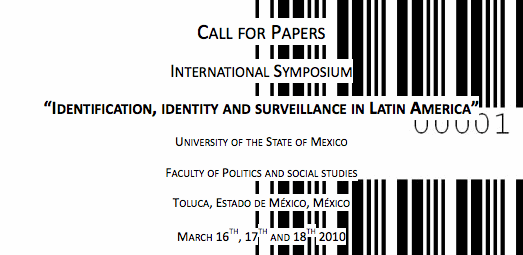
SIMPOSIO MEXICO

Introduction

In modern societies, identification systems have been used as an important mechanism to govern, manage, classify and control populations; in other words, to surveil them. This has meant the employment of certain technologies (passports, national identity letters, RFID, among others), providing interconnected data base systems with information according to specific institutional protocols. In this way, we define identification as visibility and verification of specific details of people’s lives. Likewise, these identification systems have responded to various functions: security, migration control, goods and service administration, as well for territory, space and group access.

The historical, social and politic contexts shape the particular purposes to which each identification system responds. Large-scale surveillance systems to identify the population have been installed in Latin America after decades of colonial, military and single-party governments In addition they have been prompted by increasing multiculturalism in cities, Population growth, migration rates, the perceived rise in terrorism, public security and health risks, as well as the creation of public policies (to aid poverty and unemployment) and globalization.

These conditions have caused the harmonization and articulation of corporations, institutions, technologies and specific protocols for citizen identification in Latin American countries, , depending on each country or region’s particular situation, and its relationship with other regions worldwide. Nevertheless, the Latin American environment allows us to consider the construction of privacy, identities, forms of government and the possibility of resistance policies.

Paper Proposals

In line with this analytic framework, the University of the State of Mexico, Faculty of Politics and Social Studies, hereby invites scholars, analysts and activists in Latin America and worldwide, interested in identification and surveillance, in relation to such matters as cultural or ethnic identities, privacy and data protection, new identification technologies (biometrics, RFID, etc), public policies, security, communication, ethics, law, or modes of critique or resistance; to participate in the International Symposium “Identification, identity and surveillance in Latin America”, by sending a lecture proposal.

Please send an abstract, 300-500 words long, Arial 12, space line 1.5, to the following e-mail: surveillance.studies.mexico@gmail.com, before October 30th 2009. Due to the nature of this event, the abstracts and papers are to be accepted in Spanish, Portuguese and English.

Note: There is no registration fee for this event. All participants are expected to seek their own funding for travel and accommodation. A number of rooms will be reserved with reasonable rates in a nearby hotel. More details to follow.

Main subjects

1. Governmental and corporative policies of identification

2. New technologies for identification and surveillance.

3. Purposes of identification systems in Latin America.

4. Communication and information technologies.

5. Privacy and transparency.

6. Identification, identities and subjectivities.

7. Relationship between global and local, in identification systems.

8. Postcolonial logics and political regimes.

9. Identities, surveillance and resistance.

10. Identification, identity and surveillance in Latin America: new theories?

Important Dates

Call for Papers Publication: July 30th 2009.

Abstract reception deadline: October 30th 2009.

Accepted lectures list publication: December 15th 2010.

Complete paper remittance deadline: February 15th 2010.

Complete program publication: February 28th 2010.

Second Symposium on surveillance in Latin America: March 16th, 17th y 18th 2010. University of the State of Mexico, Faculty of Politics and Social Studies. Toluca, México.

Organizing Committee

Nelson Arteaga Botello

Roberto J. Fuentes Rionda

Faculty of Politics and Social Studies, University of the State of Mexico

Rodrigo Firmito

Postgraduate Program in Urban Management, Pontifical Catholic University of Parana, Curitiba, Brazil

Fernanda Bruno

Postgraduate School of Communication, Federal University of Río de Janeiro, Brasil

Marta Kanashiro

Further Studies Laboratory of Journalism and Knowledge, Technology and Market Group, University of the State of Campinas (UNICAMP), Campinas, Brasil.

Danilo Doneda

De Campos Faculty of Law, Rio de Janeiro, Brasil

André Lemos

Federal University of Bahia, Brasil

With the support of:

David Lyon

David Murakami Wood

Department of Sociology, Queen’s University, Kingston, Ontario, Canada

Proposal reception, Information and Contact

surveillance.studies.mexico@gmail.com

Mega-events, Security and Surveillance

The connection between what are often called ‘mega-events’ (international summits, major sporting competitions etc.), securitization, and he intensification of surveillance is becoming a very interesting area and one which we wrote about in our recent book on urban resilience. I am writing some further stuff on this with Kiyoshi Abe on how mega-events have been managed in Japan.

It seems that in general, such events are either used as ‘test-beds’ for new technologies and procedures which are then either continued afterwards (as with The Olympic Games and CCTV in Greece in 2004 and The FIFA World Cup and video surveillance in Japan/Korea in 2002), or become ‘islands’ of temporary exemption where normal legal human rights protections are reduced or removed and whole areas of public space are often literally, fenced off (as in Rio de Janeiro for the Pan-American Games of 2007, whose model will apparently be extended to include walling off the poor favelas in time for the 2014 FIFA World Cup). There’s going to be a very interesting conference on The Surveillance Games later this year to tie in with the Vancouver Winter Olympics.

Now The Guardian newspaper is reporting that the London Olympics 2012 may make use of a proposal originally designed to stop the proliferation of unofficial commercial advertising near games venues in order to prevent protest. The legislation even allows police to enter private houses to seize material.

Of course the government say that they have no plans to use it in this way, but it’s interesting to see the way in which the ‘standards’ being imposed by such travelling cicuses of globalization tend to end up looking more like the authoritarian regime in Beijing (host of the highly securitized 2008 Olympics) than the supposedly liberal west, whilst at the same time promoting a very controlled but highly commercialized environment. Even the original purposes of the 2006 law (necessary for London to host the Games) are an interesting reflection of the massive corporate interests involved in the Olympics, for which they apparently need a captive and docile audience.

UK Ministry of Justice sounding old, tired and defeated

I was at a meeting organised by the Information Commissioner’s Office (ICO) today (Wednesday) in London where both Jack Straw and Michael Wills from the Ministry of Justice spoke. In the wake of the expenses revelations it was not surprising that both sounded somewhat conciliatory, but the degree of both overt and tacit admission of mistakes and changes needed was quite surprising. I had a bit of a set-to with Michael Wills on the apparent lack of knowledge amongst government ministers of the results of their own research on the (in)effectiveness of CCTV, to which he responded with the Melanie Phillips defence – i.e.: come and talk to ordinary people and they will tell you they want CCTV. This is a diversion for many reasons, not least of which is that unlike both the Daily Mail’s moral minority and the minister, I actually live in places where they only visit on official business and I also understand that what people mean when they demand CCTV is not the technology itself but a solution to the real and perceived problems of crime and anti-social behaviour that they face. They only demand CCTV because they see the programs on TV and are convinced that CCTV ‘works’ – however if you talk to senior police officers or anyone who has done research on this, they will tell you, yes, targeted mobile CCTV surveillance to deal with specific problems can be very effective (in terms of both cost and results) but mass camera surveillance is not the same thing. It is rather disappointing that a Justice Minister did not appear to understand the difference.

Jack Staw gave a weird speech. It was both full of matey bonhomie and characterised by stuttering hesitancy and vagueness. He made a number of historical errors, for example in claiming that the culture of secrecy was a product of the Cold War, when the first Official Secrets Act was a product of WW1. He also claimed that CCTV was all about ‘low-level disorder’ and ‘reassurance’, which will be news to all those (like his ministerial colleague) who still think it prevents crime. But he did rightly take some credit for Freedom of Information, including allowing parliamentary expenses to be included, even as it turned out, to his latter-day embarrassment.

Where it got very interesting was in his comments on the government’s consultation on the future of the DNA database following the damning verdict of the European Court. Contrary to Jacqui Smith, Straw indicated that he would be quite happy with the proposed 12 year retention period being reduced to 9 or even 6 years. He also claimed that there was a behind-the-scenes review of The Terrorism Act and other post-9/11 measures going on, which I don’t think many people in the room even appreciated. He admitted that the Labour government got many things wrong after 9/11 and that the environment had now also changed.

It was all very interesting, but you really got the feeling that this was a government on the way out anyway. The Tories will no doubt scrap the ID cards and register, but listening to the Shadow Justice Minister, Dominic Grieve, I got the impression that they don’t have much to offer apart from caution. That might be welcome for a while, but as a speaker from Google remarked, the debate is so far behind the reality of technological change that none of this will really matter very much unless there is a real culture shift. The ICO under the massively influential Richard Thomas, for whom this was very much a valedictory event before he steps down, has made great strides in this direction, but the government and opposition parties are still a long way away from understanding the need to establish a new basis for informational relationships between people, state and private companies that we desperately need.

The Expansion of Surveillance Studies

I’ve been away in Scotland at a special seminar organised by Mike Nellis, Kirstie Ball and Richard Jones, hence the lack of posts this week. It has been based in the Institute of Advanced Studies at Strathclyde, a place set up to encourage ‘unconstrained thinking’, but to aid this still further, two of the days were on the island of Jura where wireless is still something you listen to. The other people involved were Michael Nagenbourg from Germany, who is also involved with an ongoing project on human implantation with myself and Kirstie, Anders Albrechtslund from Denmark, Mark Renzema from the USA, Francisco Klauser from Switzerland (via Durham!), Kevin Haggerty from Canada and David Wills from England, whose PhD I examined not so long ago. Charles Raab also joined us for the days in Glasgow, although he didn’t come to Jura, and we had a talk from Jim Frazer, a DNA expert.

We were on Jura because it was the place where George Orwell wrote Nineteen Eighty-Four during 1946 and 1947, whilst he was also dying of tuberculosis. We couldn’t visit his cottage (it is a long way beyond the end of the main road), but we spent two days in the company of Ken McLeod, one of my favourite contemporary science fiction writers, whose most recent books, The Execution Channel and The Night Sessions feature surveillance as a key element of both world and plot. The aim seems to have been to rethink everything we thought we knew about surveillance through both traditional seminar session but also through the consideration of scenarios and of course, sf writing, films and even computer games.

And I have to say it has worked. I am not quite sure what conclusions I have come to but I have been shaken out of a kind of complacency that affects us all about what we just ‘do’ and what we take for granted in order to enable this. For me, this has been particularly important because my current project is specifically designed to rethink and shake up ideas around ‘surveillance’ and ‘surveillance society’, but perhaps I have not been radical enough. The tendency of surveillance studies to make ‘imperial moves’ as it grows and inevitably institutionalises to a certain extent (however open access and open source and friendly we try to keep it), is something about which I should be more concerned. In some ways, I have been one of the surveillance studies academics most keen to expand what surveillance studies is and not to limit it to being a subset of sociology. Indeed I criticised Sean Hier and Josh Greenberg’s Surveillance Studies Reader on these grounds in the relaunch issue of Surveillance & Society earlier this year, however I think I was probably somewhat unfair to do so, and what seemed obvious to me about the field may not actually be as unarguable as I had proposed. Of course not everything is surveillance as seems to be the unfortunate starting point of some of the less good stuff in the field, but surveillance studies may not even, as David Lyon has claimed, be able to add something to everything and further, for the sake of academic social relations, maybe it should not…

Back from Brazil

I’m back from Brazil now. It was an exhausting time towards the end as Paola and I packed so many visits and interviews into the last few weeks. I still have things to write up here on that, especially on Dave and I cheekily collaring Major Vargas, the Commander of BOPE outside his HQ – resulting in an hour-and-a-half long interview! There are also some others things I want to write about surveillance, community and music and the city. So there will still be some belated reports on research and experiences in Rio over the next couple of weeks in, amongst all the other things.

My PhD student, Fashie has come back from Malaysia just about simultaneously and it turns out that what we have been doing and discovering is remarkably parrallel and comparable. I am very pleased with her work. We’re planning a joint seminar to explore some of the similarities and differences in terms of crime, community and control.

I have an insane schedule over the next few weeks. I have to speak to the House of Commons Science and Technology Committee on security and individual freedoms on Tuesday, then it will straight on to Brussels the next day for our inaugural ‘Living in Surveillance Societies’ ESF-COST network management meeting. The week after I will be in Glasgow for a special invitational seminar on surveillance in Glasgow and on the island of Jura – I can stay with my sister who lives in Glasgow which will be lovely. After that I am having a few days cycling break before the next SSN/ESRC ‘Everyday Life of Surveillance’ seminar in Edinburgh. Then, the week after, I am supposed to be going to Vienna for a conference of a project in which I am no longer involved but to which I still have some left-over obligations.

By the end of May, I should also know something more about what I am doing and where I will be in the future, both professionally and personally, as the results of tests and applications of various kinds start to filter back. Can’t say more yet, but I hope it’s going to be an exciting couple of months!

Surveillance in Latin America

For the last three days, I’ve been at the Surveillance, Security and Social Control in Latin America symposium, organised by Rodrigo Firmino at PUCPR (with help from Fernanda Bruno, Marta Kanashiro, Nelson Arteaga Botello and myself). The conference was the first to be held on surveillance in Brazil and will be the start of a new network of surveillance researchers in Brazil and more widely across Latin America.

All of the presenters had something interesting to say and I learned a lot from the event, however it is worth noting some individual presentations and sessions that were really insightful. There were great keynotes from David Lyon, Luiz Antonio Machado da Silva and Nelson. Two sessions stood out for me: one on Rhetorics of Crime and Media which had an exceptional central presentation by Paola Barreta Leblanc, a film-maker and currently a student of Fernanda Bruno’s. Her paper (and films) on the way in which we impose narrative onto CCTV images argued cogently that we see CCTV with a (Hollywood) cinema-trained eye and consequently overestimate (or over-interpret) what we are seeing. The other papers in the session were also good, in particular Elena Camargo Shizuno on Brazilian police journal of the 1920s and how they trained the vision of middle and upper-class Brazilians of the time through a combination of reportage, fiction, and advocacy. The session as a whole left me with many new questions and directions of thought.

The other really sparky session was on the last day and was on the Internet and Surveillance. The first paper was from was Marcelo de Luz Batalha on police repression of community and activist networks at the State University of Campinas, which linked nicely into concerns I have been following here on the surveillance of activist networks in the UK. Then there was Hille Koskela’s theoretically sophisticated and searching paper on the Texas-Mexico border webcam system (that I noted back in January) which explored the ways in which this participatory surveillance system both succeeded and failed in inculcating an attitude of patriotic anti-outsider watchfulness and responsibilization of citizens. Finally there was an interesting if not entirely successful film from Renata Marquez and Washington Cancado which used Charles and Ray Eames’ famous Powers of Ten, one of my favourite bits of pop-science ever, as an inspiration for an exploration of the uneven gaze of Google. They provoked some very interesting thoughts on the ‘myopia’ of the new ‘god-like’ view we are afforded through interactive global mapping systems. I think their approach could be very fruitful but it is still missing some key elements – having talked to them, I am convinced they will turn this into something really excellent. I have asked them and Paula to submit their work to Surveillance & Society’s special on Performance, New Media and Surveillance, because I think both are exactly the kind of explorations we are looking for. If Fernanda Bruno’s excellent paper on participatory crime-mapping has been part of this session, it would have been perfect! See Fernanda’s thoughts on the seminar over at her blog – she was also Twittering throughout the event but I’m afraid I just can’t get on with Twitter!

Other memorable papers included Danilo Doneda’s on the new Brazilian ID system, which sparked our post-conference considerations on where to go with this new network, which will probably be a project on Identification, Citizenship and Surveillance in Latin America. Nelson Arteaga Botello has already generously agreed to host the next symposium on this theme in Mexico City next March! Fernando Rogerio Jardim gave a passionate paper on the the SINIAV vehicle tracking pilot in Sao Paulo and I was most impressed with the careful Gavin Smith-style CCTV control-room ethnography by one of Rodrigo Firmino’s students, Elisa Trevisan, and Marta Kanashiro and Andre Lemos both gave insightful presentations too – I’ve already come to expect both care and insight from Marta in the short time that I’ve known her. I hope we’ll be able to work more closely together in the future. Let’s see…

The event as a whole was a great start for the study of surveillance in Latin America, despite the disappointing lack of Spanish-language interest. This is just the beginning, and the new networks of scholars here will grow. I was just happy to be there a the start and play a small role. As for my keynote, I took the opportunity to do something a bit different and instead of doing my usual tech-centred stuff, I gave a talk on the emotional response to surveillance and how this might form the basis for reconstructing (anti-)surveillance ethics and politics. I have no idea whether it really worked or what people got out of it…