As well as trying to interview officials at national and city level here, I am also looking at a few different areas of the city, including Shinjuku, where I have done some work before. Shinjuku is a central ward of Tokyo that includes the Tokyo Metropolitan Government (TMG) buildings, part of a growing high-rise district, possibly the busiest railway station in the world, one of the most extensive entertainment districts in the city (not just Kabukicho, the conventional ‘red light’ district, but also a lot of gay clubs and bars), and substantial Korean and Chinese communities.
We had an interesting interview this week with the two officials seconded from the Metropolitan Police Department (keishicho), to run the efforts in Shinjuku (as usual there is a lot more than I can summarise here). We met in the Emergency Control Room, a cramped space full of monitors old and new, walkie-talkies and lots and lots of yellow telephones. We had a brief chat about emergency planning, but as we there to talk security and surveillance, we moved on.
Anzen anshin (or bohan) machizukuri (community safety (or security) development) in Tokyo derives from a TMG ordinance (jourei) of 2003 which encourages all ku (city wards) to implement it. The main reason was that recorded crimes had reached a record high in the city in 2002 (I’ll consider crime figures in Japan and their reliability in another post). There were a patchwork of existing community safety organisations but these appear to have been separate from the chounaikai (local community associations). What the 2003 ordinance did was to make community safety the responsibility of the chounaikai with co-ordination, information and encouragement from the ku administration.
The Shinjuku authorities are very keen on this, much more so than some others, for example, Arakawa-ku where we are living and which I am also examining, which tends to rely on much more conventional policing. This may be a matter of money (Arakawa is nowhere near as wealthy as Shinjuku), but it may also be down to the attitudes of the public and local state officials. This kind of community safety work is time-intensive, and requires a substantial commitment in order to carry out things like citizen patrols (which seem to be one of the core elements).
We also talked about CCTV, which Tokyo started to implement in 2003 as well for the same ostensible reasons. Of course Kabukicho is one of the city-centre pilot areas (along with Ikebukuro, Shibuya, Ropongi and the later addition of Ueno), with over 50 cameras operated by the city police. Given their position it is hardly surprising that they had little time for talk of a ‘surveillance society’ (or indeed even the idea of ‘surveillance’ – the word kanshi provokes quite a strong reaction here – no, no – they are definitely not doing surveillance). They also talked about the co-ordination of shoutenkai (shopkeepers’ association) CCTV systems. It seems that despite their large numbers, these systems are generally not monitored, i.e. there is not control room and no-one is watching. The officials were also certain that the shoutenkai operators themselves were not even allowed to view footage without permission from local police. This is something I will have to investigate more as I have read in the past of shoutenkai representatives claiming the opposite – that they had to give permission for the police to view footage. It seems that both shoutenkai and chounaikai are being encouraged to install CCTV systems, and there are grant systems in place – basically one third comes from the city, one third from the ku, and one third has to be found by the organisation itself from its members.
This means that coverage is very uneven and tends to be restricted to wealthy and / or particularly committed –kai. Shinjuku has many, many shoutenkai systems. Nippori, in Arakawa, in contrast has three cameras – not three systems, but three cameras…
(Thank-you very much to Mr Takahashi and Mr Yabe for their time and patience with my questions).
Well, I’m back in Tokyo, and back in the same community where we used to live. It’s been a while, but the sticky summers haven’t changed much. I’ll be carrying on with my work on my project, Cultures of Urban Surveillance, here… and there have been some interesting recent developments in this area (see the next post). However this will be the last stop on this particular project. I have to cut things short as I’ll be taking up a new job in Canada in September and unfortunately I can’t take the ESRC’s funding with me!
Following in the footsteps of leading urbanists like Mike Davis and Michael Sorkin, is a project led by Dr Jeremy Nemeth, an assistant professor at University of Colorado. which traces the degradation, securitization and privatization of what we used to optimistically refer to as ‘public space’. This project aims to map and quantify the space in three contemporary cities (New York, Los Angeles and San Fransisco) now restricted in the name of security. The website is online now, and their findings are summarized on the front page:
“Even before [the 9/11] terror attacks, owners and managers of high-profile public and private buildings had begun to militarize space by outfitting surrounding streets and sidewalks with rotating surveillance cameras, metal fences and concrete bollards. In emergency situations, such features may be reasonable impositions, but as threat levels fall these larger security zones fail to incorporate a diversity of uses and users.
Utilizing an innovative method developed by our interdisciplinary team, we find that over 17% of total space within our three study sites is closed entirely or severely limits public access. The ubiquity of these security zones encourages us to consider them a new land use type.”
(thanks to Dr Nemeth for the corrections to my original misattribution of his excellent project)
Back in 2002, David Farrington and Brandon Welsh published a study for the UK Home Office which showed that CCTV had only small effects on crime, except in car parks. Now they are back with a study that confirms all that, plus which shows that despite the evidence, more money is spent on CCTV in Britain than on any other single form of crime prevention. So much we knew, but what is a slightly unexpected finding is that CCTV apparently works better in Britain than in other countries. This is not a plus for the UK, rather it shows that in other nations it is even worse value-for-money – and it is clearly not an efficient use of public funds here as currently used. Instead the authors recommend that CCTV should be more narrowly focussed – in other words, we don’t need mass surveillance, we need targeted surveillance At the same time however, more and more money is going into CCTV in the USA in particular, where all the same ‘silver bullet’ arguments are being made as were made in the UK in the 1990s, and have now been shown to be largely unwarranted. The government has now fallen back on populism to justify the continued expansion of CCTV: ‘people want it.’ Well, on that basis, they would bring back public flogging and hanging… it would make rather more sense if they listened to the evidence from the reports they themselves are commissioning.
I’ve been away in Scotland at a special seminar organised by Mike Nellis, Kirstie Ball and Richard Jones, hence the lack of posts this week. It has been based in the Institute of Advanced Studies at Strathclyde, a place set up to encourage ‘unconstrained thinking’, but to aid this still further, two of the days were on the island of Jura where wireless is still something you listen to. The other people involved were Michael Nagenbourg from Germany, who is also involved with an ongoing project on human implantation with myself and Kirstie, Anders Albrechtslund from Denmark, Mark Renzema from the USA, Francisco Klauser from Switzerland (via Durham!), Kevin Haggerty from Canada and David Wills from England, whose PhD I examined not so long ago. Charles Raab also joined us for the days in Glasgow, although he didn’t come to Jura, and we had a talk from Jim Frazer, a DNA expert.
We were on Jura because it was the place where George Orwell wrote Nineteen Eighty-Four during 1946 and 1947, whilst he was also dying of tuberculosis. We couldn’t visit his cottage (it is a long way beyond the end of the main road), but we spent two days in the company of Ken McLeod, one of my favourite contemporary science fiction writers, whose most recent books, The Execution Channel and The Night Sessions feature surveillance as a key element of both world and plot. The aim seems to have been to rethink everything we thought we knew about surveillance through both traditional seminar session but also through the consideration of scenarios and of course, sf writing, films and even computer games.
And I have to say it has worked. I am not quite sure what conclusions I have come to but I have been shaken out of a kind of complacency that affects us all about what we just ‘do’ and what we take for granted in order to enable this. For me, this has been particularly important because my current project is specifically designed to rethink and shake up ideas around ‘surveillance’ and ‘surveillance society’, but perhaps I have not been radical enough. The tendency of surveillance studies to make ‘imperial moves’ as it grows and inevitably institutionalises to a certain extent (however open access and open source and friendly we try to keep it), is something about which I should be more concerned. In some ways, I have been one of the surveillance studies academics most keen to expand what surveillance studies is and not to limit it to being a subset of sociology. Indeed I criticised Sean Hier and Josh Greenberg’s Surveillance Studies Reader on these grounds in the relaunch issue of Surveillance & Society earlier this year, however I think I was probably somewhat unfair to do so, and what seemed obvious to me about the field may not actually be as unarguable as I had proposed. Of course not everything is surveillance as seems to be the unfortunate starting point of some of the less good stuff in the field, but surveillance studies may not even, as David Lyon has claimed, be able to add something to everything and further, for the sake of academic social relations, maybe it should not…
Over the last two weeks, we’ve talked to all kinds of police. We’ve talked to officers, both senior and junior from the Policia Militar (PM), the state-level equivalent of the French ‘gendarmerie’ or Italian ‘carabinieri’, including some who have been rebranded as ‘Policia Communitaria’; we’ve met guys from BOPE (the Rio-specific special operations group within the PM here) – and hopefully we will meet their Commander today; we’ve interviewed the Subchefe of the Policia Civil (PC), the detectives, again based at state-level; and we’ve visited the headquarters of the Guarda Municipal (GM), the relatively recently-formed city police. I haven’t talked to the firefighters, another military-state legacy, who are still an armed force, although a report from the State parliament in January recommended that they be disarmed. Back when I was in Brasilia, I also had a meeting with the Policia Federal (PF), the Brazilian ‘FBI’, another post-dictatorship development, who operate at federal level.
It is a confusing organisational landscape, and not just for me. Throughout the interviews with all the different representatives, very different perspectives emerged on what is important in policing, which force is more important and for what purpose, to what extent the current system works, and what would be the best way forward. Corruption was also something that came up time and time again, with everyone arguing that their force was improving and dealing with this, but hinting that there was still a problem with other kinds of police. There was lots of talk of ‘new generations’ of officers free from the taint of the past. But at the same time it was quite clear on the ground that people from all social classes still do not trust any of the police in general, even when they have established quite positive personal working relationships with officers in their own community.
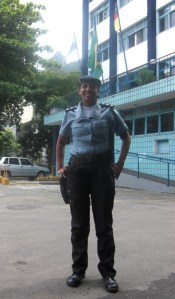
Cesar Couto Lima, Diretor de Operacoes of the Guarda Municipal
The GM are less than twenty years old and they ‘know their place’ in the hierarchy of police: at the bottom. They are not true ‘professional police’ in the sense that they have only three months basic training, followed by some specialist extra work. They are really somewhere between police and a private security force that just happens to be employed by the city – their commanders at the top level are however, ex-PM. They do, however, have a growing field of responsibility, acting both as a kind of protective and preventative force on the ground in the city centre and as a street-level agency of the ‘eyes on the street’ form of surveillance.
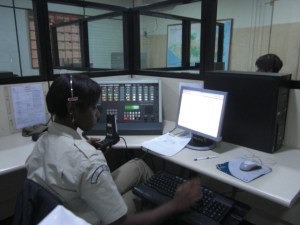
Operator in the Guarda Municpal emergency control room
They also act as the emergency services co-ordination, and this role will increase and be better integrated and funded in future. They are largely disarmed, though not because as many believe, the law prevents them from being armed. This is a strategic decision based on keeping a clear line between them and the PM. This is also the reason why they have a different uniform (in Rio a kind of unflattering beige) from the PM (blue). In our interview with the Director of Operations, Cesar Couto Lima, we were told that in the past, the uniforms had been the same colour but that this had been changed under the last mayor, Cesar Maia, to prevent GM officers from being shot by criminals in the mistaken belief that they were PM. They now have a very low rate of injury and death. The Dir Ops also wants to increase the numbers and in the very long term for the GM to be the be the main police force of a disarmed and less violent city.
It is a fine aspiration, however the new Mayor Eduardo Paes, has apparently suggested that the uniform is changed back to blue and that there should be more arming of the GM. The Dir Ops is utterly opposed to both, and I think he sees it as a deliberate ploy to give the impression of more PM around – the State Secretary for Security has already announced a plan to increase the numbers of PM in Rio by thousands, as we found out when we visited his office. The officers we met at the GM were generally pleasant, relaxed people, however the GM is not immune from corruption. I have heard allegations of extortion from street traders, the poor and criminals, in much the same way as gets reported of the two main forces, and indeed of death threats to officers who refuse to get involved with such practices. Any generalised or regular arming of the GM would only increase the temptation to act on the new power in an irregular way, and also, with so many weapons in the hands of relatively poorly paid and untrained officers lead to greater numbers of killings and a further channel for criminals to obtain weapons.
Ricardo Martins, the Subchefe of the Policia Civil would also like to see a demilitarisation of the police in the long-term. He argued that basically, the PM should be gradually abolished and absorbed into a purely civil police. He was also strongly in favour of more ‘intelligence-led’ and surveillance-based solutions, rather than force of arms or numbers. According to him, the expansion of the video surveillance system in the city was essential and absolutely necessary if the city was to be ready for the 2012 soccer World Cup (to be held across Brazil) and more particularly for the 2016 Olympics, for which the city is a frontrunner. All the senior officers an officials with whom we talked agreed that currently it was nowhere near ready. The GM also agreed with the expansion of CCTV, although they seemed to think that they would have a greater role in operating the systems in future, talking of plans for neighbourhood control rooms integrated with the emergency services control system. Neither the PC, nor more importantly, the Superintendente de Commando e Controle of the State, Claudio de Almeida Neto, gave any indication that this was the direction in which things were proceeding. Indeed the Superintendente was quite clear that there was a greater centralisation, co-ordination and professionalisation of video surveillance operations taking place through his office and his control room, which is in the old ‘Centro do Brasil’ railway station. The office of the Secretary of State for Security seemed not to be that interested in surveillance at all, and commented that it was very expensive, which suggests that the funds for the expansion of the video surveillance system that all expect, whoever they think will be running it, may not be quite as lavish as they believe or would want. I will write more about this later. The PC, however has the reputation of being the most corrupt of all the forces. Subchefe Martins pointed to the internal investigations branch as evidence of the effectiveness of their fight against corruption. Other interviewees were not as easily impressed!
Capitao Pricilla, Head of Santa Marta Community Police initiative
So where should policing in Rio go? One way forward was obvious when we interviewed Capitao Pricilla, the current ‘star’ of the PM, who heads up the Community Policing initiative in Morro Santa Marta. Capitao Pricilla is a PR-dream: attractive, articulate, intelligent, convincing in her arguments, and clearly dedicated to her work with the community. She is everything you would hope a new generation of younger PM officers would be, and she clearly stated that she is part of a new generation. And she is popular too. As we talked with her, officers would constantly come over just to say ‘hello’ and older women in particular, would treat her like a TV celebrity. Now, of course I am wary of the way in which such charisma would make her an obvious choice to head such an operation, which is much promoted as ‘the way forward’ in the media. However there have been many ‘ways forward’ before which have come to nothing and Rio is constantly making and destroying innovative initiatives before they even have a chance to have a real effect. The Santa Marta initiative probably cannot be replicated in many favelas, like Prazeres, where there is a more intimate relationship with the ‘parallel power’ of the traffickers. But Capitao Pricilla seems like the real deal. Let’s hope that she and officers like her get the support they need and are not undermined by the violence and corrupt practices of so many of their colleagues. It’s a utopian hope perhaps, and Rio is still going to need the other far more aggressive hand of the other attempt to get around corrupt practice in the PM, the BOPE – about whom I will write more after our visit today – as much as it needs the helping hand of Community Policing initiatives for a while. It is that large and less articulate mass of PM and PC officers who have no interest in doing anything different, and the equally corrupt politicians who prevent change for their own selfish reasons, that are the main barrier to any organisational change.
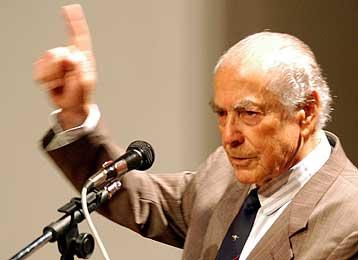
One question that has been preoccupying my thoughts recently has been the question of why the simple things are not being done in Rio to address the problems of the favelas: sanitation, education, healthcare etc… many of the people we have talked to look back to the regime of Leonel Brizola, the Governor of the State of Rio de Janeiro from 1983 to 1987 and then again from 1991 to 1994. Brizola was a left-progressive populist, a social democrat and a former opponent of the dictatorship who had had to live in exile for much of the 1970s. Sadly he died in 2004, but we had the opportunity this week to talk to his former Secretary of State for Public Security, and also briefly Governor himself from 1994-5, Nilo Batista.
We met Professor Batista in the Instituto Carioca de Crimonologia (ICC), an independent research organisation, which he runs (and funds from his legal work), along with his wife, sociologist, Vera Malaguti Batista. The Institute is housed in a sleek modern building up in the hills of Santa Teresa, from whose picture windows the city below is all but invisible and the bay appears almost as it was when Europeans first arrived. However, the concerns of the Institute are very much with the reality of the city today.
We had a long and wide-ranging conversation, which would be impossible to recount in detail here, but the basis of it was an understanding of Brazilian society, and in particular that of Rio, based on the ongoing legacies of the past, in particular slavery and authoritarianism. Vera Malaguti’s book, O Medo na Cidade do Rio de Janeiro: dois tempos de uma historia (Fear in the City of Rio de Janeiro: one story in two periods) examines previous periods of revolt by Africans in Brazil and argues that the often unspoken elite fear of the africanisation of Brazil. They argue that repressive public security strategies today are founded in this same fundamental fear, driven by the media that serves the powerful middle classes who aspire to elite values and lifestyles.
In opposition they place Brizola and that brief (and they argue, unrepeated) period at the end of the dictatorship when social justice and in particular, education, were priorities and favelas were provided with services in the same way as any other neighborhood. The security strategy of Brizola and Batista was effectively one of anti-stigmatisation. They argue that since then, media-driven fear and repression has been far more the norm and this had undermined the progress made under Brizola.The current public security-based strategy of the Governor Cabral and the ‘choque de ordem’ of Giuliani-wannabe Mayor Eduardo Paes, is one example. By concentrating on ‘pacifying’ one or two places as examples (Santa Marta and Cidade de Deus at present) without being able to afford the same strategy elsewhere, it constitutes simply a public relations exercise, and elsewhere repression without development continues as normal.
The Batistas are passionate and well-motivated, but there are many who argue that this picture of a progressive Brizola regime subsequently undermined by repressive policies is at the very least, a limited view. It was, after all, under Brizola that the traffickers grew in power and acquired weapons; the mid-eighties was the key period here as the cocaine trade grew from almost nothing to being the driving force of gang activity in Rio. This isn’t just a view held by political opponents: whilst he certainly does not (and could not with any justification) claim that the rise of the cocaine trade was anything to do with Brizola, Enrique Desmond Arias in Drugs and Democracy in Rio de Janeiro, argues that the personalist populism of Brizola undermined the leadership of the Community Associations in the favelas and left them open to co-option by drug gangs. When we visited the office of the current Secretary of State for Security, Jose Mariano Beltrami, and talked with his representative, it was quite strongly argued that Brizola neglected the issue of the growing arming and violence of drug traffickers, and also did nothing to solve the massive problem of police corruption (on which I will write more later). The current longer-term strategy is now to recruit a lot more Military Police, in the hope that numbers will do what force has not, and enable the gangs to be beaten.
We also visited the office of a leading critic of human rights abuses, Alessandro Mollon, a Deputy in the State parliament. He said that Beltrami is actually shifting, without ever having admitted to it, from a very macho and repressive approach when he first arrived from the southern state of Rio Grande do Sul, to a more considered (but hardly progressive) strategy now, of which the emphasis on police officers on the streets, rather than invasions, is one aspect.
Former Mayor of Rio, Cesar Maia
The claim that Brizola was the last real progressive figure to lead Rio also neglects some others, particularly those who have held the office of the Mayor. Under Cesar Maia (1993-7; 2001-2008), the ‘Favela Bairro’ program had much in common with what Brizola did in social terms. Indeed when we asked the leader of the Morro dos Prazeres Community Association what would be the one thing she wanted above all else, it was ‘more Favela Bairro’. In Dona Marta they also had some time for the former governor, Anthony Garotinho (1999-2002) a frankly quite foolish evangelical populist, currently under investigation for corruption, as is his wife, Rosinha, who was Governor from 2003-7. However, we heard from others that the things that they attribute to Garotinho were actually planned or initiated under previous administrations and just did not see the light until his.
What is certainly the case is that Brizola had a better attitude to the favelados as people, than other administrations, regardless of his mistakes. The current regime certainly seems to be more driven far more by middle-class fears than by social progress, but it is also the constant undermining of the progress of previous administrations like Brizola’s and then later Maia’s terms as Mayor by new waves of media-courting repression that is so depressing in Rio. It happens in every democratic country, but here in Brazil there is the most blatant inequality of any wealthy country still crying out to be addressed. If it was, then most of the issues of ‘crime’ and ‘insecurity’ would start to disappear. It would, as Deputado Mollon also pointed out, be a lot cheaper than the massive amounts of money now going into the hands or private security companies – who, as Professor Batista noted are often run by the families of senior police officers, who therefore have no actual interest in reducing crime and every reason to want to see fear continue to grow.
(With thanks to Nilo Batista, Vera Malaguti Batista, Alessandro Mollon and the staff of the office of Jose Mariano Beltrami for their time and patience. In particular, I hope to return to the Instituto Carioca de Criminologia sometime in the future to talk about the findings of this project, and to submit something to their excellent journal, Discursos Sediciosos: crime, direito e sociedade)
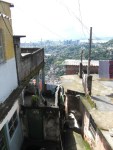
One of our most interesting visits last week was to the favela of Morro dos Prazeres, north-west of Santa Teresa. Prazeres has one of the most astonishing views of Rio of any neighbourhood, with an almost 360 degree panorama of the city, it’s perspective to the south only interupted by the statue of Christ the Redeemer, which is hardly a bad view in itself! You might think that the last thing that favelados would care about was the view but they are well aware of the beauty of their location – the assumption that the poor an desperate would not care about such things is a rather patronising misconception. Elisa, the leader of the community association, at least, seems most proud of this asset and says that like many people she wouldn’t want to live anywhere else even if she won the lottery!
But Prazeres does have serious problems. For a start, it is a ‘hot’ favela, occupied by drug traffickers, who control ‘law and order’ in the place. There is therefore no ongoing police presence, although as with many such communities, the community association does have a relationship of sorts with local military police commanders through organised coffee mornings at which problems are discussed. Luckily, despite or because of the almost complete control of a particular gang which is well integrated into the community (i.e.: they are relatives of the more law-abiding members), there are not many problems with violence and the police, ‘thank God’ (says Elisa), have not raided the favela recently, as they have many others.
In fact, as we were visiting Prazeres, as the taxi driver rather anxiously pointed out as he dropped us a safe distance away, BOPE (military police special operations) were ‘invading’ two other favelas next to it, the very hot Morro de Correoa, and Sao Carlos. The operations left eight dead, and we think what we had assumed initially were fireworks was probably the sound of small arms fire in the Sao Carlos operation. However, when we asked a PM at a nearby police post whether Prazeres was safe to enter, he seemed rather blase and relaxed about the whole thing…
Elisa was another very impressive woman. In the absence of men – who, in the favelas are in many cases, either involved in the gangs, working outside, or unemployed and alcoholic – it seems that a whole generation of strong, courageous women has emerged to try to develop their communities from the bottom up. In the past they have benefited from various attempts by previous mayors to provide development for the favelas. Unlike some places, Prazeres does not have a school built during the regimes of populist left-wing Governor, Leonel Brizola (who seems to be fondly recalled in by almost all those we have talked to in the poorer communities). However there was a lot of intervention as part of the Favela Bairro (Favela Community) program of former Mayor, Cesar Maia, and it is this normalisation or the favelas through infrastructure, social and economic development, education, health and social services that Elisa said are the only long-term solution to the problems of Prazeres. The creche in particular is a source of continual delight to her, and her face lit up whenever it is mentioned.
With social development and education, Elisa argued, eventually the ‘cold’ and uncaring gangs will recruit fewer kids, and they will wither slowly away. Confrontation however, only strengthens them by driving more young people to support the ‘insider’ traffickers against the ‘outsider’ police. They must, she said, work like little ants, with lots of small efforts adding up together to long-term success… then perhaps the anthill of Prazeres will function as a normal community.
There’s no doubt that academic research and military intelligence have a more tangled history than some would imagine, although in many countries in recent years ‘imperial disciplines’ like geography and anthropology have been through a long process of reevaluation and rejection the values that gave them birth. In the USA, however, geography remains intimately connected to the state and more particularly to current US military projects, indeed since 9/11 such ‘patriotic’ research has become more rather than less common.
z magazine has a very interesting article on a growing furore around first of a new US government cartography / geography program called the Bowman Expeditions. This half a million dollar project, México Indígena, has been mapping indigenous lands in Oaxaca, Mexico, where a popular insurgency has been growing in recent years. Local organisations under the umbrella of the Union of Organizations of the Sierra Juárez of Oaxaca (UNOSJO) have rejected the activities of the expedition and claim they were duped by researchers.
A slide from a Powerpoint from the project reveals ideological connections to US military goals, but the links are material too.
And it seems they were right to do so: the grant scheme is associated with the U.S. Army’s Foreign Military Studies Office (FMSO), which seems to be largely associated with so-called ‘open source intelligence’, in other words ‘leveraging’ academic mapping projects for military purposes, in particular the ‘cultural terrain’ for potential future counter-insurgency purposes, learning the lessons of failures in Afghanistan and Iraq. The academics involved, Jerome Dobson and Peter Herlihy from the University of Kansas, just down the road from FMSO, are now furiously backpedaling as previous denials are shown to be evasive and disingenuous…
We’ve been so busy these past two days that I have not had time to update the blog with all the visits and interviews we have been doing. I will try to do so over the weekend… Just to summarise, we’ve been to another favela, Morro dos Prazeres and met with the leader of the community association; the HQs of the Policia Civil and the Guarda Municipal. We visited the State Secretariat for Public Security twice, once to talk to people from the office of the Secretary, and once to visit the CCTV control room and talk to the director. And finally we talked to two politicians from different eras – the ex-Governor, and also Security Minister under Leonel Brisola, lawyer and academic, Nilo Batista (and also his wife, sociologist, Vera Malaguti Batista) and Deputado Estaduel, Alessandro Mollon, a leading campaigner for human rights and real public security in the state legislature and various members of his team.
Next week, on Monday, we will be going back to Morro Santa Marta to talk to BOPE Commandante Priscilla; and then I will be spending the rest of the day between the neighbourhood association of wealthy Laranjeiras and that of a nearby favela, also ‘pacified’, Tavares de Bastos, and its BOPE battalion. On Tuesday I am giving a talk on my project at the Federal University of Rio de Janeiro, and hopefully on Wednesday or Thursday morning we might just get to talk to Major Eduardo Paes, and someone from the state’s Ministry of Cities, as well as the already fixed appointment with the influential NGO, Viva Rio.
Then it’s Easter and I have to go home… I have to come back. I feel like I have barely started here. I need to do more interviews at national level, and the survey work I was hoping to do has been squeezed out by the interview schedule. In any case, the level of comparative study I am doing means I cannot explore, literally and metaphorically, all the avenues and back-alleys that I would like. And there is so much going on here that is interesting and important in terms of the complex relationships around social justice, crime and disorder, (in)security, surveillance and social control.










 ubisurv