US border project cancelled… or is it just mutating?

Neoconopticon is reporting that the Secure Border Initiative (SBI) project is to be shelved and replaced with off-the shelf surveillance equipment (UAVs etc.).

The project which was based on contracts with Boeing and Raytheon, had been in trouble for some time. I reported back in 2009 how Boeing had basically wasted most of the money on the Mexican border projects on systems that didn’t work. Neoconopticon gives the figure of $3.7Bn for the project, but in fact estimated costs for the longer-term maintenance just of the Mexican fence component had spiralled to over $10Bn.

The original source for this news, Defence Industry Daily, has a good timeline.

I am left wondering however about whether this cancellation might have anything to do with the discussions that were recently revealed on the North American Perimeter project, which I blogged back in December last year. A complete North American perimeter might reduce the pressure to add further security to the US-Canadian border at least, and Canadian government funds and people could be leveraged by the US, as they were during the Cold War with the DEW Line and BMEWS. A summit on the issue between US President, Barack Obama, and Canadian Prime Minister, Stephen Harper, had been scheduled for January and was recently pushed back into February, which has given time for the decision on the cancellation of the SBI.

This could all be coincidence, but it is certainly interesting timing…

The New North American Perimeter

Canadians have been angered to discover recently that a deal to create a new US-Canada perimeter security initiative has been going on behind their backs. This plan has been some time in the making, as we uncovered during our current research on border security. In particular, alliances of major corporations and US and Canadian government organisations have been planning together in the Security and Prosperity Partnership (SPP) and the North American Competitiveness Council (NACC) – who back in 2007 produced a document, Building a Secure and Competitive North Anerica (pdf), that seems to prefigure exactly what this ‘new’ soon to be announced plan will contain.

And already the state public relations machines have rumbled into place to prevent dissent. The government clearly has nothing but contempt for the Canadian Charter rights that this deal will damage (most notably those around information and privacy). And there seems to be no doubt that this deal will further embed US security priorities in Canadian-US relations, and effectively add an inner core of security to the economic layer of NAFTA (excluding Mexico, of course… no doubt the perimeter will continue exclude them, even while we exploit their cheap labour and resources). Indeed the ‘success’ of NAFTA (read: the success of NAFTA for business elites) is one of the reasons given for supporting this so-far unseen plan by five former Canadian ambassadors to Washington in an Opinion piece in the Globe and Mail today.

This first volley from the big guns seems to have come straight from the Ottawa PR stategy. There are references to ‘common sense’ and the ‘reassertion of sovereignty’ and attacks on ‘bellyaching’ and ‘knee-jerk anti-Americanism’. Indeed it is worth quoting the final paragraph in full because it is a masterpiece of old-fashioned continentalist propaganda combined with post-9/11 fear-stoking:

“Knee-jerk anti-Americanism is an indulgence without purpose in today’s interconnected, interdependent world. Our future economic prosperity relies on an efficient border, and we should welcome any agreement that smoothes the way for jobs and growth while toughening up our borders to security threats against both our countries.”

In this worldview, asserting sovereignty means giving it up, ‘interconnected and interdependent’ means allied with the USA rather than all the other multiplicity of friendships Canada had carefully crafted around the world prior to the Harper era, and security threats to the USA are seen as one and the same as those to Canada. In other words, we should hitch our wagon more firmly to Washington and prevent any return to that ‘indulgent’ Canadian emphasis on global security, peace-building, human development and human rights – you know, the values that once gained Canada respect around the world.

It’s quite eye-opening in a way to see former representatives of the Canadian state to the USA openly acting as US assets in Canada, clearly trying to educate the Canadian public in how to think and how to behave towards their rulers (sorry, slip of the tongue, of course I meant ‘neighbours’), and trying to preempt and predefine reaction to a plan that we haven’t even seen yet not least because people like this seem to think that Canadians don’t deserve to have a say in something that amounts to nothing less than the future sovereignty of their country.

(thanks to Harrison Smith for the NACC document and David Lyon for pointing out the Opinion piece)

Bigger than Brazil

So says a new IMS report on the surveillance market in Latin America, according to industry site, Surveillance Park.

Brazil’s emergence as an economic power means that there is increasing demand for surveillance both in individual applications and for larger infrastructure projects like the 2014 World Cup and 2016 Olympic Games. But Brazil already has what the report terms “an established eco-system of suppliers” so, in the face of this strong competition, foreign surveillance companies are advised to look elsewhere, particularly Argentina, Chile and Mexico, whose surveillance markets should provide “long-term double digit growth.

City of Leon to install mass public iris-scanning

The City of Leon in Mexico, if a report in Fast Company are to be believed, is going ahead with a scheme that goes far further than any other urban surveillance project yet in existence. They are already installing scanners that according to their manufacturers, Global Rainmakers Inc., an until recently secretive company with ties to US military operations, can read the irises of up to 50 people per minute.

Now, we have to be careful here. Gizmondo, as usual has gone way over the top with reports of ‘the end of privacy’ (which, if you believed their stories has already happened as many times as the apocalypse for 7th Day Adventists…) and talk of the ‘entire city’ being covered and ‘real-world’ operations (i.e. in uncontrolled settings). In fact, if you read the  Fast Company report, and indeed the actual description of the products from the company, they are far more limited even in their claims (which are likely to be exaggerated anyway). There is no indication that the iris scanners proposed will work in uncontrolled settings. When the company talk about the scanners working ‘on the fly’, they mean that they will work when someone is basically looking at the scanner or near enough whilst no more than 2 metres away (in the most advanced and expensive model and significantly less for most of them) and moving at no more than 1.5 metres per second (and, again, slower for the lower range devices). All the examples on the company website show ‘pinch points’ being used (walls, fences, gates etc.) to channel those being identified towards the scanner. In other words, they would not necessarily work in wide public streets or squares anyway and certainly not when people were moving freely.

So is this what is being proposed? Well, there are two phases of the partnership with Leon that the company has announced – and we have as yet no word from Leon itself on this. Phase I will cover the settings in which one might expect levels of access control to be high: prisons, police stations etc. Phase II will supposedly cover “mass transit, medical centers and banks, among other [unnammed] public and private locations”. It is also worth noting that the scheme’s enrolment is limited to convicted criminals, with all other enrolment on an entirely voluntary basis.

I am not saying that this is not highly concerning – it is. But we need to be careful of all kinds of things here. First of all, the Fast Company report is pure corporate PR, and the dreams of the CEO of Rainmakers, Jeff Carter (basically, world domination and ‘the end of fraud’ – ha ha ha, as if…) are the same kind of macho bulltoffee that one would expect from any thrusting executive in a newish company in a highly competitive marketplace. Secondly, there’s a whole lot of space here for both technological failure and resistance. The current government Leon may well find that the adverse publicity from this will lose rather than gain them votes and that in itself could see the end of the scheme, or its being limited to Phase I. In addition, without this being part of wider national networks, there may in the end be little real incentive for anyone to enrol voluntarily in this. Why would banks in Leon require this form of identification but not those in Mexico City or Toluca for example? Will the city authorities force everyone who use public transport to undergo an iris scan (which would make the ‘voluntary’ enrolment a sham)? This could all end being as insignificant as the Mexican companies offering RFID implants as a supposed antidote to kidnapping, it could be the start of a seismic shift in the nature of urban space, or it could be a messy mixture.

I hope my colleagues in Mexico are paying attention though – and I will try to keep updated on what’s really going on beyond the corporate PR.

2nd Surveillance in Latin America Symposium

Following the success of the first Surveillance Studies symposium in Brazil last year, here is the call for the next one, this time in Mexico next year.
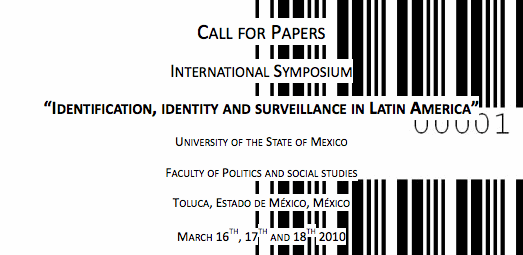
SIMPOSIO MEXICO

Introduction

In modern societies, identification systems have been used as an important mechanism to govern, manage, classify and control populations; in other words, to surveil them. This has meant the employment of certain technologies (passports, national identity letters, RFID, among others), providing interconnected data base systems with information according to specific institutional protocols. In this way, we define identification as visibility and verification of specific details of people’s lives. Likewise, these identification systems have responded to various functions: security, migration control, goods and service administration, as well for territory, space and group access.

The historical, social and politic contexts shape the particular purposes to which each identification system responds. Large-scale surveillance systems to identify the population have been installed in Latin America after decades of colonial, military and single-party governments In addition they have been prompted by increasing multiculturalism in cities, Population growth, migration rates, the perceived rise in terrorism, public security and health risks, as well as the creation of public policies (to aid poverty and unemployment) and globalization.

These conditions have caused the harmonization and articulation of corporations, institutions, technologies and specific protocols for citizen identification in Latin American countries, , depending on each country or region’s particular situation, and its relationship with other regions worldwide. Nevertheless, the Latin American environment allows us to consider the construction of privacy, identities, forms of government and the possibility of resistance policies.

Paper Proposals

In line with this analytic framework, the University of the State of Mexico, Faculty of Politics and Social Studies, hereby invites scholars, analysts and activists in Latin America and worldwide, interested in identification and surveillance, in relation to such matters as cultural or ethnic identities, privacy and data protection, new identification technologies (biometrics, RFID, etc), public policies, security, communication, ethics, law, or modes of critique or resistance; to participate in the International Symposium “Identification, identity and surveillance in Latin America”, by sending a lecture proposal.

Please send an abstract, 300-500 words long, Arial 12, space line 1.5, to the following e-mail: surveillance.studies.mexico@gmail.com, before October 30th 2009. Due to the nature of this event, the abstracts and papers are to be accepted in Spanish, Portuguese and English.

Note: There is no registration fee for this event. All participants are expected to seek their own funding for travel and accommodation. A number of rooms will be reserved with reasonable rates in a nearby hotel. More details to follow.

Main subjects

1. Governmental and corporative policies of identification

2. New technologies for identification and surveillance.

3. Purposes of identification systems in Latin America.

4. Communication and information technologies.

5. Privacy and transparency.

6. Identification, identities and subjectivities.

7. Relationship between global and local, in identification systems.

8. Postcolonial logics and political regimes.

9. Identities, surveillance and resistance.

10. Identification, identity and surveillance in Latin America: new theories?

Important Dates

Call for Papers Publication: July 30th 2009.

Abstract reception deadline: October 30th 2009.

Accepted lectures list publication: December 15th 2010.

Complete paper remittance deadline: February 15th 2010.

Complete program publication: February 28th 2010.

Second Symposium on surveillance in Latin America: March 16th, 17th y 18th 2010. University of the State of Mexico, Faculty of Politics and Social Studies. Toluca, México.

Organizing Committee

Nelson Arteaga Botello

Roberto J. Fuentes Rionda

Faculty of Politics and Social Studies, University of the State of Mexico

Rodrigo Firmito

Postgraduate Program in Urban Management, Pontifical Catholic University of Parana, Curitiba, Brazil

Fernanda Bruno

Postgraduate School of Communication, Federal University of Río de Janeiro, Brasil

Marta Kanashiro

Further Studies Laboratory of Journalism and Knowledge, Technology and Market Group, University of the State of Campinas (UNICAMP), Campinas, Brasil.

Danilo Doneda

De Campos Faculty of Law, Rio de Janeiro, Brasil

André Lemos

Federal University of Bahia, Brasil

With the support of:

David Lyon

David Murakami Wood

Department of Sociology, Queen’s University, Kingston, Ontario, Canada

Proposal reception, Information and Contact

surveillance.studies.mexico@gmail.com

US border surveillance pours billions into Boeing… and still doesn’t work

Federal Computer Week reports that the Secure Border Initiative (SBI) designed to provide secure and highly surveilled border systems between the USA and Mexico, is in trouble again. There have been major technological failures, cost overruns, and more with the result that the system is way behind schedule. Half the reason seems to be a political economic one. In many ways this system is a giant pork barrel for the Boeing Corporation, which has been sucking up US state subsidies for years and is taking literally billions of US dollars for this project and in unrelated federal recession subsidies. No-one seems to have really checked whether Boeing could really do the job, and like so many large state security and surveillance projects, and most things that have been tried on the Mexico border, it just doesn’t really work.

The article reports the new Director of the SBI, Mark Borkowski as admitting that “the program was first conceived as a quick implementation of existing off-the-shelf technologies […] In retrospect, it would have functioned better if a customized technology solution was developed to meet the requirements […] Some of the things we put into place, in hindsight, were not effective […] What we bet on, which was probably not a good bet, was that this was like buying a new printer for your computer. …We started the wrong way, in my opinion.”

The cost breakdown for the Department of Homeland Security is reported by FCW as:

$1.1Bn to Boeing ($620M  for SBInet technology and $440M for border-vehicle barriers and fencing).

$2.4Bn on construction of fencing and vehicle barriers along the southwestern border

$6.5 Bn longer-term to maintain, monitor and repair the fences and structures.

Of course the ridiculous costs are bad enough, but the wider issues here are with the obsession with controlling migration in an economic climate in which the North America Free Trade Agreement (NAFTA) has progressively stripped Mexico of any economic autonomy and made its (and by extension the whole of Central America’s) working class a reserve of cheap labour for US corporations and its relatively increasingly wealthy, a market for US consumer goods. It’s not surprising that the Mexicans regard it as more than a little unfair that they have been forced into a subservient position, yet are not welcome to come into the USA, and are subject to such harsh security and surveillance to prevent them from doing so. Added to this, as the Mexican President made clear last year, relaxed US laws on gun ownership have resulted in a massively increased flow of weapons into Mexico from the USA, which has exacerbated gang conflicts which thrive in the atmosphere of inequality and exploitation. And of course, the violence just adds to the reasons why people want to leave and find opportunities in the richer, safer USA…

In many ways, what richer nations are doing is not only prioritising their own security, but also simultaneously exporting their insecurity.

Research as Espionage

There’s no doubt that academic research and military intelligence have a more tangled history than some would imagine, although in many countries in recent years ‘imperial disciplines’ like geography and anthropology have been through a long process of reevaluation and rejection the values that gave them birth. In the USA, however, geography remains intimately connected to the state and more particularly to current US military projects, indeed since 9/11 such ‘patriotic’ research has become more rather than less common.

z magazine has a very interesting article on a growing furore around first of a new US government cartography / geography program called the Bowman Expeditions. This half a million dollar project, México Indígena, has been mapping indigenous lands in Oaxaca, Mexico, where a popular insurgency has been growing in recent years. Local organisations under the umbrella of the Union of Organizations of the Sierra Juárez of Oaxaca (UNOSJO) have rejected the activities of the expedition and claim they were duped by researchers.

A slide from a Powerpoint from the project reveals ideological connections to US military goals, but the links are material too.

And it seems they were right to do so: the grant scheme is associated with the U.S. Army’s Foreign Military Studies Office (FMSO), which seems to be largely associated with so-called ‘open source intelligence’, in other words ‘leveraging’ academic mapping projects for military purposes, in particular the ‘cultural terrain’ for potential future counter-insurgency purposes, learning the lessons of failures in Afghanistan and Iraq. The academics involved, Jerome Dobson and Peter Herlihy from the University of Kansas, just down the road from FMSO, are now furiously backpedaling as previous denials are shown to be evasive and disingenuous…

US borders with Canada strengthened

There has been a lot of interest in the US border with Mexico in recent years, and rightly so. However, what not so many people have noticed is that the closing of the closing of the USA is taking place along the world’s largest land border between two countries, the border between the USA and Canada.

Unmanned Aerial Vehicles (UAVs) already patrol the airspace (and at a low enough level that private flights have had to be restricted, thereby doing two security jobs with one technology). However, the most recent announcement concerned the installation of video surveillance towers to monitor waterways. This is all on the basis of very little information about whether this is either cost-effective or necessary; according to the AP article, the Border Patrol themselves admit this: “What we don’t know is how often that vulnerability is exploited […] if, in fact, there’s a lot more going on than we thought, then this technology will help us identify it and it will help us respond and apprehend those people in ways that we haven’t before.” So essentially, this is surveillance to see whether surveillance is necessary – it seems we are now in a surveillance double-bind, so you no longer need a strong reason to install cameras; they are their own justification and may be justified in retrospect whatever does or does not happen. If nothing is seen, they will be said to be a deterrent, if something is detected then they will be proclaimed as showing the need for surveillance!

The technology employed against those tricky Canucks will be provided by the same supplier, Boeing, that has been so criticised for its failures on the Mexican border (and there have been plenty of failures down there). It seems that even when it comes to the trump card of security, which normally wins hands-down, the congressional pork-barrel remains the joker in the pack. Now, the Canadians and local firms along the US border have already been complaining about the post-9/11 restrictions that have begun to stifle cross-border trade on which many of those communities depend. In a recession, such considerations might be thought to count for something, but it seems that the mighty Boeing’s profits matter more…

Surveillance in Latin America

For the last three days, I’ve been at the Surveillance, Security and Social Control in Latin America symposium, organised by Rodrigo Firmino at PUCPR (with help from Fernanda Bruno, Marta Kanashiro, Nelson Arteaga Botello and myself). The conference was the first to be held on surveillance in Brazil and will be the start of a new network of surveillance researchers in Brazil and more widely across Latin America.

All of the presenters had something interesting to say and I learned a lot from the event, however it is worth noting some individual presentations and sessions that were really insightful. There were great keynotes from David Lyon, Luiz Antonio Machado da Silva and Nelson. Two sessions stood out for me: one on Rhetorics of Crime and Media which had an exceptional central presentation by Paola Barreta Leblanc, a film-maker and currently a student of Fernanda Bruno’s. Her paper (and films) on the way in which we impose narrative onto CCTV images argued cogently that we see CCTV with a (Hollywood) cinema-trained eye and consequently overestimate (or over-interpret) what we are seeing. The other papers in the session were also good, in particular Elena Camargo Shizuno on Brazilian police journal of the 1920s and how they trained the vision of middle and upper-class Brazilians of the time through a combination of reportage, fiction, and advocacy. The session as a whole left me with many new questions and directions of thought.

The other really sparky session was on the last day and was on the Internet and Surveillance. The first paper was from was Marcelo de Luz Batalha on police repression of community and activist networks at the State University of Campinas, which linked nicely into concerns I have been following here on the surveillance of activist networks in the UK. Then there was Hille Koskela’s theoretically sophisticated and searching paper on the Texas-Mexico border webcam system (that I noted back in January) which explored the ways in which this participatory surveillance system both succeeded and failed in inculcating an attitude of patriotic anti-outsider watchfulness and responsibilization of citizens. Finally there was an interesting if not entirely successful film from Renata Marquez and Washington Cancado which used Charles and Ray Eames’ famous Powers of Ten, one of my favourite bits of pop-science ever, as an inspiration for an exploration of the uneven gaze of Google. They provoked some very interesting thoughts on the ‘myopia’ of the new ‘god-like’ view we are afforded through interactive global mapping systems. I think their approach could be very fruitful but it is still missing some key elements – having talked to them, I am convinced they will turn this into something really excellent. I have asked them and Paula to submit their work to Surveillance & Society’s special on Performance, New Media and Surveillance, because I think both are exactly the kind of explorations we are looking for. If Fernanda Bruno’s excellent paper on participatory crime-mapping has been part of this session, it would have been perfect! See Fernanda’s thoughts on the seminar over at her blog – she was also Twittering throughout the event but I’m afraid I just can’t get on with Twitter!

Other memorable papers included Danilo Doneda’s on the new Brazilian ID system, which sparked our post-conference considerations on where to go with this new network, which will probably be a project on Identification, Citizenship and Surveillance in Latin America. Nelson Arteaga Botello has already generously agreed to host the next symposium on this theme in Mexico City next March! Fernando Rogerio Jardim gave a passionate paper on the the SINIAV vehicle tracking pilot in Sao Paulo and I was most impressed with the careful Gavin Smith-style CCTV control-room ethnography by one of Rodrigo Firmino’s students, Elisa Trevisan, and Marta Kanashiro and Andre Lemos both gave insightful presentations too – I’ve already come to expect both care and insight from Marta in the short time that I’ve known her. I hope we’ll be able to work more closely together in the future. Let’s see…

The event as a whole was a great start for the study of surveillance in Latin America, despite the disappointing lack of Spanish-language interest. This is just the beginning, and the new networks of scholars here will grow. I was just happy to be there a the start and play a small role. As for my keynote, I took the opportunity to do something a bit different and instead of doing my usual tech-centred stuff, I gave a talk on the emotional response to surveillance and how this might form the basis for reconstructing (anti-)surveillance ethics and politics. I have no idea whether it really worked or what people got out of it…

Surveillance and the ‘Open-source Insurgency’

Hierarchical, national and corporate bodies are profoundly afraid of the openness, apparent lack of interest in conventional goals and absence of obvious leadership or deference that is represented by the new collaborative networks like Open-source. They are not ‘under control’. The answer for the military-industrial complex is a consistent one, and as usual it combines strategic military and economic goals. This answer is surveillance.

The US military-industrial complex is always trying to identify new threats to bolster its budgets. There was a minor outcry a few years ago when US military powerpoint slides on strategy seemed to indicate that it regarded international civil society organisations, including the Red Cross, as a potential source of such threat. Then came 9/11 and the war on terror and for a while it didn’t need these phantom menaces as there were real global enemies, and fortunately for the military-industrial complex, it seemed that those enemies might be infinitely expandable and malleable into what was briefly termed the ‘long war’.

But the war on terror isn’t what it was. So there seems to be some effort to resurrect previous threats. One of these is ‘the war on drugs’ now rebranded as ‘narco-terrorism’ or ‘narco-insurgency’. And the particular focus of the concern is closer to the United States: Mexico. Writing in the self-proclaimed ‘capitalist tool’, Forbes magazine, Reihan Salaam argued that Mexico’s ongoing struggle with drug-related violence was a major threat which could ‘blind-side’ the USA. Now, Republicans like Salaam are struggling to find anything important to say when its obvious what the major global problems are, and the US electorate has decided that the Republicans aren’t the people to solve them. He is of course correct that there is a serious situation in Mexico – and indeed elsewhere in Latin-America: the drug-trafficking gangs are also the major problem for the Brazilian government in any attempt to include their excluded favela communities. However, he makes no mention of the other underlying cause of destabilization in the USA’s southern neighbour – the way in which NAFTA has transformed Mexico into a subordinate economic role to the USA as source of cheap production facilities and cheap labour, all the while being told that its people are not wanted in the USA. The EU has its critics, but at least its building of free-trade has been accompanied by a far greater degree of free movement of people and reciprocal political rights. Nor is there any reference to the consumption of cocaine and crack in the USA that is driving the trade (as the first comment on the article notes).

Instead Salaam tries to analyze the Mexican situation using a recent strategic theory, and one which is profoundly worrying in its implications. In an essay in the New York Times in October 2005, John Robb argued that the Iraq war had turned into what he termed an ‘open-source’ insurgency, “a resilient network made up of small, autonomous groups”. He argued that those resisting the US occupation and other armed groups were like open-source software developers in that “the insurgents have subordinated their individual goals to the common goal of the movement”. (Never mind once again, that there is an obvious underlying common goal – that of getting rid of an occupying foreign power!).

Now of course, in many ways this was just a restatement of the whole post-Cold War, network-centric warfare hypothesis. There are also echoes back to the kind of language which has been used to describe ‘eastern’ or ‘foreign’ peoples for centuries – the British in India being unable to tell ‘them’ apart, the faceless and numberless ‘yellow peril’, the ‘godless communists’ who subordinated their individual will to the collective, and the ‘clash of civilizations’. It’s the hive-mind, the fear of humans who don’t appear to act ‘like us’. Without the overt racism of course: this is Orientalism 2.0, the politically-correct version!

However the addition of the label ‘open-source’ is no accident. Hierarchical, national and corporate bodies are profoundly afraid of the openness, apparent lack of interest in conventional goals (profit, advancement, etc.), and absence of obvious leadership or deference that is represented by the new collaborative networks like Open-source. They are not ‘under control’.

So how to bring them ‘under control’? John Robb’s first (and rather refreshing) answer was that in many ways you probably can’t and that in Iraq, the US should have probably ‘let them win’. But this is an unpopular response for the uneconstructed military-industrial complex. For them the first answer is a consistent one, and as usual it combines strategic military and economic goals. This answer is surveillance. For the Internet, we have seen, and continue to see, attempts in multiple countries to attack the basis of what makes the Internet creative and free, in the name of all kinds of ‘risks’ (mainly terrorism, identity crime, pirating and paedophilia). Of course these risks are no greater on the Internet than in the material world, but the Internet is still for many people, and many politicians in particular, a vast, unknown terrain which they do not understand: ‘here be dragons’ as the old maps used to have it of any such ‘terra incognita’.

For countries afflicted by the new ‘open-source insurgency’, the answer is the same. The Defense Industry Daily today starts off its story on Mexico with the apparently uncontentious statement that “Mexico needs surveillance.” It then lists with the usual kind of techno-pornographic relish of these publications, all the mainly Israeli UAVs and surveillance craft that the Mexican state is buying. We are supposed to cheer. We are supposed to think that this is evidence of Mexico’s growing maturity. Soon Mexico will be monitored and ‘under control’. No evidence of whether surveillance ‘works’ (even in military terms) troubles these kinds of stories. That is taken as self-evident. And certainly there is no question of whether this could in any way be the wrong approach, or even a counterproductive strategy. As the Brazilian parliamentarian to whom I was talking yesterday said, about the favelas, the only answer to both crime (because, let’s not forget that’s what ‘narco-terrorism’ really is) and the poverty on which it feeds, is in the long-term (and that means starting now not later): sanitation, schools, hospitals, transport, jobs – in other words providing the poor with access to the same society that the wealthier enjoy. Extending intensive high-tech military surveillance across the global south is not only a complete failure to address these underlying issues, it also diverts much-needed money away from social priorities. It is the wrong answer to the wrong question… except for the defense industry.