Rio gets the Olympics – and now the poor will suffer

Most people will probably have heard the announcement that Rio de Janeiro has been awarded the 2016 Olympic Games. While I am pleased that Brazil has beaten the USA in particular in this race in the sense that it shows a slight shift in global power balances towards the global south, I am very concerned as to how the current right-wing administration of both the city and region of Rio will deal with the ‘security’ issues around this mega-event. The Pan-American Games, which Rio hosted in 2007 led to the violent occupation by military police of several particularly troubled favelas (informal settlements), and the new administration has already shown its authoritarian tendencies with the Giuliani- wannabe ‘choque de ordem’ (shock of order) policies that involve building demolition, crackdowns on illegal street vendors (i.e. the poor) and more recently, the building of walls around certain favelas, and most recently the unwelcome  imposition of CCTV cameras on favelas that were just starting to enjoy improvements in trust between police and community. The favelas that line the main highways into the city from the international airport were already slated for such ghettoization, and the Olympics will only make this more likely to happen and more quickly – just as has happened in South Africa, similarly afflicted by race and class-based social conflict, during the various international meetings and summits there in recent years. Foreign delegates and tourists don’t like to see all that nasty poverty, do they?

I will write more on this later (I am on the road right now…).

Pittsburgh police use sub-lethal weapons against protestors

LRAD being used by the US Navy (ATC)

Mega-events are often the time for some surveillance / control / security innovation and experimentation by states. In what seems to be a rather unwelcome first, the Pittsburgh police have used a military sonic canon to clear protestors off the streets at the G20 summit. These devices are among many so-called ‘sub-lethal weapons’ (see the article by Steve Wright here) that have been gradually migrating from military to civilian use for a number of years – see for example the ongoing debate over the use in the UK of the ultrasonic ‘Mosquito’ device, which is supposed to target young people; its makers rather cynically advertise it as ‘so effective that they tried to ban it’.

The particular weapon used by the Pittsburgh police is the Long Range Accoustic Device (LRAD) made by the American Technology Corporation, which generates a piercing noise that is not only extremely unpleasant, it can damage eardrums and cause heart problems. It was rather eeriely appropriate to see them being used (as you can on The Guardian‘s website) on the same day that TNI / Statewatch released their report on the security-industrial complex and a reminder that this is a global phenomenon.

2nd Surveillance in Latin America Symposium

Following the success of the first Surveillance Studies symposium in Brazil last year, here is the call for the next one, this time in Mexico next year.
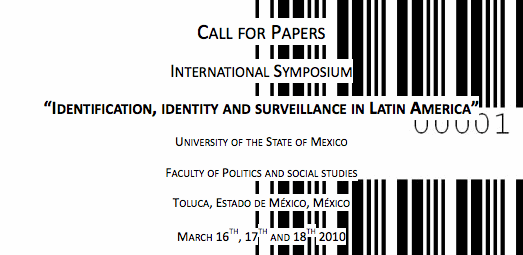
SIMPOSIO MEXICO

Introduction

In modern societies, identification systems have been used as an important mechanism to govern, manage, classify and control populations; in other words, to surveil them. This has meant the employment of certain technologies (passports, national identity letters, RFID, among others), providing interconnected data base systems with information according to specific institutional protocols. In this way, we define identification as visibility and verification of specific details of people’s lives. Likewise, these identification systems have responded to various functions: security, migration control, goods and service administration, as well for territory, space and group access.

The historical, social and politic contexts shape the particular purposes to which each identification system responds. Large-scale surveillance systems to identify the population have been installed in Latin America after decades of colonial, military and single-party governments In addition they have been prompted by increasing multiculturalism in cities, Population growth, migration rates, the perceived rise in terrorism, public security and health risks, as well as the creation of public policies (to aid poverty and unemployment) and globalization.

These conditions have caused the harmonization and articulation of corporations, institutions, technologies and specific protocols for citizen identification in Latin American countries, , depending on each country or region’s particular situation, and its relationship with other regions worldwide. Nevertheless, the Latin American environment allows us to consider the construction of privacy, identities, forms of government and the possibility of resistance policies.

Paper Proposals

In line with this analytic framework, the University of the State of Mexico, Faculty of Politics and Social Studies, hereby invites scholars, analysts and activists in Latin America and worldwide, interested in identification and surveillance, in relation to such matters as cultural or ethnic identities, privacy and data protection, new identification technologies (biometrics, RFID, etc), public policies, security, communication, ethics, law, or modes of critique or resistance; to participate in the International Symposium “Identification, identity and surveillance in Latin America”, by sending a lecture proposal.

Please send an abstract, 300-500 words long, Arial 12, space line 1.5, to the following e-mail: surveillance.studies.mexico@gmail.com, before October 30th 2009. Due to the nature of this event, the abstracts and papers are to be accepted in Spanish, Portuguese and English.

Note: There is no registration fee for this event. All participants are expected to seek their own funding for travel and accommodation. A number of rooms will be reserved with reasonable rates in a nearby hotel. More details to follow.

Main subjects

1. Governmental and corporative policies of identification

2. New technologies for identification and surveillance.

3. Purposes of identification systems in Latin America.

4. Communication and information technologies.

5. Privacy and transparency.

6. Identification, identities and subjectivities.

7. Relationship between global and local, in identification systems.

8. Postcolonial logics and political regimes.

9. Identities, surveillance and resistance.

10. Identification, identity and surveillance in Latin America: new theories?

Important Dates

Call for Papers Publication: July 30th 2009.

Abstract reception deadline: October 30th 2009.

Accepted lectures list publication: December 15th 2010.

Complete paper remittance deadline: February 15th 2010.

Complete program publication: February 28th 2010.

Second Symposium on surveillance in Latin America: March 16th, 17th y 18th 2010. University of the State of Mexico, Faculty of Politics and Social Studies. Toluca, México.

Organizing Committee

Nelson Arteaga Botello

Roberto J. Fuentes Rionda

Faculty of Politics and Social Studies, University of the State of Mexico

Rodrigo Firmito

Postgraduate Program in Urban Management, Pontifical Catholic University of Parana, Curitiba, Brazil

Fernanda Bruno

Postgraduate School of Communication, Federal University of Río de Janeiro, Brasil

Marta Kanashiro

Further Studies Laboratory of Journalism and Knowledge, Technology and Market Group, University of the State of Campinas (UNICAMP), Campinas, Brasil.

Danilo Doneda

De Campos Faculty of Law, Rio de Janeiro, Brasil

André Lemos

Federal University of Bahia, Brasil

With the support of:

David Lyon

David Murakami Wood

Department of Sociology, Queen’s University, Kingston, Ontario, Canada

Proposal reception, Information and Contact

surveillance.studies.mexico@gmail.com

US border surveillance pours billions into Boeing… and still doesn’t work

Federal Computer Week reports that the Secure Border Initiative (SBI) designed to provide secure and highly surveilled border systems between the USA and Mexico, is in trouble again. There have been major technological failures, cost overruns, and more with the result that the system is way behind schedule. Half the reason seems to be a political economic one. In many ways this system is a giant pork barrel for the Boeing Corporation, which has been sucking up US state subsidies for years and is taking literally billions of US dollars for this project and in unrelated federal recession subsidies. No-one seems to have really checked whether Boeing could really do the job, and like so many large state security and surveillance projects, and most things that have been tried on the Mexico border, it just doesn’t really work.

The article reports the new Director of the SBI, Mark Borkowski as admitting that “the program was first conceived as a quick implementation of existing off-the-shelf technologies […] In retrospect, it would have functioned better if a customized technology solution was developed to meet the requirements […] Some of the things we put into place, in hindsight, were not effective […] What we bet on, which was probably not a good bet, was that this was like buying a new printer for your computer. …We started the wrong way, in my opinion.”

The cost breakdown for the Department of Homeland Security is reported by FCW as:

$1.1Bn to Boeing ($620M  for SBInet technology and $440M for border-vehicle barriers and fencing).

$2.4Bn on construction of fencing and vehicle barriers along the southwestern border

$6.5 Bn longer-term to maintain, monitor and repair the fences and structures.

Of course the ridiculous costs are bad enough, but the wider issues here are with the obsession with controlling migration in an economic climate in which the North America Free Trade Agreement (NAFTA) has progressively stripped Mexico of any economic autonomy and made its (and by extension the whole of Central America’s) working class a reserve of cheap labour for US corporations and its relatively increasingly wealthy, a market for US consumer goods. It’s not surprising that the Mexicans regard it as more than a little unfair that they have been forced into a subservient position, yet are not welcome to come into the USA, and are subject to such harsh security and surveillance to prevent them from doing so. Added to this, as the Mexican President made clear last year, relaxed US laws on gun ownership have resulted in a massively increased flow of weapons into Mexico from the USA, which has exacerbated gang conflicts which thrive in the atmosphere of inequality and exploitation. And of course, the violence just adds to the reasons why people want to leave and find opportunities in the richer, safer USA…

In many ways, what richer nations are doing is not only prioritising their own security, but also simultaneously exporting their insecurity.

Surveillance cameras in the favelas…

Well, my fears have it seems, been vindicated already. Earlier this year, as part of my case-study on surveillance in Brazil, I visited the community of Santa Marta, a favela (informal settlement) in Rio de Janeiro. Santa Marta is interesting because of the amount of investment and effort that has been expended in occupying, pacifying and developing the place, by the new gubernatorial administration of Eduardo Paes, who has simultaneously cancelled Favela Bairro, the widely praised and more extensive favela development programs of his predecessor, Cesar Maia.

Leading the new Community Police efforts in Santa Marta was Capitao Pricilla, an indomitable and well-liked young female officer of the Military Police, one of several rising female officers with a new approach, and we heard from residents how trust was being rebuilt between police and community because of her. At the same time, there were storm clouds on the horizon as the city administration was insistent on cracking down still further with its policies of choque de ordem (the shock of order), which involved harassing illegal street vendors from the favelas, and demolishing illegally-built buildings, and also building walls along the edges of some favelas. The word ‘ghetto’ was mentioned on more than one occasion by our interviewees and in more casual conversations.

Now, just last month, the Military Police have decided to install seven CCTV cameras in Santa Marta, in different areas of the community. This has prompted complaints of invasion of privacy, an there have already, my sources report, been protests about this in he favela, but it seems that this is coming from further up the chain of command than Capitao Pricilla and the community police. She isn’t mentioned at all by the article in O Globo, despite being a bit of a PR star, and instead the justification for the cameras is given by one Coronel José Carvalho, who also stated that there are plans to put cameras into the other two areas currently being targeted for development, the famous Cidade de Deus, and the much less well-known and more distant favela of Batan. This also contradicts what I was being told by the Commnder of the police central CCTV control room we visited, which is quoted as being one of the places where the cameras will be monitored. What is interesting is the cameras seem to be being treated by police almost as a tool of urban warfare: a Major Orderlei Santos talks about their experimental use for determine the deployment of officers in the favela.

Could the old macho, male, approach to policing as a war on the poor be trumping the new trust being developed by community policing? I hope not, but everything points that way.

(thanks once again to Paola and David for keeping me in touch…)

Facebook forced to grow up by Canadians

Wel, Facebook has finally been forced to grow up  and develop a sensible approach to personal data. Previously, as I have documented elsewhere, the US-based social networking site had pretty much assumed ownership of all personal data in perpetuity. However it has now promised to develop new privacy and consent rules and ways of allowing site users to chose which data they will allow to be shared with third parties.

So why the sudden change of heart? Well, it’s all down to those pesky Canucks. Yes, where the USA couldn’t bothered and where the EU didn’t even try, the Canadian Privacy Commissioner, Jennifer Stoddart, had declared Facebook to be in violation of Canada’s privacy laws. And it turns out that in complying it was just easier for Facebook to make wholesale changes for all customers rather than trying to apply different rules to different jurisdictions.

This suggests an interesting new phenomenon. Instead of transnational corporations being able to always seek out a country with the lowest standards as a basis for compliance on issues like privacy and data protection, a nation with higher standards and an activist regulator has shown itself able to force such a company to adjust its global operations to its much higher standard. This is good news for net users worldwide.

However, we shouldn’t rejoice too much: as Google and Yahoo have shown in the case of China, in the absense of any meaningful internal ethical standards, a big enough market can still impose distinct and separate policies that are far more harmful to the interests of individual users in those nations.

Controlling the outsiders

One of the most interesting meetings we had in our last week here in Japan was with two representatives from the Japan Civil Liberties Union (JCLU) and the association to defend the rights of foreign migrant workers. One thing that has always been clear to me from being a gaikokujin (or more casually, just gaijin – foreigner) in Japan is how distinct is this status. I’m a white, western European and therefore at the top of the list of acceptability in foreigners in Japan, but even so I’ve had some interesting experiences, including having two police squad cars and 5 officers deal with the matter of my ‘suspicious’ bicycle (an experience that practically all resident foreigners have had at one time or another), and just the other day I was stopped at the train station by two plain-clothes police officers, who started off quite strong, but then backed down and started mumbling apologies about ‘looking for someone’ when they realised my (Japanese) wife was just behind me. It was pretty obvious that they were conducting an immigration sweep – i.e. just stopping anyone who ‘looked foreign’ to check their immigration status.

This gave me just a tiny taste of what life can be like here for those whose immigration status is problematic. And, as the campaigners told us, this is an increasing number of people who have come to Japan because of the wealth and opportunities and because, whisper it, Japan needs immigrants. Like so many advanced industrial nations, Japan is a hyper-ageing society, with an increasingly unbalanced population pyramid. There are not enough working age Japanese people to support the increasing number of retirees, and government schemes to encourage people to have more children simply haven’t worked. The problem is that successive Japanese governments have refused to recognise the implications. The rules now make provision for ‘skilled’ immigrants, but not for those who are ‘unskilled’ and it is actually those in this latter category that Japan needs. In practice this is demonstrated by the increasing numbers of foreign delivery and construction workers in Tokyo as well as those working in the shadier areas of the ‘night economy’ – doormen, bar staff, masseurs, prostitutes etc.. The same politicians who deny the need for immigrants are probably having their personal ‘needs’ serviced by Filipino or Vietnamese women and this hypocrisy colours all the mainstream political debate about the place of foreigners in Japan, especially in Tokyo where Mayor Ishihara has never disguised his nationalist views in this area.

So, whilst the politicians refuse to deal with reality, the police are enforcing the law as it is. We have spent some time, whilst we are here (and I have gathered data on previous visits) in the night city of Kabukicho in Shinjuku. This time I was taken out to bars in the old post-war neighbourhood of Golden Gai by Professor Tonoma, who formerly led both Shinjuku-ku and Tokyo city planning bodies, and we also talked to Shinjuku community safety officers, and to the Kabukicho Town Manager, who runs the day-to-day operations of the body trying to improve Kabukicho’s image, Kabukicho Renaissance.

Kabukicho of course is famous as the first place that the Tokyo police installed CCTV, ostensibly to deal with Chinese gangs, but according to what we learned from these visits and from talking to the campaigners, as crime has declined (as it has nationally – it’s probably nothing to do with the cameras), the cameras and intensive policing (raids etc.) have been used largely to curb illegal migrant workers. And the authorities seem to make no distinction between the gangsters and the mainly South-east Asian women who work in the bars and massage parlours. They are all visa-overstayers. There is no attempt to treat the women as people in need of help and support at all. Of course this all inflates the crime figures and makes it easy to paint what the police always term ‘foreign crime’ (whatever the exact nature or seriousness of the crime) as a growing threat, as it becomes proportionally a larger part of shrinking crime rates (which were already low by global standards to begin with).

Now there is a new threat to this already massively targeted population. The inclusion of foreigners on the jyuminhyo (residents’ registry), combined with the digitisation and networking of this registry through juki-net, means that the authorities will be able to correlate residency and immigration status much more easily – the residency information for foreigners will be linked to the Houmusho (Ministry of Justice), which has entry records, and now fingerprints and facial photos too, following post-9/11 reforms. Of course, resident skilled foreigners wanted to be in the residents’ registry. They argued that not being on it was itself a form of discrimination and meant further difficulties in terms of things like buying property. However the inclusion of foreigners now opens up new forms of discriminatory practice against those who are already the most disadvantaged in Japanese society, the kinds of foreigners who more high-status ‘official’ foreigners do not generally recognise as kin to them at all.

Japan’s surveillance society, like most, is therefore a profoundly uneven one. Every society has its Others, and surveillance is deployed both to distinguish those Others and to control them. In each of the cities I have been studying the Others are different populations. In London, the Others are (at the moment) the resident Muslim community (or more particularly, ‘radicalised’ young Muslims). Here the surveillance combines repression and ‘caring’ programs to bring the disaffected back into the mainstream. In Rio de Janeiro, the Others are the urban poor, the favelados. They are largely simply excluded – walls protect the rich in their homes, and now walls are being built around the poor communities. In Tokyo, the Others are foreigners, but there are gradations of Otherness, and effectively still aping the western ‘scientific racism’ that it acquired during the Meiji period modernisation at the end of the nineteenth century, Japan’s Others are poor Blacks and Asians (for many on the right here, the Japanese are not ‘Asian’ at all, but something unique). Just as the British state is struggling with the legacy of its particular colonial and post-colonial approach to immigration, and the Brazilian state with a history of years of differentiated citizenship, the Japanese state has still not yet really come to terms with the prospect of the mixing of people at all.

Moon protest highlights wider border surveillance issues

The mass mooning of the US balloon camera owned by Sierra Nevada Corporation went ahead, but the irony was that the system had already been disabled by the weather. Apparently a large thunderstorm cause a gash in the fabric of the balloon last week which, if nothing else, should prove rather more effective than the protest in making sure that the US government does not invest in it.

However the wider issue of the US surveillance of the border with Canada remains (not mention that of the Mexican border, already a major concern) and whilst this particular technology and the appropriately ridiculous protest, has attracted most attention in the media, let’s not forget that camera towers have been erected and the USA is flying UAVs along the border. Surely President Obama should realise that the paranoid policies of his predecessor do nothing apart from damage relationships (and trade) with a close neighbour?

Meanwhile, back in the USA…

Just when you though the USA might not be going down the same kind of vehicle tracking route that the UK, Japan and Brazil are following, former Congressman, longtime privacy advocate and erstwhile scourge of ECHELON, Bob Barr, reports in his Atlanta Journal and Constitution blog, that increasing numbers of jurisdications in the States are indeed investing in license plate reading systems. California seems to be leading the way, but there’s plenty of others states following, and no doubt this will be another way of wasting (sorry, investing) Obama’s massive recession-busting boost for security…

Vehicle tracking in Japan: N-system

Back in February, I reported from Brazil about the progress of a proposed RFID-based vehicle tracking system, SINIAV. Of course RFID is not at all necessary for tracking. In the UK, the police have used Automatic Numberplate Recognition (ANPR) systems based on roadside cameras since 1993 in London – following the Provisional IRA bombings of the City and Docklands (see the account in my erstwhile collaborator, Jon Coaffee‘s book, Terrorism, Risk and the City – and since 2005, this has been in the process of being expanded into a nationwide network (see also the official Press Release from the Association of Chief Police Officers concerning the launch here).

What is rather less well-known to the outside world is that Japan developed such an automated camera system far earlier, from the early 1980s. The so-called N-system thereafter was gradually expanded to cover almost all major expressways and strategic urban locations in Tokyo and Osaka. Kabukicho, the entertainment district in Shinjuku, which I have spent some time studying over the last few years and will write about more tomorrow, is surrounded by N-system cameras and it is, I estimate, impossible to drive into this area without your license plate being recorded. These cameras are in addition to the 50 CCTV cameras that cover just about every street within the district. N-system is supposed to have played a major role on snaring suspects from the apocaylptic cult, Aum Shinrikyo, which carried out the Sarin gas attacks on the Tokyo underground in 1995, and who also assassinated top policemen and judges. Aum, now renamed ‘Aleph’, has been under official state surveillance ever since.

The Japanese police are not very forthcoming about N-system, let alone the details of how long data is kept and what it is used for. However one particular lawyer’s office in Tokyo did a very good investigation of the constitutional, legal and practical aspects of N-system back in the late 90s, and the updated pages are available here, including a nice little animation explaining how the system works.

We will hopefully be talking to them before we leave Tokyo. We still have time for a few more interviews here including the East Japan Railways security research lab, the Japanese consumers’ association, the organisation for the welfare of foreign workers, and the Suginami ward community safety people. And I will also just about have time to shoot down to Kobe to talk to Professor Kiyoshi Abe, a friend and collaborator, who is also one of the leading surveillance researchers here.