Flying Down to Rio

ariasI’m off to Rio de Janeiro on Thursday… as most people will be aware, Rio is far a long way from the romantic Hollywood-generated image of sun-kissed decadence. It is perhaps the most extremely divided city in the world. The richest parts have a higher standard of living than almost anywhere else and the poorest parts barely cling to the hillsides and to any kind of an existence. I have been reading Enrique Desmond Arias’ enlightening Drugs and Democracy in Rio de Janeiro (amongst many other books) in preparation, and right on cue, a major drugs war has apparently broken out between trafficking gangs in the Copacabana area…

I am going to be interviewing state and community representatives, and carrying out mapping exercises to assess the state of surveillance and security in several different neighbourhoods of varying social classes. The drug war is making me a little nervous, but in many ways it is an ideal time to be asking the kinds of questions I need to ask. Of course reading a book like Arias’, you tend to get anthropology-envy, but I just have to remember that my study is a very different kind of research. I am still trying to get a feel for the kinds of indicators that would enable us to make serious comparisons between the intensities and forms of surveillance across cultures and nations – and I am still very much at the beginning of the project. Some of these indicators might seem common sense and obvious but some are not, and some may not even be in any way ‘measurable’…

My fantastic temporary Research Assistant is Paola Barreta Leblanc – she has created a mash-up of my current schedule here (it will get more complex!).

Wish me luck!

US plans surveillance drone airship

I am sure there will be arguments about the violation of airspace, which will not be trivial as the ongoing diplomatic and increasingly military row over US surveillance vessels off China is showing…

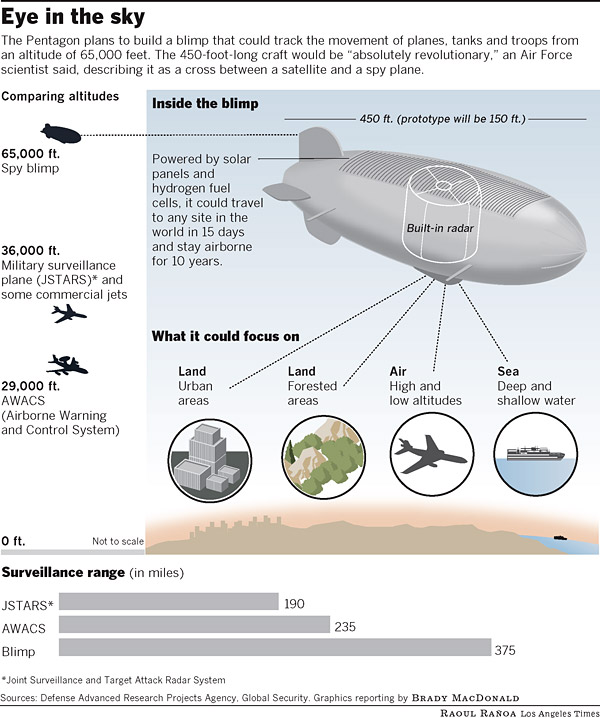
Unmanned aerial vehicles (UAVs) are one of the fastest-developing areas of surveillance technology. A new plan revealed by the US Department of Defense combines old and new tech with a plan, first revealed by the Los Angeles Times, for an pilotless surveillance airship called ISIS (Integrated Sensor Is the Structure) that will fly right at 65,000 feet (about 20km) high, right at the edge of ‘airspace’. The point of the airship is to provide the kind of constant watch that a geostationary satellite provides, but at a much lower level so that for more detailed pictures of the precise movements of vehicles, objects and people could be observed.

airship

Well, as usual, the reports only seem to to be concerned about how great this would be for US military tactics, and are not interested in the law, politics and ethics of such devices. For example, I am sure there will be arguments about the violation of airspace, which will not be trivial as the ongoing diplomatic and increasingly military row over US surveillance vessels off China is showing. And of course there are issues around the violation of human rights by such intrusive technology: international violations are very hard to deal with, however. And this will only be the beginning. The new Obama administration has promised more investment in intelligence and surveillance and less in warfighting. That sounds good in some ways, but of course just poses new problems and new issues for those of us concerned with ongoing US attempts to cover the whole world with surveillance for the benefit of its strategic aims.

Global CCTV datamining project revealed

As a result of an annual report on datamining sent to the US Congress by the Office of the Director of National Intelligence, a research project, Video Analysis and Content Extraction (VACE), has been revealed. The program is aiming to produce an computer system that will be able to search and analyse video images, especially “surveillance-camera data from countries other than the United States” to identify “well-established patterns of clearly suspicious behavior.”

Conducted by the Office of Incisive Analysis, part of the Intelligence Advanced Research Projects Activity (IARPA), the program has apparently been running since 2001,and is merely one of several post-9/11 research projects aiming to create advanced dataveillance systems to analyse data from global sources. How the USA would obtain the information is not specified…

One could spend a long time listing all the DARPA and IARPA projects that are running, many of which are speculative and come to nothing. The report also mentions the curious Project Reynard that I have mentioned before, which aims to analyse the behaviours of avatars in online gaming environments with the aim of detecting ‘suspicious behaviours’. Reynard is apparently achieving some successful results, but we have no real idea at what stage VACE is, and the report only states that some elements are being tested with real world data. This implies that there is nowhere near a complete system. Nevertheless the mentality behind these projects is worrying. It is hardly the first time that the USA has tried to create what Paul Edwards called a ‘closed world’ and these utopian projects which effectively try to know the whole world in some way (like ECHELON, or the FBI’s proposed Server in the Sky) are an ongoing US state obsession.

It is the particular idea that ‘suspicious patterns of behaviour’ can be identified through constant surveillance and automated analysis, that our behaviour and indeed thoughts are no longer our own business. Because it is thoughts and anticipating action that is the ultimate goal. One can see this, at a finer grain, of programs like Project Hostile Intent, a Department of Homeland Security initiative to analyse ‘microexpressions’, supposedly preconscious facial movements. The EU is not immune from such incredibly intrusive proposals: so-called ‘spy in the cabin’ cameras and microphones in the back of every seat have been proposed by the EU-funded SAFEE project, which is supported by a large consortium of security corporations. The European Commission has already hinted that it might try to ‘require’ airlines to use the system when developed.

No doubt too, because of the close (and largely secret and unaccountable) co-operation of the EU and USA on security issues, all the images and recordings would find their way into these proposes databases and their inhuman agents would check them over to make sure we are all passive, good humans with correct behaviours, expressions and thoughts, whether we are in the real or the virtual world…

The rise of personal surveillance

Personal surveillance is only going to get harder to regulate as things like ‘smart dust’ and micro-UAVs come down in price and are more easily available…

CBS News in the USA is reporting on the rise of stalking and in particular the use of more powerful, smaller and cheaper surveillance devices: embedded hidden cameras, GPS trackers and so on. They discuss in particular the case of Michael Strahan, a sportsman who seems to be obsessed with keeping watch on family and friends. But the bigger pictures is that stalking is something that apparently affects around 3.4 million US citizens. That’s more than one in a hundred, an astonishing figure if it’s anywhere near ‘right’.

Stalking and personal surveillance are an integral part of the culture of any state in which order in ensured through surveillance. We are creating unhealthy societies in which personal relationships between people are increasingly characterised by the same fear and distrust as states have of their people.

Smart Dust chips (Dust Networks)

ravenThis is only going to get harder to regulate as things like ‘smart dust’ and micro-UAVs come down in price and are more easily available. And already surveillance equipment like head-mounted cameras for cyclists, is marketed as ‘toys’… regulation is only half the answer. The other half has to be in working out how to shift away from this mistrustful, fearful, risk-obsessed culture. Part of this has to be down to government: the more that surveillance is part of every solution they come up with to any problem, the worse the social malaise will become.

Surveillance in Latin America

For the last three days, I’ve been at the Surveillance, Security and Social Control in Latin America symposium, organised by Rodrigo Firmino at PUCPR (with help from Fernanda Bruno, Marta Kanashiro, Nelson Arteaga Botello and myself). The conference was the first to be held on surveillance in Brazil and will be the start of a new network of surveillance researchers in Brazil and more widely across Latin America.

All of the presenters had something interesting to say and I learned a lot from the event, however it is worth noting some individual presentations and sessions that were really insightful. There were great keynotes from David Lyon, Luiz Antonio Machado da Silva and Nelson. Two sessions stood out for me: one on Rhetorics of Crime and Media which had an exceptional central presentation by Paola Barreta Leblanc, a film-maker and currently a student of Fernanda Bruno’s. Her paper (and films) on the way in which we impose narrative onto CCTV images argued cogently that we see CCTV with a (Hollywood) cinema-trained eye and consequently overestimate (or over-interpret) what we are seeing. The other papers in the session were also good, in particular Elena Camargo Shizuno on Brazilian police journal of the 1920s and how they trained the vision of middle and upper-class Brazilians of the time through a combination of reportage, fiction, and advocacy. The session as a whole left me with many new questions and directions of thought.

The other really sparky session was on the last day and was on the Internet and Surveillance. The first paper was from was Marcelo de Luz Batalha on police repression of community and activist networks at the State University of Campinas, which linked nicely into concerns I have been following here on the surveillance of activist networks in the UK. Then there was Hille Koskela’s theoretically sophisticated and searching paper on the Texas-Mexico border webcam system (that I noted back in January) which explored the ways in which this participatory surveillance system both succeeded and failed in inculcating an attitude of patriotic anti-outsider watchfulness and responsibilization of citizens. Finally there was an interesting if not entirely successful film from Renata Marquez and Washington Cancado which used Charles and Ray Eames’ famous Powers of Ten, one of my favourite bits of pop-science ever, as an inspiration for an exploration of the uneven gaze of Google. They provoked some very interesting thoughts on the ‘myopia’ of the new ‘god-like’ view we are afforded through interactive global mapping systems. I think their approach could be very fruitful but it is still missing some key elements – having talked to them, I am convinced they will turn this into something really excellent. I have asked them and Paula to submit their work to Surveillance & Society’s special on Performance, New Media and Surveillance, because I think both are exactly the kind of explorations we are looking for. If Fernanda Bruno’s excellent paper on participatory crime-mapping has been part of this session, it would have been perfect! See Fernanda’s thoughts on the seminar over at her blog – she was also Twittering throughout the event but I’m afraid I just can’t get on with Twitter!

Other memorable papers included Danilo Doneda’s on the new Brazilian ID system, which sparked our post-conference considerations on where to go with this new network, which will probably be a project on Identification, Citizenship and Surveillance in Latin America. Nelson Arteaga Botello has already generously agreed to host the next symposium on this theme in Mexico City next March! Fernando Rogerio Jardim gave a passionate paper on the the SINIAV vehicle tracking pilot in Sao Paulo and I was most impressed with the careful Gavin Smith-style CCTV control-room ethnography by one of Rodrigo Firmino’s students, Elisa Trevisan, and Marta Kanashiro and Andre Lemos both gave insightful presentations too – I’ve already come to expect both care and insight from Marta in the short time that I’ve known her. I hope we’ll be able to work more closely together in the future. Let’s see…

The event as a whole was a great start for the study of surveillance in Latin America, despite the disappointing lack of Spanish-language interest. This is just the beginning, and the new networks of scholars here will grow. I was just happy to be there a the start and play a small role. As for my keynote, I took the opportunity to do something a bit different and instead of doing my usual tech-centred stuff, I gave a talk on the emotional response to surveillance and how this might form the basis for reconstructing (anti-)surveillance ethics and politics. I have no idea whether it really worked or what people got out of it…

Protecting yourself from surveillance

The Electronic Frontier Foundation (EFF) and the Open Society Initiative have created the very useful ‘Surveillance Self-Defense’ (SSD) site. Although the SSD is aimed at US citizens and the legal aspects are therefore more relevant to those living in the States, the general advice and information on risk management and defensive technologies is all worth reading for anyone who uses a computer anywhere in the world.

Essentially this is a kind of care and maintenance of your ‘data double’ concept, which is one response to the growth of surveillance. Of course no-one should think that this kind of ‘personal information economy’ approach is enough and the EFF certainly don’t. There is in any case a general effect that could emerge from this kind of action should large numbers of people start taking the advice of EFF: mass surveillance effectively becomes more difficult, more expensive and less worthwhile. However, things like SSD cannot be a substitute for political action to curb the powers of state and private sector to monitor us and reduce individual liberties and dignity.

Surveillance in the UK and the USA: commonalities and differences

In one of those fortuitous instances of synchronicity, there are two stories today that illustrate some of both the commonalities and the differences between state surveillance practices and regulation in the UK and the USA.

In the UK, The Guardian has revealed that the Surveillance Commissioner (a separate office to the Information Commissioner) has been very critical behind the scenes, as the Lords Committee was in public, of the uses to which the Regulation of Investigatory Powers Act (2000) (RIPA) has been put, not this time by local government, but by national ministries like the Department for Environment, Food and Rural Affairs (DEFRA) and agencies, including Ofcom (the broaadcast and communications regulator) and the Charities Commission. DEFRA came in for a particular telling-off over its spying on fishermen. The chief commissioner, Sir Christopher Rose found generalised lax practice, a lack of proper justification for and proportionality in the used of RIPA, and little training or accountability. In short, RIPA is being used because the powers exist not because there is any pressing justification to use surveillance in this manner – the used of surveillance has expanded because it is available.

It is very interesting that The Guardian had to discover all this through Freedom of Information Act (FOIA) requests, and that the Surveillance Commissioner had not put all of this in the public domain as a matter of course. It highlights for me, once again, the clear difference in attitude and regulatory practice between him and the open, accountable, and active Information Commissioner’s Office (ICO). It confirms my view that we would be much better off if the Surveillance Commissioner’s work was absorbed into the ICO.

In the USA, it is to lawyers that people immediately turn if some bad practice is suspected on behalf of the government. The Los Angeles Times reports that on Friday, the US government lost the case it had been bringing to try to stop an Islamic charity based in Oregon from suing them over what they claim were illegal wiretapping operations targeted at them. The case stems from the Bush administration’s attempts to bypass what were already very weak regulations governing the surveillance of American citizens which were introduced in the Foreign Intelligence Surveillance Act (1978) (FISA) and recently amended in the Protect America Act (2007). Requests are supposed to go to the Foreign Intelligence Surveillance Court (FISC) which meets in secret and does not have to publish its rulings and so far as we know, has never turned down a request – so it is somewhat mystifying except as a matter of speed and convenience that the Bush administration did bypass the court.

Now the Obama administration is (shamefully) defending the actions of his predecessor. This is not entirely surprising. Intelligence is one area of continuity between governments: it is what Peter Gill called the ‘secret state’, a core that remains constant regardless of changes of administration. Nixon and Bush were both stupid enough to get caught, but the NSA, CIA and FBI are continually looking for different ways to get around domestic regulations on surveillance. Political devices like the UKUSA agreement served this purpose for many years – whereby Canadian and British intelligence services would collect SIGINT on Americans and supply it to the NSA and vice-versa. But GCHQ and others just don’t have the capabilities to carry out the amount of monitoring that now goes on. It’s been the reality for many years now that the NSA in particular does spy on Americans. Again, they have the capabilities so those capabilities are used.

Of course, unlike in the UK, we are talking about the threat of terrorism not anglers catching one-too-many fish; that really does say something about the petty bureaucracy that characterises the UK! However RIPA was also justified originally with reference to terrorism and serious and organised crime. Anyway, the ruling in the Oregon case clearly states that state secrets privilege was not enough to justify warrantless surveillance of suspects, whatever they had allegedly done. It seems that at least is one point of hope that the USA and the UK have in common. Let’s see where these situations now lead in each country…

Brazilian church sends mixed signals on security

CNBB 2009 Campaign on 'Fraternity and Public Security'

One organisation I haven’t mentioned much since I have been in Brazil is one of the most important, influential and yet always controversial: the Catholic Church. Brazil was one of the centres of the Liberation Theology movement and these activist priests, unlike the church hierarchy in many Catholic countries, never sided with the dictatorships. Liberation Theology remains a major influence and movement within the Brazilian church and it is no surprise to see the fraternal organisation of the Conferência Nacional dos Bispos do Brasil (National Conference of Bishops of Brazil or CNBB) taking their campaign theme for this year as Public Security.

However, at the same time, the Church in Brazil seems to be clamping down on dissent and on those priests who are too outspoken on behalf of the poor and the victims of violence and insecurity. Today, the BBC is reporting that Father Luiz Couto, who is from the north-east and a colleague of President Lula (he’s a Workers’ Party federal deputy), has been suspended by the Church for advocating the use of condoms for public health and having a liberal attitude to gay rights.

Couto has however also been for many years a serious campaigner against unofficial ‘death squads’ and Autodefesas Communitárias. It seems to be at the very least bad timing by the church to suspend him just after announcing their year of campaigning on public security. He has my support and my sympathy. The Church needs to live up to what the CNBB are proposing this year and focus more on the realities of the big social questions that bedevil Brazil and not shoot themselves in the foot by suspending their best members over what should be matters of opinion on personal morality.

Austin no longer the coolest city in the USA

The latest city to fall for the current wave of government enthusiasm for surveillance that is sweeping the USA is, unfortunately, the city of Austin… Sorry Austin – unless you people do something about this, you are off my list of cool cities…

Austin, Texas… lone island of sanity and liberalism in a less-than-liberal state. With its laid-back attitude, massive urban bat population, superb music scene and reputation for weirdness, it must for some time have been a candidate for coolest city in the States.

Austin... no longer cool

Well no longer. The latest city to fall for the current wave of government enthusiasm for surveillance that is sweeping the USA is, unfortunately, the city of Austin, whose authorities have voted to install a CCTV system. The local newspaper, The Daily Texan, jauntily informs us that the city has voted to sacrifice privacy for security: that does not sound like the attitude of a confident, hip place. Sorry Austin – unless you people do something about this, you are off my list of cool cities!

Seriously, though: Austin is not a city with an especially high crime rate, nor has it seen any massive recent increase in crime – even if CCTV was any good at reducing crime, which we know from the multiple assessments done in the UK and elsewhere that it isn’t. Yet Police Chief Art Acevedo is quoted as praising CCTV in the UK, specifically in London. Perhaps he has been reading too much of the hype and hasn’t read the British government’s own assessments of CCTV (conducted under the auspices of the Home Office)?

So why the sudden urge to install cameras? Could it be because of the lure of federal funding from the Department of Homeland Security? It could be. Austin has acquired $350,000 to install cameras, and what set of city fathers turns down cash (whatever it is for)? That was one of the main lessons of the expansion of CCTV in Britain in the 1990s and of course cities are now paying the long-term price of their enthusiasm as they struggle to find the money to monitor and maintain their camera systems. Chief Acevedo seems to have no worries about this though – this techno-evangelist is already talking about automation and computer recognition systems. He really sounds like a guy who has started to believe the sales pitches at all those law enforcement technology trade fairs…

The downside of Brasilia

on foot, you are immediately confronted by the unpleasant reality of what is to the pedestrian effectively a huge expanse of carpark and highway separating the areas you might want to be. The functional split between the ‘zones’ only makes this worse.

Again, this is urbanism rather than surveillance, but here are some more musings and pictures on the urban form of Brasilia. Yesterday, I posted a lot of conventionally attractive shots of the buildings around the monumental axis of Brasilia. However, leaving aside the wider question of whether Brasilia outside of the planned centre functions as a city, there is a rather less beautiful side to the core.

This mainly has to do with the practical consequences of the philosophy behind the plan and particularly with functional separation and transport. As I noted when I first arrived, the city is dominated by roads. 5-lane highways run down either side of the monumental axis, and it is crossed by two major motorways in deep cuttings, with all the attendant slipways. These probably look very attractive as bold curving lines on a plan. They may even function if you are traveling by car (or bus). But on foot, you are immediately confronted by the unpleasant reality of what is to the pedestrian effectively a huge expanse of carpark and highway separating the areas you might want to be. The functional split between the ‘zones’ only makes this worse. Say you are in the hotel zone that I was staying in and you want to go out for a meal and a drink. Well, that’s 30-minutes walk to the nearest residential centre (where most of the evening options are located). Sure, you can take a taxi, but why should you have to? All the sports clubs are in separate ‘club zones’ even further away from either hotel, commercial or residential districts.

Now, okay, so the residential districts have most of their facilities (not including clubs) within walking distance – I said in my first impressions blog entry that I could actually imagine living here with a young family. And I still could. Natives of Brasilia are fanatical about the place. The residential districts work. You don’t really have to go anywhere near the soulless and secured shopping centres or take your chances running across massive motorways with uncaring drivers trying their best to ignore you. There is a simple metro system which runs between the districts and the centre (though it was largely closed for the building of new stations when I was there). You can walk around, between and under the blocks. They don’t appear to be totally obsessed with security in the manner of Sao Paulo or indeed most other large Brazilian cities. The blocks have concierges but not fences, walls and gates. Most of the windows do not even have bars.

But there is a reason and a price for this too. The residential zones are simply not socially mixed. Just about everyone who lives in the big blocks is a government or big corporate office employee. The ordinary workers and the poor live elsewhere entirely, in one of the satellite cities of Brasilia, and are bussed in and out via the busy central bus station every day. At the bus station, you find glimpses of the ‘ordinary Brazil’ – the cheap lanchonetes and pastelerias (in fact probably the best pasteleria I have found in Brazil so far)!, sidewalk vendors of DVDs and knock-off jewelry, the beggars, the hungry and the desperate. In many ways I felt more comfortable there than in the dry Le Corbusian dreamspaces of the government buildings.

Anyway, here’s some pictures of the ‘real Brasilia’ – or what it looks like if you stop focusing on the architecture and take a wider view!