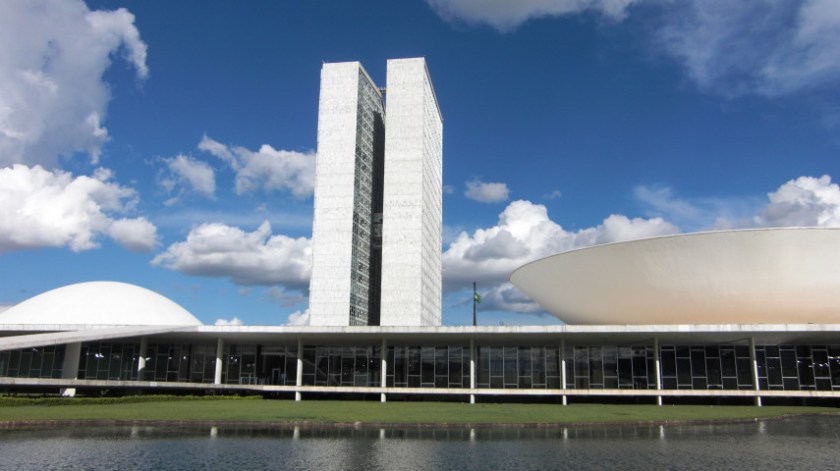
Not surveillance-related, but here’s some of the many, many pictures that I took whilst getting very sunburnt walking around the big open spaces under the huge skies of Brasilia last week. There are a couple more pictures of the Parliament complex in my report from my meeting there last week. My first set of photos of Niemeyer’s work from Sao Paulo can be found here.
Category: Americas
Chicago: the future of US CCTV?
…despite Britain’s reputation as a surveillance society… the USA is now eclipsing the UK. The post-9/11 surveillance surge has seen to that.
Back in the USA again. Chicago has been featuring a lot this week for its CCTV system. Newspapers generally offered glowing assessments of its capabilities based around homey anecdotes of pretty harmless incidents ‘solved’ by CCTV – in this case the stories, for example those in the Chicago Sun-Times and the New York Times, featured a theft from a Salvation Army kettle, which sounds like it is straight from a Mayoral press release. It is depressingly poor journalism and once again, all very reminiscent of the situation in the UK in the 1990s before academic and even government assessments dampened the enthusiasm for CCTV. There’s also a depressing naivety (and factual incorrectness) about the insistence from the authorities and from some ‘experts’ that these cameras have nothing to do with human rights like privacy as they are all in public spaces.
But there is one very important difference. Chicago, with massive investment from the Department for Homeland Security, has gone much further than most UK cities, not only in coverage but also in capabilities. First of all, Daley and police-chief Orozco have promised that “We’re going to grow the system until we eventually cover one end of the city to the other” in other words they do want, as the Chicago Sun-Times subheading claims, ” a camera on every street corner.”
The particular innovation that the city is pushing here is the linking up of the law-enforcement aspects with emergency services through something called Computer-Aided Dispatch (CAD). This is system that uses a live Geographic Information System to match camera location to reported incident location, so that when an incident is called in via 911, the nearest cameras can immediately turn to picture the scene. This is part of what Chicago calls ‘Operation Virtual Shield’, a fibre-optic cable system which links the cameras with other biological and chemical weapons-detection system in a “homeland security grid.’’

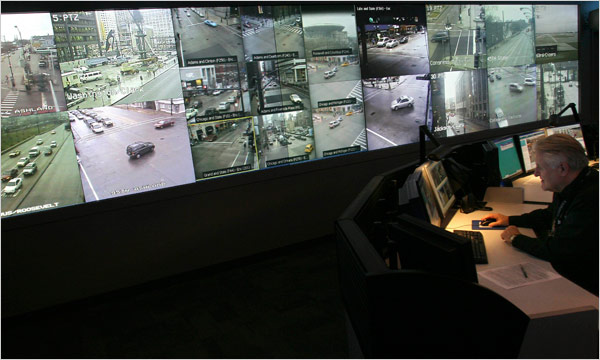
As part of the work we did for our latest book, Jon Coaffee Pete Rogers and I visited and analysed several different cities in the UK to assess their emergency-response and surveillance systems. While most had intentions to use the cameras for more active emergency-response purposes and particular local police were starting to try to install override systems for the multiple local camera systems that exist in the UK in the case of citywide emergencies (like a mass evacuation). And in particular, Manchester (whose high-tech control room looks like the Chicago one as seen in the NYT (picture above) and also often features in media PR for CCTV) has gone further down the Chicago route than most. But they still don’t come close. Britain’s systems are fragmented, ageing, generally not integrated with other functions and certainly don’t link to other kinds of sensors. Britain has introduced some stupid authoritarianism like the infamous ‘shouting cameras’ mostly as part of the Respect (sic) Zones initiative. But despite Britain’s reputation as a surveillance society I suspect that in terms of advanced integrated cameras systems, the USA is now eclipsing the UK. The post-9/11 surveillance surge has seen to that.
There’s two other points worth noting here. The first is that Chicago is bidding for the Olympics in 2016. I can almost hear multiple researchers in surveillance studies around the world, releasing a collective ‘of course!’. Mega-events like the Olympics, the World Cup – there will be a fantastic conference on this theme in November this year in Vancouver – or other non-sporting ones like world summits or the G-8 conference are often the trigger for the introduction of repressive measures and new surveillance systems. This was true in Japan (where state CCTV was first introduced because of the soccer World Cup in 2002), in South Africa (for various major world summits), and in Athens for the Olympics in 2004. Mayor Daley wants the city to be 100% free from the possibility of terrorist attack. Laving aside the actual impossibility of that desire, how far will he go to get there?
Well, the last Olympic venue, Beijing, might give some indication. For it is actually the plans in authoritarian, non-democratic China that seem most similar to what is going on in Chicago. Even the names have an eerie reminiscence: China’s Golden Shield, Chicago’s Virtual Shield. That is trivial, however the substance is not. The Chinese government, as Naomi Klein has written, is installing massive and comprehensive camera systems in every major city in China. It is also, of course, linking this system into its infamous Internet monitoring operation, with the ultimate aim of being able to track individuals in real and virtual space. Of course, the US, like most other nations is now trying to control Internet use too and the NSA already keeps massive data banks of communications traffic information as well as doing real-time monitoring as recent revelations have, once again, shown. But, it’s different in the USA isn’t it? The USA wouldn’t link up all these systems, would it? The Land of the Free? The home of democracy? I wouldn’t bet against it…
Could the US fiscal stimulus lead to a surveillance surge?
Largely unnoticed in commentary on US President Obama’s fiscal stimulus plan has been the $4Bn for the Justice Department. Now there are various very worthy programs nominated for funding including quite a large chunk to combat violence against women, but also a lot of cash washing around for rather more vague aims, in particular the $2Bn (i.e.: half the cash injection) for the Edward Byrne Justice Assistance Grant (JAG) program “to fund grants for state and local programs that combat crime”.
The JAG program has already providing funding for many cities to install cameras as part of ‘demonstration programs’, as well as covert surveillance capabilities. However $2Bn is a massive increase in funding and will allow some rather more ambitious schemes to be funded. With the current popularity of CCTV cameras as a catch-all solution in the USA (regardless of negative assessments of their effectiveness elsewhere – see ACLU’s recent convenient US-focused summary), could one side-effect of the stimulus package be a massive ‘surveillance surge’ in the USA? After all, this is exactly what happened in the UK in the 1990s when central state funding through the ‘City Challenge’ program sparked a mania for installing city-centre CCTV systems – see the editorial and the articles by Will Webster, Pete Fussey and Roy Coleman in the special issue of Surveillance & Society on CCTV.
Those concerned with civil liberties and the intensifying push for videosurveillance in the USA should keep a careful eye on applications to the JAG program.
At the Camara dos Deputados
I had a great meeting at the architecturally stunning Camara dos Deputados (the Brazilian equivalent of the British House of Commons or the House of Representatives in the USA), which almost made up for the fact that it was the only one of the three scheduled interviews that I had arranged that actually went ahead… it really does look like I will have to come back.

This meeting took place in the Comissao de Direitos Humanos e Minorias (the Commission for Human Rights and Minorities) and was with Federal Deputy and committee member, Pompeo de Mattos, the secretary of the Commission, Marcio Marques de Araujo, and Hebe Guimareas-Dalgaard, who works in the International Relations office and who served as translator.
The meeting covered all sorts of background issues around security in Brazil, and concentrated on Deputado de Mattos’s specialities in this area, which are in justice and drug-trafficking issues. Again, I won’t do more than summarize a few immediately important things here. There was a lot of talk of police corruption and some hair-raising stories of the ways in which military police officers in particular has become involved in selling equipment and ammunition, and of course the autodefesas communitarias that I have mentioned before. Interestingly though, it was the deputy’s opinion that the military police, despite having a ‘culture of violence’ inherited from their role as enforcers of the military dictatorship, were less corrupt (in an everyday way) than the civil police. The latter are even lower down the police food-chain and correspondingly more poorly paid and equipped.
The inadequacies of the civil police has led many Mayors of larger towns and cities to introduce so-called ‘Municipal Guards’ – basically private security given some official status. They have few powers but are basically there to increase the visibility of security, a kind of prophylactic community policing. The problem is however that the official police and the massive private security sector are thoroughly intermixed already. Many officers moonlight as private security guards, which leads to all kinds of conflicts of interest.
Deputado de Mattos was certainly not obsessed with the inadequacies of the police however. Serious and organized crime associated with drug-trafficking paralyzes the everyday life of poorer areas of large cities in Brazil. Despite the fears of the rich over crime, it is the poorest that suffer most. He described the drug gangs as being the major obstacle to any positive change in Brazilian cities. However he didn’t see any militaristic solution – fighting a war against the drug gangs would only lead to more violence. The only solution to the problems of both crime and the poverty from which it emerges is social inclusion. The favelados must be provided with the same opportunities and infrastructure as everyone else. The need schools, hospitals, transport, and so on. Programs like Bolsa Familia, however well-intentioned, make no fundamental difference, he argued – contradicting, as most people with whom I have talked have done, the assessment of external organisations like the World Bank.
However providing such opportunities is not easy, and not just because of the costs. The drug-gangs actively resist any attempt by the state to introduce services, to the extent of intimidating or even killing construction workers. And this shouldn’t be in any way romanticized as some kind of popular resistance of the poor to the imposition of unwanted state interference – this is an attempt to maintain the rule of fear and violence. Somehow, one can never get away from the security issue in Brazil.

(Thanks to Deputado Pompeo de Mattos, who as you will see if you check out his website is quite a character. He is fiercely proud of his southern ‘gaucho’ roots, and writes poetry to that effect. He is also – and I don’t say this very often of politicians – a genuinely nice guy. Thanks also to Marcio Marques de Araujo and to Hebe Guimares-Dalgaard without whom the meeting would have been impossible).
Facebook, Privacy and the follies of youth
It is hard to say anything about Facebook that hasn’t been said elsewhere. Of course, the decision to reverse its attempt to change its terms, which would have made it nigh on impossible for members to remove material they had posted, is a good one. Effectively what it would have done is made Facebook the owner of all personal data posted on the site.
The campaign against it was of course organised through Facebook groups! That in itself should have been enough to persuade Facebook’s young owners of the power and passion generated by the system they had created. But I don’t think they really do understand it, or indeed very much about the implications of what they are doing at all. I mentioned their youth. Last time Facebook got into trouble, it was because of comments made by their ‘Marketing Director’ (age: 24) at Davos, which were (apparently erroneously) taken by the press to indicate that Facebook was going to sell personal data.
Now, I know that it’s not cool and probably won’t make me popular to knock youth at a time where youth is everything (despite the fact that the word is ageing) – Fast Company last month had snowboarder Shaun White as its cover star in a story full of fawning admiration about how rich he had become by telling big companies about the youth market. But at least White seems to have his head screwed on – maybe it’s a class thing? Facebook’s owners on the other hand need to grow up a bit. They need to learn a bit more about the value of some rather old-fashioned fundamental rights, particularly privacy, and strop treating the system they have created as the personal spare-time sophomore project as which it began. I think that they just didn’t appreciate how people would view their proposals.
There is a serious issue here. Privacy is something that you only start to truly truly understand as you get older. Partly this is because your mistakes and your secrets get more serious and more potentially damaging as you get older! But, as I have said before, most of those are nobody’s business but your own and no-one benefits from forced transparency – honesty and conscience are also profoundly personal matters. It has been argued that the ‘youthfulness’ of the Net has encouraged a general carelessness with privacy. I am not sure that is entirely true, as Facebook users have shown – they care. But it’s the careless and – let’s face it – privileged youth of many of these new entrepreneurs, the fast companies, which is more concerning. Most are not success stories from the wrong side of the tracks, who have learned ‘the hard way’.
The threat of legal action from EPIC, which was preparing to take them to the Federal Trade Commission might have concentrated minds in this regard. Maybe it was just the threat itself – EPIC have a strong record in these kinds of cases and have taken down Microsoft and Doubleclick. However I would like to think that the arrogance and energy of youth might be tempered with a bit more maturity and consideration in the future. If only, as I’ve said before, because Facebook is no longer a fresh young company in Web 2.0 terms and could easily be eclipsed by the next big thing. Perhaps they can hire someone more ‘real’ like Shaun White to tell them how privacy rights and user control of information would be like, totally rad, dude…

On a more serious note, EPIC put a lot of time and money into protecting privacy in the USA and they do a damn good job, and in cases like that of Facebook they are having a positive affect the world over, so give them some money!
Surveillance and the ‘Open-source Insurgency’
Hierarchical, national and corporate bodies are profoundly afraid of the openness, apparent lack of interest in conventional goals and absence of obvious leadership or deference that is represented by the new collaborative networks like Open-source. They are not ‘under control’. The answer for the military-industrial complex is a consistent one, and as usual it combines strategic military and economic goals. This answer is surveillance.
The US military-industrial complex is always trying to identify new threats to bolster its budgets. There was a minor outcry a few years ago when US military powerpoint slides on strategy seemed to indicate that it regarded international civil society organisations, including the Red Cross, as a potential source of such threat. Then came 9/11 and the war on terror and for a while it didn’t need these phantom menaces as there were real global enemies, and fortunately for the military-industrial complex, it seemed that those enemies might be infinitely expandable and malleable into what was briefly termed the ‘long war’.
But the war on terror isn’t what it was. So there seems to be some effort to resurrect previous threats. One of these is ‘the war on drugs’ now rebranded as ‘narco-terrorism’ or ‘narco-insurgency’. And the particular focus of the concern is closer to the United States: Mexico. Writing in the self-proclaimed ‘capitalist tool’, Forbes magazine, Reihan Salaam argued that Mexico’s ongoing struggle with drug-related violence was a major threat which could ‘blind-side’ the USA. Now, Republicans like Salaam are struggling to find anything important to say when its obvious what the major global problems are, and the US electorate has decided that the Republicans aren’t the people to solve them. He is of course correct that there is a serious situation in Mexico – and indeed elsewhere in Latin-America: the drug-trafficking gangs are also the major problem for the Brazilian government in any attempt to include their excluded favela communities. However, he makes no mention of the other underlying cause of destabilization in the USA’s southern neighbour – the way in which NAFTA has transformed Mexico into a subordinate economic role to the USA as source of cheap production facilities and cheap labour, all the while being told that its people are not wanted in the USA. The EU has its critics, but at least its building of free-trade has been accompanied by a far greater degree of free movement of people and reciprocal political rights. Nor is there any reference to the consumption of cocaine and crack in the USA that is driving the trade (as the first comment on the article notes).
Instead Salaam tries to analyze the Mexican situation using a recent strategic theory, and one which is profoundly worrying in its implications. In an essay in the New York Times in October 2005, John Robb argued that the Iraq war had turned into what he termed an ‘open-source’ insurgency, “a resilient network made up of small, autonomous groups”. He argued that those resisting the US occupation and other armed groups were like open-source software developers in that “the insurgents have subordinated their individual goals to the common goal of the movement”. (Never mind once again, that there is an obvious underlying common goal – that of getting rid of an occupying foreign power!).
Now of course, in many ways this was just a restatement of the whole post-Cold War, network-centric warfare hypothesis. There are also echoes back to the kind of language which has been used to describe ‘eastern’ or ‘foreign’ peoples for centuries – the British in India being unable to tell ‘them’ apart, the faceless and numberless ‘yellow peril’, the ‘godless communists’ who subordinated their individual will to the collective, and the ‘clash of civilizations’. It’s the hive-mind, the fear of humans who don’t appear to act ‘like us’. Without the overt racism of course: this is Orientalism 2.0, the politically-correct version!
However the addition of the label ‘open-source’ is no accident. Hierarchical, national and corporate bodies are profoundly afraid of the openness, apparent lack of interest in conventional goals (profit, advancement, etc.), and absence of obvious leadership or deference that is represented by the new collaborative networks like Open-source. They are not ‘under control’.
So how to bring them ‘under control’? John Robb’s first (and rather refreshing) answer was that in many ways you probably can’t and that in Iraq, the US should have probably ‘let them win’. But this is an unpopular response for the uneconstructed military-industrial complex. For them the first answer is a consistent one, and as usual it combines strategic military and economic goals. This answer is surveillance. For the Internet, we have seen, and continue to see, attempts in multiple countries to attack the basis of what makes the Internet creative and free, in the name of all kinds of ‘risks’ (mainly terrorism, identity crime, pirating and paedophilia). Of course these risks are no greater on the Internet than in the material world, but the Internet is still for many people, and many politicians in particular, a vast, unknown terrain which they do not understand: ‘here be dragons’ as the old maps used to have it of any such ‘terra incognita’.
For countries afflicted by the new ‘open-source insurgency’, the answer is the same. The Defense Industry Daily today starts off its story on Mexico with the apparently uncontentious statement that “Mexico needs surveillance.” It then lists with the usual kind of techno-pornographic relish of these publications, all the mainly Israeli UAVs and surveillance craft that the Mexican state is buying. We are supposed to cheer. We are supposed to think that this is evidence of Mexico’s growing maturity. Soon Mexico will be monitored and ‘under control’. No evidence of whether surveillance ‘works’ (even in military terms) troubles these kinds of stories. That is taken as self-evident. And certainly there is no question of whether this could in any way be the wrong approach, or even a counterproductive strategy. As the Brazilian parliamentarian to whom I was talking yesterday said, about the favelas, the only answer to both crime (because, let’s not forget that’s what ‘narco-terrorism’ really is) and the poverty on which it feeds, is in the long-term (and that means starting now not later): sanitation, schools, hospitals, transport, jobs – in other words providing the poor with access to the same society that the wealthier enjoy. Extending intensive high-tech military surveillance across the global south is not only a complete failure to address these underlying issues, it also diverts much-needed money away from social priorities. It is the wrong answer to the wrong question… except for the defense industry.

At the Departamento de Policia Federal
Both human rights advocates and the police seem to be strongly in favour of the new RIC system as a means of social inclusion and to replace the chaotic and corrupt identification system based in individual Brazilian states at present, which allows anyone with any other form of ID to get a state Registro Geral card in each different state.

I have just come back from a very productive interview with Romulo Berredo, from the Director-General’s office at the Departamento de Policia Federal (DPF), who are the Brazilian equivalent of the FBI. There was a lot covered and I couldn’t hope to reproduce it all here. There were however a number of immediately interesting aspects.
The first was more evidence that the whole basis on which identity cards and database issues are being considered here is entirely different from the UK. Now I know this represents a police, and a state, view, but so far, both Brazilian human rights advocates and the police seem to be strongly in favour of the new Registro de Identidade Civil (RIC) system. This is both as a means of social inclusion and to replace the chaotic and corrupt identification system based in individual Brazilian states at present, which allows anyone with any other form of ID to get a state Registro Geral card in each different state. It is fairly easy to acquire 27 different identities in Brazil at present. And identification is important here. The great fear that many people seem to have – indeed it was called a ‘cultural’ characteristic by Berredo – is not the use of identification by the state as a form of control or intrusion but as a guarantee against the anonymity that would allow abuses by the state or indeed by other malicious persons. It provides a metaphysical and material kind of certainty and stability. The legacy of the last dictatorship was not so much an East German-style nightmare of knowledge and order but of corrupt and arbitrary rule.
It is this latter legacy which also drives the divisions between the different police forces in Brazil. The states-based Policia Militar (Military Police) and Policia Civil are both tainted in different ways by associations with authoritarian rule, and the former particularly with extra-legal execution and torture, and they continue to be regarded with caution, suspicion or even hatred by many Brazilians. The other police forces are also suspicious of the growing role of the DPF, which is often seen in terms of a power struggle not rational subsidiarity. Ironically then it is the states-based police forces that are dragging their heels over plans to create the kinds of national databases of criminal information that the UK has, and not for any libertarian reasons. In fact the DPF seem far more concerned with protecting human rights and defending the idea of citizenship, and because they are tasked with anti-corruption investigations have even arrested Senators and Judges, something unheard of even ten years ago. Of course those very same Senators and Judges are now fighting back, in a manner rather similar to Berlusconi in Italy, trying to alter the law to give immunities and protections. For example, handcuffing of arrested suspects was always normal until it happened to a Senator arrested for corruption. The Senate suddenly became interested in the ‘human rights’ of arrested suspects and passed a law limiting the use of handcuffs! Corruption at every level is still an enormous problem here, though Berredo argued that it was largely associated with those who had retained power from the years of the dictatorship.
The concentration on inclusion and joining-up government where it is clearly much needed does however lead to some gaps in thinking. The creation of new databases brings with it new duties and new potential problems of data-handling. As the privacy and data-protection law expert, Danilo Doneda, pointed out to me the other day, Brazil is in an almost unique position in not having any kind of regulator for privacy and information / data rights. He argued it was because the authorities just don’t see the need. Berredo confirmed this. He claimed that the DPF were trusted by the public – and relative to other police forces, that is certainly true! – and that they had to carry out their duties appropriately or they would lose that trust. It sounds nice, but it isn’t a good-enough (or legally-sound) basis for the protection of data-rights.
It all confirmed once again that Brazil is not yet a surveillance society – the state does not yet have the capabilities. There is no national database of fingerprints (even for convicted criminals) for example. But as Berredo said, it is moving in that direction. He was keen that there should be be limits. I liked the fact that he used this word. ‘Limits’ is a word that I found that the neither the UK government nor the European Commission seem to like, and they seem very unwilling to say what limits might be. However Berredo was quite clear that a technologically-driven surveillance future in which individuals could be tracked – he used the example of Google Latitude – was not one which he wanted to see. He recognised that he was both a policemen (at work) and a private citizen (at home) and that he, as much as anyone else, valued his privacy.
(Thank-you very much to Delegado Romulo Barredo of the DPF, for his openness, time and patience, and also to Agent Alessandre Reis, for his help)
China calls for better international regulation of space
…it is the USA that effectively controls earth orbit. However many other emerging economies see no reason why this should be the case….
Following last week’s collision between an obsolete Russian military satellite and an US Iridium communications satellite, there has been a lot of discussion about the management of orbital space (or, more accurately, the lack of it). Orbital positions are managed by the International Telecommunications Union (ITU), but the effective control of orbital space is a matter of power projection – i.e.: which country can maintain a stronger and more pervasive presence in space. With the Russian program almost defunct, and European satellites limited in number, it is the USA that effectively controls earth orbit. However many other emerging economies see no reason why this should be the case. India now has a regular launch program and in particular China is massively expanding its space presence, even making noises about its ability to destroy satellites if necessary.
China seems now to be using this incident to sound out other countries and the international scientific community about a more coherent and comprehensive international management of orbital space. In an article published on the official English-language news site, Chinadaily, various senior Chinese scientists and People’s Daily journalists are quoted in favour of “establishing a system for the promotion of space safety is an important method of space traffic management”, through “long-term cooperation from the international community”, and perhaps even a “space traffic law”, although it is acknowledged that this is “still a very remote concept”.
The one organisation that is not going to like this at all is the US military. USSTRATCOM has absorbed the space power doctrine developed in the 1990s by USSPACECOM, which argued effectively that orbital space should be part of US military plans for ‘Full-Spectrum Dominance’ (FSD) and that international projects like the International Space Station would be tolerated only insofar as they could be ‘leveraged’ to US advantage. The US military wants to maintain the ‘ultimate high ground’ that dominance of earth orbit gives them, for communications, for surveillance, for weapons targeting. They are not even very keen on the EU Galileo project, the new and more technically-advanced rival to GPS (which is a US military system).
Just as with the discussion about internationalising management of the Internet and moving it beyond US government control, any suggestions of a more comprehensive international management of space are likely to be resisted even at the expense of logic and reason. The Chinese know this very well, and are being rather cleverly provocative. They are however, right.
UK and USA have actively undermined international law
A major new report by the independent International Commission of Jurists has concluded that the actions taken by the many countries, but in particular the USA and the UK, since 9/11 in the name of fighting terrorism add up to “a serious threat to the integrity of the international human rights legal framework.” Acording to the BBC, the eminent jurists have been ‘shocked’ by the “excessive or abusive counter-terrorism measures in a wide range of countries around the world,” including detention without trial, torture (and of course the massive extension of surveillance powers). The report, entitled Assessing Damage, Urging Action is available for download here.
In Brasilia: monumental space and… hip-hop?
I am now in Brasilia, where I have a number of interviews with parliamentarians, and officials from government Ministries and the federal police. The hotel I am staying in is right off the main monumental axis, in the northern hotel district. It is in some ways, the total opposite of where I was in Sampa, being masterplanned, spacious and with visible greenery. But it is a masterplan typical of Le Corbusier and his acolytes, that seems totally lacking in any flexibility or consideration for people not traveling by what they thought would be mankind’s liberation: the private car. So it is almost impossible to walk to a decent bar or cheap restaurant in the evening. You have to get a cab (or a bus if you know where you are going), to another ‘district’ for such things. The spaces are large and clearly designed to be monumental, but actually they fail in both being genuinely impressive and in being accessible. That is not to say that there are not some amazing buildings – of course there are many of Oscar Niemeyer’s greatest creations – but it is a place that looks better from the godlike view of the plan, or the selective gaze of the tourist brochure, than being within it as an ordinary person.
The taxi from the airport took a route through some of the contemporaneously planned and built residential districts. If it wasn’t for the semi-tropical vegetation, it could have been the Netherlands… long lines of similar 60s housing blocks, broken into neighbourhoods, each with its own little row of shops and restaurants, and divided by little parks and other community facilities. The blocks show quite a lot of variation in design and are certainly not all exactly the same, nor are they so large that they become inhuman in scale. With all the trees, and the facilities within walking distance, this really did seem like it wouldn’t be a bad – if not really an exciting – place to live. Which is exactly what I feel about many places in the Netherlands! For today, calm and unexciting is exactly what I need!
Strangely enough however, almost the first thing I came across when I got here was a local-government organised (and state petrochemicals company, Petrobras-sponsored) hip-hop festival, right on the main axis in the shadow of the TV Tower. So as the sun went down (if we could have seen it through the clouds) and the lights of the city blinked behind the hemispheres and towers of the Parliament building, I was getting down (well, tapping my feet) to some phat beats and conscious lyrics about the hardship and violence of life in the ‘periferia’ from the likes of Liberdade Condicional, and other favela stars. This, if nothing else so far, made me feel rather more hopeful for the future. For this evening only, the periferia had come right into the centre and was, symbolically at least, at the heart of Brazilian democracy.