Japanese surveillance studies researchers

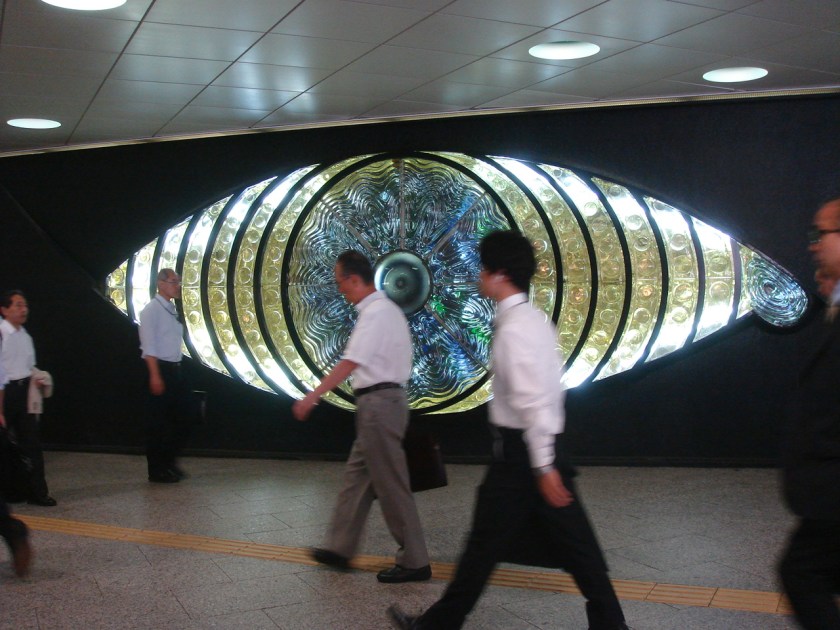
Somebody's watching you... office workers walk past an installation in Shinjuku station, Tokyo

We’ve met with several Japanese surveillance studies researchers whilst out here this time. I mentioned Ogura Toshimaru already the other day, but we also had a long meeting the week before with Hino Kimihiro, a researcher into bohan machizukuri (community security development), and government advisor on security planning. Dr Hino has been carrying out a number of research projects on both ‘designing out crime’ and on the effectiveness and public acceptability of CCTV in Japan. I hadn’t come across this research before as my contacts here were mainly in social sciences and law and Dr Hino tends to publish in urban planning journals and is not connected to other Japanese surveillance researchers. His work is very interesting and reminiscent of that of Martin Gill or Farrington and Welsh in the UK. It is a shame, that just like those researchers who have carried out analyses of CCTV for the UK Home Office, his assessments tend to be ignored by the government. Dr Hino’s latest project is to assess the trials of a new movement recognition system in Kawasaki city. I hope he can come to the January Camera Surveillance workshop at Queen’s University, Ontario, or the April Surveillance & Society conference in London (details coming soon!).

I also met today with Tajima Yasuhiko, a professor of media law in the School of Journalism at Jochi (Sophia) University in Tokyo. Professor Tajima has been one of the most important critical voices in the debate about surveillance in Japan, and has bridged the academic and activist world, being involved with legal action against juki-net and Google StreetView. We had a productive conversation about the politics of surveillance in Japan and the prospects for critical voices to be heard. He wasn’t optimistic that they would be, and neither am I after our meeting at the Prime Minister’s IT Strategic JQ the other day, however I am also convinved that in many ways Japan has not yet gown as coordinated and centralised a route on issues of security and surveillance as has the UK. There is, so far as I can see, no real attempt to link up things like juki-net or other databases and the anshin anzen (or bohan) machizukuri agenda, and i-Japan, national and local police, and wider community security agendas do not really coordinate at all. This is due to the lack of an obvious ‘threat’ like that of terrorism in the UK, around which such coordination can occur. The government half-heartedly tries to get people worried about North Korea, but really they aren’t, and ‘ageing society’, whilst a phrase used to justify almost anything (including central databases) is a worry, it does not generate the fear that comes with the war on terror.

We also considered the relative weakness of Japanese civil liberties organisations and the failure of the mainstream media to pick up on issues of privacy and surveillance. There seems to be some effort now to try to coordinate various organisations to push for an explicit constitutional protection for privacy (rather than the rather vague inclusion of such an idea in a wider notion of the ‘pursuit of happiness’), but whilst I can see that being happily accepted after the government has got its central database(s), I can’t see it being done in time to alter either this trajectory or the way in which the database(s) are built.

Private sector data loss in Japan

I’ve blogged a fair bit in the past about state and private data losses in the UK. In Japan too this has been a big problem, and is a reasons given by central government for the need to centralise databases and by opponents talking about the risk of such centralisation.

The latest major data loss, just the other day, was by the giant banking combine, Mitsubishi UFJ Nicos, which accidentally ‘threw away’ personal data on almost 200,000 customers from 1993 to 2001. Of course MUFJ Nicos say there is no security or financial risk, but then organisations in these situation always say something like that…

Not all of these data losses are accidents however. Back in April, another part of the Mitsubishi keiretsu (a Japanese term for a loosely-connected ‘family’ of companies), Mitsubishi UFJ Securities, fired one of its managers, Hideaki Kubo, who is alleged to have stolen personal data on almost one and and half million customers, and had allegedly already sold data on 49,000 to data brokers for the rather unimpressive sum of just 32,0000 Yen (around $3200 US). He is believed to have had considerable debts.

In short, it doesn’t matter how strong your firewalls are, or how good your computer security is, if there is an employee, or a government bureaucrat with access to sensitive data, who is in financial difficulty or who is simply aggrieved or greedy, then data will leak out. The risks are not small, in fact it seems almost inevitable, and I believe that the number and scale of such losses are probably significantly under-reported by both private firms and government. Of course, it is also significant just how many supposedly reputably companies are prepared to pay for stolen data. This trade is certainly not taken seriously enough by regulators in most countries…

Varieties of anti-surveillance activism in Japan

Although some progressive activists would like it to be otherwise, anti-surveillance feeling is not confined to the left, indeed in many countries, like the USA, libertarian individualist right-wing anti-surveillance activism is perhaps more common. And it seems that such a position is not unusual in Japan either.

Having returned from a weekend of hot springs, fine sake-tasting and eating way too much, today we met with the Mayor of the Suginami ward of Tokyo, Hiroshi Yamada, a prominent figure in the anti-juki-net campaign, and a also one of the leaders of a group of right-wing figures trying to promote a new nationalist grouping at that end of the Japanese political spectrum. But this new right is not at all a simple matter of ‘back to the 1930s’ that some commentators would have you believe. Yes, this group – which also includes the Mayors of major cities including Yokohama and Nagoya as well as popular journalists like Yoshiko Sakurai – has very conservative, revisionist views, on Japanese history, but in many ways they have far more in common with the new US libertarian right in their rejection of large state and high taxes, and in other areas too, for example Sakurai has rather unscientific views on climate change!

Part of the this libertarian outlook is the rejection of state intrusion into the private lives of individuals. Mayor Yamada saw the juki-net system as part of unwelcome movement towards a more top-down society, concentrating power at the centre. He was very clear that the state’s ability to collect information on the individual should be based on what the individual wanted to give up, not on what the state thought it needed (this is very much the opposite of what the Prime Minister’s IT Strategic HQ said to us last week). He was also most concerned about the risks posed by large databases, both as an attractive target to external hackers and to corrupt use from inside operators. Yamada is not opposed to what he calls IT shakai (IT society), but the use of IT should be based on what is useful to individuals, and of course what is actually he needed, he argued, would often be less expensive than the massive computerisation schemes favoured by the current administration as part of their i-Japan strategy. In this sense, he said he would oppose any move to unnecessary centralised databases and certainly to any possible national ID register or card.

In most respects, what Mayor Yamada said could probably have been said by any left-wing civil liberties activist in the UK, or by conservative right opponents of intrusive state like Conservative ex-Shadow Cabinet Minister, David Davis. Perhaps many aspects of what is felt to be wrong with surveillance society do not correlate neatly with old left-right divisions. This view was shared by Toshimaru Ogura, a Toyama University professor and major figure in left-wing anti-surveillance activism whom we met with just afterwards, along with campaigning journalist, Midori Ogasawara again. Just as the Convention on Modern Liberty event earlier in the year showed for the UK, there are many different varieties of anti-surveillance feeling in Japan, and whilst opponents may disagree with each other, and may even find other aspects of the politics of their erstwhile collaborators utterly distasteful, they do collaborate, even if it is only for short periods.

Professor Ogura’s analysis, as that of Ogasawara and indeed of Kanshi-no! whom we met the other day, is much more focused on the way in which surveillance excludes and discriminates – against union members, activists, gaikokujin (foreigners) and so on – and also the ways in which it favours the interests not just of the state but capital. We’ll be talking to groups who deal with the concerns of these excluded people in the last week we are here. Privacy is important, but Ogura’s analysis is concerned with the disproportionate effects of surveillance. It is not just that privacy is affected but that particular groups’ and individuals’ rights are damaged more than others, and those people are not generally the ‘ordinary taxpayers’ to whom Yamada and the libertarian right are trying to appeal.

Like me, Professor Ogura is also particularly interested in the way in which particular corporations and business coalitions pushing technological ‘solutions’ to social and organisational problems can have a profound influence the way government makes decisions. Such coalitions would still be there however large government was, and in some ways, without a government large enough to stand up to the private sector, a different kind of more purely market-driven surveillance society would emerge. In that sense, it is what government does, and to whom it responds, that is more important that more arbitrary questions of ‘size’.

There’s a lot more to consider here too, in particular the extent to which any of the things we consider under the umbrella of ‘surveillance’ are actually and actively part of some coordinated state (or other) plan. I’m starting to develop a sense of this here, but I will leave those thoughts to another post.

(Thank-you to Mayor Hirioshi Yamada, Professor Ogura Toshimaru and again, to Midori Ogasawara for being so generous with their valuable time).

At the IT Strategic Headquarters

Yesterday we visited the Prime Minister’s IT Senryaku Honbu (IT Strategic Headquarters). (This has actually been the only national-level government agency that has agreed to speak to us, and some of the reasons for refusal have been rather telling, not least that of Houmusho (the Ministry of Justice), which claimed that they had nothing to do with privacy and so on, which betrays a level of ignorance about the effects of their own policies that is probably more the result of bureaucratic sectionalism and literalism than anything else but is nevertheless interesting!). The IT Strategic HQ is responsible for developing the ‘i-Japan’ strategy, the latest incarnation of what has at various times been called ‘Information Society Japan’ and ‘e-Japan’ policy. They are also the agency that wrote the most recent Japanese data protection laws, which I wrote about a couple of weeks ago.

We were treated to a prepared presentation on the latest incarnation of the i-Japan strategy, in which the ‘i’ seems to stand for ‘inclusion’ and ‘innovation’ but not apparently for ‘interactive’, which one might expect from its use elsewhere in computing. However it was the brief interview we had afterwards that was more enlightening.

In short, the government has acknowledged that what they originally wanted out of juki-net has failed due to opposition, despite the supreme court victory that ruled that the current cut-down version was constitutional. However, as Kanshi-no! argued, they are not going to back down that easily. The movement towards the creation of centralised government databases will continue, and there most likely will eventually be a fully configured identification system (and card) and rather alarmingly, the new i-Japan strategy makes it quite clear that laws that currently prevent this from happening will simply be changed or removed. They do not want opposition groups, nor indeed the current global recession, to be able to hold up or change these plans.

However the main thrust of development of centralised databases has shifted away from juki-net and the jyuminhyo (residents’ registration) system, towards national insurance, health and pensions. This is, as the agency than runs juki-net, Lasdec, suggested to us – and I am now beginning to think that this suggestion was rather more of a loaded hint than I had first thought – by far the most data-rich area of government records and therefore in many ways more suitable for being the basis of an architecture of central registration and identification. The database that the government intends to create in this area will also have the possibility for citizens to add in (voluntarily, they say), information from private sources, such as bank account and other financial details. Of course this could be more ‘convenient’ in terms of benefits and taxes, but it also puts an enormous amount of previously private data in the government’s hands and presents a huge temptation to identity fraud and theft from both outside and, more importantly inside the state bureaucracy (and let’s not forget, most identity fraud is an inside job).

It gets more worrying still as despite the advanced stage of these plans, the government has apparently still not decided exactly who will have access to this database, and the police in particular, as well as private insurance companies, are still considered as potential users. It seems that although the IT Strategic HQ might have developed data protection in Japan but they do not appear to understand its principles of necessity, proportionality and consent – indeed I asked them about these principles and they really had no serious reply. Instead they claimed that people in Japan wanted to have these central databases because the current fragmented system had led to poor security and data losses, and in any case, ageing society and the pensions crisis meant this had to be done. I have noticed that in Japan, ‘ageing society’ like ‘terrorism’ in the UK, seems to have become the spectre evoked to silence potential criticism.

There are many other issues too: the government is also trying to introduce a voluntary system of Electronic Health Records (EHR), but this is not as developed as the Connecting for Health centralised database that is still experiencing significant problems in its introduction in the UK; and there are some rather less controversial social inclusion measures included the provision of computers for schools and so on. However my overall impression after leaving the IT Strategic HQ was of a government that was determined to press ahead with centralised collection and control of personal information regardless of the views of citizens or of whether it is really necessary even to achieve the policy aims they have. And this won’t change as the result of a change in government either. If, as seems likely, the Liberal Democratic Party (LDP or Jyuminshuto) are voted out, the Democratic Party of Japan (DPJ or Minshuto) which will succeed them, has already said that it will create a central database.

(Thank-you to the officials of the IT Strategic Headquarters for their time).

The new Japanese ‘jury’ system

The Guardian Comment is Free site asked me to do a (very quick) comment piece on the new Japanese ‘jury’ system and it’s now online here. I had to cut my original down to around 600 words and they edited it a little more to fit, and added an awful photo (where on earth they got it I am not quite sure…). Here’s the full version…

Disorder in the Court

Japan’s courts are not usually the subject of massive popular interest in the country. Salacious details of criminal cases fill the pages of the popular weekly magazines and provide fodder for cheap TV shows, but the court system itself is seen as distant, formal and, above all, dull.

The courts have long been seen as a a rubber-stamping exercise for cases already decided by confession in police cells. Japan’s 95% confession rate has been attributed to a cultural sense of shame, or to the thorough and minutely detailed dossiers of public prosecutors, but according to Amnesty International, the psychological pressure of up to 23 days of isolation and constant questioning (not to mention intimidation and physical violence) might provide a better explanation. In recent years, the issue of coerced confessions has been increasingly recognised in Japan, and the most recent example was the freeing in June this year of Toshikazu Sugaya, a man who DNA evidence has now shown could not have been guilty of the killing of a 4-year old girl, a crime that he confessed to in police cells and of which he was consequently convicted of in 1990.

Added to this is a growing feeling that the courts were too remote from people. So in 2004, a new law was passed to introduce a new method of adjudication for some criminal trials beginning in May 2009. Now the first trial using this new system, a case of murder involving elderly neighbours, has just started in Tokyo. Some have characterised this saiban-in as a ‘jury’ system, but it is actually a ‘lay-judge’ system. Whereas in the UK, twelve ordinary people are called by the courts to hear evidence and make a judgement on the guilt of the accused, in the new Japanese system six citizens join three professional judges. They not only hear evidence, but are also able to question witnesses and help decide the sentence. Verdicts are majority decisions but have to include at least one of the professional judges.

It seems an onerous task. So it is not surprising that many who were originally short-listed for lay-judge duty but did not make the final six for the first trial, are relieved to have escaped not because, as is so common in the UK, they found it inconvenient, but because of the burden of responsibility they felt. This has particular cultural components. Strongly-stated opinions and absolutes are not favoured in Japan, and people like to keep options open. The selection process itself was remarkably complex and involved summoning an initial 100 candidates, some of which were excused on grounds of infirmity or age, and more were then deselected after detailed questioning on their views and attitudes. Even court officials are now admitting that they may have overdone it.

But why this particular, strange, hybrid system? The answer is that it had form. Japan had an almost identical system from 1928 to 1943. During the Taisho period that saw a brief flowering of a more democratic culture in Japan, progressives had tried to introduce a full Anglo-American style twelve-person jury, however, judges, and conservative and nationalist politicians opposed this initiative and forced a compromise: the saiban-in system.However according to research by Takashi Maruta, the lay-judges still actually challenged the professional judges in many serious cases refusing to accept the confession and dossiers of evidence and preferring to rely on oral testimony of the accused and witnesses in court. Even in its compromised form such a volatile system offended traditionalist judges (who like many state representatives saw their power as deriving from the Emperor and therefore ultimately, divine sources), lawyers and was hardly suited to the militarist regime that gained control in the 1930s, and was eventually stopped.

But opposition seems rather different this time around. In the UK, civil libertarians have been fighting to defend jury systems, but in Japan civil liberties arguments have been marshalled by protestors against the new system. Opponents argue that the selection process violates privacy by forcing citizens’ personal views to be exposed, and is also authoritarian because citizens cannot refuse to serve unless they have health reasons. Some have even likened the system to a lynch-mob, because of course Japan still uses the death penalty.

However dig deeper, and underlying these arguments are reactionary and conservative concerns and the once-again rising influence of nationalists, in other words very similar conditions to those of the late 1920s: defence of the ‘professionalism’ of judges, and the arguments about the quasi-sacred integrity and necessary distance of courts from popular influence. More generally though, even though this system is the result of a bill passed five years ago, it seems part of an air of populist desperation from the increasingly unpopular ruling Liberal Democratic Party that faces defeat for the first time in decades in the general election at the end of this month.

However, if nothing else, the controversy over the system has excited Japanese people about the court system, and not just in bloody tales of murder and mayhem, and whatever happens in the future, any disorder in the court that results in interest and engagement in criminal justice has to be a good thing.

Why Japan is a surveillance society

We met yesterday with member of the Campaign Against Surveillance Society (AKA Kanshi-No!) a small but active organisation formed in in 2002 in response to the Japanese government’s jyuminkihondaichou network system (Residents’ Registry Network System, or juki-net). plans and the simultaneous introduction of police video surveillance cameras in Kabukicho in Tokyo. We had a long and detailed discussion which would be impossible to reproduce in full here, but I did get much more of a sense of what in particular is seen as objectionable about past and current Japanese government actions in this area.

The main thrust of the argument was to do with the top-down imposition of new forms of control on Japanese society. This they argued was the product of the longtime ruling Liberal Democratic Party’s neo-liberal turn and has thus been some time in the making. It is not a post-9/11 phenomenon, although they were also clear that the G-8 summit held in Hokkaido in 2008 used many of the same forms of ‘community action’ in the name of preventing terrorism as are used in the name of anzen anshin (safety) or bohan (security) from crime in Japanese cities everyday.

However, they argued that this might be a product of neo-liberalism, but the forms of community security were drawn from or influenced by a much older style of governance, that of the Edo-period mutual surveillance and control of the goningumi (five family groups). (this is actually remarkably similar to the argument that I, David Lyon and Kiyoshi Abe made in our paper in Urban Studies in 2007!). Thus the mini-patoka and wan-wan patrol initiatives in Arakawa-ku were seen as as much a part of an imposed state ordering process as the more obviously externally-derived CCTV-based form of urban governance going on in Shunjuku.

Underlying all this was the creation of an infrastructure for the surveillance society, juki-net. They were certainly aware of the way that juki-net had been limited from the original plans, and indeed they regarded these limits as being the major success of the popular campaign against the system, however they argued that the 11-digit unique number now assigned to every citizen was the most important element of the plans and this remained and could therefore serve as the foundation for future expansion and linking of government databases. They pointed to the way that the passport system had already been connected.

Kanshi-no! were also concerned, in this context, about the development of plans for experimental facial recognition systems to be used in Tokyo (at a location as yet unrevealed). This would imply the development of a national database of facial images, and a further extension of the personal information held by central government on individuals.

So was this all in the name of puraibashi (privacy) or some wider social concerns of something else? Certainly, privacy was mentioned, but not as much as one would expect in an interview with a British activist group on the same issues. I asked in particular about the decline of trust and community. The argument here was that community and any lingering sense of social trust had already been destroyed and that CCTV cameras and other surveillance measures were not responsible in themselves. However, from an outside perspective it does seem that there is more of a sense of social assurance and community, even in Tokyo than there is in the UK. I do wonder sometimes when people (from any country) refer back to some time when some idealised ‘trust’ or ‘community’ existed, when exactly it was! Rather than a  particular time, it seems to be a current that either asserts itself or is suppressed of co-opted into the aims of more powerful concerns in particular times and places.

I asked at one point what immediate change or new laws Kashi-no! would want, and the answer was quite simple: no new laws, just for the state to respect the constitution which they said already made both CCTV cameras and juki-net illegal (although of course the Supreme Court recently disagreed).

(Thank-you to the two members of Kanshi-no! for their time and patience with my questions)

CCTV and urban regeneration in Nippori

The link between urban regeneration or redevelopment and the introduction of video surveillance has been well documented by many different authors in Britain, in particularly Roy Coleman in Reclaiming the Streets. It seems that the link is strong in Tokyo too. This new CCTV scheme in the front of Nippori railway station in Arakawa-ku is not only clearly part of the social and spatial restructuring of this area, it is an essential part of the new image, with the new entranceway celebrating the security cameras as much as the area’s name. This is the area we were told by Shinjuku officials had only three cameras, whereas in fact it has the princely total of ten! In retrospect the Shinjuku people seemed to be rather condescending towards Arakawa-ku.

Planning and protest in central Tokyo

Tokyo is a constantly changing stew of styles and forms, but don’t be fooled into thinking this is just ‘organic’ change. The capital of Japan is a playground for capital, local and global, and there isn’t much in the way of planning law or practice to stop the developers doing exactly what they want. It’s worth reading Andre Sorensen’s The Making of Urban Japan for a good account in English of why this is.

Inasmuch as the traditional morphology of machi (neighbourhoods) survive, it is largely due to either the unfashionable character of the area putting off developers, temporary lulls in the property market, or the sheer stubbornness of residents in refusing to being intimidated into selling land or putting up with the serial replication of blocks of manshon (typical 5+ storey apartment complexes). Strong property rights and small traditional plots do at least mean that it is more difficult to put together the land in what is called tochi kukaku seiri (land readjusment) to make really large developments which, as a result, tends to be restricted to whole sites that come on the market through things like the privatisation of Japan Railways (although some private developers like Mori Building Co. have managed private massive land readjustment projects like Roppongi Hills that I have researched on previous visits).

Of course the building regulations that do exist tend to favour development too, as they regard any old building as inherently unsafe (because of susceptibility to fire and earthquake) and it is thus very difficult, for example, to get traditional wooden houses repaired let alone new ones built. In addition, since the Edo period regulations have sought to open fire-breaks in the urban structure and increase the width of roads and alleyways – and again, the traditional and wonderfully characterful narrow roji (lanes) are very difficult to maintain as any new building has to be set back to newer road standards. This in turn tends to make the backstreets more accessible to faster-moving traffic and thus gradually dehuamanize and desocialize these places.

So communities have a lot to contend with and, despite the 196os environmental movements and machizukuri (community development) and the 1980s craze for ‘amenity’ (which included the promulgation of a ‘sunlight ordinance’ that was supposed to stop the construction of taller buildings that would block out the sun from neighbouring plots), the developers continue to try to squeeze in unwanted and inappropriately massive structures wherever they can.

We came across this small example of a local neighbourhood campaign to stop a new manshon being built at the edge of the historic (but much damaged) Yanaka district. It might not loo very exciting but you add these developments up all over the city and it goes a long way to explaining why Tokyo is gradually losing the remaining historic and social character that makes it a surprisingly human place to live, despite its size…

At the Tokyo Metropolitan Police HQ

The Tokyo Metropolitan Police HQ in Chiyoda-ku

We had an enlightening interview, which will give me much to analyse later, with three senior officers from the Seikatsu Anzen Bu (literally, ‘Everyday Life Safety Division’) of the Keisicho (Tokyo Metropolitan Police). Interestingly, this division that was created as a result of the Seikatsu Anzen Jourei (Governor Ishihara’s 2003 Tokyo Metropolitan Government ordinance) and which deals with all the community security and safety initiatives, including CCTV, is separate from the Chiki Bu (the community division) that is responsible for the koban neighbourhood police box system.

Like almost everyone in authority we have met here, the police were convinced that they were not doing surveillance in using the cameras. They also confirmed that almost all of the CCTV systems operated by shoutenkai (shopkeepers’ associations) are not monitored and are simply recorded. They also stressed their deep concern for privacy and the rights of citizens and said that data from the police-operated cameras – of which there are around 150 in Shinjuku (the largest system with 50 cameras in the Kabukicho entertainment district), Shibuya, Ikebukuro, Roppongi and Ueno – was only kept for 7 days unless there was a specific reason to retain it. This is a legal requirement not just a police guideline. The police cameras are monitored both in local stations and in a central control room, but we were told that it was strictly forbidden for us to visit (unlike every other city in which I have done research) as everyone who enters has to be pre-enrolled in the police iris-scan security database.

We talked a lot about the history of the development of CCTV and of community safety initiatives in Tokyo, and Governor Ishihara’s absolutely central role in backing video surveillance became very clear (it’s a shame he has so far refused an interview with us!). What was also particularly interesting was that the police themselves did not think that apparently obvious ‘trigger events’ were as important as it might seem. For example, they claim that the police only really began considering the use of CCTV cameras not after the Aum Shinrikyo sarin gas attacks on the Tokyo underground but because of the influence of G8 summit security. One officer specifically mentioned the Gleneagles summit (which was just starting when terrorists attacked the London transport system), but this was in 2005, well after the TMG had already introduced CCTV, and after which the Tokyo police have not introduced a lot more cameras. So I don’t quite understand their point. It may become clearer once I have the complete transcripts… They also claimed that it was the Tokyo police rather than Japan Railways themselves or the Tokyo Metro authority who insisted on installing CCTV in the Tokyo transport network after the Aum attacks.

The officers talked a lot about community involvement. They dismissed the objections to their public space CCTV systems for several reasons, not least as I have already mentioned that they were not doing ‘surveillance’, but more importantly because they claimed to have done extensive consultation with local community groups, businesses etc. The claimed that they could not do anything without this support. This may have been true for Kabukicho, which was undoubtedly afflicted by an influx of Chinese gangs in the 1990s, but we heard from the local government of another ward that is being lined up for one of the new volunteer-based child safety camera systems being introduced from 2010 that they were given no choice by the police, and that local people were not happy about it. The problem is that this local authority don’t want to be interviewed further about this as they are in a rather delicate position over this new system.

(Thank-you very much to the officers from the Seikatsu Anzen Bu for giving us their time)

Death of the dojunkai apartments

As I mentioned the other day, after the Kanto daishinsai (Great Kanto Earthquake) of 1923, there were many changes to planning and architecture in Tokyo, in particular a series of experiments with introducing western-style elements into the city, including wider streets to accommodate trams (streetcars), and new concrete mass housing influenced by the modern movement.

Dojunkai, a special organisation under the Interior Ministry, was set to provide such things. Between 1924 and 1936, this agency built 16 apartment blocks out of ferroconcrete and wood in Tokyo and Yokohama. The best known were those in Daikanyama (near Shibuya) and on Omotesando Avenue in Aoyama. The latter were controversially demolished in 2003 by the Mori Building Company Ltd to make way for their soulless Omotesando Hills shopping complex.

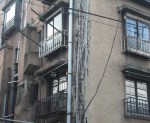
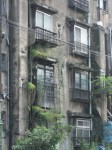
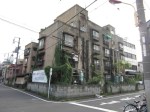
Much less celebrated however, were the Dojunkai appartments in Nippori (not Minowa as most people seem to think) in Aarakawa-ku, just round the corner from where I am staying. They’ve been empty and crumbling for a while, but now the writing is very literally on the wall, saying that they will be demolished too. It’s a sad moment: another episode in the slow death of the utopian urban ideal of the Twentieth Century. It’s also a reflection of the very high land prices in Tokyo and relative lack of value in what is on the land at any time (see this article for a good summary of the difficulty of any architectural preservation in Tokyo).

Anyway, not only are they valuable historical buildings, they are also degenerating rather stylishly so, at the very least, I thought I should get in and take some pictures before it was too late. So I did – much to the surprise of a crew of local authority workers who were surveying the place as I came out. Here are some of the shots. I didn’t (yet) go into any of the indvidual apartments – all those I tried were locked and some chained too – though I might try to in the early morning this week before anyone is around.