Community Safety in Arakawa

Far from the skyscrapers and bright lights of Shinjuku, where we had our last interview on community security and safety development (anzen anshin machizukuri), Arakawa-ku is a defiantly shitamachi (‘low-town’ or working class) area to the north-east of Tokyo just north of Ueno and outside the Yamanote-sen JR railway loop line that has for much of the last 40 years defined the boundaries of the richer parts of the city.

Bordering the Ara river and split by the Sumida river, it was traditionally a marshy place liable to flooding. It was also a place with a large buraku (outcaste) population and Minowa (in the north of the ward) contains the mournful Jokan-ji (or Nagekomi – ‘thrown-away’) temple, where prostitutes who died in the Yoshiwara pleasure district were cremated. The place has been hit hard by disaster. It was levelled twice in the the Twentieth Century, first by 1923 Kanto daishinsai (Great Kanto Earthquake) and then again by the firebombing in the last years of WW2.

Nevertheless, its rough, industrious, hardworking spirit has continued, and these days, despite the march of secure manshon (high-rise housing) down the post-war avenues, it remains a place full of small industrial units, especially recycling businesses and clothing wholesalers and manufacturers in Nippori, small bars and family restaurants, and lots of ordinary housing, even some of the last remaining dojunkai (early concrete public housing) constructed after the earthquake. It’s also the starting point of the last remaining tramway (streetcar line) in Tokyo, the Toden Arakawa-sen. I like it a lot and it’s where my wife and I have lived in Tokyo in the past, and where we still stay when we return (there will be more pictures in a later post).

It was natural then to turn our attention to the place as a case-study area, mainly because it is so different from Shinjuku and the other areas that have gained so much attention from the Tokyo Metropolitan Government’s recent initiatives. We met with three officials from the Community Safety section of the local administration: the boss and two guys who had been seconded from the city police and the fire service respectively. The boss was full of enthusiasm for the direction that Arakawa-ku has taken, which although they don’t use the term ‘machizukuri‘ is far more about real community involvement than some places that do.

The HQ of Arakawa community safety

Arakawa has no comprehensive CCTV strategy, although the police do consult with the developers of large new buildings on its installation. That’s not to say that they don’t have a certain degree of ‘CCTV envy’ of those places with the latest high-tech gadgets that Arakawa can’t afford, but they are not dazed by the glamour of cameras and are realistic about both the limitations of CCTV and the appropriateness of such systems for their city. Instead they concentrate on using and enhancing the natural surveillance capacities of the local communities. They make a great deal of use of volunteers, retired police officers and ordinary local people, who do their own patrols, including the delightful wan-wan (‘woof-woof’) patrol which, judging from the posters, involves mainly older female residents and very small dogs! Participation in the various community initiatives is encouraged through the use of techniques like professional rakugo (traditional comic monologue) performances in schools and community centres. They also run community patrols in miniature versions of police patoka (patrol cars), which not only look more friendly but unlike the US-style police cars can get through much narrower streets.

The cute community patrol cars

However these diverse community projects are being stitched together in quite an innovative way, with the use of small anzen anshin sutashion (security and safety stations), which are a bit like community versions of the police koban, the miniature two-person police boxes which dot the city. Indeed the officials referred to them as minkan koban (‘people’s koban’). These small help stations, staffed mainly by ex-police don’t just provide ‘security’ information, they also deal with social security in the broader sense, offering help for older people with benefits, for example. In almost all cases, they have replaced koban that were closed by the police. So one could argue that this is essentially the local authority being forced to pick up the bill for services that used to be provided by the police and at the same time is actually losing real police service. However, the strategy overall is a valiant attempt to make ‘community safety’ less an issue of exclusionary security and more one of inclusivity and community development, more a natural and intimate part of everyday life that does not involve new forms of external control.

Of course, crime isn’t really a massive issue here anyway. Arakawa has consistently had the second or third lowest crime rates of all the 23 Tokyo wards. But even since the introduction of these initiatives, crime has fallen still further from the relative high point it reached a few years ago. And hardly a CCTV camera in sight…

Tokyo Brandscaping and the SuiPo system

Brandscaping is a term used in marketing to describe the metaphorical landscape of brands (either for a particular brand, company or sector), however it is also being used by some researchers, including me, to describe the way in which brands are being infiltrated into urban landscapes, with the ultimate aim of being ‘inhabitable’ perhaps even 24/7 (see for example Disney’s move into urban development with Celebration in Florida).

Contemporary brandscaping makes use of new ambient intelligence, pervasive or ubiquitous computing technologies (‘ubicomp’) and ubiquitous wireless communications to create a landscape in which the consumer is targeted with specific messages directing them to certain consumption patterns. Such communication cans of course be two-way and provide corporations with valuable and very personal data on consumption patterns. As I’ve argued in many presentations over the last few years, ubicomp is necessarily also ubiquitous surveillance (what I call ‘ubisurv’ – hence the name of this blog!) because to work it requires locatability and addressability. Japan, and Tokyo in particular, has been the site for a number of cutting edge experiments in this regard, including the ‘Tokyo Ubiquitous Technology Project’ which embedded 1000 RFID tags which can communicate with RFID-enabled keitai (mobile phones) in upscale Ginza as well as several other pilot schemes around Ueno Park and Shinjuku.

TUTP is not all about marketing surveillance however, part of the scheme has involved ‘Universal Design’ (UD) principles, with one experiment to embed chips in the yellow tactile tiles designed to help guide sight- and mobility-impaired people around the city so that useful access information could be passed through specially-enabled walking sticks. I’m very interested in such experiments as they indicate an alternative direction for ubicomp environments which are about genuinely enabling people who are currently disabled by social and architectural norms, and creating a richer sensory landscape. They show that both surveillance and ‘scary’ technology like RFID chips can be humanised.

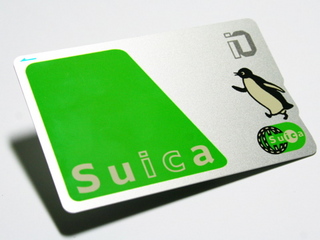
Unfortunately in our consumer-capitalist world (and Tokyo is the exemplary city of hyper-consumption), marketing and building brandscapes tends to take priority over enabling the excluded and the disadvantaged. But there are different ways of doing this too, which can be more or less intrusive and consensual. The other day I was talking about the growth in functionality of the Suica smart travel card system. Suica-enabled keitai can now, be used buying all sorts of things and since 2006 there have been a growing number of ‘SuiPo’ (short for ‘Suica Poster’) sites, Suica-enabled advertising hoardings that will, on demand send information to your mobile e-mail address with on particular advertising in which you are interested if you pass your Suica card or phone over a scanner placed next to the poster (see photos below)

The difference between SuiPo and the Ginza RFID scheme however is that it with SuiPo is that it is the consumer who makes the choice whether to activate any particular poster’s additional information system. In this sense it is a development of the i-Mode system in which many keitai can read information from special barcodes embdedded in magazine advertisements. It doesn’t automatically call your phone every time you pass an enabled poster, once you have signed up. Not as high-tech but slightly more consensual. However this will, of course, lead to the accumulation of a lot of data on consumption interests. This potentially generates a massive consumer surveillance tool, because it can be linked up travel patterns (your registered Suica card sends information back on where you go – I was wrong about the absolute differences between London’s Oyster and Tokyo’s Suica systems the other day) and information about consumption.

So will this potential become reality? The page on privacy and data protection on the SuiPo website (as usual the link is hidden away at the bottom of the front page!), is pretty standard stuff except for the legitimate purposes for which the data can be used once you sign up. They are, for those who don’t read Japanese, for:

  1. Sending the specific requested information to you;
  2. Improving services;
  3. Data processing and analysis;
  4. JR East’s promotional marketing; and
  5. JR East customer questionnaires.

Purposes 2 and 3 pretty much allow JR to do anything it likes with the data once you have signed up, and there is no statement as to what can or cannot be done with data once it has been ‘mined’ – analysed and transformed into more useful to the company or other organisations (corporate or state) which might want to buy or access such knowledge. ‘Ubisurv’ indeed…

A juki-net footnote

I had a conversation yesterday (not a formal interview) with Midori Ogasawara, a freelance journalist and writer who used to report on privacy issues for the Asahi Shimbun newspaper. This was mainly to set up further interviews with those who are or were involved with campaigns on surveillance and privacy issues in Tokyo. However I also managed to clarify a few of my own questions about juki-net and the opposition which it attracted.

In short, there seem to have been several objections.

  1. First of all was the objection to the idea of a centralised database, which was able to link between other previously separate databases.
  2. Secondly, there was the fact that this was the national state asserting authority over both local government and citizens. Both Local Authorities and citizens groups had argued for ‘opt-in’ systems, whereby firstly, towns could adopt their own policies towards juki-net, and secondly and more fundamentally, individual citizens could decide whether they wanted their details to be shared.
  3. The third objection was to there being a register of addresses at all. Many people saw this simply as an unnecessary intrusion onto their private lives, and in any case, the administration of welfare, education and benefits worked perfectly well before this (from their point of view) so why was such a new uniform system introduced?
  4. Next there were objections based on what was being networked. The jyuminhyo (see my summary from the other day) is not actually a simple list of individuals and where they live, but is a household registry. It might not, like the koseki, place the individual in a family line, but is still a system based on patriarchal assumptions, with a designated ‘head’ of the household, and ‘dependents’ including wives and even adult children.
  5. Finally, there was the question of the construction of an identification infrastructure. Whether or not juki-net is considered as an identification system, and it does have a unique identifying number for each citizen, and has the potential to be built on to create exactly such a comprehensive system of national identification. Lasdec, who we talked to the other day, may not approve of this, or believe it will happen, but they are only technicians, they are not policymakers and don’t have the power or the access to know or decide such matters. And in the end, if they are required by law to run an ID system then they will have to run it.
  6. There were, as I already mentioned, objections to the potential loss or illicit sharing of personal information. I don’t think this is intrinsic to juki-net, or indeed to database systems, but of course both databases and networks make such things easier. People are also quite cynical about promises of secure systems. Lasdec may say that that juki-net is secure, but there have been enough incidences of government data leaks in the past for people not to accept such assertions.
  7. Finally, Juki-net connects to the border, passport and visa system. The reason that foreigners will finally be included on the jyuminhyo (and therefore juki-net) from 2012 is not therefore to respond to long-term foreign residents’ requests for equal treatment but in fact to make it even easier to sort out and find gaikokujin, check their status, and deal with unofficial and illegal migrants. Groups campaigning for the rights of foreign workers (mainly the exploited South-East Asian and Brazilian factory workers) have therefore been very much involved. Of course it also makes it possible to connect the overseas travel of Japanese people to a central address registry.

I’ll be meeting Midori again soon, I hope, along with other researchers and objectors. I am also still hoping to be able to talk to officials from the Homusho (Ministry of Justice) and the Somusho (Ministry of Public Management, Home Affairs, Posts & Telecommunications), but they are are currently passing around my request to different offices and generally delaying things in the best bureaucratic traditions!

Identification in Japan (Part 2): Juki-net

As I mentioned yesterday, one of the big developments in state information systems in Japan in recent years has been the development of the jyuminkihondaichou network system (Residents’ Registry Network System, or juki-net). Very basically juki-net is a way of connecting together the 1700 (recently restructured from 3300) local authorities’ residents’ registries (jyuminhyo). These are a record of who lives in the area and where, that are held on a multiplicity of different local computer (and even still, paper) databases. Japanese government services are always struggling to catch up with massive and swift social changes, particularly the increased mobility of people, that made first the Meiji-era koseki (family registers) and then the disconnected local jyuminhyo (which were both themselves introduced to deal with earlier waves of increased social and spatial mobility) inadequate.

Operational from 2002, juki-net is restricted by law to only transmitting four pieces of personal data (name, sex, date-of-birth and address), plus a randomly-generated 11-digit unique number. Nevertheless, the system was strongly opposed and has sparked multiple legal challenges from residents’ groups who did not want to be on the system at all, and who considered the risk of data leakage or privacy violation to be too great for the system to be lawful. These challenges were combined together into one class-action suit, which finally failed at the highest level, the Supreme Court, in March 2008. The court ruled that juki-net was constitutional and there was no serious security risk in the system itself but according to some analysts did not address the possibility of mistakes being made by operatives. But this would seem to me to be a problem of data protection in general in Japan, rather than an issues that is specific to juki-net. Like Brazil, but unlike Canada and the UK for example, Japan has no independent watchdog agency or commissioner for safeguarding privacy or kojin deta (personal data), and other than internal procedures, the courts are the citizen’s only recourse. In any case, as Britain’s comparatively frequent incidence of data loss by public authorities shows, even having such a system does not necessarily make for better practice. There is in Japan, as in Britain, training and advice in data protection provided by a specialist government information systems agency.

We interviewed officials at that government agency, Lasdec (the Local Authorities Systems Development Centre) today. Lasdec also developed and runs juki-net and is responsible for the new jyuminhyo / juki-net card that enables easy access to local (and some national) services via the web or ATM-like machines at local government offices. Unsurprisingly they were quite bemused by the opposition to juki-net, which they say was based on a lack of understanding amongst citizens about what it was, and a general fear of computers and databases. They argued that many people (including one or two local authorities) had the impression juki-net was, or was planned to be, an extensive database of all personal information held by different parts of the government, or even was the basis for a new system of national identification or indeed was a new system of national identification – indeed that was the impression one got from reading both Japanese and foreign civil and cyber-liberties groups’ reports in 2002/2003 with plenty of stories of the new Japanese ‘Big Brother’ system (see the archived collection here for example).

However Lasdec argued that both ideas were incorrect. The officials recognised both that the 11-digit unique number was adapted from a previous failed identification scheme, and that juki-net could in theory become the basis for any proposed future national ID scheme, but this was prevented by the enabling law. In any case juki-net was not even the best existing system on which to base an ID system: passport, driving licence and healthcare databases all had more information and certainly information with higher levels of personal identifiability – and no-one seems to be objecting the amount of information contained on the driving licence system, for example. Juki-net has no photos or other biometric data and no historical information. Likewise the residents’ card can have a photo if the resident wishes, but this is not shared through juki-net, and in fact the card itself is entirely voluntary. In addition, only in one city has take-up of the card exceeded more than 50% of the adult population (Lasdec has detailed information on take-up but only published a ‘league table’ without percentages). You also do not lose anything by chosing not to have or use the card.

The officials at Lasdec were, as with many technical and systems engineers in both public and private sectors whom I have interviewed, far more aware of privacy, data protection and surveillance issues than most politicians and mainstream (non-technical) government officials. They did not shy away from the terms kanshi (surveillance) or kanshi shakai (surveillance society) and indeed were as critical of the unregulated spread of things like CCTV in public space as many activists. They saw themselves in fact as controllers of information flow as much as facilitators. They were committed to the minimalist model of information-sharing set out by the law governing juki-net and wanted to find always the ways that information that was necessary to be shared could be shared without the creation of central databases or the exchange of additional unnecessary information. In addition, new laws came into force (in 2006), which make the residential information more private than it was before. In fact, such local registers used to be entirely public (anyone could access them), and now they are far more restricted – this only seems to have been noticed by direct marketing firms, who of course were not 100% happy with this change.

This puts me into a strange position. I have colleagues here who have been utterly opposed to juki-net, and I have always assumed that it was in some way similar or equivalent to the UK National Identity Register / ID card scheme. However in fact, it seems very similar to the ‘information clearing house’ idea which I and others have proposed for the UK, in opposition to the enormous NIR which would seem to suck in every kind of state-held information on the citizen! In addition juki-net does not require any more information from the Japanese citizen than is already held by the state, again unlike the NIR in the UK, for which multiple new forms of information are being requested by the state and indeed there are fines, and ultimately prison sentences, proposed by law for refusal to give up or update such information. In contrast, juki-net is more like the electoral register in the UK, to which hardly anyone objects.

This all makes me wonder exactly what it is that provoked such vociferous opposition to juki-net. If it is a actually or potentially repressive surveillance system, somewhat like Barthes’ famous description of Tokyo, it is one with an empty centre; there is no ‘Big Brother’ only a rather well-meaning set of bespectacled technicians who are just trying, as they see it, to make things work better so that people don’t have to keep proving who they are every time they move to a new area. Perhaps there are particular cultural and political factors (that is after all the working hypothesis of this entire project – and perhaps in making assumptions about both systems and oppositions across borders we obscure the specifics). Perhaps it is the association of the 11-digit number with previous proposed ID schemes. Perhaps, as in Germany, in new government information systems, there are resonances with older systems of identification and control that hark back to more repressive, fascist, times. Or perhaps there is a general cynicism of successive government ‘information society’ / ‘e-Japan’ / ‘i-Japan’ strategies and initiatives, each of which promise empowerment and in practice deliver more bureaucracy. These are some questions I need to explore further with other officials academics and activists.

Identification in Japan (Part 1)

Just as I did in Brazil, I am going to be looking a little at the way in which systems of government information and identification work in Japan.

One of the immediately obvious things is that Japan has no national system of ID cards. Instead, as in the UK, the Driving Licence is used as a de-facto ID. The Japanese Driving License until recently was rather like that in Brazil, in that it connected to individual strongly to the family though carrying the honseki, the address where the koseki (family registration) was registered. However, this section can now be left blank and may be removed altogether in the future. The current driving license has a photo but no other biometric data, and whilst being a plastic card with a credit card form factor, is not any kind of smart card. There’s a really nice photo-essay on the process of obtaining a Japanese driving license on super-otaku, Danny Choo’s site.

The koseki is a very traditional way of registering people based on their family’s place of origin or residency and can often stretch back many generations with details of parents, grandparents etc. The individual is no more than one name on this register. The koseki is simply a computer record these days, although paper print-outs are used in more formal identification procedures, but very few people carry a copy of their koseki around with them.

In addition to the koseki, there is a jyuminhyou (Residents’ Register), a current address register, which every local authority keeps. As with the koseki, there was an associated old paper certificate for many years. In 1999, the old Resident Registration Law was updated and came into effect in 2002 and this included a provision to introduce a voluntary Resident Registration Card. This is a smart card, and is supposed to make access to local services easier, though some see it as a precursor to a full national ID-card scheme, especially as from 2004 the card could also be used to do other things online, like tax-returns. The suspicions are also because of the way in which the card as introduced along with a new system for connecting up all the local authority residents’ registry systems in Japan, juki-net. I’ll write more about this tomorrow as we are going to talk to the official responsible for the implementation of the card and juki-net at Lasdec, the Local Authorities Systems Development Center.* On Friday afternoon, I will also be meeting up with Ogasawara Midori, a freelance journalist who specialized in covering the juki-net controversy and is also a former student of my future boss, Professor David Lyon.

There is of course an exception to the lack of national ID. Foreign residents often get very upset that they are forced to carry the gaikokujin touroku shoumeisho (Certificate of Alien Registration). This is seen as discriminatory and it is particularly so in the case of families who are identified by the state as ‘Korean’ or ‘Chinese’, whose increasingly distant ancestors came from those countries. The gaikokujin touroku shoumeisho was also particularly controversial as it included fingerprinting requirements for Koreans and Chinese that were seen as a product of the colonial period, but which were only removed in 1999. But then, following on from reactions to 9/11, and G8 plans for standardized biometric passports and visas, they were reintroduced in 2007 along with fingerprinting and facial photographs of all foreigners at the border. In one small progressive step however, permanent Korean and Chinese residents would not have the ‘colonial stigma’ reintroduced.

Foreigners are also not included on the jyuminhyou except at the discretion of local officials, although indications are that they will be included from 2012 when the system in further rationalised, although it is probably down to the campaigns for change from naturalised and long-term foreign residents like Ardudou Debito.

*Although as I am also going ‘out on the town’ with an important figure in Shinjuku urban planning (and regular in the Golden Gai stand-up bar neighbourhood), I might not get round to writing this sequel up until Friday morning.

Resident Registration Card

Mega-events, Security and Surveillance

The connection between what are often called ‘mega-events’ (international summits, major sporting competitions etc.), securitization, and he intensification of surveillance is becoming a very interesting area and one which we wrote about in our recent book on urban resilience. I am writing some further stuff on this with Kiyoshi Abe on how mega-events have been managed in Japan.

It seems that in general, such events are either used as ‘test-beds’ for new technologies and procedures which are then either continued afterwards (as with The Olympic Games and CCTV in Greece in 2004 and The FIFA World Cup and video surveillance in Japan/Korea in 2002), or become ‘islands’ of temporary exemption where normal legal human rights protections are reduced or removed and whole areas of public space are often literally, fenced off (as in Rio de Janeiro for the Pan-American Games of 2007, whose model will apparently be extended to include walling off the poor favelas in time for the 2014 FIFA World Cup). There’s going to be a very interesting conference on The Surveillance Games later this year to tie in with the Vancouver Winter Olympics.

Now The Guardian newspaper is reporting that the London Olympics 2012 may make use of a proposal originally designed to stop the proliferation of unofficial commercial advertising near games venues in order to prevent protest. The legislation even allows police to enter private houses to seize material.

Of course the government say that they have no plans to use it in this way, but it’s interesting to see the way in which the ‘standards’ being imposed by such travelling cicuses of globalization tend to end up looking more like the authoritarian regime in Beijing (host of the highly securitized 2008 Olympics) than the supposedly liberal west, whilst at the same time promoting a very controlled but highly commercialized environment. Even the original purposes of the 2006 law (necessary for London to host the Games) are an interesting reflection of the massive corporate interests involved in the Olympics, for which they apparently need a captive and docile audience.

Travel cards: Tokyo vs. London

NB: this post is largely incorrect… at least in the fact that actually the systems are much more similar and becoming even more so. I am not going to change the post (because being wrong is part of research and learning), but will direct you to a more recent post here.

Tokyo and London both have pre-paid smart card systems for travel on public transport. They look superficially similar but also have crucial differences.

JR East's Suica card

In fact, first of all, there are several smart cards from different railway companies in Japan. Each of main privatised regional railway companies has one: the most common in Tokyo are the Suica card operated by JR Higashi (East Japan Railways) and the Pasmo card issued by a collection of smaller private railway companies as well as the TOEI subway, bus and Tokyo Metro systems. JR NIshi (JR West) and JR Toukai (JR Central) also have their own cards, ICOCA and TOICA respectively. They are all now pretty much interchangeable and Suica, which is the oldest system in operation since 2001, in particular can now be used for other kinds of payments in station shops and the ubiquitous Lawson chain of konbini (convenience stores) elsewhere in the city. It also now has a keitai denwa (mobile phone) enabled version in which the card is virtually present as a piece of phone software.

Great! It’s convenient, costs no more than buying tickets separately and if you forgot to bring any cash for your morning paper, you can use Suica for that too.

So, just like London’s Oyster card then?

Well, no.

TfL's Oyster card
TfL's Oyster card

The Oyster card, issued by Transport for London, looks pretty much the same and operates along similar technological lines, but because it also requires the user to register using a verifiable name, address and telephone number, with which the card is then associated, it is effectively also a tracking system, which is gradually producing an enormous database of movement surveillance. And of course this has not gone unnoticed to the UK’s police and security services who have reserved the right to mine this database for reasons of ‘national security’ and detection of crime. If you lose your card or have it stolen, then not only do you lose your £3 deposit, you’d better tell the authorities too or you might end up having some criminal activity associated with your name on the database.

Suica cards, on the other hand, can be bought from any ticket machine, require no deposit and no registration, and it doesn’t matter if you lose them, or leave the country, even for several years.

Tokyo and London’s transport systems have both experienced terrorist attacks so there’s no particular reason why Japan’s authorities shouldn’t have demanded a similar database (if you accept the UK’s reasoning). Tokyo also has a far more extensive, complex and multiply-owned transport infrastructure. Surely this must inevitably lead to an insecure and out-of-control system where disaster is inevitable.

So in which of the two cities does the transport system work far more efficiently? And where is that you are actually less likely to be a victim of crime, and feel safer?

I’ll give you a clue – it isn’t London.

Community Safety in Shinjuku

As well as trying to interview officials at national and city level here, I am also looking at a few different areas of the city, including Shinjuku, where I have done some work before. Shinjuku is a central ward of Tokyo that includes the Tokyo Metropolitan Government (TMG) buildings, part of a growing high-rise district, possibly the busiest railway station in the world, one of the most extensive entertainment districts in the city (not just Kabukicho, the conventional ‘red light’ district, but also a lot of gay clubs and bars), and substantial Korean and Chinese communities.

We had an interesting interview this week with the two officials seconded from the Metropolitan Police Department (keishicho), to run the efforts in Shinjuku (as usual there is a lot more than I can summarise here). We met in the Emergency Control Room, a cramped space full of monitors old and new, walkie-talkies and lots and lots of yellow telephones. We had a brief chat about emergency planning, but as we there to talk security and surveillance, we moved on.

Anzen anshin (or bohan) machizukuri (community safety (or security) development) in Tokyo derives from a TMG ordinance (jourei) of 2003 which encourages all ku (city wards) to implement it. The main reason was that recorded crimes had reached a record high in the city in 2002 (I’ll consider crime figures in Japan and their reliability in another post). There were a patchwork of existing community safety organisations but these appear to have been separate from the chounaikai (local community associations). What the 2003 ordinance did was to make community safety the responsibility of the chounaikai with co-ordination, information and encouragement from the ku administration.

The Shinjuku authorities are very keen on this, much more so than some others, for example, Arakawa-ku where we are living and which I am also examining, which tends to rely on much more conventional policing. This may be a matter of money (Arakawa is nowhere near as wealthy as Shinjuku), but it may also be down to the attitudes of the public and local state officials. This kind of community safety work is time-intensive, and requires a substantial commitment in order to carry out things like citizen patrols (which seem to be one of the core elements).

We also talked about CCTV, which Tokyo started to implement in 2003 as well for the same ostensible reasons. Of course Kabukicho is one of the city-centre pilot areas (along with Ikebukuro, Shibuya, Ropongi and the later addition of Ueno), with over 50 cameras operated by the city police. Given their position it is hardly surprising that they had little time for talk of a ‘surveillance society’ (or indeed even the idea of ‘surveillance’ – the word kanshi provokes quite a strong reaction here – no, no – they are definitely not doing surveillance). They also talked about the co-ordination of shoutenkai (shopkeepers’ association) CCTV systems. It seems that despite their large numbers, these systems are generally not monitored, i.e. there is not control room and no-one is watching. The officials were also certain that the shoutenkai operators themselves were not even allowed to view footage without permission from local police. This is something I will have to investigate more as I have read in the past of shoutenkai representatives claiming the opposite – that they had to give permission for the police to view footage. It seems that both shoutenkai and chounaikai are being encouraged to install CCTV systems, and there are grant systems in place – basically one third comes from the city, one third from the ku, and one third has to be found by the organisation itself from its members.

This means that coverage is very uneven and tends to be restricted to wealthy and / or particularly committed –kai. Shinjuku has many, many shoutenkai systems. Nippori, in Arakawa, in contrast has three cameras – not three systems, but three cameras…

(Thank-you very much to Mr Takahashi and Mr Yabe for their time and patience with my questions).

Data Protection in Japan

Comprehensive data protection in Japan is fairly recent. Until 2003, data protection was still governed under much two earlier ‘ information society initiatives: firstly, the Act for the Protection of Computer Processed Personal Data Held by Administrative Organisation (1988) and secondly, the Protection of Computer Processed Personal Data Act (1990), which are based on the 1980 OECD Guidelines on the Protection of Privacy and Transborder Flows of Personal Data. These laws were limited an applied only to the state, and within that, only to some national government organisations rather than all of them.

Lawyers and those concerned with privacy within and without government were well aware of these limitations, and in the late 90s, a special Privacy Issues Study Working Group was set upby the Electronic Commerce Promotion Council of Japan (ECom). This committee issued Guidelines Concerning Protection of Personal Data in Electronic Commerce in the Private Sector in March 1998. The Chair of that committee, Professor Masao Horibe, provides an account here.

Subsequently, a Personal Data Protection Legislation Special Committee was established in January 2000 under the Advanced Information and Telecommunications Society Promotion Headquarters (now the IT Strategic Headquarters), a body responsible directly to the Japanese cabinet. This body has issued all the laws and directions regarding IT, e-Japan etc.

The need to “protect personal data” (kojin deta) was mentioned in Article 22 of the Basic Law on the Formation of an Advanced Information and Telecommunications Network Society within the rubric of ‘security’. This was followed up by the e-Japan strategy of January 2001, which under the section on the Facilitation of E-Commerce, recommended that “Necessary legislative measures should be taken to win the confidence of consumers, including submission of a bill to protect personal data to the ordinary session of the Diet in 2001.”

The Bill was introduced in March 2001, but as a result of concerns about its effects on the freedom of the press, was left to fall by 2002. However the Personal Information Protection Bill was passed in 2003, one of five bills with implications for data protections to be passed in that Diet session.The bill came into force in 2005. I’ll discuss the content and operation of the bill later, but there’s a good summary in English from when the Bill was passed here.

The one particularly interesting thing to note here is that it doesn’t designate or establish any one body to oversee the operation of the law or the enforcement of rights, or deal with complaints as in European countries and Canada, for example, Instead it keeps data protection as an internal matter for designated government ministries (and for companies), with legal action an option if all else fails. The law is generally on the side of data flow and commercial / administrative convenience, which is not surprising given its origins in industry-led e-commerce promotion organisations.

Tokyo Elections and Urban Development

Pretty much as predicted, the LDP lost badly in the Assembly elections for Tokyo. They ended up with only 38 seats to the Democratic Party of Japan’s (DPJ) 54. The LDP will continue to be part of the largest bloc in the Assembly thanks to the 22 seats held by the Komeito, the party of the Soka Gakkai, a lay organisation of the large Nichiren Shoshu evangelical Buddhist sect. The Komeito have almost single-handedly kept the LDP in power in Japan for years now, and seem to have no point to their existence at all, apart from ensuring that laws on religious organisations are kept as light as possible. Nevertheless, even as a bloc, the LDP / Komeito no longer have a majority in the 127-seat Assembly.

Under pressure, unpopular LDP Prime Minister, Aso Taro, has now called elections to the national Diet for August 30th. Normally one would expect a wipe-out of the LDP, but that’s not how Japanese politics works. With very strong rural and regional support, the LDP will most likely win again, but a different faction will get their man (and it will most probably be a man) into the PM’s office. There has been a non-LDP government before, but it happens so infrequently as to be almost unheard of…

Whilst Aso is unpopular and LDP’s response to the recession has been both predictably unimaginative and unsustainable (in short, “more concrete!”), this wasn’t just about national issues, despite what LDP spokespeople in Tokyo would have us believe. There are some serious economic and urban development issues in Tokyo. More people seem to have lost patience with long-standing Governor Ishihara, who is backed by the LDP on the whole, and in particular the almost collapse of Ishihara’s subsidies for Tokyo banks affected by the global collapse of financial services, and the latest mega-scheme to free up land for private sector redevelopment, the proposed move of the famous Tsukiji fishmarket from its convenient and historic location at the edge of fashionable and expensive Ginza to some remote toxic waste dump in the middle of nowhere. 20 years ago, even 5 years ago, such ridiculous schemes to aid private capital were routinely forced through, but in the current climate, this may not be possible. Finally, like Rio de Janeiro, where I was earlier in the year, Tokyo is candidate city for the 2016 Olympics with all the financial (and social and security) implications that bidding for and hosting such a mega-event implies, and people are starting to wonder whether the city can afford it.

Still, the relentless march of redevelopment continues elsewhere: the old Koma Theatre in Kabukicho, which I predicted would be targeted by developers as soon as they started trying to secure the area with CCTV cameras and intensified policing a few years back, is now almost demolished (pictures soon)… apparently Shinjuku’s red light district is now officially safe for more mainstream and less obviously dirty forms on capitalism.