Reclaim your data!

A new campaign launches on the 1st October in Europe to reclaim your data from the European police authorities.

Now in Europe, national police databases systems, the Schengen Information System (SIS) on immigration and border control, the files of Europol and more, are planned to be integrated following the Prüm Treaty and the so-called ‘Stockholm Programme’ (now in preparation for European Council vote in December this year).

As the organisers make clear, this does not just concern people convicted of any crime, but all immigrants, political protestors arrested at demonstrations, all the many entirely innocent people included on the UK’s National DNA Database – or any other national police database that includes data on the innocent, etc. What’s more, as a result of pre-existing (and originally secretly negotiated) agreements with the USA, the data will also be shared with the FBI and other US intelligence agencies.

So – first of all, protest! In what ever way you can. And secondly, as the campaign suggests:

“to anyone who would like to know what the police (think they) know about you, or simply to register your dissent, we recommend exercising your right to access your own data by sending a request for information to the relevant police authority in your country. The digest received in response will help to give us an idea of the full extent of police access to citizen data, as well as serving as a starting point for getting your data out of the computer systems, by legal or political means.”

Further details here (in English and German).

German-language document generator for data requests.

India plans ‘world class’ electronic surveillance for Commonwealth Games

The Times of India reports on the Indian government’s plans to implement comprehensive surveillance for the 2010 Commonwealth Games. One aim seems to be to create the kind of ‘island security’ with which we have become so familiar at these kinds of mega-events: vehicle check-points with automatic license-plate recording and recognition; x-ray machines and other scanners for vehicles (and perhaps people too). They will also massively expand CCTV systems and not just in the actual Games area, but throughout the city of Delhi.There are also, as usual plans to use more experimental surveillance and control techniques (as with the use of sub-lethal sonic weapons in Pittsburgh the other day), in this case a drone surveillance airship,” capable of taking and transmitting high-density visual images of the entire city.”

However, this is not just about the temporary security of the games. As with many other such mega-events, the Indian government appears to be planning to use the Delhi games as a kind of Trojan Horse for the rolling out of similar and more permanent measures in big cities across the country. The Times article claims that the Ministry of Home Affairs intends to expand the measures and “soon the same model is planned to be replicated across the country,” and in particular on use of airships, “similar airships would be launched in other big and vulnerable cities like Mumbai, Bangalore, Kolkata and Chennai.” And there will be an infrastructure too, apparently “the IB [Intelligence Bureau] is silently working to create a command center to monitor all-India intelligence and surveillance.”

Of course the threat of ‘terror groups’ is the justification, and there’s no doubt there is a threat to Indian cities from such groups, particularly those based in Pakistan. However, the Indian public shouldn’t assume that anything done in the name of ‘anti-terrorism’ will: 1. actually work (in the sense of preventing terrorism); or 2. be used for those purposes anyway. This same trend happened  in the UK during the early 1990s, when the threat of the Provisional IRA was the justification, and before most people in Britain had even noticed, a massive (and it seems ever-expanding) patchwork of CCTV camera systems had been created, which were joined by further repressive measures even before 9/11. And did this massive number of cameras stop London being attacked by terrorists? No, it didn’t.  7/7 still happened. But of course we had lots of good pictures after the event for the media… and they are very expensive and don’t even do much to stop regular crime, as a recent meta-study has shown. What would be more effective would be peace and co-operation with Pakistan, a move away from both chauvinistic Hindu and Muslim nationalisms and extremisms which only generate resentment and hatred, and old-fashioned targeted intelligence work on those very few people who are actually planning terrorism – not mass surveillance and the gradual erosion of civil liberties of the entire population based on state fears that some of them might be guilty.

Finally, this is about globalization. The whole way this is promoted by the Indian government is as if there is some international competition to install as much CCTV and security as possible. But the global spread of the surveillance standards and expectations of the rich western elite is a self-fulfilling logic that benefits only the massive global security-industrial complex.

Europe’s new security-industrial complex

neoconopticonThere is a superb and chilling new report out today that utterly demolishes the European Union’s claims to be in any way an  ethical or progressive leader on issues of security and surveillance. The report written by Ben Hayes for the Transantional Institute and Statewatch, documents in some detail the new vision for security in the EU, which the authors describe as a ‘neo-con-opticon.’ The report confirms a lot of things that have been concerning me about the direction and emphasis of EU security research and the increasingly unnacountable and behind closed-doors ways in which security policy is being developed. I asked back in January in an editorial in Surveillance & Society whether surveillance was becoming the new ‘baroque arsenal’, Mary Kaldor’s famous phrase to describe the huge, intricate and complex technocentric security structures of the second Cold War. This report answers that question with a resounding ‘yes’.

The press release quotes from the introduction:

“Despite the often benign intent behind collaborative European research into integrated land, air, maritime, space and cyber-surveillance systems, the EU’s security and R&D policy is coalescing around a high-tech blueprint for a new kind of security. It envisages a future world of red zones and green zones; external borders controlled by military force and internally by a sprawling network of physical and virtual security checkpoints; public spaces, micro-states and mega events policed by high-tech surveillance systems and rapid reaction forces; peacekeeping and crisis management missions that make no operational distinction between the suburbs of Basra or the Banlieue; and the increasing integration of defence and national security functions at home and abroad.

It is not just a case of sleepwalking into or waking up to a surveillance society, as the UK’s Information Commissioner famously warned, it feels more like turning a blind eye to the start of a new kind of arms race, one in which all the weapons are pointing inwards. Welcome to the NeoConOpticon.”

But don’t stop there. You can (well, you must) read the full report here: NeoConOpticon – The EU Security-Industrial Complex

And whilst you are at it, download Tony Bunyan’s equally superb report, The Shape of Things to Come – the EU Future Group, on the EU’s thoroughly undemocratic attempt to bypass public debate and hand internal security and surveillance policy over to the transnational security companies and the police and intelligence services.

(thanks to Rosamunde van Brakel for passing this on)

Nineteen Eighty-Four in Spain

Tim Robbins and The Actors’ Gang are putting on a fascinating-looking adaptation of George Orwell’s Nineteen Eighty-Four in Barcelona. The production deliberately ties in with contemporary concerns about surveillance in the city, and in Spain and beyond. This production has already toured the USA, and you can find out more about it here.

Of course, this is far from the first adaptation of Orwell’s novel. Earlier this year, which is the 5oth anniversary of the publication of this seminal work, the UK’s National Media Museum put on a special version with John Hurt playing Winston Smith as he did in the 1984 cinema version, directed by Michael Radford (with its chilly soundtrack by The Eurythmics, which many regard as inappropriate but I really like!). The best version I have seen was done by Northern Stage in my old home city of Newcastle. This was a violent, uncompromising version (see this review in The Guardian) mixing live cinema and theatre. There was also the much earlier 1956 film directed by Michael Anderson and starring Edmond O’Brien, which shared with the climate in which the novel was written, the air of post-war ruin and privation (or at least its memory). Of course, one could regard Terry Gilliam’s Brazil as a riff off Nineteen Eighty-Four – but he’s never a director for a straight version!

(thanks to Aaron Martin for pointing me in the direction of the Barcelona production…)

Another day, another ‘intelligent’ surveillance system…

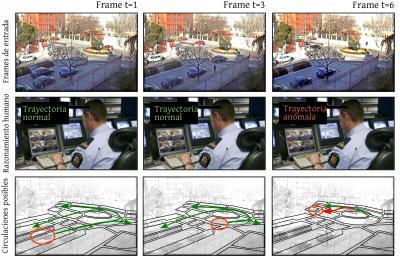
Yet another so-called ‘intelligent’ surveillance system has been announced. This one comes from Spain and is designed to detect abnormal behaviour on and around pedestrian crossings.

Comparison between the reasoning models of the artificial system and a theoretical human monitor in a traffic-based setting. (Credit: ORETO research group / SINC)

The article in Science Daily dryly notes that it could be used “to penalise incorrect behaviour”… Now, I know there’s nothing intrinsically terribly wrong with movement detection systems, but the trend towards the automation of fines and punishment, nor indeed of everyday life and interaction more broadly, is surely not one that we should be encouraging. I’ve seen these kinds of systems work in demonstrations (most recently at the research labs of Japan Railways, more of which later…) but, despite their undoubtedly impressive capabilities and worthwhile potential, they leave me with a sinking feeling, and a kind of mourning for the further loss of little bits of humanity. Maybe that’s just a personal emotion, but I don’t think we take enough account of both the generation and loss of emotions in response to increasing surveillance and control.

Further Reference: David Vallejo, Javier Albusac, Luis Jiménez, Carlos González y Juan Moreno. (2009) ‘A cognitive surveillance system for detecting incorrect traffic behaviors,’ Expert Systems with Applications 36 (7): 10503-10511

UK opposition plans to roll back ‘the surveillance state’

The Conservative Party Shadow Justice Minister, Dominic Grieve has launched a brief report outlining the opposition’s plans to introduce a new attitude to surveillance in the UK, and reverse many of the current Labour government’s policies. And it is mostly good, insofar as it goes. But, it is where it doesn’t go that is the problem.

The main measures include things we already knew, like a pledge to scrap the National Identity Register (NIR) and ID card scheme, and proposals to limit the proliferation of central databases and control the National DNA Database (NDNAD). However the Tories also want to abolish the Contact Point children’s database, restrict Local Government’s rights under the Regulation of Investigatory Powers Act (RIPA), strengthen the powers and functions of the Information Commissioner’s Office (ICO) and require mandatory Privacy Impact Assessment (PIA) for all new legislation or other state proposals.

So far so good – and these are all things I have proposed myself at various times – but there are also some very weak or pointless elements. First of all, the attitude to the private sector is predictably laissez-faire. Though the report includes a long list of the data losses that plagued the Labour government over the last few years, they fail to note how many of them involved private sector contractors or partners. And their only real mention of the private sector is to suggest that the ICO consults with industry on ‘guidelines’ and the possibility of introducing a ‘kitemark’ (a kind of stamp of approval). These are both pretty much worthless and tokenistic efforts. The Tories, as much as Labour, fail to appreciate that contemporary threats to privacy come as much from the private sector as the public. Unfortunately recognising and dealing with this would require a rather more robust attitude to private business than either of the UK’s two main parties are prepared to muster right now. This, I guess, is the reason why the Tories talk about ‘the surveillance state’ as opposed to ‘the surveillance society’ (the term used by ourselves and the ICO).

Secondly, there is no proposal to do anything to control or roll-back the most obvious and intrusive aspect of the UK’s surveillance society, the vast number of CCTV cameras and systems operated by everyone from the police down to housing associations and schools. In fact there is not a single mention of CCTV or public space surveillance in the report. Rather than missing an elephant in the room, this is more like failing to notice a whale in your bathtub…

Finally, there is the suggestion to introduce a right to privacy as part of a ‘British Bill of Rights’. Certainly what privacy means in British law needs to be clarified and strengthened, but actually this could be done through amending the existing Human Rights Act to make it better reflect the European Court’s already published views on the interpretation of Article 8 of the European Directive. Unfortunately, the Tories are stupidly ideologically opposed to doing anything to strengthen the HRA, and in fact their proposed ‘British Bill of Rights’ is a rag-bag collection of populist proposals that will instead replace the most progressive change to British law for some decades.

Finally, there is no mention of any changes to the pernicious Terrorism Act or Counter-Terrorism Act, that have further undermined the presumption of innocence and other longstanding foundations of British citizenship. There’s no mention of previous legislation that restricted traditional freedoms like the Criminal Justice and Public Order Act. In fact, there’s every reason to believe that the Conservative Party will be just as willing to clamp down on such freedoms in the name of the war on terror, or crime, or anti-social behaviour as the Labour Party, and no reason to suppose that they deal honestly with the underlying issues – which would mean, of course, telling people things that they don’t want to hear.

The full report can be found here.

UK ID cards to be abolished?

(Ironically, my last post in the UK, a couple of weeks ago was about Canada, and my first here in Canada will be about the UK…)

The Guardian newspaper’s headline today seems to indicate that the UK government is considering scrapping the controversial National Identity Register and card program, along with the Trident nuclear submarine upgrade. This is based on a speech that the increasingly influential Chancellor of the Exchequer, Peter Mandelson, gave to the centrist Progress think-tank. However, reading the whole article, it is much less clear that any such radical move will take place. Mandelson hedges his bets and says when asked about cost savings from the mooted cancellations:

“I have seen some rather different figures relating to the savings that would arise from cancelling those projects which don’t make the contributions that some people imagine.”

But at the same time, he said “it would be foolish to rule out anything.”

He’s right in many ways. Contracts have been signed. Money has been committed and legal costs could be very high if the government tries to wiggle out of those contracts now. As David Lyon’s new book on ID makes it very clear, ID cards schemes are a global industry with powerful corporate forces involved.

In any case, the real reason the scheme should be scrapped or significantly reduced in ambition, is because it is based on flawed premises and is massively intrusive and controlling. The fact that it also costs a ridiculous amount of money (and will of course, escalate in costs still further, as every state computer project inevitably does), is simply a contingent factor.

Controlling the outsiders

One of the most interesting meetings we had in our last week here in Japan was with two representatives from the Japan Civil Liberties Union (JCLU) and the association to defend the rights of foreign migrant workers. One thing that has always been clear to me from being a gaikokujin (or more casually, just gaijin – foreigner) in Japan is how distinct is this status. I’m a white, western European and therefore at the top of the list of acceptability in foreigners in Japan, but even so I’ve had some interesting experiences, including having two police squad cars and 5 officers deal with the matter of my ‘suspicious’ bicycle (an experience that practically all resident foreigners have had at one time or another), and just the other day I was stopped at the train station by two plain-clothes police officers, who started off quite strong, but then backed down and started mumbling apologies about ‘looking for someone’ when they realised my (Japanese) wife was just behind me. It was pretty obvious that they were conducting an immigration sweep – i.e. just stopping anyone who ‘looked foreign’ to check their immigration status.

This gave me just a tiny taste of what life can be like here for those whose immigration status is problematic. And, as the campaigners told us, this is an increasing number of people who have come to Japan because of the wealth and opportunities and because, whisper it, Japan needs immigrants. Like so many advanced industrial nations, Japan is a hyper-ageing society, with an increasingly unbalanced population pyramid. There are not enough working age Japanese people to support the increasing number of retirees, and government schemes to encourage people to have more children simply haven’t worked. The problem is that successive Japanese governments have refused to recognise the implications. The rules now make provision for ‘skilled’ immigrants, but not for those who are ‘unskilled’ and it is actually those in this latter category that Japan needs. In practice this is demonstrated by the increasing numbers of foreign delivery and construction workers in Tokyo as well as those working in the shadier areas of the ‘night economy’ – doormen, bar staff, masseurs, prostitutes etc.. The same politicians who deny the need for immigrants are probably having their personal ‘needs’ serviced by Filipino or Vietnamese women and this hypocrisy colours all the mainstream political debate about the place of foreigners in Japan, especially in Tokyo where Mayor Ishihara has never disguised his nationalist views in this area.

So, whilst the politicians refuse to deal with reality, the police are enforcing the law as it is. We have spent some time, whilst we are here (and I have gathered data on previous visits) in the night city of Kabukicho in Shinjuku. This time I was taken out to bars in the old post-war neighbourhood of Golden Gai by Professor Tonoma, who formerly led both Shinjuku-ku and Tokyo city planning bodies, and we also talked to Shinjuku community safety officers, and to the Kabukicho Town Manager, who runs the day-to-day operations of the body trying to improve Kabukicho’s image, Kabukicho Renaissance.

Kabukicho of course is famous as the first place that the Tokyo police installed CCTV, ostensibly to deal with Chinese gangs, but according to what we learned from these visits and from talking to the campaigners, as crime has declined (as it has nationally – it’s probably nothing to do with the cameras), the cameras and intensive policing (raids etc.) have been used largely to curb illegal migrant workers. And the authorities seem to make no distinction between the gangsters and the mainly South-east Asian women who work in the bars and massage parlours. They are all visa-overstayers. There is no attempt to treat the women as people in need of help and support at all. Of course this all inflates the crime figures and makes it easy to paint what the police always term ‘foreign crime’ (whatever the exact nature or seriousness of the crime) as a growing threat, as it becomes proportionally a larger part of shrinking crime rates (which were already low by global standards to begin with).

Now there is a new threat to this already massively targeted population. The inclusion of foreigners on the jyuminhyo (residents’ registry), combined with the digitisation and networking of this registry through juki-net, means that the authorities will be able to correlate residency and immigration status much more easily – the residency information for foreigners will be linked to the Houmusho (Ministry of Justice), which has entry records, and now fingerprints and facial photos too, following post-9/11 reforms. Of course, resident skilled foreigners wanted to be in the residents’ registry. They argued that not being on it was itself a form of discrimination and meant further difficulties in terms of things like buying property. However the inclusion of foreigners now opens up new forms of discriminatory practice against those who are already the most disadvantaged in Japanese society, the kinds of foreigners who more high-status ‘official’ foreigners do not generally recognise as kin to them at all.

Japan’s surveillance society, like most, is therefore a profoundly uneven one. Every society has its Others, and surveillance is deployed both to distinguish those Others and to control them. In each of the cities I have been studying the Others are different populations. In London, the Others are (at the moment) the resident Muslim community (or more particularly, ‘radicalised’ young Muslims). Here the surveillance combines repression and ‘caring’ programs to bring the disaffected back into the mainstream. In Rio de Janeiro, the Others are the urban poor, the favelados. They are largely simply excluded – walls protect the rich in their homes, and now walls are being built around the poor communities. In Tokyo, the Others are foreigners, but there are gradations of Otherness, and effectively still aping the western ‘scientific racism’ that it acquired during the Meiji period modernisation at the end of the nineteenth century, Japan’s Others are poor Blacks and Asians (for many on the right here, the Japanese are not ‘Asian’ at all, but something unique). Just as the British state is struggling with the legacy of its particular colonial and post-colonial approach to immigration, and the Brazilian state with a history of years of differentiated citizenship, the Japanese state has still not yet really come to terms with the prospect of the mixing of people at all.

We are all libertarians now?

A rather telling little piece on The Guardian‘s ‘Comment is Free’ site today by UK Labour MP, Diane Abbot. First she takes a cheap shot at the Conservative shadow-cabinet minister, Damien Green, for having been successful in getting his details removed from the UK police National DNA Database (NDNAD). She then says that, well, she is doing much more to help by holding clinics for her young, black, constituents to help them with their complaints against the NDNAD. This is excellent, of course.

However two things spring to mind immediately. Firstly, is this Diane Abbot the same New Labour loyalist who voted in favour of the original bill to set up the NDNAD and made no attempt to amend it to prevent the kind of racially-biased abuses of which she is no complaining? I think it is. And now, why is she not also condemning the former Home Secretary, Jacqui Smith’s rather pathetic and weaselly response the judgement of the European Court that condemned the NDNAD, which was essentially to try to avoid doing anything fundamental at all?

This is not an issue on which anyone in New Labour can really make any political capital unless they take a rather stronger moral stance. Basically, and in addition to the stance that there should be no state retention of DNA data at all, there are only two ‘fair’ ways to maintain a police DNA database, and those are to keep the DNA of the guilty, or to keep the DNA of everyone. Which you prefer depends largely on your attitude to surveillance and your trust in the accountability of the state, but politicians like Abbot are hedging and avoiding making any serious attempt to put pressure on their own government to reform the law we have.

The end of the war on photographers?

The UK Home Office has finally issued a circular on Photography and Counter-Terrorism (012/2009) in response to the widespread complaints about police harassment of both professional and amateur photographers in the name of ‘anti-terrorism’ – which I covered here and here. The circular advises police of can and cannot be done under three separate parts of the Terrorism Act 2000: Sections 43 on searches, 44 on authorised area searches and 58A on eliciting and publishing information on members of the police, armed forces or intelligence services, which was introduced as part of the Counter-Terrorism Act 2008. This is of course to be welcomed, even if it is rather late in the day.

On Section 43, they make is clear that the Act “does not prohibit the taking of photographs, film or digital images in a public place and members of the public and the press should not be prevented from doing so in exercise of the powers conferred by section” and that it is the suspicion of being a terrorist that gives the justification for any search, not the fact of taking photographs.

On Section 44, they remind the police that neither the Press nor public can be prevented from taking pictures in an area defined as an ‘authorised area’ by the police, and that officers have no powers to delete pictures or seize film. And finally, on Section 58a, they remind officers that ‘reasonable excuses’ for taking pictures, even of subjects considered sensitive, include tourism, sight-seeing and journalism. Interestingly, however, they do not actually give academic research as an example of reasonable excuse!

Of course, all of this serves to remind us that the Terrorism Act was drawn way too vaguely and widely and gave too much discretion to individual police forces and officers in its interpretation. Earlier this year, Jack Straw promised at several meetings that the government was to review all of the legislation on terrorism and counter-terrorism – perhaps this guidance is a result but it is only about interpretation and does not make or propose any change to the law itself.