Here comes the US ID-card push

For a while now, I’ve been wondering why the US didn’t attempt to push for a national biometric ID card system in the wake of the 9/11 bombings.

Given reported statements from biometrics industry bosses about 9/11 being ‘what we’ve been waiting for’ and so on, one might have expected there to be a major effort in this direction but officially, as Zureik and Hindle (2004) point out, the International Biometrics Industry Association (IBIA) was relatively cautious in its post-9/11 press work, although it argued that biometrics had a major role to play in the fight against terrorism. Even the 9/11 Commission didn’t recommend a national ID card scheme, instead limiting itself in its final report to In its final report, to recommending a “biometric entry-exit screening system” for travelers in and out of the USA.

Part of this is because of the uneasy relations between the federal government and states governments, and suspicion of the former from the latter, and particularly from the political right has meant national ID cards have always been out of the question, even in an era of identification. So even though ID is frequently required in social situations, especially in dealing with banks, police and government agencies, the US relies on the ubiquitous driver’s licenses, which are issued by states not by the federal government. I remember from my time living in the US (in Virginia) as a non-driver, that in order to have valid form of ID, I had the choice of either carrying my passport or getting a special non-driver’s driver’s license, which always struck me simply as an absurd commentary on the importance of the automobiles in US life because, being young at the time, the nuances of federal-state relationships escaped me. And of course, passports won’t cut it for most, as less than 50% of US citizens have one.

So, if the apparently ubiquitous threat of terrorism was not going to scare states’ rights advocates and the right in general into swallowing the industry lines about security that they might usually have lapped up, what would? Well, the one thing that scares the right more than terrorism – Mexicans! More seriously, the paranoia about undocumented migrants combined with the spiralling cost of oppressive yet clearly ineffective border control (walls, drones, webcams, vigilantes etc. etc.) seems to have no done what the fear of terrorism could not, and inspired a push on both the centre and the right for ID cards – not that there’s much evidence that biometric ID cards will do a better job of excluding undocumented migrants, given that they do nothing to address what’s driving this migration – the demand for cheap, tax-free labour in the USA.

Today, not only the beltway insider’s bible, the Washington Post has an editorial demanding biometric social security cards for all (and a concomitant reduction in spending on hardening the border) following on from a cross-party senate recommendation, but also the Los Angeles Times, a paper which in the past has often been wary of the march to a ‘surveillance society’ – indeed it was the first major US newspaper to use this term, way back in 1970 as well as publishing critics like Gary Marx (see Murakami Wood, 2009) – has an op-ed arguing for a national ID card. The LA Times version, written by Robert Pastor, also claims that this is necessary to deal with voter fraud, a constant concern of the right and which always has a strong undertone of racism, so it’s unsurprising coming after a black Democrat has been elected as President for a second time in a tight election. Ironically, however, the President whose supporters are clearly the target of such attacks, has recently made it clear that he is also a supporter of a ‘tamper-proof’ national ID system.

No-one has yet made the international competition argument that is also so often used in these debates (‘if India and Brazil can do it, then surely the USA can’), but this debate is now ramping up in a way that even 9/11 couldn’t manage. Interesting times ahead…

References:

Murakami Wood, David. “The Surveillance Society’: Questions of History, Place and Culture.” European Journal of Criminology 6.2 (2009).
Zureik, Elia, and Karen Hindle. “Governance, security and technology: the case of biometrics.” Studies in Political Economy 73 (2004).
(thanks to Sarah Soliman and Aaron Martin for the newspaper articles…)

Chipping Pre-School Kids in the USA

ACLU is reporting that nursery schools kids in Richmond, California are being issued with jerseys embedded with RFID chips. GPS-enabled and/or RFID-chipped clothing has been available for a while now, and there have also been (pre-)schools in other countries that have issued tracking devices to kids, notably in Yokohama in Japan, but this appears to be the first time in the USA. RFID is a very simple, insecure technology, and this type of initiative gives a false sense of security and is about at once raising and appeasing social anxiety and parental paranoia about the incredibly rare instances of child kidnapping. ACLU note correctly that this is just likely to make stalking and kidnapping easier as harder, but really all this does is enable the school to know where the jersey is – like left on the back of a bus, swapped with a friend or thrown in a ditch. It’s more pointless security theater, but at a more intimate level than the kind we are used to at airports and public buildings.

No need to fear a database society?

Peter Bradwell of Demos raises some interesting points in his summary of their new report on people’s attitudes to state databases in the UK, but he also sets up a straw man, and as I am one of the people implicated, I object to this. He argues that there are many positive sides to databases (of course!) and contrasts this with the former Information Commissioner’s statement on ‘sleepwalking into a surveillance society’ as ‘fear-based’. However, the reaction of the ICO was to commission a report in 2006, which I coordinated, to examine the concept of the ‘surveillance society’. This was pretty balanced and stressed the positive aspects of surveillance as much as the negative, indeed it did exactly the kind of assessment that Demos claims it’s doing here. So it’s rather ironic that the author is trying to stop people being afraid of the word ‘database’ yet still promoting the idea that ‘surveillance’ is automatically a bad thing to be feared! However, I would urge rather less optimism. We’re currently writing an update to our 2006 report and it’s pretty clear that in most areas, the UK has gone further, faster, than even we anticipated.

The basic argument of Demos appears to be that if all of this was under some kind of accountable control, then perhaps one might have grounds for optimism. But that’s true of just about almost anything and it’s a rather big ‘if’. What are the developments in the direction of accountability that they have seen which give rise for optimism? There are none in the piece, and the report itself is about what people think about state databases. That is very interesting from a political point of view, but unfortunately doesn’t tell us much about what is actually happening or likely to happen, only what people believe about it. Of actual examples of increasing accountability recently, I can only think of the state’s retreat on RIPA, but that wasn’t particularly profound, and the only other serious changes have come when the British government’s hand has been forced by European Court decisions (on the National DNA Database, for example)… can Demos help me out here with more than just the fact that people don’t think it’s that bad? I will have to read the full report and get back to you…

The Surveillance Games

I’ll be off the next few days at ‘The Surveillance Games’ conference in Vancouver.

Coincidentally, the local police have recently announce that they will be buying the same kind of sonic weapons we saw being used against protestors at the Pittsburgh G8 meeting. Except they want us to call them ‘megaphones’ and claim they won’t use them aggressively*. I think we still need to call a weapon a weapon. Just think, with such rebranding the police could get over their recent little problem with tasers too: just call them ‘joy-buzzers’ (just with a whole lot more ‘joy’...). The urban arms race that such mega-events always spark off as manufacturers push their latest toys to anxious governments, of course just adds another layer of bitter irony to the fact that Canada also intends to ignore its own call for global truce during the Games… it seems that you don’t even need the actual gesture for gesture politics these days.

*Even if these devices were just megaphones, this purchase would in any case be rather ironic given that Vancouver city has banned protestors from using any amplification devices by amending their bylaws in July 2009.

Hille Koskela’s new book

pelkoTop Finnish surveillance studies academic, Hille Koskela, has a new book out, Pelkokierre – pelon politiikka, turvamarkkinat ja kamppailu kaupunkitilasta (‘The Spiral of Fear. Politics of Fear, Security Business, and the Struggle over Urban Space’). It looks like a fine addition to the literature on fear, security and surveillance, but unfortunately I can’t read it – as it’s in Suomi. Great cover though!

It should of course be translated into English and made available by an English-language publisher, but I doubt this will happen. Publishers don’t like to take what they consider to be a risk by publishing academic work from foreign countries, so unless the author is very famous or dead (or preferably both) it doesn’t happen. We tried very hard to get Michalis Lianos’s very important French book on control society published by an English-language publisher, with many supporting letters and so on, but there was no real interest.

Anyway, Hille has sent me a translation of the table of contents, which are:

1. The paradoxes of security

2. Birth of the security society
Relevant theories in sociology, social policy, geography, architecture, media studies, law and IR

3. The ontology of fear
The social production of fear, the spatial and temporal patterns, fear  as a commodity, streetwise semiotics

4. Fear in everyday life
Housing, workplaces, SUVs, public transport, tourism, child rearing,  ‘threatening’ teenagers, high school massacres

5. The architecture of fear
The classic ideas of Jacobs and Newman, contemporary architecture in public and private spaces, gating, surveillance

6. The politics of fear
Legislation (the public order act etc.), national and local security strategies, urban security politics, ‘the war’ on graffiti

7. The economy of fear
Security services, technology and other security products, images of place, crime and fear in the media

8. Towards a culture of tolerance

Japanese surveillance studies researchers

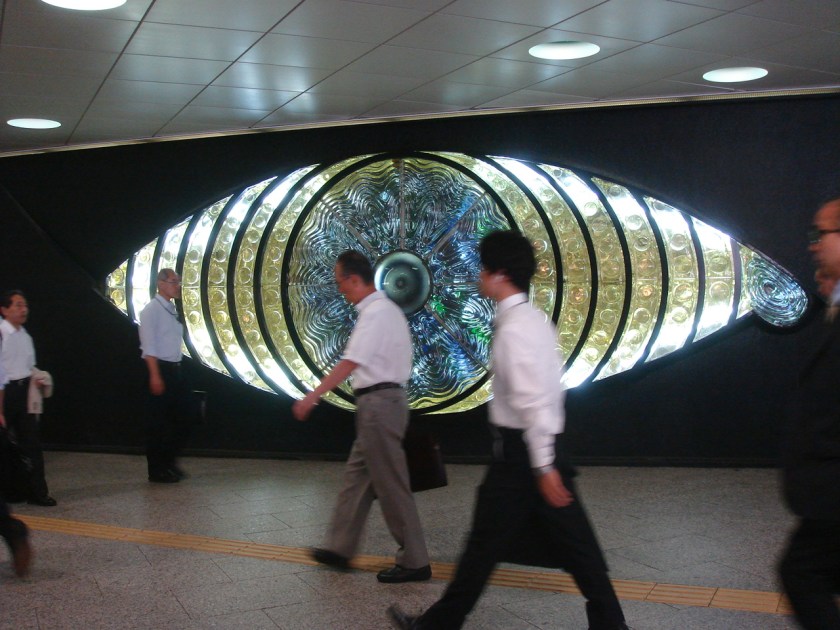
Somebody's watching you... office workers walk past an installation in Shinjuku station, Tokyo

We’ve met with several Japanese surveillance studies researchers whilst out here this time. I mentioned Ogura Toshimaru already the other day, but we also had a long meeting the week before with Hino Kimihiro, a researcher into bohan machizukuri (community security development), and government advisor on security planning. Dr Hino has been carrying out a number of research projects on both ‘designing out crime’ and on the effectiveness and public acceptability of CCTV in Japan. I hadn’t come across this research before as my contacts here were mainly in social sciences and law and Dr Hino tends to publish in urban planning journals and is not connected to other Japanese surveillance researchers. His work is very interesting and reminiscent of that of Martin Gill or Farrington and Welsh in the UK. It is a shame, that just like those researchers who have carried out analyses of CCTV for the UK Home Office, his assessments tend to be ignored by the government. Dr Hino’s latest project is to assess the trials of a new movement recognition system in Kawasaki city. I hope he can come to the January Camera Surveillance workshop at Queen’s University, Ontario, or the April Surveillance & Society conference in London (details coming soon!).

I also met today with Tajima Yasuhiko, a professor of media law in the School of Journalism at Jochi (Sophia) University in Tokyo. Professor Tajima has been one of the most important critical voices in the debate about surveillance in Japan, and has bridged the academic and activist world, being involved with legal action against juki-net and Google StreetView. We had a productive conversation about the politics of surveillance in Japan and the prospects for critical voices to be heard. He wasn’t optimistic that they would be, and neither am I after our meeting at the Prime Minister’s IT Strategic JQ the other day, however I am also convinved that in many ways Japan has not yet gown as coordinated and centralised a route on issues of security and surveillance as has the UK. There is, so far as I can see, no real attempt to link up things like juki-net or other databases and the anshin anzen (or bohan) machizukuri agenda, and i-Japan, national and local police, and wider community security agendas do not really coordinate at all. This is due to the lack of an obvious ‘threat’ like that of terrorism in the UK, around which such coordination can occur. The government half-heartedly tries to get people worried about North Korea, but really they aren’t, and ‘ageing society’, whilst a phrase used to justify almost anything (including central databases) is a worry, it does not generate the fear that comes with the war on terror.

We also considered the relative weakness of Japanese civil liberties organisations and the failure of the mainstream media to pick up on issues of privacy and surveillance. There seems to be some effort now to try to coordinate various organisations to push for an explicit constitutional protection for privacy (rather than the rather vague inclusion of such an idea in a wider notion of the ‘pursuit of happiness’), but whilst I can see that being happily accepted after the government has got its central database(s), I can’t see it being done in time to alter either this trajectory or the way in which the database(s) are built.

The paranoid bubble of Offender Locator

TechCrunch reports that one of the Top 10 current iPhone apps in the USA is something called ‘Offender Locator’. This is a little mash-up that overlays the location of those on registries of sex offenders onto google maps, so you can check where sex offenders live whilst you are on the move.

This is such a world of wrongness, its hard to know where to start.

Let’s begin with the categorisation. The category of ‘sex offender’ varies from jurisdiction to jurisdiction. This app is clearly targeted at parents worried about paedophiles, yet depending on the state, offender registers can include people convicted of innocuous things like public nudity, public urination and simple underage sex (and please don’t try to tell me that a 17-year old kid who has consensual sex with a 15 year-old kid is a technically a paedophile, that’s just normal, whatever the laws of some backwards states may say).

The second thing is that even the US Department of Justice says that such registers cannot be guaranteed to be accurate. So now these non-guaranteed lists are available to you mapped out on your iPhone. Does that somehow make them more accurate? No, but all those red arrows on a map do look much very ‘real’ and scary though, don’t they?

Which brings me to the third point. What are you supposed to do with this ‘information’? It’s hardly empowering, in fact it creates a false view of the world based on fear. Will you not let your kids out within several miles of any red marker on the map, will you take a detour to avoid neighbourhoods with high concentrations of offenders when you are driving, or of course, in contrast, will you deliberately go to such places with a baseball bat to show those sex offenders who’s boss?

Finally, of course, this information isn’t ‘live’. It shows you where sex offenders live, but they aren’t chipped yet, so not where they actually are at any one moment in time. It provides at once a false sense of reassurance and the nagging feeling of doubt that they could really be right behind that tree over there, or in the shadows. And what do ‘they’ look like? That man over there with the 5 o’clock shadow at 11 in the morning sure looks like a sex offender… and there’s definitely some in this neighbourhood, your iPhone says so!

Apps like this, policies like this, also increase the pressure for more ‘comprehensive’ solutions – especially this app. Because it isn’t ‘live’, they’ll be people asking ‘why not?’ Why not tag these people for the rest of their lives with GPS cuffs, or implant them with RFID chips?

Finally, the thinking behind this app is just wrong in terms of what we know about sex offenses. Most real sexual violence and sexual abuse of children takes place within the home and within ‘normal’ family relationships (and ‘normal’ schools and nurseries too). That’s what Mr or Mrs iPhone doesn’t want to hear. ‘It couldn’t be my husband, okay he gets angry with the kids sometimes, but he’s under a lot of pressure at work and I know he loves us…’ Far easier to externalize the ‘threat’, to cast it ‘out there’ amongst the red arrow markers on the streets of some other neighbourhood…

Surveillance isn’t necessarily the same thing as paranoia but when surveillance becomes pathological, paranoia is the result. Some paranoia is about surveillance, some is expressed in surveillance. This kind of apparently democratic, freedom of information app, demonstrates the worst and most pathological places that a society of ubiquitous surveillance can start to go. It creates defensive bubbles of individualized, desocialized paranoia, of protecting ‘the kiddies’ against the threats from the ‘Other’, outside. Perhaps you should just stay inside and buy everything from amazon.com and make your kids live in some virtual world where only those nice marketers can prey on them…

(thanks to Aaron Martin for pointing this snippet of news out to me)

Google: ‘give us data or you could die!’

I’ve been keeping a bit of an eye on the way that online systems are being used to map disease spread, including by Google. What I didn’t anticipate is that Google would use this as a kind of emotional blackmail to persuade governments to allow them as much data as they like for as long as possible.

Arguing against the European Commission’s proposal that Google should have to delete personal data after 6 months, Larry Page claims that to do so would be “in direct conflict with being able to map pandemics” and that without this the “more likely we all are to die.”

Google talk a lot of sense sometimes –  I was very impressed with their Privacy counsel, Richard Fleischer, at a meeting I was at the other week – and in many ways they are now an intimate part of the daily lives of millions of people, but this kind of overwrought emotionalism does them no favours and belies their moto, ‘don’t be evil’.

(again, thanks to Seda Gurses for finding this)

The last progressive government of Rio?

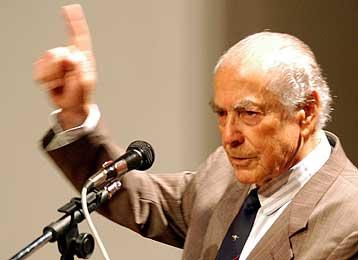
Leonel Brizola, 1922-2004

One question that has been preoccupying my thoughts recently has been the question of why the simple things are not being done in Rio to address the problems of the favelas: sanitation, education, healthcare etc… many of the people we have talked to look back to the regime of Leonel Brizola, the Governor of the State of Rio de Janeiro from 1983 to 1987 and then again from 1991 to 1994. Brizola was a left-progressive populist, a social democrat and a former opponent of the dictatorship who had had to live in exile for much of the 1970s. Sadly he died in 2004, but we had the opportunity this week to talk to his former Secretary of State for Public Security, and also briefly Governor himself from 1994-5, Nilo Batista.

We met Professor Batista in the Instituto Carioca de Crimonologia (ICC), an independent research organisation, which he runs (and funds from his legal work), along with his wife, sociologist, Vera Malaguti Batista. The Institute is housed in a sleek modern building up in the hills of Santa Teresa, from whose picture windows the city below is all but invisible and the bay appears almost as it was when Europeans first arrived. However, the concerns of the Institute are very much with the reality of the city today.

We had a long and wide-ranging conversation, which would be impossible to recount in detail here, but the basis of it was an understanding of Brazilian society, and in particular that of Rio, based on the ongoing legacies of the past, in particular slavery and authoritarianism. Vera Malaguti’s book, O Medo na Cidade do Rio de Janeiro: dois tempos de uma historia (Fear in the City of Rio de Janeiro: one story in two periods) examines previous periods of revolt by Africans in Brazil and argues that the often unspoken elite fear of the africanisation of Brazil. They argue that repressive public security strategies today are founded in this same fundamental fear, driven by the media that serves the powerful middle classes who aspire to elite values and lifestyles.

In opposition they place Brizola and that brief (and they argue, unrepeated) period at the end of the dictatorship when social justice and in particular, education, were priorities and favelas were provided with services in the same way as any other neighborhood. The security strategy of Brizola and Batista was effectively one of anti-stigmatisation. They argue that since then, media-driven fear and repression has been far more the norm and this had undermined the progress made under Brizola.The current public security-based strategy of the Governor Cabral and the ‘choque de ordem’ of Giuliani-wannabe Mayor Eduardo Paes, is one example. By concentrating on ‘pacifying’ one or two places as examples (Santa Marta and Cidade de Deus at present) without being able to afford the same strategy elsewhere, it constitutes simply a public relations exercise, and elsewhere repression without development continues as normal.

The Batistas are passionate and well-motivated, but there are many who argue that this picture of a progressive Brizola regime subsequently undermined by repressive policies is at the very least, a limited view. It was, after all, under Brizola that the traffickers grew in power and acquired weapons; the mid-eighties was the key period here as the cocaine trade grew from almost nothing to being the driving force of gang activity in Rio. This isn’t just a view held by political opponents: whilst he certainly does not (and could not with any justification) claim that the rise of the cocaine trade was anything to do with Brizola, Enrique Desmond Arias in Drugs and Democracy in Rio de Janeiro, argues that the personalist populism of Brizola undermined the leadership of the Community Associations in the favelas and left them open to co-option by drug gangs. When we visited the office of the current Secretary of State for Security, Jose Mariano Beltrami, and talked with his representative, it was quite strongly argued that Brizola neglected the issue of the growing arming and violence of drug traffickers, and also did nothing to solve the massive problem of police corruption (on which I will write more later). The current longer-term strategy is now to recruit a lot more Military Police, in the hope that numbers will do what force has not, and enable the gangs to be beaten.

We also visited the office of a leading critic of human rights abuses, Alessandro Mollon, a Deputy in the State parliament. He said that Beltrami is actually shifting, without ever having admitted to it, from a very macho and repressive approach when he first arrived from the southern state of Rio Grande do Sul, to a more considered (but hardly progressive) strategy now, of which the emphasis on police officers on the streets, rather than invasions, is one aspect.

Former Mayor of Rio, Cesar Maia

The claim that Brizola was the last real progressive figure to lead Rio also neglects some others, particularly those who have held the office of the Mayor. Under Cesar Maia (1993-7; 2001-2008), the ‘Favela Bairro’ program had much in common with what Brizola did in social terms. Indeed when we asked the leader of the Morro dos Prazeres Community Association what would be the one thing she wanted above all else, it was ‘more Favela Bairro’. In Dona Marta they also had some time for the former governor, Anthony Garotinho (1999-2002) a frankly quite foolish evangelical populist, currently under investigation for corruption, as is his wife, Rosinha, who was Governor from 2003-7. However, we heard from others that the things that they attribute to Garotinho were actually planned or initiated under previous administrations and just did not see the light until his.

What is certainly the case is that Brizola had a better attitude to the favelados as people, than other administrations, regardless of his mistakes. The current regime certainly seems to be more driven far more by middle-class fears than by social progress, but it is also the constant undermining of the progress of previous administrations like Brizola’s and then later Maia’s terms as Mayor by new waves of media-courting repression that is so depressing in Rio. It happens in every democratic country, but here in Brazil there is the most blatant inequality of any wealthy country still crying out to be addressed. If it was, then most of the issues of ‘crime’ and ‘insecurity’ would start to disappear. It would, as Deputado Mollon also pointed out, be a lot cheaper than the massive amounts of money now going into the hands or private security companies – who, as Professor Batista noted are often run by the families of senior police officers, who therefore have no actual interest in reducing crime and every reason to want to see fear continue to grow.

(With thanks to Nilo Batista, Vera Malaguti Batista, Alessandro Mollon and the staff of the office of Jose Mariano Beltrami for their time and patience. In particular, I hope to return to the Instituto Carioca de Criminologia sometime in the future to talk about the findings of this project, and to submit something to their excellent journal, Discursos Sediciosos: crime, direito e sociedade)

Heavy rain

It’s been raining all night and sometimes the rain has been very heavy, pounding on the corrugated plastic roof of my small room. It is making me think more urgently of the favelas and their situation. Following what Paulo Saad was telling me yesterday, I have been reading a very interesting and worrying article by Schuster et al. in a book on landslides. The combination of the climate (heavy rains from January to March) and underlying geology (steep weathered granite slopes and residual soil on top) makes Rio particularly susceptible to landslides. Combined with the prevalence of illegal and unsafe building spreading further to higher and steeper slopes, you have a real recipe for disaster: simple landslides can become debris flows as more material accumulates into the slide and adds to its weight and destructive capacity.

In 1966 and 1967, there were over 1000 deaths from landslides after particularly heavy rain in the Rio area. Santa Teresa was also badly hit by last series of catastrophic landslides to affect Rio in 1988, when the Santa Genoveva Hospital for elderly people was destroyed, killing 34. Altogether 120 people were killed and, perhaps even more worrying for future development, 22,000 were made homeless. According to sources quoted by Schuster et al., this was after less than an hour of particularly heavy rain…

After the late 1960s events that action was taken to reforest the undeveloped slopes around Santa Teresa and reinforce some parts of the hill with concrete channels to direct the flow of water. Building regulations were also strengthened. However, it is in this area that much of the recent illegal building is taking place – and as I mentioned, not just by the desperate and ignorant poor, but also by simply greedy and uncaring middle classes.

Reference

Robert L. Schuster, Daniel A. Salcedo and Luis Valenzuela. Overview of catastrophic landslides in South America in the twentieth century, pp.1-34 in Catastropic Landslides: Effects, Occurrences, Mechanisms. ed. Stephen G. Evans and Jerome V. DeGraf, Geological Society of America, 2002.