
Well, I’m back in Tokyo, and back in the same community where we used to live. It’s been a while, but the sticky summers haven’t changed much. I’ll be carrying on with my work on my project, Cultures of Urban Surveillance, here… and there have been some interesting recent developments in this area (see the next post). However this will be the last stop on this particular project. I have to cut things short as I’ll be taking up a new job in Canada in September and unfortunately I can’t take the ESRC’s funding with me!
Category: personal
Why no posts?
I’ve been very busy and having a bit of an ‘anti-blogging’ feeling. I’ll be back at the start of July, when I will be off to Japan to do the next phase of my research…
USA, EU and UK all investing in advanced biometrics
News from various sources has revealed that the United State, the European Union and the United Kingdom are all preparing to invest further large sums in advanced biometrics and surveillance research.
According to an anonymous message to Slashdot, in the USA, Department of Justice requisitions for the coming year show “$233.9 million in funding for an ‘Advanced Electronic Surveillance’ project, and $97.6 million to establish the ‘Biometric Technology Center.'” The former is largely to deal with the problems of intercepting Voice-over-Internet Protocol (VoIP) communications – like Skype. The latter is what Slashdot calls a “vast database of personal data including fingerprints, iris scans and DNA which the FBI calls the Next Generation Identification” for the FBI. In other words, the architecture of the proposed ‘Server in the Sky’ system, which The Guardian revealed last year – for some notes on this and other systems under development, see here.
Meanwhile Owen Bowcott in The Guardian today has a story which puts together various bits and pieces from the EU’s FP7 Security theme research budget and UK security investment. In the UK, there is to be £15 million spent on updating UK biometric security for embassies, and more interestingly other unspecified ‘surveillance’ purposes, and in addition, rolling out of facial recognition systems to more UK airports. As we know, the controlled environments of airports where people are required to look at cameras, are one of the few place where this technology works properly.
This provides a rather tenuous link to the headline of the Guardian story which is an EU-funded study into brain-scanning (yet again) called Humabio (Human Monitoring and Authentication using Biodynamic Indicators and Behaviourial Analysis). There are lots of these about, and one of them may work sooner or later, but it is worth pointing out that people have been putting out ‘we will soon have brain scanning’ stories since the 1980s and like, nuclear fusion, it always seems to be 5 or 10 years in the future. Brain-scanning seems to be the technology of the future… always has been, always will be?
Back from Brazil
I’m back from Brazil now. It was an exhausting time towards the end as Paola and I packed so many visits and interviews into the last few weeks. I still have things to write up here on that, especially on Dave and I cheekily collaring Major Vargas, the Commander of BOPE outside his HQ – resulting in an hour-and-a-half long interview! There are also some others things I want to write about surveillance, community and music and the city. So there will still be some belated reports on research and experiences in Rio over the next couple of weeks in, amongst all the other things.
My PhD student, Fashie has come back from Malaysia just about simultaneously and it turns out that what we have been doing and discovering is remarkably parrallel and comparable. I am very pleased with her work. We’re planning a joint seminar to explore some of the similarities and differences in terms of crime, community and control.
I have an insane schedule over the next few weeks. I have to speak to the House of Commons Science and Technology Committee on security and individual freedoms on Tuesday, then it will straight on to Brussels the next day for our inaugural ‘Living in Surveillance Societies’ ESF-COST network management meeting. The week after I will be in Glasgow for a special invitational seminar on surveillance in Glasgow and on the island of Jura – I can stay with my sister who lives in Glasgow which will be lovely. After that I am having a few days cycling break before the next SSN/ESRC ‘Everyday Life of Surveillance’ seminar in Edinburgh. Then, the week after, I am supposed to be going to Vienna for a conference of a project in which I am no longer involved but to which I still have some left-over obligations.
By the end of May, I should also know something more about what I am doing and where I will be in the future, both professionally and personally, as the results of tests and applications of various kinds start to filter back. Can’t say more yet, but I hope it’s going to be an exciting couple of months!
The beauty and cruelty of Rio de Janeiro
There is no reason why with the same infrastructural, social and economic support as anyone else in society would expect, that the favelas could not become truly beautiful without being cruel…
I am trying to think of something not too banal or cliched to say about Rio de Janeiro. It is rather difficult when I am sitting in my room in this artist’s house in Santa Teresa with its balcony overlooking the whole city centre and the bay and Niteroi on the other side, with bossa nova drifting up from the room below…
Being on a hill though, Santa Teresa is as good a place as any to try to get an initial feel for the geography of the place. Whatever you have read about Rio, however many pictures or films you have seen, it is still impossible not to feel utterly astonished, and in many ways delighted, by the place. Rio is unquestionably the most beautiful city I have ever been in. The shapes of the hills, the curves of the coast, the collision of architectures, the forest which comes right down into the city itself. Flying in, you could see its sprawl (this is a city of over 10 million people), but from the inside it is all small neighbourhoods, and more importantly all edges. One never seems to be entirely in one place in Rio, rather one constantly walks the boundary between city and forest, wealth and poverty, high rise and favela…
Because the poverty and the favelas are also inescapable. Unlike in San Paulo, where the favelas are located more on the periphery and can therefore be ignored by the rich, in Rio the rich and poor neighbourhoods are locked together like the fingers of clasped hands – but are they locked in mutual dependence or a death grip? The richer areas tend to run up the flattest land, whilst the favelas cling to the steeper slopes above and below. The disturbing thing for anyone who would try to form any swift opinion, is how beautiful the favelas are seen from my bird’s eye view. Rio’s beauty is matched by its cruelty, and even its cruelty is beautiful. The houses of the favelas follow the precarious topology of the hills, they pile onto each other, tiny alleys and stairs running in between. Self-constructed, they take the most natural forms that available resources allow, and in many ways are therefore the most human-looking places one can imagine. They most resemble the ancient towns of Greek islands or the Italian coasts, what Donald Ritchie called the ‘crammed mosaic’ of Tokyo neighbourhoods or Cornish fishing villages – the kinds of places that inspire deep feelings of the most intimate community.
But these are places of the most miserable poverty, crime and violence. From the bird’s eye view, you can’t smell the shit flowing in the streets, or see the tired, desperate faces of the inhabitants. It is because the architectural form, whilst it evolves from necessity, is not the cause of the socio-economic problems. Form does not, contrary to a still quite prevalent but regressive moral imagination, lead to a necessary moral or social outcome. The old rightist way of dealing with the ‘favela problem’, which was shared with leftist modernism, was the blank slate. Wipe out the favelas, put the people somewhere else, and everything will be okay. They were wrong. There is no reason why with the same infrastructural, social and economic support as anyone else in society would expect, that the favelas could not become truly beautiful without being cruel, why they could not come to be seen equally much as examples of the perfection of human settlement as Santorini or the old town of Lisbon, Mousehole or Mejiro…
The big question is how they get there. Rio’s multiple edges, its ubiquitous boundaries, are in many ways the most secure borders. The favelas are oppressed both by the most intimate micro-authoritarian internal control of the drug trafficking gangs, the uncaring external ‘prison-wardening’ and exploitation of the police and vigilante groups, and the utter fear and disgust of the richer classes who often see the favelados as nothing but criminals. I can’t suggest easy solutions to the fundamental problems, but part of what I am going to do over the next two weeks is to talk to a whole variety of people about the issues of surveillance and control and how some forms of surveillance should be broken or released and some should be made to work for people, not against them.
I’m on holiday
I’m off on an overdue but short holiday until Monday 23rd March, and no I am not the kind of person who blogs from the beach!
There won’t be any new stuff here until then.
The rise of personal surveillance
Personal surveillance is only going to get harder to regulate as things like ‘smart dust’ and micro-UAVs come down in price and are more easily available…
CBS News in the USA is reporting on the rise of stalking and in particular the use of more powerful, smaller and cheaper surveillance devices: embedded hidden cameras, GPS trackers and so on. They discuss in particular the case of Michael Strahan, a sportsman who seems to be obsessed with keeping watch on family and friends. But the bigger pictures is that stalking is something that apparently affects around 3.4 million US citizens. That’s more than one in a hundred, an astonishing figure if it’s anywhere near ‘right’.
Stalking and personal surveillance are an integral part of the culture of any state in which order in ensured through surveillance. We are creating unhealthy societies in which personal relationships between people are increasingly characterised by the same fear and distrust as states have of their people.
- Don’t trust your kids and all the people that might come into contact with them? Solution: irremovable RFID tags disguised as digital watches, GPS clothing…
- Don’t trust your workers to be doing what they should? Solution: Put cameras in their bathrooms, and employ specialists to record their every action...
- Don’t trust your spouse? Get their mobile phone registered with a tracking service, and put a GPS tag on their car…
- and so on.

 This is only going to get harder to regulate as things like ‘smart dust’ and micro-UAVs come down in price and are more easily available. And already surveillance equipment like head-mounted cameras for cyclists, is marketed as ‘toys’… regulation is only half the answer. The other half has to be in working out how to shift away from this mistrustful, fearful, risk-obsessed culture. Part of this has to be down to government: the more that surveillance is part of every solution they come up with to any problem, the worse the social malaise will become.
Surveillance in Latin America
For the last three days, I’ve been at the Surveillance, Security and Social Control in Latin America symposium, organised by Rodrigo Firmino at PUCPR (with help from Fernanda Bruno, Marta Kanashiro, Nelson Arteaga Botello and myself). The conference was the first to be held on surveillance in Brazil and will be the start of a new network of surveillance researchers in Brazil and more widely across Latin America.
All of the presenters had something interesting to say and I learned a lot from the event, however it is worth noting some individual presentations and sessions that were really insightful. There were great keynotes from David Lyon, Luiz Antonio Machado da Silva and Nelson. Two sessions stood out for me: one on Rhetorics of Crime and Media which had an exceptional central presentation by Paola Barreta Leblanc, a film-maker and currently a student of Fernanda Bruno’s. Her paper (and films) on the way in which we impose narrative onto CCTV images argued cogently that we see CCTV with a (Hollywood) cinema-trained eye and consequently overestimate (or over-interpret) what we are seeing. The other papers in the session were also good, in particular Elena Camargo Shizuno on Brazilian police journal of the 1920s and how they trained the vision of middle and upper-class Brazilians of the time through a combination of reportage, fiction, and advocacy. The session as a whole left me with many new questions and directions of thought.
The other really sparky session was on the last day and was on the Internet and Surveillance. The first paper was from was Marcelo de Luz Batalha on police repression of community and activist networks at the State University of Campinas, which linked nicely into concerns I have been following here on the surveillance of activist networks in the UK. Then there was Hille Koskela’s theoretically sophisticated and searching paper on the Texas-Mexico border webcam system (that I noted back in January) which explored the ways in which this participatory surveillance system both succeeded and failed in inculcating an attitude of patriotic anti-outsider watchfulness and responsibilization of citizens. Finally there was an interesting if not entirely successful film from Renata Marquez and Washington Cancado which used Charles and Ray Eames’ famous Powers of Ten, one of my favourite bits of pop-science ever, as an inspiration for an exploration of the uneven gaze of Google. They provoked some very interesting thoughts on the ‘myopia’ of the new ‘god-like’ view we are afforded through interactive global mapping systems. I think their approach could be very fruitful but it is still missing some key elements – having talked to them, I am convinced they will turn this into something really excellent. I have asked them and Paula to submit their work to Surveillance & Society’s special on Performance, New Media and Surveillance, because I think both are exactly the kind of explorations we are looking for. If Fernanda Bruno’s excellent paper on participatory crime-mapping has been part of this session, it would have been perfect! See Fernanda’s thoughts on the seminar over at her blog – she was also Twittering throughout the event but I’m afraid I just can’t get on with Twitter!
Other memorable papers included Danilo Doneda’s on the new Brazilian ID system, which sparked our post-conference considerations on where to go with this new network, which will probably be a project on Identification, Citizenship and Surveillance in Latin America. Nelson Arteaga Botello has already generously agreed to host the next symposium on this theme in Mexico City next March! Fernando Rogerio Jardim gave a passionate paper on the the SINIAV vehicle tracking pilot in Sao Paulo and I was most impressed with the careful Gavin Smith-style CCTV control-room ethnography by one of Rodrigo Firmino’s students, Elisa Trevisan, and Marta Kanashiro and Andre Lemos both gave insightful presentations too – I’ve already come to expect both care and insight from Marta in the short time that I’ve known her. I hope we’ll be able to work more closely together in the future. Let’s see…
The event as a whole was a great start for the study of surveillance in Latin America, despite the disappointing lack of Spanish-language interest. This is just the beginning, and the new networks of scholars here will grow. I was just happy to be there a the start and play a small role. As for my keynote, I took the opportunity to do something a bit different and instead of doing my usual tech-centred stuff, I gave a talk on the emotional response to surveillance and how this might form the basis for reconstructing (anti-)surveillance ethics and politics. I have no idea whether it really worked or what people got out of it…
Protecting yourself from surveillance
The Electronic Frontier Foundation (EFF) and the Open Society Initiative have created the very useful ‘Surveillance Self-Defense’ (SSD) site. Although the SSD is aimed at US citizens and the legal aspects are therefore more relevant to those living in the States, the general advice and information on risk management and defensive technologies is all worth reading for anyone who uses a computer anywhere in the world.
Essentially this is a kind of care and maintenance of your ‘data double’ concept, which is one response to the growth of surveillance. Of course no-one should think that this kind of ‘personal information economy’ approach is enough and the EFF certainly don’t. There is in any case a general effect that could emerge from this kind of action should large numbers of people start taking the advice of EFF: mass surveillance effectively becomes more difficult, more expensive and less worthwhile. However, things like SSD cannot be a substitute for political action to curb the powers of state and private sector to monitor us and reduce individual liberties and dignity.
The downside of Brasilia
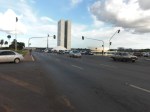
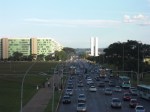
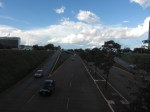
on foot, you are immediately confronted by the unpleasant reality of what is to the pedestrian effectively a huge expanse of carpark and highway separating the areas you might want to be. The functional split between the ‘zones’ only makes this worse.
Again, this is urbanism rather than surveillance, but here are some more musings and pictures on the urban form of Brasilia. Yesterday, I posted a lot of conventionally attractive shots of the buildings around the monumental axis of Brasilia. However, leaving aside the wider question of whether Brasilia outside of the planned centre functions as a city, there is a rather less beautiful side to the core.
This mainly has to do with the practical consequences of the philosophy behind the plan and particularly with functional separation and transport. As I noted when I first arrived, the city is dominated by roads. 5-lane highways run down either side of the monumental axis, and it is crossed by two major motorways in deep cuttings, with all the attendant slipways. These probably look very attractive as bold curving lines on a plan. They may even function if you are traveling by car (or bus). But on foot, you are immediately confronted by the unpleasant reality of what is to the pedestrian effectively a huge expanse of carpark and highway separating the areas you might want to be. The functional split between the ‘zones’ only makes this worse. Say you are in the hotel zone that I was staying in and you want to go out for a meal and a drink. Well, that’s 30-minutes walk to the nearest residential centre (where most of the evening options are located). Sure, you can take a taxi, but why should you have to? All the sports clubs are in separate ‘club zones’ even further away from either hotel, commercial or residential districts.
Now, okay, so the residential districts have most of their facilities (not including clubs) within walking distance – I said in my first impressions blog entry that I could actually imagine living here with a young family. And I still could. Natives of Brasilia are fanatical about the place. The residential districts work. You don’t really have to go anywhere near the soulless and secured shopping centres or take your chances running across massive motorways with uncaring drivers trying their best to ignore you. There is a simple metro system which runs between the districts and the centre (though it was largely closed for the building of new stations when I was there). You can walk around, between and under the blocks. They don’t appear to be totally obsessed with security in the manner of Sao Paulo or indeed most other large Brazilian cities. The blocks have concierges but not fences, walls and gates. Most of the windows do not even have bars.
But there is a reason and a price for this too. The residential zones are simply not socially mixed. Just about everyone who lives in the big blocks is a government or big corporate office employee. The ordinary workers and the poor live elsewhere entirely, in one of the satellite cities of Brasilia, and are bussed in and out via the busy central bus station every day. At the bus station, you find glimpses of the ‘ordinary Brazil’ – the cheap lanchonetes and pastelerias (in fact probably the best pasteleria I have found in Brazil so far)!, sidewalk vendors of DVDs and knock-off jewelry, the beggars, the hungry and the desperate. In many ways I felt more comfortable there than in the dry Le Corbusian dreamspaces of the government buildings.
Anyway, here’s some pictures of the ‘real Brasilia’ – or what it looks like if you stop focusing on the architecture and take a wider view!








 ubisurv