Manchester Airport trials virtual strip-search system

Rapiscan image (BBC)

You would think after 4 years of trials at Heathrow, that British airports would now be able to work out whether or not they could and more importantly, should, use the various varieties of body scanners that are now available. However Manchester Airport is holding another trial starting from now at its Terminal 2. At least it will give a chance for the public to say what they think. The scans are remote – i.e.: the officer observing the images is not on the airport floor, which prevents the kind of scenario we mentioned in our Report on the Surveillance Society of lewd remarks directed at passengers. Personally, I am rather less concerned about this rather abstract view of my body being seen briefly as I pass through an airport than I am about my financial details and personal life being traded between private companies, or about being under constant video surveillance in ordinary public space in the city. However, the images, although ghostly, are detailed enough that genitals, deformities, medical implants and so on can be seen, and if this story is to be believed it would seem that there is no provision for women’s images to be seen by a women alone and men’s only by a man. This will make it entirely unacceptable to some people, in particular members of certain religious groups. But the scans are – at least, for now – voluntary, in that passengers can refuse and have a traditional pat-down search instead.

However, this technology won’t be staying in the airports for long. I reported back in July on stories that terahertz wave scanning could soon be made to fit into portable cameras. That raises a whole different set of social, political and ethical questions…

(Thanks to Simon Reilly for sending me the link)

Racial profiling hits a new low

Just when you think that state surveillance in supposedly free countries could not sink any lower, it has been revealed that UK Border Agency is finding a pilot project into using DNA and isotope analysis to determine the origin of asylum-seekers. This is not a joke or a scare-story. It is a real project. Science Insider has the details here. The Agency is refusing to say who is doing this research for them, nor has it provided any references to studies that show that what they are proposing will work. It appears that most scientists working in the area think it is based on entirely faulty premises and there is no reason to believe it will work. That’s only a minor objection compared to the political and ethical ones of course. As the story in Science Insider points out the Border Agency seem to be making a fundamental (and totally racist) error in assuming that ethnicity and nationality are synonymous. And this research would probably not got past any university ethics committee, which makes one wonder what kind of screening or ethical procedures the Border Agency used, and indeed who would carry out such an obviously unsound piece of research. It’s another example of increasingly unaccountable arms-length agencies (which have proliferated in recent years) using the ‘technical’ as an excuse to bypass what should be a matter of high-level policy, and indeed something that so obviously harks back to the bad days of Europe’s racist and genocidal past that it beggars belief that any sane official would have let this get further than a suggestion in a meeting.

(thanks to Andy Gates for pointing me to the story)

More border madness

I could probably blog all the time just about border surveillance and security issues… Aaron Martin has pointed out the reported latest new development on the Israel-Palestine border, which is an apparently arbitrarily used stamp which allows visitors to visit only the Palestinian territories in the West Bank and not Israel itself. Gaza remain closed to foreign visitors, and effectively an open-air prison camp.

It seems hard to define this as a ‘policy’ since the Israeli government officially deny that any order was given for the new stamp, despite the fact there is witness and photographic evidence of its use. Its purpose seems to be clearly to define for future reference, ‘enemies of Israel’ and to make it as hard as possible for those interested in the welfare of Palestinians to enter Israel.

Locational Privacy

PDF file

The Electronic Frontier Foundation has a very good little report on locational privacy, “the ability of an individual to move in public space with the expectation that under normal circumstances their location will not be systematically and secretly recorded for later use.”

As usual for EFF, it is written in clear, understandable language and is free-to-access and download.

* I’m going to be away up to the mountains for a couple of days, so there won’t be any more posts here until Sunday at the earliest… next week is a slow one here in Japan as it is O-bon, the Buddhist festival of the dead, and many people go back to their family home and offices are generally closed for some or all of the week. I won’t be doing much in the way of interviewing, but I still have quite a few interviews and visits from the last two weeks to write up.

In Tokyo

Well, I’m back in Tokyo, and back in the same community where we used to live. It’s been a while, but the sticky summers haven’t changed much. I’ll be carrying on with my work on my project, Cultures of Urban Surveillance, here… and there have been some interesting recent developments in this area (see the next post). However this will be the last stop on this particular project. I have to cut things short as I’ll be taking up a new job in Canada in September and unfortunately I can’t take the ESRC’s funding with me!

USA, EU and UK all investing in advanced biometrics

News from various sources has revealed that the United State, the European Union and the United Kingdom are all preparing to invest further large sums in advanced biometrics and surveillance research.

According to an anonymous message to Slashdot, in the USA, Department of Justice requisitions for the coming year show “$233.9 million in funding for an ‘Advanced Electronic Surveillance’ project, and $97.6 million to establish the ‘Biometric Technology Center.'”  The former is largely to deal with the problems of intercepting Voice-over-Internet Protocol (VoIP) communications – like Skype. The latter is what Slashdot  calls a “vast database of personal data including fingerprints, iris scans and DNA which the FBI calls the Next Generation Identification” for the FBI. In other words, the architecture of the proposed ‘Server in the Sky’ system, which The Guardian revealed last year – for some notes on this and other systems under development, see here.

Meanwhile Owen Bowcott in The Guardian today has a story which puts together various bits and pieces from the EU’s FP7 Security theme research budget and UK security investment. In the UK, there is to be £15 million spent on updating UK biometric security for embassies, and more interestingly other unspecified ‘surveillance’ purposes, and in addition, rolling out of facial recognition systems to more UK airports. As we know, the controlled environments of airports where people are required to look at cameras, are one of the few place where this technology works properly.

This provides a rather tenuous link to the headline of the Guardian story which is an EU-funded study into brain-scanning (yet again) called Humabio (Human Monitoring and Authentication using Biodynamic Indicators and Behaviourial Analysis). There are lots of these about, and one of them may work sooner or later, but it is worth pointing out that people have been putting out ‘we will soon have brain scanning’ stories since the 1980s and like, nuclear fusion, it always seems to be 5 or 10 years in the future. Brain-scanning seems to be the technology of the future… always has been, always will be?

The beauty and cruelty of Rio de Janeiro

There is no reason why with the same infrastructural, social and economic support as anyone else in society would expect, that the favelas could not become truly beautiful without being cruel…

I am trying to think of something not too banal or cliched to say about Rio de Janeiro. It is rather difficult when I am sitting in my room in this artist’s house in Santa Teresa with its balcony overlooking the whole city centre and the bay and Niteroi on the other side, with bossa nova drifting up from the room below…

Being on a hill though, Santa Teresa is as good a place as any to try to get an initial feel for the geography of the place. Whatever you have read about Rio, however many pictures or films you have seen, it is still impossible not to feel utterly astonished, and in many ways delighted, by the place. Rio is unquestionably the most beautiful city I have ever been in. The shapes of the hills, the curves of the coast, the collision of architectures, the forest which comes right down into the city itself. Flying in, you could see its sprawl (this is a city of over 10 million people), but from the inside it is all small neighbourhoods, and more importantly all edges. One never seems to be entirely in one place in Rio, rather one constantly walks the boundary between city and forest, wealth and poverty, high rise and favela…

Because the poverty and the favelas are also inescapable. Unlike in San Paulo, where the favelas are located more on the periphery and can therefore be ignored by the rich, in Rio the rich and poor neighbourhoods are locked together like the fingers of clasped hands – but are they locked in mutual dependence or a death grip? The richer areas tend to run up the flattest land, whilst the favelas cling to the steeper slopes above and below. The disturbing thing for anyone who would try to form any swift opinion, is how beautiful the favelas are seen from my bird’s eye view. Rio’s beauty is matched by its cruelty, and even its cruelty is beautiful. The houses of the favelas follow the precarious topology of the hills, they pile onto each other, tiny alleys and stairs running in between. Self-constructed, they take the most natural forms that available resources allow, and in many ways are therefore the most human-looking places one can imagine. They most resemble the ancient towns of Greek islands or the Italian coasts, what Donald Ritchie called the ‘crammed mosaic’ of Tokyo neighbourhoods or Cornish fishing villages – the kinds of places that inspire deep feelings of the most intimate community.

But these are places of the most miserable poverty, crime and violence. From the bird’s eye view, you can’t smell the shit flowing in the streets, or see the tired, desperate faces of the inhabitants. It is because the architectural form, whilst it evolves from necessity, is not the cause of the socio-economic problems. Form does not, contrary to a still quite prevalent but regressive moral imagination, lead to a necessary moral or social outcome. The old rightist way of dealing with the ‘favela problem’, which was shared with leftist modernism, was the blank slate. Wipe out the favelas, put the people somewhere else, and everything will be okay. They were wrong. There is no reason why with the same infrastructural, social and economic support as anyone else in society would expect, that the favelas could not become truly beautiful without being cruel, why they could not come to be seen equally much as examples of the perfection of human settlement as Santorini or the old town of Lisbon, Mousehole or Mejiro…

The big question is how they get there. Rio’s multiple edges, its ubiquitous boundaries, are in many ways the most secure borders. The favelas are oppressed both by the most intimate micro-authoritarian internal control of the drug trafficking gangs, the uncaring external ‘prison-wardening’ and exploitation of the police and vigilante groups, and the utter fear and disgust of the richer classes who often see the favelados as nothing but criminals. I can’t suggest easy solutions to the fundamental problems, but part of what I am going to do over the next two weeks is to talk to a whole variety of people about the issues of surveillance and control and how some forms of surveillance should be broken or released and some should be made to work for people, not against them.
The downside of Brasilia

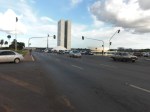
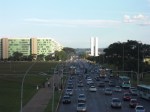
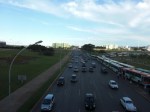
on foot, you are immediately confronted by the unpleasant reality of what is to the pedestrian effectively a huge expanse of carpark and highway separating the areas you might want to be. The functional split between the ‘zones’ only makes this worse.

Again, this is urbanism rather than surveillance, but here are some more musings and pictures on the urban form of Brasilia. Yesterday, I posted a lot of conventionally attractive shots of the buildings around the monumental axis of Brasilia. However, leaving aside the wider question of whether Brasilia outside of the planned centre functions as a city, there is a rather less beautiful side to the core.

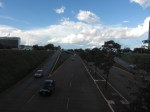
This mainly has to do with the practical consequences of the philosophy behind the plan and particularly with functional separation and transport. As I noted when I first arrived, the city is dominated by roads. 5-lane highways run down either side of the monumental axis, and it is crossed by two major motorways in deep cuttings, with all the attendant slipways. These probably look very attractive as bold curving lines on a plan. They may even function if you are traveling by car (or bus). But on foot, you are immediately confronted by the unpleasant reality of what is to the pedestrian effectively a huge expanse of carpark and highway separating the areas you might want to be. The functional split between the ‘zones’ only makes this worse. Say you are in the hotel zone that I was staying in and you want to go out for a meal and a drink. Well, that’s 30-minutes walk to the nearest residential centre (where most of the evening options are located). Sure, you can take a taxi, but why should you have to? All the sports clubs are in separate ‘club zones’ even further away from either hotel, commercial or residential districts.

Now, okay, so the residential districts have most of their facilities (not including clubs) within walking distance – I said in my first impressions blog entry that I could actually imagine living here with a young family. And I still could. Natives of Brasilia are fanatical about the place. The residential districts work. You don’t really have to go anywhere near the soulless and secured shopping centres or take your chances running across massive motorways with uncaring drivers trying their best to ignore you. There is a simple metro system which runs between the districts and the centre (though it was largely closed for the building of new stations when I was there). You can walk around, between and under the blocks. They don’t appear to be totally obsessed with security in the manner of Sao Paulo or indeed most other large Brazilian cities. The blocks have concierges but not fences, walls and gates. Most of the windows do not even have bars.

But there is a reason and a price for this too. The residential zones are simply not socially mixed. Just about everyone who lives in the big blocks is a government or big corporate office employee. The ordinary workers and the poor live elsewhere entirely, in one of the satellite cities of Brasilia, and are bussed in and out via the busy central bus station every day. At the bus station, you find glimpses of the ‘ordinary Brazil’ – the cheap lanchonetes and pastelerias (in fact probably the best pasteleria I have found in Brazil so far)!, sidewalk vendors of DVDs and knock-off jewelry, the beggars, the hungry and the desperate. In many ways I felt more comfortable there than in the dry Le Corbusian dreamspaces of the government buildings.

Anyway, here’s some pictures of the ‘real Brasilia’ – or what it looks like if you stop focusing on the architecture and take a wider view!