Hot Air on the Surveillance Industry from the UK

Privacy International has produced a much-needed survey of the state of the surveillance industry, following its other excellent report on the use of development aid to push surveillance technologies on developing countries. The British government’s response, voiced by the Chair of the Parliamentary Committee on Arms Export Controls, Sir John Stanley,  has been a typically limp one, largely concerned with the possibility of such systems being sold to ‘authoritarian regimes’ yet blustered and talked of ‘grey areas’ when it came to Britain’s responsibility for this trade.

But this is all way too little too late. I warned of the danger of the increased technological capabilities and decreasing costs of ‘surveillance-in-a-box’ systems as far back as 2008 (see my post here which refers to that). Instead of taking horizon-scanning and pre-emptive action to limit this, Britain, the USA and many other states have encouraged this trade with state aid – as they have with military and security industries more broadly – and, not least, encouraged the use of surveillance on a global scale themselves. Their own extensive breaches of human rights through programs like PRISM and TEMPEST give them no real moral high ground to talk about what authoritarian regimes might do, when they are already pursuing the same actions.

Watching Downtown Tokyo

So, I’m back in Tokyo until next April, revisiting the areas which I examined in 2005-6, where surveillance cameras have been installed by the Tokyo Metropolitan Police, and the wards where I did case-study research on community safety development in 2009 (see my posts in this blog from July to September 2009).

One initial impression is that the progress of video surveillance has not perhaps been as rapid as I would have thought, but it may be that this impression is mistaken. Certainly, the numbers of cameras deployed by the TMP have not increased rapidly. While I looked initially at Shinjuku’s Kabukicho district, where cameras were first introduced in 2002 and Shibuya and Ikebukuro (2004), they were also introduced in Ueno (2006) and Roppongi (2007). The numbers of cameras in these areas and the technologies in use have not changed greatly since their introduction: Kabukicho has 55; Shibuya, 20;  Ikebukuro, 49; Ueno, 12; and Roppongi, 44. The cameras are all in areas associated with the night economy – pink or ‘red line areas’, or what in the UK would be called ‘red light districts’ or places strongly associated with gang-related nightlife activities.

From then there was a gap and nothing happened until this year, when the TMP introduced a small number of cameras into an area they seem to have previously overlooked: the so-called ‘Kabukicho of the East’ – it’s even referred to in this way by tourist guides – Kinshicho in Sumida ward, still very much a rough, working class area. Kinshicho is apparently known for two things: gambling (on horse-racing – it’s not coincidentally the HQ of  the Japan Racing Association) and ‘gaijin bars’ (or hostess bars staffed by foreign hostesses). But, if one examines the crime maps produced by the TMP, Kinshicho is not a particularly high crime area especially compared to its western counterpart, Kabukicho, and there are other areas of dubious repute in Tokyo, so what’s behind this particular move at this time?

AJ201205130014M
CCTV cameras at the Tokyo Sky Tree Tower (Hirotaka Kawakami)

This is simply speculation on my part, and I will be talking to police and others about this in the next few months, but Sumida ward is gentrifying. In 2006, the massive new Olinas shopping complex was built in the Kinshicho area, and then in 2012, the Tokyo Sky Tree Tower, the new communications tower for Tokyo, complete with associated shopping and entertainment complex, landed in Oshiage, just to the north. Shitamachi (literally ‘low city’ – or downtown) areas have become fashionable now and not just among tourists. But this nostalgic search for an older, ‘authentic’ Tokyo, usually that of the post-WW2 period, is limited to safe images of craftsmen, small shops, stand-up bars, street food, hard-work and propriety. Frankly, Kinshicho seems to be seen as an embarrassing throwback to a shadow image of the ‘bad old days’ of the shitamachi of gangs, gambling and the sex trade, that the authorities at least do not want associated with the new and more pleasant presentation they are seeking to create.

But the TMP cameras are only a small part of the story of public space video surveillance in Tokyo, and if one sticks to the police numbers, one would get a very misleading impression. For example, the Sky Tree Tower has been the focus of a major introduction of video surveillance through the main mechanism for public space surveillance in Tokyo, the 2003 Anzen Anshin Machizukuri Jourei (Community Safety Ordinance). This empowers neighbourhood and shopkeepers’ associations to introduce camera systems with support from ward governments and the Tokyo Metropolitan Government. In Oshiage, a very large and locally controversial 77 camera-system was introduced from 2012, with most of the cameras (66) directly around the Sky Tree. Kinshicho also has its TMP cameras supplemented by an even larger number of non-TMP cameras – the Asahi article above claims 47 but it’s unclear whether that includes the TMP cameras or not.

The progress of community safety development is the main focus of my research here this time, so I’ll be visiting Oshiage and Kinshicho in the near future. And I’ll be writing much more about this method of crime control through development planning, as it will no doubt be a key feature of how preparations for the 2020 Olympics are made.

On rejecting drones

There’s an all-too infrequently unquestioned assumption in a lot of popular and academic writing about surveillance, that surveillance just spreads and intensifies and that new surveillance technologies proceed in a teleological manner to fulfill their designed purpose. Sure, we have all read the science and technology studies literature and pay lip service to ideas of technological failure and we all keep searching for ‘resistance’ or even just ‘politics’, but even if, like me, we talk deliberately talk about ‘sociotechnical trajectories’ without trying to assign one possible direction to these trajectories, we very rarely make the retreat, diminution and easing off of surveillance the central focus of our work or our writing.

Drones have been the latest demonstration of this. Practically all my blog entries on the subject over the last few years have been telling a story of the seemingly unstoppable spread of drones from particular military applications to widespread military use, to civilian policing and thence to other government and private uses. So it is really instructive to see the introduction of drone surveillance stopped in its apparent tracks twice in one week. This is exactly what has happened in Seattle, Washington, and Charlottesville, Virginia this week. The Seattle Police Department had intended to implement a strategy of drone surveillance and had purchased two Micro-UAVs (MAVs). But rather than these following the CCTV route of government promotion and general public apathy or support bolstered the usual police surveys showing how ‘effective’ the new technology has been, instead, following massive public concern over privacy,  Mayor Mike McGinn this week returned the two drones to the manufacturer and put a stop to any further development. He stopped short of introducing any ordinance banning drones, as Charlottesville did in the same week with a resolution pledging that the city would not purchase any such technology and calling on the state legislature to introduce an outright ban.

However in many ways the Seattle decision might be more influential as it is a far larger metropolis and this could resonate in major cities across North America – and beyond, given that Seattle is an aspiring global city too. But how influential? We will have to see. Certainly the UAV manufacturers and police associations will try to fight back with renewed PR and sales pitches – I am fully expecting lots of ‘drone success stories’ in the media in the next few weeks and months as a result. But what these two decisions should do is remind us all that the domestic politics of drones is still open, the future is unwritten and there are many possible trajectories – which we should emphasize more than we do.

Surveillance devices get smaller… but it’s privacy that vanishes.

I’ve been blogging for a while about miniaturization and the ‘vanishing’ of surveillance devices. This disappearance occurs in many ways, one of which is the incorporation of high-tech surveillance features into objects and devices that we are already used to or their reduction to a size and form factor that is relatively familiar. Two examples coincidentally arrived in my inbox over the last week.

The first was the news that the US Navy has awarded a development contract for binoculars that incorporate three-dimensional face-recognition technology from StereoVision Inc (who may well be the bunch of  California-based face recog people I met at a biometrics industry show a few years back). This supposedly gets round the problems that standard two-dimensional face recognition has dealing with unpredictably mobile crowds of people in natural light (AKA ‘the real world’). The issue I’m highlighting here however is that we don’t expect binoculars to be equipped with face recognition. Binoculars may not be entirely socially acceptable items, and already convey implications of creepy voyeurism when used in urban or domestic situations, however this is something else entirely.

NY-CD236_NYPD1_G_20130123200238
Small terahertz wave scanner being tested by NYPD in January (NYPD_

The second is the extraordinarily rapid ongoing progress towards working handheld terahertz wave technology (a far more effective form of scanning technology than either the backscatter x-ray or millimeter wave systems used in the bulky bodyscanners currently in use at airports). Just four years ago, I noted the theoretical proof that this was possible, and last month, it was revealed that police in New York were testing handheld terahertz wave scanners, (Thruvision from Digital Barriers) which of course people were likening to Star Trek’s tricorders. The idea that the police could perform a virtual strip search on the street without even having to ask is again, a pretty major change, but it’s also the case that the basic technology can be incorporated into standard video camera systems – potentially everyone with a mobile phone camera could be doing this in a few years.

I’m not a technological determinist, but in the context of societies in which suspicion, publicity and exposure are becoming  increasingly socially normative, I have to ask what these technologies and many others like them imply for conventional responses based on ‘privacy’. Privacy by design is pretty much a joke when the sole purpose of such devices is to breach privacy. And control by privacy regulators is based on the ability to know that one is actually under surveillance – when everything can potentially be performing some kind of highly advanced surveillance, how is one able to tell, let alone select which of the constant breaches of privacy is worth challenging? So, do we simply ban the use of certain forms of surveillance technology in public places? How, would this be enforced given that any conventional form factor might or might not contain such technology? And would this simply result in an even more intense asymmetry of the gaze, when the military and the police have such devices, but people are prevented from using them? Do we rely of camouflage, spoofing and disabling techniques and technologies against those who might be seeking to expose us? You can bet the state will not be happy if these become widespread – just look at the police reaction to existing sousveillance and cop-watching initiatives…

The Iconography of High Velocity DNA tagging

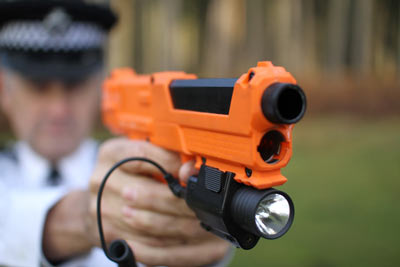
There’s been quite a lot of media coverage in the last few days about the ‘High Velocity DNA Tagging System‘, made by UK company Selectamark, and apparently in line to be purchased by several UK police forces. The system uses a kind of airgun that can fire “a uniquely-coded DNA pellet” for up to 30-40 metres, which “can be used to mark an individual so that they can be apprehended at a less confrontational time for officers.” Claims on the website include one that the microdots of artificial DNA can penetrate through clothing and mark the skin of individuals, and also that the artificial DNA used can result in ‘infinite number’ of unique numerical identifiers.

None of this is entirely new: Selectamark is a company who’s core business is anti-theft marking of equipment, and essentially what they have done is create a gun-based delivery system for an existing technology that was previously used to mark things, thus turning it into a system for identifying individual human beings, in much the same way as has been suggested would occur with RFID implants (but which has not yet really happened in any widespread fashion). Like RFID, the identification is not biometric, i.e. resulting from unique bodily characteristics, but what amounts to a high-tech form of instant temporary tattooing or paint-marking. The company is silent on how temporary this is – and whether the microdots – which are just visible, but show up better under UV light – can be easily removed or washed off by those tagged.

What’s also really interesting is the imagery deployed in the website. Of course there are the usual images of policemen with large guns (here complete with light source for night-time use). These guns, like tasers, have an interestingly toy-like quality to them with their bright orange plastic finish. Guns that aren’t really guns…

selectadna-high-velocity-pistol-400

However what’s more interesting are the background images used on the site. The targets of the tagging system are clearly depicted in one background image and will be recognisable to all British readers – ‘hoodies’ – the marginalized urban youth who were implicated in the rioting in London in 2011 (although there is also an inevitable pop culture association, especially with all that light-saber-y UV around, with the evil Sith from the Star Wars franchise).

slider2

The youths are depicted encircled in lines of UV-like light whose coils also reflect the image of DNA, which is used here as another background image.

slider

The late Dorothy Nelkin and M. Susan Lindee described DNA as a ‘cultural icon‘, and indeed, the never-really-explained ‘artificial DNA’ technology which underpins Selectamark’s product seems deliberate discursively confused with exisiting DNA identification technologies, or at least the association is clear: that DNA fingerprinting, which is already understood in media discouse as standing for absolute certainty as to identification, is ‘the same’ as this technology. And clearly this sounds better than associating it, as I did earlier, with tattooing – which has a much less wholesome image when it comes to the state’s usage (Nazi death camps etc.).

And then the lines of light that surround the youth also seem to beam out across and enclose the entire world, which is both a standard marketing trope (“we are a global company”) but also a shift in scale that reflects the way in which security and surveillance has moved, to encompass the globe. The world is also depicted as dark with the suggestion of a coming sunrise (fitting in with the overall ‘crime lurks in the darkness and Selectamark will shine a (UV) light in it” theme) and almost entirely urban:

slider3

But then what is the value in this global world, which Selectamark (and the police) are seeking to protect? What is the source of the light? Well, the answer, in the final background image, will surprise no-one. It isn’t those who need justice, the poor, the downtrodden, the huddled masses, it’s big companies:

slider4

The corporate sector is depicted as icons streaming information-superhighway style from the light along grid patterns: rational, clean and bright and filling, overcoming, the darkness beyond, in a corporate version of the creation story in the Book of Genesis. We are saved! Thank-you, Selectamark and your High Velocity DNA Tagging!

Canadian police to expand drone use

qube_mediagallery
AeroVironment Qube (avinc.com)

The Royal Canadian Mounted Police (RCMP) are investing more in micro-UAVs, in particular little remote-control surveillance helicopter drones, according to the National Post today. The new drones will be the quad rotor AeroVironment Qube model, one of the most popular small drones used by police worldwide.

According to the police themselves, they will limit the use of the drones to “accident reconstruction, search-and-rescue operations, major crime scenes and situations involving emergency response teams”, however as the article also notes, they don’t actually have a formal policy on the use of UAVs, and as with other controversial purchases by Canadian police, for example the LRAD accoustic weapons in Toronto and Vancouver, this highlights how little oversight there is of what technologies police can purchase.

(Thanks to Chris Prince for the story)

War on Terror corrupts US justice

On January 1st this year, US President Obama signed into law the National Defense Authorization Act (NDAA) that, amongst other many other provisions, allows for the US military to indefinitely detain without trial anyone suspected of terrorists acts inside the United States and, the same for anyone captured in battle wherever it is in the world. Even the UK’s provisions, which were widely criticised, were nothing like this, indeed the argument was not about indefinite detention at all, but simply over how many days someone suspected of terrorism should be allowed to be detained without trial: 14 or 28. That’s some way short of indefinite.

Of course, the infinitely compromising and slippery Obama is trying to have his cake and eat by promising that he will not actually allow this power to be used except in strict accordance with the constitution. That may provide some temporary relief for US citizens accused of terrorism, at least and until a more gung-ho President is elected or Obama gives in to demands that he must use it – something military sources are looking forward to, it seems. However the provisions on the treatment of foreign captives effectively provide a legal footing in domestic law for the extrajudicial actions of former President Bush’s establishment of Guantanemo Bay and the associated global network of extraordinary rendition and torture / interogation sites. They undoubtedly contravene the Geneva Conventions (see 75 UNTS 135, for example)and several other aspects of International Law, notably the International Covenant on Civil and Political Rights.

But, this is far from the only current assault on the rights of those who remain innocent in law of any criminal act in the USA. In New York, for example, the New York Police Department in conjunction with the CIA was last year revealed as operating a secret surveillance program against Muslims, titled ‘Ancestries of Interest’. It is unlikely to be the only such program. Like Obama’s indefinite detention provision, this is a perversion of the constitutional rights of US citizens. US police forces from the FBI downwards are not generally permitted to use undercover agents without there being some kind of specific allegation or exisiting evidence of crime. Essentially, this makes a whole community subject to categorical suspicion and permanent infiltration and investigation. It seems that every level of policing and justice in the USA from investigation to trial to sentencing has been indelibly stained by the War on Terror.

But this has all happened several times before of course, and happily not everyone has forgotten their history. Now black Christian pastors who remember the FBI/NSA COINTELPRO operations of the 1960s against black radical and civil rights groups,  are reportedly joining with Islamic groups in opposing the NYPD’s racist and islamophobic surveillance program. Along with the challenges being mounted to Obama’s new law by ACLU and others, there are signs that Obama is no longer being given the benefit of the doubt by many of the groups who supported him first time around. How successful any of these moves will be is anyone’s guess but solidarity that moves beyond American Islamic groups having to defend themselves against the howling mob is something of a step forward.

Rio police invade favelas ahead of FIFA World Cup and Olympics

As I, along with many others, predicted as soon as it was announced that Rio de Janeiro would host the two most globally important sports mega-events, the Rio authorities have launched a major drive to occupy and ‘pacify’ a growing number of the most significant favelas (informal settlements) in the city.

The rationale behind this is to drive out the gangs which control many of these communities. To this end a series of special police units has been created, the UPPs, which attempt to gain control of the settlements. Early experiments were in three favelas, one of which, Santa Marta, I visited in early 2009, when, along with Paola Barreto Leblanc, I conducted interviews with community association leaders and police.

Just last week the police moved into the largest favela, Rocinha. Unusually with police raids of this kind, there was little overt violence and ‘collateral damage’. This is certainly an improvement on some previous operations. However, not everyone was that impressed. This video from ITN News shows the stage-managed nature of the event, which seems to have been largely a demonstration of the ability of the Rio authorities to produce security on demand. As the reporter notes, only one person was arrested which means that hundreds of gang members (in this case of the Amigos dos Amigos, AdA, or ‘Friends of Friends’) will either have fled or remain in the favela.

The plan is apparently for the net to be widened still further, with Sergio Cabral, the Governor, claiming that 40 UPPs will be established, including very soon in the Mare Complex, 16 favelas with over 130,000 in all, which is vital to the preparation for the mega-events as it is close to the international aiport and other major transport links from Rio to the economic hub of Brazil, Sao Paulo. Many AdA members from Rocinha may have fled to the Mare Complex and at some point the pacification is bound to be become violent and less media-friendly. There are also, at least two other alliances of gangs who occupy other important favelas.

The current authorities have also started to emphasize the ‘community-building’ intention of these pacification measures, but it should not be forgotten that almost the first act that Cabral and his sidekick, the Mayor of Rio, Eduardo Paes, implemented on coming to office was to cancel the internationally-praised slum-upgrading program, favela bairro (see some thoughts I had on this after my interviews in 2009) of the former Mayor Cesar Maia, which was aimed at a much deeper and longer-term improvements not just at appeasing middle class voters and impressing the International Olympic Committee and FIFA. We will also see whether, like in Santa Marta, the initial community building efforts are undermined (or perhaps aided) by the installation of surveillance cameras

GPS tracking goes mainstream

There is increasing evidence that US police forces are now using GPS tracking devices regularly and with impunity. Following court rulings at different levels which have left the legal situation unclear with only the Supreme Court left (this coming week), police forces across the country have been slapping GPS trackers on thousands of private vehicles, without warrants, and until recently, without the knowledge of those being tracked.

However, Wired‘s Threat Level blog has been reporting on the growing numbers of cases of Americans who have discovered GPS trackers on their cars, and in one particularly bizarre case, a device that was replaced by undercover officers while the Wired reporters were in the vicinity, having just removed and photographed the original device!

There are many pictures and manufacturers’ detail on Threat Level. Here are a couple…

GPS tracker in place:

GPS tracker disassembled showing souped-up longlife battery, including manufacturer’s details:

One of the more perplexing things about the use of these devices is what recourse the US citizen has when they discover them. If they are placed ‘legally’, do you have the right to remove or indeed to disassemble them? What would be done if they are removed? The experience of Wired would suggest that the device would be replaced, but how many times could this go on? At what point would the state take some kind of legal action to attempt to prevent the removal of a device? In the case of location tracking devices that are known about but unable to be legally removed, surely you have a situation that becomes equivalent not to simple (if it is even simple) unwarranted surveillance, but to electronic tagging.