As if the govenrment wasn’t in enough of a bind over the police National DNA databases, in a landmark ruling yesterday, the High Court of England and Wales has decided that the DNA of the innocent should not be on the database in the current legal circumstances. The man from County Durham was maliciously accused of assaulting a pupil at the school at which he was a teacher, and despite volunteering for questioning was arrested, fingerprinted and swabbed. These records were of course kept despite his innocence.
This story reminds us that being on the NDNAD is not an isolated thing, but part of a complex network of records that do imply suspicion (like it or not) – even Sir Alec Jeffreys, who pioneered DNA fingerprinting, thinks so… in the case of this teacher, he would have been wrongly suspected every time he applied for jobs working with children.
This is another indication that the government’s policy on the DNA database and police tactics to populate it, have been not just morally questionable but illegal, and confirms that the response issued this week was inadequate and devious. It will be interesting to see how they might now immediately have to modify their plans to conform to this new ruling (which, being a British court, they can hardly blame on ‘un-British’ European law)…
The government’s official response to the damning ruling by the European Court over the retention of DNA and fingerprint samples and data is a farce, which seems utterly contemptuous of the ruling and reasoning of the court, shows no sign of understanding the significance of Article 8 or the British common law principle of innocent until proven guilty.
One thing that has struck me recently in the UK has been the sudden increase in the level of defensiveness by New Labour over the surveillance apparatus it has constructed over the last 12 years. Report after report has damned their slapdash attitude to human rights and civil liberties – we expect the government’s official response to the Lords Constitution Committee report next week – and there have been attacks from various political ‘big beasts’ including David Blunkett, former MI5 Chief Stella Rimington, and most recently Stephen Byers and even current cabinet ministers reportedly asked for the ID card scheme to be scrapped.
However, in the second category, today we got the government’s official responseto the damning ruling by the European Court over the retention of DNA and fingerprint samples and data by the UK police. It is, to put it mildly, a farce, which seems utterly contemptuous of the ruling and reasoning of the court, and shows no sign of understanding the significance of Article 8 for individual liberty. Mind you, it also shows little sign of comprehending the British common law principle of innocent until proven guilty.
The government proposals are to retain the DNA samples and profiles, and fingerprints (these are just as important and not so often mentioned in the news reports) of all those convicted of a crime. Of the innocent, the National DNA Database (NDNAD) has around 350,000+ people who are certainly in such a position, however the police apparently need two years to go through the Police National Computer to check the other 500,000+ DNA profiles of those not convicted of any crime, as they can’t be sure whether existing profiles match to those who have committed offences (so much for joined-up government…). Then those people, who are, let’s not forget, entirely innocent in law will be sorted into two categories – those arrested but not convicted for serious and violent offences, and those arrested and not convicted of minor offences.
Will the latter have their profiles immediately removed, as we might reasonably expect?
Err, no.
In fact, these innocent people will have their DNA profiles and fingerprints retained for 6 years – more than the number of years (5) that Scotland retains the DNA of those suspected of serious and violent offences. Those in the latter category will have their DNA profiles and fingerprints retained for 12 years. In addition the profiles of children will be retained until they are 18, and then removed only if they have been arrested (again, not convicted) for one minor offence.
Is this an acceptable response? Quite clearly not. It is against the spirit of the ruling by the European Court, even if it might be interpreted as complying with the exact wording issued. More to the point, it is an attempt to get around the difficult issues, not deal with them. It is devious, based on the pre-emptive logic of risk-surveillance principles, and goes against the long-standing principles of British Common Law as well as more recent developments in Human Rights law, and is not the response of a government that has any trust in the people who elected them. It allows the police to continue to populate the NDNAD by stealth. And they certainly are using whatever methods they can to do so – for example, one key indicator is the rise in the number of stop and searches under Section 44 of the Terrorism Act, which in London, it was also reported today, rose from 72,000 in 2007 to 170,000 in 2008, a rise of 236%, however it rose by 325% amongst the black population. There seems to be no mention of the role that discriminatory stop and search policing plays in populating the NDNAD in recent government statements, however it is quite clear that stop and search policing is discriminatory, and we know too that young black men are disproportionately represented in the NDNAD.
In this climate, with a government obsessed by pre-emptive security to compensate for its growing loss of power and trust, and a police service that appears, after the G20, increasingly out-of-control, what is the chance of developing a fair, accountable, just and transparent system of personal data retention in law enforcement in the UK? At the moment, it could appear, the answer is ‘very small’.
It has been revealed that the British government has been passing information gathered by the police on citizens to private companies. The Guardian todayshowed that data on climate change protestors found its way from the police to the ridiculously-renamed Department for Business, Enterprise and Regulatory Reform (BERR) to power company, E-ON.
Now, of course the government can argue that electricity supply is a matter of ‘resilience’, ‘contingency planning’ and ‘national security’, but then how can they justify it being in private corporate hands in the first place? How exactly can companies whose primary aim is to provide ‘shareholder value’ at all costs, many of whom are transnationals that have no commitment to the UK, be treated as if they were state organisations, and be given data from state databases? The boundaries between public and private are being increasingly eroded, and once, again it is the relationship between citizen and state which suffers.
The government cannot just give data, especially data which was collected in very questionable ways for highly dubious reasons in the first place, to whoever it thinks might find it useful. This kind of action shows that the the state is now quite often simply the servant of private enterprise, and the police no better than an adjunct to private security. It makes a mockery of regulation of surveillance power and data protection, and does nothing for our already-weakened trust in the state’s ability to protect our rights or or information.
In the latest dispatch in the British state’s ongoing war on photographers (or was that supposed to be terrorists?), a father and son from Austria have been ‘ordered’ by two policemen to delete pictures of bus and tube stations from their digital camera. Klaus and Loris Matzka were told that it was ‘strictly forbidden’ to take such pictures and the police took their personal details including passport numbers and the addresses of the hotel where they were staying.
This is harassment and intimidation, pure and simple. Later The Guardian quotes the Metropolitan Police as sating that they “had no knowledge of any ban on photographing public transport in the capital.” This is a curious way to put it. It is not a question of the police’s knowledge of a ban. There is no ban. The police are well aware of this.
The Met in particular, are currently way out at the edge of their powers and pushing the envelope rather too far, but it seems with relative impunity. As I have written before, they seem to think it is suspicious to be interested in CCTV. It is also apparently suspicious (if not ‘strictly forbidden’) to take pictures of almost anything. But there’s much more. This is also the same force that invaded Parliament mob-handed to arrest Conservative MP, Damien Green, for it now seems, entirely political reasons. This is the same force whose officers have been captured on camera beating protestors – and who may have caused a passer-by to die of a heart-attack. This is the same force that keeps tabs on law-abiding protestors nationwide in case they might break the law, and that provides offices to private organisations running their own intelligence operations (ACPO). And, let us not forget, this is the same force whose incompetent surveillance operation resulted in the shooting of an innocent Brazilian man in the mistaken belief that he was a terrorist.
The Metropolitan Police needs to have a serious lesson in the liberties that they are supposed to be protecting, not restricting. Rather than learning the lessons of inquiry after inquiry, officers (and whether it is more than indvidual officers, one cannot say) appear to be out of control and making de facto policy by intimidation. Surely, this cannot be allowed to continue?
Marina Hyde in the Guardian last week wrote a very interesting piece on the ongoing fallout from the death of Ian Tomlinson at the G20 protests in London. She argued that the appearance of mobile telephone camera foogtage, which revealed more about the way the police treated the passerby, showed that this kind of inverse surveillance (or what Steve Mann calls ‘sousveillance’) was the way to fight the increase of surveillance in British society.
I’ve been suggesting this as one possible strategy for many years too, however what Hyde didn’t really deal with is the other side of the coin: the fact that the authotorities in Britain already know that this is a potential response and are trying to cut down on the use of photographic equipment in public places. Anti-terrorism laws already make it illegal to photograph members of the armed forces, and in the new Counter-Terrorism Act, there is a provision to allow the police to isue an order preventing photography in particular circumstances. Further, it is now regarded as suspicious by police to be seen taking an interest in surveillance cameras.
The bigger issue here is the fight for control of the means of visibility, and the legitimate production of images. The British state is slowly trying to restrict the definition of what is considered to be ‘normal’ behaviour with regards to video and photography. In the new normality, state video is for the public good, but video by the public is potential terrorism; police photographing demonstrators is important for public order, but demonstrators photographing police is gathering material potentially of use in the preparation of a terrorist act.
However, I am not 100% in favour of the proliferation of cameras, whoever is wielding them. I think it’s essential that we, at this moment in time, turn our cameras on an overintrusive and controlling state. However a society in which we all constantly film each other is not one in which I would feel comfortable living either. A mutual surveillance society in which cameras substitute for richer social interactions and social negotiation, is still a surveillance society and still a society of diminished privacy and dignity. I worry that sousveillance, rather than leading to a reduction in the intrusiveness of the state, will merely generate more cameras and more watchers, and merely help reinforce a new normality of being constantly observed and recorded.
Over the last two weeks, we’ve talked to all kinds of police. We’ve talked to officers, both senior and junior from the Policia Militar (PM), the state-level equivalent of the French ‘gendarmerie’ or Italian ‘carabinieri’, including some who have been rebranded as ‘Policia Communitaria’; we’ve met guys from BOPE (the Rio-specific special operations group within the PM here) – and hopefully we will meet their Commander today; we’ve interviewed the Subchefe of the Policia Civil (PC), the detectives, again based at state-level; and we’ve visited the headquarters of the Guarda Municipal (GM), the relatively recently-formed city police. I haven’t talked to the firefighters, another military-state legacy, who are still an armed force, although a report from the State parliament in January recommended that they be disarmed. Back when I was in Brasilia, I also had a meeting with the Policia Federal (PF), the Brazilian ‘FBI’, another post-dictatorship development, who operate at federal level.
It is a confusing organisational landscape, and not just for me. Throughout the interviews with all the different representatives, very different perspectives emerged on what is important in policing, which force is more important and for what purpose, to what extent the current system works, and what would be the best way forward. Corruption was also something that came up time and time again, with everyone arguing that their force was improving and dealing with this, but hinting that there was still a problem with other kinds of police. There was lots of talk of ‘new generations’ of officers free from the taint of the past. But at the same time it was quite clear on the ground that people from all social classes still do not trust any of the police in general, even when they have established quite positive personal working relationships with officers in their own community.
Cesar Couto Lima, Diretor de Operacoes of the Guarda Municipal
The GM are less than twenty years old and they ‘know their place’ in the hierarchy of police: at the bottom. They are not true ‘professional police’ in the sense that they have only three months basic training, followed by some specialist extra work. They are really somewhere between police and a private security force that just happens to be employed by the city – their commanders at the top level are however, ex-PM. They do, however, have a growing field of responsibility, acting both as a kind of protective and preventative force on the ground in the city centre and as a street-level agency of the ‘eyes on the street’ form of surveillance.
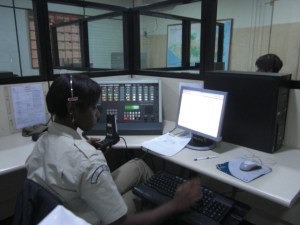
Operator in the Guarda Municpal emergency control room
They also act as the emergency services co-ordination, and this role will increase and be better integrated and funded in future. They are largely disarmed, though not because as many believe, the law prevents them from being armed. This is a strategic decision based on keeping a clear line between them and the PM. This is also the reason why they have a different uniform (in Rio a kind of unflattering beige) from the PM (blue). In our interview with the Director of Operations, Cesar Couto Lima, we were told that in the past, the uniforms had been the same colour but that this had been changed under the last mayor, Cesar Maia, to prevent GM officers from being shot by criminals in the mistaken belief that they were PM. They now have a very low rate of injury and death. The Dir Ops also wants to increase the numbers and in the very long term for the GM to be the be the main police force of a disarmed and less violent city.
It is a fine aspiration, however the new Mayor Eduardo Paes, has apparently suggested that the uniform is changed back to blue and that there should be more arming of the GM. The Dir Ops is utterly opposed to both, and I think he sees it as a deliberate ploy to give the impression of more PM around – the State Secretary for Security has already announced a plan to increase the numbers of PM in Rio by thousands, as we found out when we visited his office. The officers we met at the GM were generally pleasant, relaxed people, however the GM is not immune from corruption. I have heard allegations of extortion from street traders, the poor and criminals, in much the same way as gets reported of the two main forces, and indeed of death threats to officers who refuse to get involved with such practices. Any generalised or regular arming of the GM would only increase the temptation to act on the new power in an irregular way, and also, with so many weapons in the hands of relatively poorly paid and untrained officers lead to greater numbers of killings and a further channel for criminals to obtain weapons.
Ricardo Martins, the Subchefe of the Policia Civil would also like to see a demilitarisation of the police in the long-term. He argued that basically, the PM should be gradually abolished and absorbed into a purely civil police. He was also strongly in favour of more ‘intelligence-led’ and surveillance-based solutions, rather than force of arms or numbers. According to him, the expansion of the video surveillance system in the city was essential and absolutely necessary if the city was to be ready for the 2012 soccer World Cup (to be held across Brazil) and more particularly for the 2016 Olympics, for which the city is a frontrunner. All the senior officers an officials with whom we talked agreed that currently it was nowhere near ready. The GM also agreed with the expansion of CCTV, although they seemed to think that they would have a greater role in operating the systems in future, talking of plans for neighbourhood control rooms integrated with the emergency services control system. Neither the PC, nor more importantly, the Superintendente de Commando e Controle of the State, Claudio de Almeida Neto, gave any indication that this was the direction in which things were proceeding. Indeed the Superintendente was quite clear that there was a greater centralisation, co-ordination and professionalisation of video surveillance operations taking place through his office and his control room, which is in the old ‘Centro do Brasil’ railway station. The office of the Secretary of State for Security seemed not to be that interested in surveillance at all, and commented that it was very expensive, which suggests that the funds for the expansion of the video surveillance system that all expect, whoever they think will be running it, may not be quite as lavish as they believe or would want. I will write more about this later. The PC, however has the reputation of being the most corrupt of all the forces. Subchefe Martins pointed to the internal investigations branch as evidence of the effectiveness of their fight against corruption. Other interviewees were not as easily impressed!
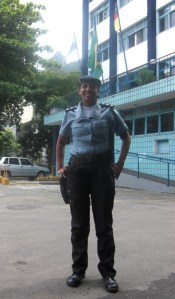
Capitao Pricilla, Head of Santa Marta Community Police initiative
So where should policing in Rio go? One way forward was obvious when we interviewed Capitao Pricilla, the current ‘star’ of the PM, who heads up the Community Policing initiative in Morro Santa Marta. Capitao Pricilla is a PR-dream: attractive, articulate, intelligent, convincing in her arguments, and clearly dedicated to her work with the community. She is everything you would hope a new generation of younger PM officers would be, and she clearly stated that she is part of a new generation. And she is popular too. As we talked with her, officers would constantly come over just to say ‘hello’ and older women in particular, would treat her like a TV celebrity. Now, of course I am wary of the way in which such charisma would make her an obvious choice to head such an operation, which is much promoted as ‘the way forward’ in the media. However there have been many ‘ways forward’ before which have come to nothing and Rio is constantly making and destroying innovative initiatives before they even have a chance to have a real effect. The Santa Marta initiative probably cannot be replicated in many favelas, like Prazeres, where there is a more intimate relationship with the ‘parallel power’ of the traffickers. But Capitao Pricilla seems like the real deal. Let’s hope that she and officers like her get the support they need and are not undermined by the violence and corrupt practices of so many of their colleagues. It’s a utopian hope perhaps, and Rio is still going to need the other far more aggressive hand of the other attempt to get around corrupt practice in the PM, the BOPE – about whom I will write more after our visit today – as much as it needs the helping hand of Community Policing initiatives for a while. It is that large and less articulate mass of PM and PC officers who have no interest in doing anything different, and the equally corrupt politicians who prevent change for their own selfish reasons, that are the main barrier to any organisational change.
From today, private lives in the UK will be a little less private, as EU Directive 2006/24/EC becomes part of national law.
Traffic data on e-mail, website visits and Internet telephone calls now have to be recorded and retained by Internet Service Providers (ISPs). Specifically, the Directive mandates the retention of: the source of a communication; the destination of a communication; the date, time and duration of a communication; the type of communication; the type and identity of the communication device; and the location of mobile communication equipment.
This is coming into force despite the fact that many countries and ISPs still object to the directive. It has to be said that many ISPs are objecting on grounds of cost rather than any ethical reason. German courts are yet to determine the constitutionality of the directive and Sweden is not going to implement it at all.
As with many of these kinds of laws, it was rushed through on a wave of emotion after a particular ‘trigger event’ – in this case, the 7/7 bombings in London in 2005. There was a whole lot of devious practice in the Council of Ministers to get it passed too – if the Directive had been considered as a policing and security matter, it would still have needed unanimity, which means that the objections of Germany and Sweden would have vetoed the Directive. Instead, it was reclassified as ‘commercial’ on the grounds that it was about the regulation of corporations, and commerical matters need only a majority vote. How convenient…
The Home Office in Britain says our rights are safe because of RIPA, which is hardly cause for rejoicing. My main concerns, apart from the fact that this is yet another moment in the gradual erosion of private life, are that:
1. police access will rapidly become routine rather than specific, and this could be extended to many other public authorities – the original drafts of the Communications Bill would have extended the right of access to such data to all RIPA-empowered organisations (which includes most public authorities);
2. the data will be used illicitly by ISP employees for criminal purposes (remember that most identity thefts are inside jobs) – the records will be a blackmailers delight;
3. there will more ‘losses’ of this data by ISPs and others who have access to it. Remember the accidental revelation of user data by AOL in the USA?
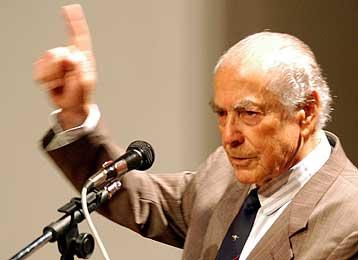
One question that has been preoccupying my thoughts recently has been the question of why the simple things are not being done in Rio to address the problems of the favelas: sanitation, education, healthcare etc… many of the people we have talked to look back to the regime of Leonel Brizola, the Governor of the State of Rio de Janeiro from 1983 to 1987 and then again from 1991 to 1994. Brizola was a left-progressive populist, a social democrat and a former opponent of the dictatorship who had had to live in exile for much of the 1970s. Sadly he died in 2004, but we had the opportunity this week to talk to his former Secretary of State for Public Security, and also briefly Governor himself from 1994-5, Nilo Batista.
We met Professor Batista in the Instituto Carioca de Crimonologia (ICC), an independent research organisation, which he runs (and funds from his legal work), along with his wife, sociologist, Vera Malaguti Batista. The Institute is housed in a sleek modern building up in the hills of Santa Teresa, from whose picture windows the city below is all but invisible and the bay appears almost as it was when Europeans first arrived. However, the concerns of the Institute are very much with the reality of the city today.
We had a long and wide-ranging conversation, which would be impossible to recount in detail here, but the basis of it was an understanding of Brazilian society, and in particular that of Rio, based on the ongoing legacies of the past, in particular slavery and authoritarianism. Vera Malaguti’s book, O Medo na Cidade do Rio de Janeiro: dois tempos de uma historia (Fear in the City of Rio de Janeiro: one story in two periods) examines previous periods of revolt by Africans in Brazil and argues that the often unspoken elite fear of the africanisation of Brazil. They argue that repressive public security strategies today are founded in this same fundamental fear, driven by the media that serves the powerful middle classes who aspire to elite values and lifestyles.
In opposition they place Brizola and that brief (and they argue, unrepeated) period at the end of the dictatorship when social justice and in particular, education, were priorities and favelas were provided with services in the same way as any other neighborhood. The security strategy of Brizola and Batista was effectively one of anti-stigmatisation. They argue that since then, media-driven fear and repression has been far more the norm and this had undermined the progress made under Brizola.The current public security-based strategy of the Governor Cabral and the ‘choque de ordem’ of Giuliani-wannabe Mayor Eduardo Paes, is one example. By concentrating on ‘pacifying’ one or two places as examples (Santa Marta and Cidade de Deus at present) without being able to afford the same strategy elsewhere, it constitutes simply a public relations exercise, and elsewhere repression without development continues as normal.
The Batistas are passionate and well-motivated, but there are many who argue that this picture of a progressive Brizola regime subsequently undermined by repressive policies is at the very least, a limited view. It was, after all, under Brizola that the traffickers grew in power and acquired weapons; the mid-eighties was the key period here as the cocaine trade grew from almost nothing to being the driving force of gang activity in Rio. This isn’t just a view held by political opponents: whilst he certainly does not (and could not with any justification) claim that the rise of the cocaine trade was anything to do with Brizola, Enrique Desmond Arias in Drugs and Democracy in Rio de Janeiro, argues that the personalist populism of Brizola undermined the leadership of the Community Associations in the favelas and left them open to co-option by drug gangs. When we visited the office of the current Secretary of State for Security, Jose Mariano Beltrami, and talked with his representative, it was quite strongly argued that Brizola neglected the issue of the growing arming and violence of drug traffickers, and also did nothing to solve the massive problem of police corruption (on which I will write more later). The current longer-term strategy is now to recruit a lot more Military Police, in the hope that numbers will do what force has not, and enable the gangs to be beaten.
We also visited the office of a leading critic of human rights abuses, Alessandro Mollon, a Deputy in the State parliament. He said that Beltrami is actually shifting, without ever having admitted to it, from a very macho and repressive approach when he first arrived from the southern state of Rio Grande do Sul, to a more considered (but hardly progressive) strategy now, of which the emphasis on police officers on the streets, rather than invasions, is one aspect.
Former Mayor of Rio, Cesar Maia
The claim that Brizola was the last real progressive figure to lead Rio also neglects some others, particularly those who have held the office of the Mayor. Under Cesar Maia (1993-7; 2001-2008), the ‘Favela Bairro’ program had much in common with what Brizola did in social terms. Indeed when we asked the leader of the Morro dos Prazeres Community Association what would be the one thing she wanted above all else, it was ‘more Favela Bairro’. In Dona Marta they also had some time for the former governor, Anthony Garotinho (1999-2002) a frankly quite foolish evangelical populist, currently under investigation for corruption, as is his wife, Rosinha, who was Governor from 2003-7. However, we heard from others that the things that they attribute to Garotinho were actually planned or initiated under previous administrations and just did not see the light until his.
What is certainly the case is that Brizola had a better attitude to the favelados as people, than other administrations, regardless of his mistakes. The current regime certainly seems to be more driven far more by middle-class fears than by social progress, but it is also the constant undermining of the progress of previous administrations like Brizola’s and then later Maia’s terms as Mayor by new waves of media-courting repression that is so depressing in Rio. It happens in every democratic country, but here in Brazil there is the most blatant inequality of any wealthy country still crying out to be addressed. If it was, then most of the issues of ‘crime’ and ‘insecurity’ would start to disappear. It would, as Deputado Mollon also pointed out, be a lot cheaper than the massive amounts of money now going into the hands or private security companies – who, as Professor Batista noted are often run by the families of senior police officers, who therefore have no actual interest in reducing crime and every reason to want to see fear continue to grow.
(With thanks to Nilo Batista, Vera Malaguti Batista, Alessandro Mollon and the staff of the office of Jose Mariano Beltrami for their time and patience. In particular, I hope to return to the Instituto Carioca de Criminologia sometime in the future to talk about the findings of this project, and to submit something to their excellent journal, Discursos Sediciosos: crime, direito e sociedade)
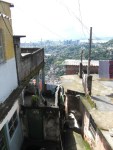
One of our most interesting visits last week was to the favela of Morro dos Prazeres, north-west of Santa Teresa. Prazeres has one of the most astonishing views of Rio of any neighbourhood, with an almost 360 degree panorama of the city, it’s perspective to the south only interupted by the statue of Christ the Redeemer, which is hardly a bad view in itself! You might think that the last thing that favelados would care about was the view but they are well aware of the beauty of their location – the assumption that the poor an desperate would not care about such things is a rather patronising misconception. Elisa, the leader of the community association, at least, seems most proud of this asset and says that like many people she wouldn’t want to live anywhere else even if she won the lottery!
But Prazeres does have serious problems. For a start, it is a ‘hot’ favela, occupied by drug traffickers, who control ‘law and order’ in the place. There is therefore no ongoing police presence, although as with many such communities, the community association does have a relationship of sorts with local military police commanders through organised coffee mornings at which problems are discussed. Luckily, despite or because of the almost complete control of a particular gang which is well integrated into the community (i.e.: they are relatives of the more law-abiding members), there are not many problems with violence and the police, ‘thank God’ (says Elisa), have not raided the favela recently, as they have many others.
In fact, as we were visiting Prazeres, as the taxi driver rather anxiously pointed out as he dropped us a safe distance away, BOPE (military police special operations) were ‘invading’ two other favelas next to it, the very hot Morro de Correoa, and Sao Carlos. The operations left eight dead, and we think what we had assumed initially were fireworks was probably the sound of small arms fire in the Sao Carlos operation. However, when we asked a PM at a nearby police post whether Prazeres was safe to enter, he seemed rather blase and relaxed about the whole thing…
Elisa was another very impressive woman. In the absence of men – who, in the favelas are in many cases, either involved in the gangs, working outside, or unemployed and alcoholic – it seems that a whole generation of strong, courageous women has emerged to try to develop their communities from the bottom up. In the past they have benefited from various attempts by previous mayors to provide development for the favelas. Unlike some places, Prazeres does not have a school built during the regimes of populist left-wing Governor, Leonel Brizola (who seems to be fondly recalled in by almost all those we have talked to in the poorer communities). However there was a lot of intervention as part of the Favela Bairro (Favela Community) program of former Mayor, Cesar Maia, and it is this normalisation or the favelas through infrastructure, social and economic development, education, health and social services that Elisa said are the only long-term solution to the problems of Prazeres. The creche in particular is a source of continual delight to her, and her face lit up whenever it is mentioned.
With social development and education, Elisa argued, eventually the ‘cold’ and uncaring gangs will recruit fewer kids, and they will wither slowly away. Confrontation however, only strengthens them by driving more young people to support the ‘insider’ traffickers against the ‘outsider’ police. They must, she said, work like little ants, with lots of small efforts adding up together to long-term success… then perhaps the anthill of Prazeres will function as a normal community.
We visited two very different communities today, Santa Marta and Santa Teresa, but despite their differences, in both places we met with an equally impressive community representative.
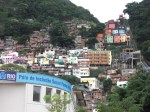
Morro Santa Marta is a relatively small favela that climbs the steep slope below the peak known as Dona Marta (which is why the favela is often incorrectly called ‘Dona Marta’), above Botafogo, and just on the other side of the hill from the much wealthier neighbourhood of Laranjeiras. Santa Marta is well-known largely because it is perceived as a success story, indeed as we were being taken around he community, journalists from Globo TV were embarking on a month-long series of features and interviews with different members of the community, and representatives were scouting the place as a location for the ‘Red Bull Down’ urban downhill mountain biking series (see this description of a related event in Puerto Rico)… in short, Santa Marta is fashionable.
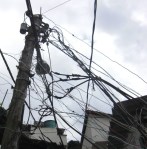
It is also the target for a number of state interventions; indeed I don’t think I have seen as many different workers from as many different agencies in one place at one time anywhere in Brazil. There were transportation workers on the newly-finished cliff railway, there were workers from the planning department shoring up recently-constructed houses to prevent landslides, there were electric company workers struggling to make sense of the maze of cables, there were refuse workers, and at the base of the favela there was a load of people from the new Motorola-sponsored Digital Santa Marta initiative that is wirelessing the whole neighbourhood. It seemed that various government interests badly want Santa Marta to continue improving, and that a lot is riding on this.
However, as we soon discovered, there is a more complex and fragile reality underlying the business and the superficially sheen of hype. Our guide for the morning was Sonia Oliveira, one of the directors of the community association, and a resident for many years. As we ascended the railway with her, we met her son, and other people, like Luis Gustavo, who she had known since he was a baby… it was clear that Sonia was well-known and well-liked. And who wouldn’t like her? Sonia is a strong woman with a calm, determined presence and an insight matched by the realism of experience.
The key to Santa Marta’s success so far has been the combination of many years of careful community work, combined more recently with a determined effort by a particular battalion of the BOPE (military police special operations) to drive out drug traffickers and secure the community, under Commandate Priscilla, who we will hopefully meet next week. It is not as if the community is any more sympathetic to the police than anyone else in Rio, but the relationship between the people involved here is clearly a special one. And whilst the police still do not understand the community fully – there are still frequent complaints of harassment of young men and the closing down of parties – there is some evidence that they are learning and changing to a small but important extent. One problem now is that the wider context of the ‘choque de ordem’, which is basically a rather more aggressive version of the famous New York ‘zero tolerance’ policy, is threatening to roll back these small improvements in trust and understanding. The police hassle unlicensed stall-holders, which is how most favelados make their living, they stop taxi drivers for checks of insurance and licensing, and of course, they threaten, and indeed carry out the threats, to demolish illegally constructed buildings – which is of course, potentially any piece of the favela. However, for Sonia, the over-assertiveness of ‘choque de ordem’ policing is outweighed by a far greater another fear – which is what happens if the political climate changes, or financial or strategic reviews mean that the BOPE are forced to withdraw from Santa Marta. If they do, she argues, the traffickers will return, and it will be worse than before, as not only will they take control of the community, but they will ‘punish’ it for collaborating with the authorities.
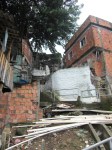
And things must continue here. In many ways they have hardly started. There might be a lot of activity but the favela remains lacking in infrastructure, especially sewage and healthcare. Most of the self-built constructions remain precarious and a severe risk to their inhabitants and those below in the case of heavy rains and consequent landslides. And the understanding of neighbouring communities is far from guaranteed. One might think that neighbours would be grateful that the traffickers are gone and even make efforts to integrate Santa Marta further into the city, but Laranjeiras in particular has been causing all sorts of problems for the favela, in particular over the construction of a school and creche at the top of the neighbourhood. The problem was basically that the school can be seen over the top of the hill, and this led to the fear that Santa Marta would begin to spread over the top and down to the back gates of the expensive apartments and villas of this rather exclusive community inhabited by people like Governor Sergio Cabral. In fact, unlike several other favelas, Santa Marta is not expanding at all. It is becoming a more mature and controlled community, and it is rather ironic that it is at this stage of its development, that it becomes an object of fear and concern for its richer neighbours. The argument has been resolved for now, and the school stays, indeed it is the temporary home of the battalion and the community police, who get a good overview of the neighbourhood from its commanding position. The lack of expansion of Santa Marta has not stopped the State from starting the construction of a wall along its west side. As Sonia says, there is no need to make favelados feel like they are living in a ghetto…
Paulo Oscar Saad was against the building of the school, indeed he is against the expansion of any illegal community into the hills of the area, but in truth this is the only real substantive grounds for disagreement between the leader of the Santa Teresa community association and those in Santa Marta. Santa Teresa is however, an entirely different place. Once a hillside retreat for the rich, its crumbling mansions have for a while now been occupied by an eclectic mixture of artists, academics and other bourgeois but generally progressive people. For many years it served as a kind of cultural centre for the surrounding poorer neighbourhoods, including the many favelas, with favelados mixing with the artists in the bohemian bars and cafes.
However, this mixture has been undermined by three main developments. The first is the aforementioned illegal building, which threatens the very stability of the hillsides which support Santa Teresa. It isn’t just what one would recognise as ‘favelas’ either; many of the illegal buildings are constructed by relatively or even very wealthy people, and often on land reforested precisely to prevent landslides after two previously disastrous deluges in the 1960s and 1980s. The second is the change in the nature and intensity of crime in Santa Teresa. The neighbourhood had always put up with a certain amount of petty theft and pickpocketing, but the arrival of cocaine (and more recently, crack) and in particular the arming of the drug gangs has led to an increase in both actual serious crime and fear. Finally, the gentrification of Santa Teresa is threatening to destroy the easy-going and bohemian atmosphere of the hillside on which it is based. It is an old story, seemingly destined to be endlessly repeated in similar communities all over the world. The old bars and cafes close, and the new upmarket establishments exclude the poor either overtly by policy or implicitly through price. The fear of crime has also driven many residents into the arms of private security companies, who have gated several dead-end streets and equipped them with guardposts. The signs say they are legal; the Community Association says that they are not. In fact the latter are correct. Paulo, like some other I have talked to here, is sure that the private security companies are intimately linked to the militias and indeed to the criminal gangs, all of which reinforce each other in an ongoing spiral of criminality and securitisation. However it is not as if the police (of any kind) or the politicians can be trusted to deal with the situation. According to the community association leader, the police are entirely corrupt and the politicians are fashion-driven media slaves. The only hope lies in bottom-up community power, yet the community is increasingly divided, and even the remaining assets that make Santa Teresa what it is are being cashed in: the wonderful antique tram system that rattles up the hillside is being privatised and its future is uncertain…
It seems that both community leaders are scared of losing what they have and battling to keep their neighbourhoods alive, inclusive and connected, but both are being hampered by uncertainty and contradictory policies and developments at levels which they cannot seems to influence. The future of Rio depends on people like this being supported not undermined by the state at its various levels (which still do not appear to know what each is doing, let alone look like working together). Oh, and I almost didn’t mention surveillance… that’s because like almost everyone else on the ground here, surveillance is seen as a frippery of the rich and something which has no practical use or meaning for the reality of their lives. There is also a strong sense of freedom too: and things like CCTV are seen as a definite infringement of that liberty. The more I get to know people and places here, the more I am certain that Brazil is nothing like a surveillance society and the changes that it would take to become one would be almost inconceivable in scale and cost.
redemption?
public face
Laranjeiras
Santa Marta Digital
police
School
Sonia
tangle
Inside
funicular
wall
Santa Marta
Note: there are photos of Santa Teresa in the next post and there will be more later this week.


















 ubisurv