A rather telling little piece on The Guardian‘s ‘Comment is Free’ site today by UK Labour MP, Diane Abbot. First she takes a cheap shot at the Conservative shadow-cabinet minister, Damien Green, for having been successful in getting his details removed from the UK police National DNA Database (NDNAD). She then says that, well, she is doing much more to help by holding clinics for her young, black, constituents to help them with their complaints against the NDNAD. This is excellent, of course.
However two things spring to mind immediately. Firstly, is this Diane Abbot the same New Labour loyalist who voted in favour of the original bill to set up the NDNAD and made no attempt to amend it to prevent the kind of racially-biased abuses of which she is no complaining? I think it is. And now, why is she not also condemning the former Home Secretary, Jacqui Smith’s rather pathetic and weaselly response the judgement of the European Court that condemned the NDNAD, which was essentially to try to avoid doing anything fundamental at all?
This is not an issue on which anyone in New Labour can really make any political capital unless they take a rather stronger moral stance. Basically, and in addition to the stance that there should be no state retention of DNA data at all, there are only two ‘fair’ ways to maintain a police DNA database, and those are to keep the DNA of the guilty, or to keep the DNA of everyone. Which you prefer depends largely on your attitude to surveillance and your trust in the accountability of the state, but politicians like Abbot are hedging and avoiding making any serious attempt to put pressure on their own government to reform the law we have.
Tokyo is a constantly changing stew of styles and forms, but don’t be fooled into thinking this is just ‘organic’ change. The capital of Japan is a playground for capital, local and global, and there isn’t much in the way of planning law or practice to stop the developers doing exactly what they want. It’s worth reading Andre Sorensen’s The Making of Urban Japan for a good account in English of why this is.
Inasmuch as the traditional morphology of machi (neighbourhoods) survive, it is largely due to either the unfashionable character of the area putting off developers, temporary lulls in the property market, or the sheer stubbornness of residents in refusing to being intimidated into selling land or putting up with the serial replication of blocks of manshon (typical 5+ storey apartment complexes). Strong property rights and small traditional plots do at least mean that it is more difficult to put together the land in what is called tochi kukaku seiri (land readjusment) to make really large developments which, as a result, tends to be restricted to whole sites that come on the market through things like the privatisation of Japan Railways (although some private developers like Mori Building Co. have managed private massive land readjustment projects like Roppongi Hills that I have researched on previous visits).
Of course the building regulations that do exist tend to favour development too, as they regard any old building as inherently unsafe (because of susceptibility to fire and earthquake) and it is thus very difficult, for example, to get traditional wooden houses repaired let alone new ones built. In addition, since the Edo period regulations have sought to open fire-breaks in the urban structure and increase the width of roads and alleyways – and again, the traditional and wonderfully characterful narrow roji (lanes) are very difficult to maintain as any new building has to be set back to newer road standards. This in turn tends to make the backstreets more accessible to faster-moving traffic and thus gradually dehuamanize and desocialize these places.
So communities have a lot to contend with and, despite the 196os environmental movements and machizukuri (community development) and the 1980s craze for ‘amenity’ (which included the promulgation of a ‘sunlight ordinance’ that was supposed to stop the construction of taller buildings that would block out the sun from neighbouring plots), the developers continue to try to squeeze in unwanted and inappropriately massive structures wherever they can.
We came across this small example of a local neighbourhood campaign to stop a new manshon being built at the edge of the historic (but much damaged) Yanaka district. It might not loo very exciting but you add these developments up all over the city and it goes a long way to explaining why Tokyo is gradually losing the remaining historic and social character that makes it a surprisingly human place to live, despite its size…
We had an enlightening interview, which will give me much to analyse later, with three senior officers from the Seikatsu Anzen Bu (literally, ‘Everyday Life Safety Division’) of the Keisicho (Tokyo Metropolitan Police). Interestingly, this division that was created as a result of the Seikatsu Anzen Jourei (Governor Ishihara’s 2003 Tokyo Metropolitan Government ordinance) and which deals with all the community security and safety initiatives, including CCTV, is separate from the Chiki Bu (the community division) that is responsible for the koban neighbourhood police box system.
Like almost everyone in authority we have met here, the police were convinced that they were not doing surveillance in using the cameras. They also confirmed that almost all of the CCTV systems operated by shoutenkai (shopkeepers’ associations) are not monitored and are simply recorded. They also stressed their deep concern for privacy and the rights of citizens and said that data from the police-operated cameras – of which there are around 150 in Shinjuku (the largest system with 50 cameras in the Kabukicho entertainment district), Shibuya, Ikebukuro, Roppongi and Ueno – was only kept for 7 days unless there was a specific reason to retain it. This is a legal requirement not just a police guideline. The police cameras are monitored both in local stations and in a central control room, but we were told that it was strictly forbidden for us to visit (unlike every other city in which I have done research) as everyone who enters has to be pre-enrolled in the police iris-scan security database.
We talked a lot about the history of the development of CCTV and of community safety initiatives in Tokyo, and Governor Ishihara’s absolutely central role in backing video surveillance became very clear (it’s a shame he has so far refused an interview with us!). What was also particularly interesting was that the police themselves did not think that apparently obvious ‘trigger events’ were as important as it might seem. For example, they claim that the police only really began considering the use of CCTV cameras not after the Aum Shinrikyo sarin gas attacks on the Tokyo underground but because of the influence of G8 summit security. One officer specifically mentioned the Gleneagles summit (which was just starting when terrorists attacked the London transport system), but this was in 2005, well after the TMG had already introduced CCTV, and after which the Tokyo police have not introduced a lot more cameras. So I don’t quite understand their point. It may become clearer once I have the complete transcripts… They also claimed that it was the Tokyo police rather than Japan Railways themselves or the Tokyo Metro authority who insisted on installing CCTV in the Tokyo transport network after the Aum attacks.
The officers talked a lot about community involvement. They dismissed the objections to their public space CCTV systems for several reasons, not least as I have already mentioned that they were not doing ‘surveillance’, but more importantly because they claimed to have done extensive consultation with local community groups, businesses etc. The claimed that they could not do anything without this support. This may have been true for Kabukicho, which was undoubtedly afflicted by an influx of Chinese gangs in the 1990s, but we heard from the local government of another ward that is being lined up for one of the new volunteer-based child safety camera systems being introduced from 2010 that they were given no choice by the police, and that local people were not happy about it. The problem is that this local authority don’t want to be interviewed further about this as they are in a rather delicate position over this new system.
(Thank-you very much to the officers from the Seikatsu Anzen Bu for giving us their time)
Just as I did in Brazil, I am going to be looking a little at the way in which systems of government information and identification work in Japan.
One of the immediately obvious things is that Japan has no national system of ID cards. Instead, as in the UK, the Driving Licence is used as a de-facto ID. The Japanese Driving License until recently was rather like that in Brazil, in that it connected to individual strongly to the family though carrying the honseki, the address where the koseki (family registration) was registered. However, this section can now be left blank and may be removed altogether in the future. The current driving license has a photo but no other biometric data, and whilst being a plastic card with a credit card form factor, is not any kind of smart card. There’s a really nice photo-essay on the process of obtaining a Japanese driving license on super-otaku, Danny Choo’s site.
The koseki is a very traditional way of registering people based on their family’s place of origin or residency and can often stretch back many generations with details of parents, grandparents etc. The individual is no more than one name on this register. The koseki is simply a computer record these days, although paper print-outs are used in more formal identification procedures, but very few people carry a copy of their koseki around with them.
In addition to the koseki, there is a jyuminhyou (Residents’ Register), a current address register, which every local authority keeps. As with the koseki, there was an associated old paper certificate for many years. In 1999, the old Resident Registration Law was updated and came into effect in 2002 and this included a provision to introduce a voluntary Resident Registration Card. This is a smart card, and is supposed to make access to local services easier, though some see it as a precursor to a full national ID-card scheme, especially as from 2004 the card could also be used to do other things online, like tax-returns. The suspicions are also because of the way in which the card as introduced along with a new system for connecting up all the local authority residents’ registry systems in Japan, juki-net. I’ll write more about this tomorrow as we are going to talk to the official responsible for the implementation of the card and juki-net at Lasdec, the Local Authorities Systems Development Center.* On Friday afternoon, I will also be meeting up with Ogasawara Midori, a freelance journalist who specialized in covering the juki-net controversy and is also a former student of my future boss, Professor David Lyon.
There is of course an exception to the lack of national ID. Foreign residents often get very upset that they are forced to carry the gaikokujin touroku shoumeisho (Certificate of Alien Registration). This is seen as discriminatory and it is particularly so in the case of families who are identified by the state as ‘Korean’ or ‘Chinese’, whose increasingly distant ancestors came from those countries. The gaikokujin touroku shoumeisho was also particularly controversial as it included fingerprinting requirements for Koreans and Chinese that were seen as a product of the colonial period, but which were only removed in 1999. But then, following on from reactions to 9/11, and G8 plans for standardized biometric passports and visas, they were reintroduced in 2007 along with fingerprinting and facial photographs of all foreigners at the border. In one small progressive step however, permanent Korean and Chinese residents would not have the ‘colonial stigma’ reintroduced.
Foreigners are also not included on the jyuminhyou except at the discretion of local officials, although indications are that they will be included from 2012 when the system in further rationalised, although it is probably down to the campaigns for change from naturalised and long-term foreign residents like Ardudou Debito.
*Although as I am also going ‘out on the town’ with an important figure in Shinjuku urban planning (and regular in the Golden Gai stand-up bar neighbourhood), I might not get round to writing this sequel up until Friday morning.
Comprehensive data protection in Japan is fairly recent. Until 2003, data protection was still governed under much two earlier ‘ information society initiatives: firstly, the Act for the Protection of Computer Processed Personal Data Held by Administrative Organisation (1988) and secondly, the Protection of Computer Processed Personal Data Act (1990), which are based on the 1980 OECD Guidelines on the Protection of Privacy and Transborder Flows of Personal Data. These laws were limited an applied only to the state, and within that, only to some national government organisations rather than all of them.
Lawyers and those concerned with privacy within and without government were well aware of these limitations, and in the late 90s, a special Privacy Issues Study Working Group was set upby the Electronic Commerce Promotion Council of Japan (ECom). This committee issued Guidelines Concerning Protection of Personal Data in Electronic Commerce in the Private Sector in March 1998. The Chair of that committee, Professor Masao Horibe, provides an account here.
Subsequently, a Personal Data Protection Legislation Special Committee was established in January 2000 under the Advanced Information and Telecommunications Society Promotion Headquarters (now the IT Strategic Headquarters), a body responsible directly to the Japanese cabinet. This body has issued all the laws and directions regarding IT, e-Japan etc.
The need to “protect personal data” (kojin deta) was mentioned in Article 22 of the Basic Law on the Formation of an Advanced Information and Telecommunications Network Society within the rubric of ‘security’. This was followed up by the e-Japan strategy of January 2001, which under the section on the Facilitation of E-Commerce, recommended that “Necessary legislative measures should be taken to win the confidence of consumers, including submission of a bill to protect personal data to the ordinary session of the Diet in 2001.”
The Bill was introduced in March 2001, but as a result of concerns about its effects on the freedom of the press, was left to fall by 2002. However the Personal Information Protection Bill was passed in 2003, one of five bills with implications for data protections to be passed in that Diet session.The bill came into force in 2005. I’ll discuss the content and operation of the bill later, but there’s a good summary in English from when the Bill was passed here.
The one particularly interesting thing to note here is that it doesn’t designate or establish any one body to oversee the operation of the law or the enforcement of rights, or deal with complaints as in European countries and Canada, for example, Instead it keeps data protection as an internal matter for designated government ministries (and for companies), with legal action an option if all else fails. The law is generally on the side of data flow and commercial / administrative convenience, which is not surprising given its origins in industry-led e-commerce promotion organisations.
Pretty much as predicted, the LDP lost badly in the Assembly elections for Tokyo. They ended up with only 38 seats to the Democratic Party of Japan’s (DPJ) 54. The LDP will continue to be part of the largest bloc in the Assembly thanks to the 22 seats held by the Komeito, the party of the Soka Gakkai, a lay organisation of the large Nichiren Shoshu evangelical Buddhist sect. The Komeito have almost single-handedly kept the LDP in power in Japan for years now, and seem to have no point to their existence at all, apart from ensuring that laws on religious organisations are kept as light as possible. Nevertheless, even as a bloc, the LDP / Komeito no longer have a majority in the 127-seat Assembly.
Under pressure, unpopular LDP Prime Minister, Aso Taro, has now called elections to the national Diet for August 30th. Normally one would expect a wipe-out of the LDP, but that’s not how Japanese politics works. With very strong rural and regional support, the LDP will most likely win again, but a different faction will get their man (and it will most probably be a man) into the PM’s office. There has been a non-LDP government before, but it happens so infrequently as to be almost unheard of…
Whilst Aso is unpopular and LDP’s response to the recession has been both predictably unimaginative and unsustainable (in short, “more concrete!”), this wasn’t just about national issues, despite what LDP spokespeople in Tokyo would have us believe. There are some serious economic and urban development issues in Tokyo. More people seem to have lost patience with long-standing Governor Ishihara, who is backed by the LDP on the whole, and in particular the almost collapse of Ishihara’s subsidies for Tokyo banks affected by the global collapse of financial services, and the latest mega-scheme to free up land for private sector redevelopment, the proposed move of the famous Tsukiji fishmarket from its convenient and historic location at the edge of fashionable and expensive Ginza to some remote toxic waste dump in the middle of nowhere. 20 years ago, even 5 years ago, such ridiculous schemes to aid private capital were routinely forced through, but in the current climate, this may not be possible. Finally, like Rio de Janeiro, where I was earlier in the year, Tokyo is candidate city for the 2016 Olympics with all the financial (and social and security) implications that bidding for and hosting such a mega-event implies, and people are starting to wonder whether the city can afford it.
Still, the relentless march of redevelopment continues elsewhere: the old Koma Theatre in Kabukicho, which I predicted would be targeted by developers as soon as they started trying to secure the area with CCTV cameras and intensified policing a few years back, is now almost demolished (pictures soon)… apparently Shinjuku’s red light district is now officially safe for more mainstream and less obviously dirty forms on capitalism.
After protest and parliamentary questions, The Register reports this week that the London Metropolitan Police have finally got round to reminding their officers that it is not in fact a criminal offence for ordinary people to take photographs or video in public places, nor even to take pictures of police officers. The way that many Met officers had been acting over the past couple of years with harassment of photographers, even tourists in some cases, and arrests under the Terrorism Act, there appeared to be a deliberate attempt to change or extend the meaning of the law by police policy. This was at the same time that the Met had been running campaigns stating that it was suspicious for anyone to be interested in CCTV. Part of this is also the fault of the Act (and others like it, including the recent Counter-Terrorism Act), which are very broadly drawn and easily subject to extreme interpretation by those who would want to abuse them to attack individual liberties.
This isn’t over yet however; there are many other police forces in the rest of the country and also quasi-police (community support officers, town centre managers etc.) as well as private security, who need to recognise that the public have a right to take photographs in public, and should not be harassed, assaulted or threatened with some non-existent sanction for a perfectly legal pastime.
I was at a meeting organised by the Information Commissioner’s Office (ICO) today (Wednesday) in London where both Jack Straw and Michael Wills from the Ministry of Justice spoke. In the wake of the expenses revelations it was not surprising that both sounded somewhat conciliatory, but the degree of both overt and tacit admission of mistakes and changes needed was quite surprising. I had a bit of a set-to with Michael Wills on the apparent lack of knowledge amongst government ministers of the results of their own research on the (in)effectiveness of CCTV, to which he responded with the Melanie Phillips defence – i.e.: come and talk to ordinary people and they will tell you they want CCTV. This is a diversion for many reasons, not least of which is that unlike both the Daily Mail’s moral minority and the minister, I actually live in places where they only visit on official business and I also understand that what people mean when they demand CCTV is not the technology itself but a solution to the real and perceived problems of crime and anti-social behaviour that they face. They only demand CCTV because they see the programs on TV and are convinced that CCTV ‘works’ – however if you talk to senior police officers or anyone who has done research on this, they will tell you, yes, targeted mobile CCTV surveillance to deal with specific problems can be very effective (in terms of both cost and results) but mass camera surveillance is not the same thing. It is rather disappointing that a Justice Minister did not appear to understand the difference.
Jack Staw gave a weird speech. It was both full of matey bonhomie and characterised by stuttering hesitancy and vagueness. He made a number of historical errors, for example in claiming that the culture of secrecy was a product of the Cold War, when the first Official Secrets Act was a product of WW1. He also claimed that CCTV was all about ‘low-level disorder’ and ‘reassurance’, which will be news to all those (like his ministerial colleague) who still think it prevents crime. But he did rightly take some credit for Freedom of Information, including allowing parliamentary expenses to be included, even as it turned out, to his latter-day embarrassment.
Where it got very interesting was in his comments on the government’s consultation on the future of the DNA database following the damning verdict of the European Court. Contrary to Jacqui Smith, Straw indicated that he would be quite happy with the proposed 12 year retention period being reduced to 9 or even 6 years. He also claimed that there was a behind-the-scenes review of The Terrorism Act and other post-9/11 measures going on, which I don’t think many people in the room even appreciated. He admitted that the Labour government got many things wrong after 9/11 and that the environment had now also changed.
It was all very interesting, but you really got the feeling that this was a government on the way out anyway. The Tories will no doubt scrap the ID cards and register, but listening to the Shadow Justice Minister, Dominic Grieve, I got the impression that they don’t have much to offer apart from caution. That might be welcome for a while, but as a speaker from Google remarked, the debate is so far behind the reality of technological change that none of this will really matter very much unless there is a real culture shift. The ICO under the massively influential Richard Thomas, for whom this was very much a valedictory event before he steps down, has made great strides in this direction, but the government and opposition parties are still a long way away from understanding the need to establish a new basis for informational relationships between people, state and private companies that we desperately need.
Larry Elliot, the Guardian’s main economics reporter, has written a great piece today which pretty much sums up what I and other surveillance studies scholars, as well as people writers like Hardt and Negri, Zygmunt Bauman and Naomi Klein, have been saying about the direction of global policy, but particularly in the UK, in recent years. In short, it argues that the current government has completely abandoned the main principles of a liberal democracy, which were to control the market for the common good, and instead has reversed the equation, and now, largely through surveillance, seeks to control people for the benefit of the market. Although this is hardly a new argument, Elliot’s piece is particularly succinct and clear. Worth a read…
Over the last two weeks, we’ve talked to all kinds of police. We’ve talked to officers, both senior and junior from the Policia Militar (PM), the state-level equivalent of the French ‘gendarmerie’ or Italian ‘carabinieri’, including some who have been rebranded as ‘Policia Communitaria’; we’ve met guys from BOPE (the Rio-specific special operations group within the PM here) – and hopefully we will meet their Commander today; we’ve interviewed the Subchefe of the Policia Civil (PC), the detectives, again based at state-level; and we’ve visited the headquarters of the Guarda Municipal (GM), the relatively recently-formed city police. I haven’t talked to the firefighters, another military-state legacy, who are still an armed force, although a report from the State parliament in January recommended that they be disarmed. Back when I was in Brasilia, I also had a meeting with the Policia Federal (PF), the Brazilian ‘FBI’, another post-dictatorship development, who operate at federal level.
It is a confusing organisational landscape, and not just for me. Throughout the interviews with all the different representatives, very different perspectives emerged on what is important in policing, which force is more important and for what purpose, to what extent the current system works, and what would be the best way forward. Corruption was also something that came up time and time again, with everyone arguing that their force was improving and dealing with this, but hinting that there was still a problem with other kinds of police. There was lots of talk of ‘new generations’ of officers free from the taint of the past. But at the same time it was quite clear on the ground that people from all social classes still do not trust any of the police in general, even when they have established quite positive personal working relationships with officers in their own community.
Cesar Couto Lima, Diretor de Operacoes of the Guarda Municipal
The GM are less than twenty years old and they ‘know their place’ in the hierarchy of police: at the bottom. They are not true ‘professional police’ in the sense that they have only three months basic training, followed by some specialist extra work. They are really somewhere between police and a private security force that just happens to be employed by the city – their commanders at the top level are however, ex-PM. They do, however, have a growing field of responsibility, acting both as a kind of protective and preventative force on the ground in the city centre and as a street-level agency of the ‘eyes on the street’ form of surveillance.
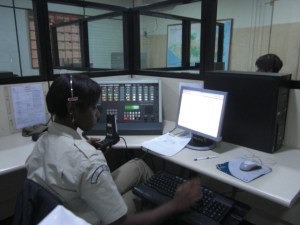
Operator in the Guarda Municpal emergency control room
They also act as the emergency services co-ordination, and this role will increase and be better integrated and funded in future. They are largely disarmed, though not because as many believe, the law prevents them from being armed. This is a strategic decision based on keeping a clear line between them and the PM. This is also the reason why they have a different uniform (in Rio a kind of unflattering beige) from the PM (blue). In our interview with the Director of Operations, Cesar Couto Lima, we were told that in the past, the uniforms had been the same colour but that this had been changed under the last mayor, Cesar Maia, to prevent GM officers from being shot by criminals in the mistaken belief that they were PM. They now have a very low rate of injury and death. The Dir Ops also wants to increase the numbers and in the very long term for the GM to be the be the main police force of a disarmed and less violent city.
It is a fine aspiration, however the new Mayor Eduardo Paes, has apparently suggested that the uniform is changed back to blue and that there should be more arming of the GM. The Dir Ops is utterly opposed to both, and I think he sees it as a deliberate ploy to give the impression of more PM around – the State Secretary for Security has already announced a plan to increase the numbers of PM in Rio by thousands, as we found out when we visited his office. The officers we met at the GM were generally pleasant, relaxed people, however the GM is not immune from corruption. I have heard allegations of extortion from street traders, the poor and criminals, in much the same way as gets reported of the two main forces, and indeed of death threats to officers who refuse to get involved with such practices. Any generalised or regular arming of the GM would only increase the temptation to act on the new power in an irregular way, and also, with so many weapons in the hands of relatively poorly paid and untrained officers lead to greater numbers of killings and a further channel for criminals to obtain weapons.
Ricardo Martins, the Subchefe of the Policia Civil would also like to see a demilitarisation of the police in the long-term. He argued that basically, the PM should be gradually abolished and absorbed into a purely civil police. He was also strongly in favour of more ‘intelligence-led’ and surveillance-based solutions, rather than force of arms or numbers. According to him, the expansion of the video surveillance system in the city was essential and absolutely necessary if the city was to be ready for the 2012 soccer World Cup (to be held across Brazil) and more particularly for the 2016 Olympics, for which the city is a frontrunner. All the senior officers an officials with whom we talked agreed that currently it was nowhere near ready. The GM also agreed with the expansion of CCTV, although they seemed to think that they would have a greater role in operating the systems in future, talking of plans for neighbourhood control rooms integrated with the emergency services control system. Neither the PC, nor more importantly, the Superintendente de Commando e Controle of the State, Claudio de Almeida Neto, gave any indication that this was the direction in which things were proceeding. Indeed the Superintendente was quite clear that there was a greater centralisation, co-ordination and professionalisation of video surveillance operations taking place through his office and his control room, which is in the old ‘Centro do Brasil’ railway station. The office of the Secretary of State for Security seemed not to be that interested in surveillance at all, and commented that it was very expensive, which suggests that the funds for the expansion of the video surveillance system that all expect, whoever they think will be running it, may not be quite as lavish as they believe or would want. I will write more about this later. The PC, however has the reputation of being the most corrupt of all the forces. Subchefe Martins pointed to the internal investigations branch as evidence of the effectiveness of their fight against corruption. Other interviewees were not as easily impressed!
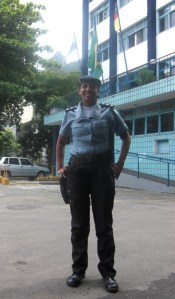
Capitao Pricilla, Head of Santa Marta Community Police initiative
So where should policing in Rio go? One way forward was obvious when we interviewed Capitao Pricilla, the current ‘star’ of the PM, who heads up the Community Policing initiative in Morro Santa Marta. Capitao Pricilla is a PR-dream: attractive, articulate, intelligent, convincing in her arguments, and clearly dedicated to her work with the community. She is everything you would hope a new generation of younger PM officers would be, and she clearly stated that she is part of a new generation. And she is popular too. As we talked with her, officers would constantly come over just to say ‘hello’ and older women in particular, would treat her like a TV celebrity. Now, of course I am wary of the way in which such charisma would make her an obvious choice to head such an operation, which is much promoted as ‘the way forward’ in the media. However there have been many ‘ways forward’ before which have come to nothing and Rio is constantly making and destroying innovative initiatives before they even have a chance to have a real effect. The Santa Marta initiative probably cannot be replicated in many favelas, like Prazeres, where there is a more intimate relationship with the ‘parallel power’ of the traffickers. But Capitao Pricilla seems like the real deal. Let’s hope that she and officers like her get the support they need and are not undermined by the violence and corrupt practices of so many of their colleagues. It’s a utopian hope perhaps, and Rio is still going to need the other far more aggressive hand of the other attempt to get around corrupt practice in the PM, the BOPE – about whom I will write more after our visit today – as much as it needs the helping hand of Community Policing initiatives for a while. It is that large and less articulate mass of PM and PC officers who have no interest in doing anything different, and the equally corrupt politicians who prevent change for their own selfish reasons, that are the main barrier to any organisational change.






 ubisurv