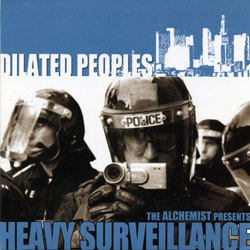
Watch this video from The Guardian on Camden, NJ. It’s ostensibly about police surveillance, and I was expecting to be outraged (once again…) at the use of over-the-top high technology – visual and audio surveillance – to deal with everyday crime.
But instead, what struck me was not so much the ostensible subject but the backdrop: the place itself. The areas patrolled by the officers in this film look almost post-apocalyptic. I’ve seen favelas in Rio de Janeiro that are in better shape, and many certainly seem to have more hope than this. Poverty and inequality in the USA, grounded in a history and present of racial and class exploitation, have become extreme. There’s no other way to put it.
And yet, outside of these places, which are everywhere across the USA, and ironically given the investment in technologies of visibility, the reality is invisible. The use of surveillance here is just a recognition of the lack of anything that amounts to a conception of a decent and fair society in practise, while people are still blinded by the noble goals of the USA as expressed in its constitution. This constitution means little to millions of Americans forced to live in these conditions, while being treated all the time as not even ‘potential criminals’ but simply ‘future criminals’, who will commit a crime at some point, and are destined for nothing more than to be churned through a carceral system that is in itself now a profitable and perhaps even essential component of American capitalism. However, this seems to have escaped the notice and concern of those who actually vote in elections and make decisions, whether they class themselves as liberals or conservatives, most of whom are so far removed from these conditions, physically and emotionally that they could not possibly understand.
This makes it even more bitterly ironic that The Guardian choses to title this report as ‘Minority Report meets The Wire‘, as if the only way to understand this is through fiction – that, somehow, it can’t be real. Yet here it is.
For a while now, I’ve been wondering why the US didn’t attempt to push for a national biometric ID card system in the wake of the 9/11 bombings.
Given reported statements from biometrics industry bosses about 9/11 being ‘what we’ve been waiting for’ and so on, one might have expected there to be a major effort in this direction but officially, as Zureik and Hindle (2004) point out, the International Biometrics Industry Association (IBIA) was relatively cautious in its post-9/11 press work, although it argued that biometrics had a major role to play in the fight against terrorism. Even the 9/11 Commission didn’t recommend a national ID card scheme, instead limiting itself in its final report to In its final report, to recommending a “biometric entry-exit screening system” for travelers in and out of the USA.
Part of this is because of the uneasy relations between the federal government and states governments, and suspicion of the former from the latter, and particularly from the political right has meant national ID cards have always been out of the question, even in an era of identification. So even though ID is frequently required in social situations, especially in dealing with banks, police and government agencies, the US relies on the ubiquitous driver’s licenses, which are issued by states not by the federal government. I remember from my time living in the US (in Virginia) as a non-driver, that in order to have valid form of ID, I had the choice of either carrying my passport or getting a special non-driver’s driver’s license, which always struck me simply as an absurd commentary on the importance of the automobiles in US life because, being young at the time, the nuances of federal-state relationships escaped me. And of course, passports won’t cut it for most, as less than 50% of US citizens have one.
So, if the apparently ubiquitous threat of terrorism was not going to scare states’ rights advocates and the right in general into swallowing the industry lines about security that they might usually have lapped up, what would? Well, the one thing that scares the right more than terrorism – Mexicans! More seriously, the paranoia about undocumented migrants combined with the spiralling cost of oppressive yet clearly ineffective border control (walls, drones, webcams, vigilantes etc. etc.) seems to have no done what the fear of terrorism could not, and inspired a push on both the centre and the right for ID cards – not that there’s much evidence that biometric ID cards will do a better job of excluding undocumented migrants, given that they do nothing to address what’s driving this migration – the demand for cheap, tax-free labour in the USA.
Today, not only the beltway insider’s bible, the Washington Post has an editorial demanding biometric social security cards for all (and a concomitant reduction in spending on hardening the border) following on from a cross-party senate recommendation, but also the Los Angeles Times, a paper which in the past has often been wary of the march to a ‘surveillance society’ – indeed it was the first major US newspaper to use this term, way back in 1970 as well as publishing critics like Gary Marx (see Murakami Wood, 2009) – has an op-ed arguing for a national ID card. The LA Times version, written by Robert Pastor, also claims that this is necessary to deal with voter fraud, a constant concern of the right and which always has a strong undertone of racism, so it’s unsurprising coming after a black Democrat has been elected as President for a second time in a tight election. Ironically, however, the President whose supporters are clearly the target of such attacks, has recently made it clear that he is also a supporter of a ‘tamper-proof’ national ID system.
No-one has yet made the international competition argument that is also so often used in these debates (‘if India and Brazil can do it, then surely the USA can’), but this debate is now ramping up in a way that even 9/11 couldn’t manage. Interesting times ahead…
References:
Murakami Wood, David. “The Surveillance Society’: Questions of History, Place and Culture.” European Journal of Criminology 6.2 (2009).
Zureik, Elia, and Karen Hindle. “Governance, security and technology: the case of biometrics.” Studies in Political Economy 73 (2004).
(thanks to Sarah Soliman and Aaron Martin for the newspaper articles…)
Peter Tu writes over on Collective Imagination, that greater automation might prevent racism and provide for greater privacy in visual surveillance, providing what he calls ‘race-blind glasses’. The argument is not a new one at all, indeed the argument about racism is almost the same proposition advanced by Professor Gary Marx in the mid-90s about the prospects for face-recognition. Unfortunately, Dr Tu does several of the usual things: he argues that ‘the genie is out of the bottle’ on visual surveillance, as if technological development of any kind is an unstoppable linear force that cannot be controlled by human politics; and secondly, seemingly thinking that technologies are somehow separate from the social context in which they are created and used – when of course technologies are profoundly social. Although he is more cautious than some, this still leads to the rather over optimistic conclusion, the same one that has been advanced for over a century now, that technology will solve – or at least make up for – social problems. I’d like to think so. Unfortunately, empirical evidence suggests that the reality will not be so simple. The example Dr Tu gives on the site is one of a simple binary system – a monitor shows humans as white pixels on a black background. There is a line representing the edge of a station platform. It doesn’t matter who the people are or their race or intent – if they transgress the line, the alarm sounds, the situation can be dealt with. This is what Michalis Lianos refers to as an Automated Socio-Technical Environment (ASTE). Of course these simple systems are profoundly stupid in a way that the term ‘artificial intelligence’ disguises and the binary can hinder as much as it can help in many situations. More complex recognition systems are needed if one wants to tell one person from another or identify ‘intent’, and it is here that all those human social problems return with a vengeance. Research on face-recognition systems, for example, has shown that prejudices can get embedded within programs as much as priorities, in other words the politics of identification and recognition (and all the messiness that this entails) shifts into the code, where it is almost impossible for non-programmers (and often even programmers themselves) to see. And what better justification for the expression of racism can there be that a suspect has been unarguably ‘recognised’ by a machine? ‘Nothing to do with me, son, the computer says you’re guilty…’ And the idea that ‘intent’ can be in any way determined by superficial visualisation is supported by very little evidence which is far from convincing, and yet techno-optimist (and apparently socio-pessimist) researchers push ahead with the promotion of the idea that computer-aided analysis of ‘microexpressions’ will help tell a terrorist from a tourist. And don’t get me started on MRI…
I hope our genuine human ‘collective imagination’ can do rather better than this.
I received the following message from James A. Goldston, Executive Director of the Open Society Justice Initiative, on a very important finding on racial profiling by the UN Human Rights Committee. I reprint he message in full, as it speaks for itself.
On July 30, 2009, the United Nations Human Rights Committee became the first international tribunal to declare that police identity checks that are motivated by race or ethnicity run counter to the international human right to non-discrimination. The committee issued its views concerning the Rosalind Williams v. Spain communication, originally filed by the Justice Initiative and Women’s Link Worldwide in 2006.
Williams’ case began 17 years ago, when she, a naturalized Spanish citizen, was stopped by a National Police officer in the Valladolid, Spain rail station. Of all the people on the train platform, she was the only one to be stopped and asked for her identity documents. She was also the only black person on the platform. Williams soon launched a legal challenge to the identity check, claiming she was targeted because of her race. In 2001, the Spanish Constitutional Tribunal approved the practice of relying on specific physical or racial characteristics as “reasonable indicators of the non-national origin of the person who possesses them,” arguing that racial criteria are “merely indicative of the greater probability that the interested party not Spanish.” The court’s endorsement lent legitimacy to a pervasive discriminatory policy of ethnic profiling that had for years been widely documented by human rights monitoring bodies.
In finding a violation of the International Covenant on Civil and Political Rights the UN Human Rights Committee concluded that while identity checks might be permitted for protecting public safety, the prevention of crime, or to control illegal immigration, “the physical or ethnic characteristics of the persons targeted should not be considered as indicative of their possibly illegal situation in the country. Nor should identity checks be carried out so that only people with certain physical characteristics or ethnic backgrounds are targeted. This would not only adversely affect the dignity of those affected, but also contribute to the spread of xenophobic attitudes among the general population; it would also be inconsistent with an effective policy to combat racial discrimination.”
The committee found that while there was no written policy to conduct police identity checks on the basis of skin color, “…it does appear that the police officer did act according to such a criterion — something that was justified by the courts that heard the case. The responsibility of the State party is clearly compromised.”
“… the Committee can only conclude that the petitioner was singled out only because of her racial characteristics, and this was the decisive factor for suspecting unlawful conduct. The Committee recalls its jurisprudence that not all differential treatment constitutes discrimination if the criteria for differentiation are reasonable and objective and if the goal is legitimate under the Covenant. In this case, the Committee finds that the criteria of reasonableness and objectivity were not met.”
The implications of the UN Human Rights Committee’s judgment extend far beyond Spain, where ethnicity-based police stops are still a common practice, to wider Europe, where years of monitoring have revealed a persistent and damaging pattern of ethnic profiling of minorities and immigrants in police stops and searches without explanation and without clear or effective purpose. The Justice Initiative has documented the prevalence and harms of this impermissible practice in reports such as “I Can Stop and Search Whoever I Want” — Police Stops of Ethnic Minorities in Bulgaria, Hungary and Spain and Ethnic Profiling in the European Union: Pervasive, Ineffective, and Discriminatory!, and has long advocated for operational, policy, and legal reforms before national and regional actors.
Although previous regional human rights tribunals have touched upon the issue of ethnic profiling — most notably the European Court of Human Rights in its 2005 Timishev v. Russia judgment, which held that the applicant had been unjustifiably subjected to differential treatment in relation to his right to liberty of movement “solely” due to his ethnic origin — Williams v. Spain is the first case to explicitly challenge ethnic profiling as a practice, and the UN Human Rights Committee the first international tribunal to issue a ruling prohibiting race- and ethnicity-based police stops.
Following this landmark judgment, the Justice Initiative will continue to work with government representatives and law enforcement agencies in Spain and other EU Member States, as well as with EU institutions in Brussels, to make sure that the policy and practice changes in line with the principles established by the UN Human Rights Committee are adopted and implemented.
A rather telling little piece on The Guardian‘s ‘Comment is Free’ site today by UK Labour MP, Diane Abbot. First she takes a cheap shot at the Conservative shadow-cabinet minister, Damien Green, for having been successful in getting his details removed from the UK police National DNA Database (NDNAD). She then says that, well, she is doing much more to help by holding clinics for her young, black, constituents to help them with their complaints against the NDNAD. This is excellent, of course.
However two things spring to mind immediately. Firstly, is this Diane Abbot the same New Labour loyalist who voted in favour of the original bill to set up the NDNAD and made no attempt to amend it to prevent the kind of racially-biased abuses of which she is no complaining? I think it is. And now, why is she not also condemning the former Home Secretary, Jacqui Smith’s rather pathetic and weaselly response the judgement of the European Court that condemned the NDNAD, which was essentially to try to avoid doing anything fundamental at all?
This is not an issue on which anyone in New Labour can really make any political capital unless they take a rather stronger moral stance. Basically, and in addition to the stance that there should be no state retention of DNA data at all, there are only two ‘fair’ ways to maintain a police DNA database, and those are to keep the DNA of the guilty, or to keep the DNA of everyone. Which you prefer depends largely on your attitude to surveillance and your trust in the accountability of the state, but politicians like Abbot are hedging and avoiding making any serious attempt to put pressure on their own government to reform the law we have.
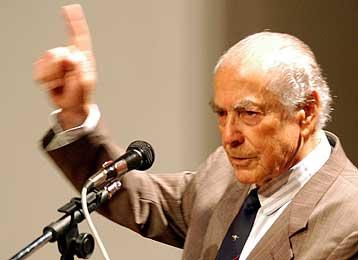
One question that has been preoccupying my thoughts recently has been the question of why the simple things are not being done in Rio to address the problems of the favelas: sanitation, education, healthcare etc… many of the people we have talked to look back to the regime of Leonel Brizola, the Governor of the State of Rio de Janeiro from 1983 to 1987 and then again from 1991 to 1994. Brizola was a left-progressive populist, a social democrat and a former opponent of the dictatorship who had had to live in exile for much of the 1970s. Sadly he died in 2004, but we had the opportunity this week to talk to his former Secretary of State for Public Security, and also briefly Governor himself from 1994-5, Nilo Batista.
We met Professor Batista in the Instituto Carioca de Crimonologia (ICC), an independent research organisation, which he runs (and funds from his legal work), along with his wife, sociologist, Vera Malaguti Batista. The Institute is housed in a sleek modern building up in the hills of Santa Teresa, from whose picture windows the city below is all but invisible and the bay appears almost as it was when Europeans first arrived. However, the concerns of the Institute are very much with the reality of the city today.
We had a long and wide-ranging conversation, which would be impossible to recount in detail here, but the basis of it was an understanding of Brazilian society, and in particular that of Rio, based on the ongoing legacies of the past, in particular slavery and authoritarianism. Vera Malaguti’s book, O Medo na Cidade do Rio de Janeiro: dois tempos de uma historia (Fear in the City of Rio de Janeiro: one story in two periods) examines previous periods of revolt by Africans in Brazil and argues that the often unspoken elite fear of the africanisation of Brazil. They argue that repressive public security strategies today are founded in this same fundamental fear, driven by the media that serves the powerful middle classes who aspire to elite values and lifestyles.
In opposition they place Brizola and that brief (and they argue, unrepeated) period at the end of the dictatorship when social justice and in particular, education, were priorities and favelas were provided with services in the same way as any other neighborhood. The security strategy of Brizola and Batista was effectively one of anti-stigmatisation. They argue that since then, media-driven fear and repression has been far more the norm and this had undermined the progress made under Brizola.The current public security-based strategy of the Governor Cabral and the ‘choque de ordem’ of Giuliani-wannabe Mayor Eduardo Paes, is one example. By concentrating on ‘pacifying’ one or two places as examples (Santa Marta and Cidade de Deus at present) without being able to afford the same strategy elsewhere, it constitutes simply a public relations exercise, and elsewhere repression without development continues as normal.
The Batistas are passionate and well-motivated, but there are many who argue that this picture of a progressive Brizola regime subsequently undermined by repressive policies is at the very least, a limited view. It was, after all, under Brizola that the traffickers grew in power and acquired weapons; the mid-eighties was the key period here as the cocaine trade grew from almost nothing to being the driving force of gang activity in Rio. This isn’t just a view held by political opponents: whilst he certainly does not (and could not with any justification) claim that the rise of the cocaine trade was anything to do with Brizola, Enrique Desmond Arias in Drugs and Democracy in Rio de Janeiro, argues that the personalist populism of Brizola undermined the leadership of the Community Associations in the favelas and left them open to co-option by drug gangs. When we visited the office of the current Secretary of State for Security, Jose Mariano Beltrami, and talked with his representative, it was quite strongly argued that Brizola neglected the issue of the growing arming and violence of drug traffickers, and also did nothing to solve the massive problem of police corruption (on which I will write more later). The current longer-term strategy is now to recruit a lot more Military Police, in the hope that numbers will do what force has not, and enable the gangs to be beaten.
We also visited the office of a leading critic of human rights abuses, Alessandro Mollon, a Deputy in the State parliament. He said that Beltrami is actually shifting, without ever having admitted to it, from a very macho and repressive approach when he first arrived from the southern state of Rio Grande do Sul, to a more considered (but hardly progressive) strategy now, of which the emphasis on police officers on the streets, rather than invasions, is one aspect.
Former Mayor of Rio, Cesar Maia
The claim that Brizola was the last real progressive figure to lead Rio also neglects some others, particularly those who have held the office of the Mayor. Under Cesar Maia (1993-7; 2001-2008), the ‘Favela Bairro’ program had much in common with what Brizola did in social terms. Indeed when we asked the leader of the Morro dos Prazeres Community Association what would be the one thing she wanted above all else, it was ‘more Favela Bairro’. In Dona Marta they also had some time for the former governor, Anthony Garotinho (1999-2002) a frankly quite foolish evangelical populist, currently under investigation for corruption, as is his wife, Rosinha, who was Governor from 2003-7. However, we heard from others that the things that they attribute to Garotinho were actually planned or initiated under previous administrations and just did not see the light until his.
What is certainly the case is that Brizola had a better attitude to the favelados as people, than other administrations, regardless of his mistakes. The current regime certainly seems to be more driven far more by middle-class fears than by social progress, but it is also the constant undermining of the progress of previous administrations like Brizola’s and then later Maia’s terms as Mayor by new waves of media-courting repression that is so depressing in Rio. It happens in every democratic country, but here in Brazil there is the most blatant inequality of any wealthy country still crying out to be addressed. If it was, then most of the issues of ‘crime’ and ‘insecurity’ would start to disappear. It would, as Deputado Mollon also pointed out, be a lot cheaper than the massive amounts of money now going into the hands or private security companies – who, as Professor Batista noted are often run by the families of senior police officers, who therefore have no actual interest in reducing crime and every reason to want to see fear continue to grow.
(With thanks to Nilo Batista, Vera Malaguti Batista, Alessandro Mollon and the staff of the office of Jose Mariano Beltrami for their time and patience. In particular, I hope to return to the Instituto Carioca de Criminologia sometime in the future to talk about the findings of this project, and to submit something to their excellent journal, Discursos Sediciosos: crime, direito e sociedade)
Brazil can’t really be called a surveillance society… talk of surveillance is just science fiction. It doesn’t mean anything to the people at the bar.
Back at the bar last night I got talking with the regulars – in the limited way I can manage to in Portuguese – about all sorts of things particularly the upcoming carnival – I’m invited – and the football: Brazil beat Italy yesterday in a friendly match. But it was how these ordinary guys – one is a factory worker, one works in an office, and another runs his own one-man business that seems to do anything and everything to do with IT – talked about fear and danger, security and safety, in the city that really interested me. We got talking about where they lived, and the centre of Sao Paulo and how they felt in each place. I told them what I had been advised about not going out at night here, and despite the fact that we were all out at night, Milton, the IT guy, a chunky black man in his 40s, agreed that this wasn’t bad advice for the centre. The area, he said, was full of thieves and drug-addicts, and whilst anyone would be safe amongst friends (and here he gestured expansively to include me and practically everyone else at the bar), even he wouldn’t want to spend much time alone. Milton is from out east – he’s a Corinthians fan; the centre-west is Palmeiras territory, and the red Metro line goes from one to the other – and in his own neighbourhood he says he doesn’t have much to worry about, although of course he has security. Everyone has security. You have to. Joao, the fat, slightly lugubrious office worker, nods in silent agreement.
I tell them I’d quite like to talk to some women. This prompts laughter and a lot of nudging and punching of arms: of course you do, don’t we all? No, no, I mean I’m interested in what women think about all this – what about her? I ask, gesturing to a handsome black women probably about the same age as Milton. Carla? No, you don’t want to talk to her. Not without paying. Open your eyes! (he makes an eye-opening signal with his right hand). Of course I could see that Carla wasn’t just here for fun. And that’s exactly why I wanted to talk to her. She agreed with the guys about the danger, but added that it was much worse for her, not because she was working nights, but because she was black. Being a black woman in Brazil is not good. Everyone, she said, pinching the skin of her forearm, just sees the colour of your skin. especially if you are on your own. With her white friend, people don’t care. I told her that some people think that Brazil isn’t racist or dangerous for black people. She laughed and not in a happy way. Those people didn’t know her life. I asked her if Lula had changed things – it is something I try to ask everyone at some point – in particular with the Programa Bolsa Familia since Carla had told me she has three kids, one grown up and two still at home. She shook her head. No. Nothing. Nothing has changed. It may be pessimistic or cynical but it’s what everyone seems to be thinking apart from the government and the World Bank.
All this bar talk might be casual and fueled by beer (and it is often difficult to understand exactly what people are saying) but it is a useful corrective to the formal interviews and other research I am doing here. It also tends to add to my growing certainty that Brazil can’t really be called a surveillance society at all in terms of how people experience their lives and relationships with the state. Talk of surveillance is just science fiction. It doesn’t mean anything to the people at the bar. The reality is all about danger (not risk in the bland sociological terminology, but actual danger) and security.
An interesting article entitled ‘Watching Rap’ by Eric Nielson on police surveillance of hip-hop artists in the USA. It’s worth a read and has some nice analysis of the response in rap lyrics, which is a pleasant change from the concentration on mainstream film and fiction that you tend to get in Surveillance Studies. However, it is unfortunately illustrated with a lot of rather irrelevent cliched images of CCTV cameras, Banksy etc. and is rather lacking in a deeper political context. It is not as if rappers are the first group of popular cultural figures, or the first African Americans to be put under surveillance by the US state: he should perhaps have looked back at least to the Black Panthers and the FBI’s COINTELPRO program of the 1960s. This isn’t just a cultural connection: Nielson starts off with the rumours around the shooting of Tupac Shakur, whose mother was, of course, deeply involved in the Panthers… but a very worthwhile piece nevertheless.
The centre of Sao Paulo not a place for those who don’t like the scent of human beings together or being touched and jostled. The streets smell of piss and sweat and there are boys begging and running and men lying in boarded-up doorways or just on the sidewalks, with their dogs or without…
It’s hot and wet and I’m lying on a bed in a hotel which is a good 2 stars short of the 4 that it claims to have, in a neighbourhood in which the only stars you’ll see are if you’re lying in the gutter. And many are.
I’m sorry to go gonzo on y’all but on first impressions that is the way I will have to write it. Sao Paulo is the kind of city that seems to have that effect. I’ve only really come here to talk to a few social organisations and to see Rio’s great rival, but it’s hard to know what to make of it. Flying into Congohas, we cut through the low clouds to the spectacle of this endless sprawl of towers and factories and suburbs and favelas and highways thrown together with as little sense or plan as any place I’ve been in Asia. Like Tokyo or Mumbai it’s just too big to take in or apprehend even from the air, although you can’t avoid the scalar indicators of class divisions – both vertical and horizontal. The airport is one of those which has been drowned in this rising sea of humanity which makes the final descent pass with a feeling of rooftop-skimming alarm, which a slight sideways jolt on the infamously greasy runway surface – a plane skidded out of control here in July 2007, killing 187 people – does little to allay.
We make it safely down. As we are heading to the terminal I see my first helicopter, another reminder of the social extremes of this place where the super-rich just don’t let their feet be soiled by the streets any more and which has the largest private helicopter use outside of New York.A taxi to the centre – they tell me there aren’t any buses though I am sure there are, and I won’t be making that mistake again!. The highway that snakes deeper into the city is hemmed in with rotting stone and concrete and every space that hasn’t been walled off has been reclaimed and is packed tight with self-constructed dwellings in various stages from shack to house. Occasionally huge voids are opened up – precursors to a further gentrification, some new fortified tower condominium – and the archaeology of the city is laid bare: a splash of colonial colour, deco curves and the confident lines of Brazilian modernism, all cut neatly and disrespectfully for some tower block with a European name and not a hint of Indio or African heritage. Brazil might not be an overtly racist culture in many ways, but ‘whiteness’ remains the shade of aspiration…
Then a sharp left off the highway and we are in the old centre. The taxi driver knows the map but he doesn’t know the area, and out path is blocked by a Sunday market. I take a mental note – I’ll be back later. We get to the hotel, which pleasingly is not anything like the priggish image on the website and if it is ‘perfect for business’, it certainly doesn’t look like the kind of business you do with a briefcase… This turns out to be exactly what O Centro is all about. I get out and head back towards the market for a pastel com queijo and a cool caldo de cana com limao, and just to wander amongst the fruit and veg sellers. This place is much more obviously mixed than Curitiba. The faces of the vendors are a whole range of darker shades, the accents more varied, tougher and more incomprehensible!
The toughness isn’t just in the voices of the stallholders though. The is a brash, hard city. The centre of Sao Paulo not a place for those who don’t like the scent of human beings together or being touched and jostled. The streets smell of piss and sweat and there are boys begging and running and men lying in boarded-up doorways or just on the sidewalks, with their dogs or without. Sleeping, drunk, dead – who knows? The market is winding down, an at the ends of the street, amidst the sickly sweet decaying piles of vegetable leaves and squeezed sugarcane pulp, several middle-aged whores work the last few departing customers. They half-heartedly ask me if I want something. I just smile and politely say no thank-you very much, which seems to amuse them. I don’t suppose they get or expect much of that sort of interaction. This sets a theme. There are women working the car parks, women on the street, women trying to entice any likely-looking customers into a seedy-looking film theatre for ‘fantasia’. Turning a corner suddenly the street is full of younger men standing around with largely older guys passing by. It’s only after the second transvestite offers me something else that I realise I’ve entered another kind of business district, which happily filters into a much more ordinary a relaxed set of gay bars and pastelarias. There seems to be some kind of club open, with another very tall transvestite on the door, but the queue outside seems to be mostly teenagers. I’ve only been a few blocks and this isn’t even (apparently) the really lively part of SP…
Cutting back to the Praca da Republica, there’s another much bigger market winding down, this one more of a craft-type affair with lots of wiry men and women selling hats and carvings and a whole avenue of dealers in stones and minerals and, outside the entrance to the Metro, food stalls selling either Japanese yakisoba or cream cakes. Neither appeals, and as it looks like rain, I head into a bar. Sao Paulo against Botafogo is on the TV but not too loudly and no-one seems interested, the beer is cheap and the woman behind the bar is singing to herself so I stay and sip the cold lager and watch the rain come down and the passing beggars and freaks and drunks and I am thinking that I am just a few hundred yards from Parque da Luz where the city has installed public-space CCTV, and it might be the beer but just makes me want to laugh. It just seems so tiny, so pathetic a gesture, how can it possibly do anything to this roiling mass of humanity with its desires and suffering and joy and desperation.
“whilst Curitiba may not be as divided as its bigger northern neighbour, the pervasiveness of defensive urban architecture is clear”
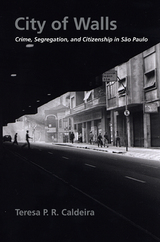
City of Walls by Teresa Caldeira
I have only been here a few days, but some things are already pretty clear. Brazil does not (yet) seem to be as obsessed by surveillance as the UK, but there is a noticeable concern with physical security. The Brazilian urbanist, Teresa Caldeira, called Sao Paulo the ¨City of Walls¨ in her excellent book of the same name, and whilst Curitiba may not be as divided as its bigger northern neighbour, the pervasiveness of defensive urban architecture is clear. Even fairly ordinary suburban houses have high walls, fences and gates, and some boast razor wire or even electric fences on top. Shopping malls and banks have large numbers of private security guards who are not just hanging around doing nothing as they do in the UK, but seem alert and active. When I went to change some traveller´s cheques, the agency could only be accessed one person at a time, via two locked doors with intercoms and an intervening antechamber with a metal detector.
What is the source of the fear? Of course it is the poor, and in particular the favelados (the people who live in the favelas, the informal settlements that line the riverbanks). Even though in Curitiba, there are not so many favelas and they are not so extensive as in the larger cities of Brazil, the favelas are still no-go areas for non-favelados and I have been warned not even to think about entering. Of course I will be later in Rio, but I will have local help (I hope). Whether one thinks that these are people driven to desperation and crime, or as one contact here said, it is because the drug-runners chose to live amongst the favelados because the police will not follow them there, the division between the favelados and the rest of society is obvious. It is also blatantly racial. The favelados are generally darker, although in Curitiba, which is generally a more European and less African part of Brazil, there are also a significant number of favelados of eastern European descent, the families of immigrants who came to work in construction and were later left without work.
The engineering faculty of the Pontifical Catholic University of Parana, home to the Postgraduate School of Urban Management, where I am based for now, is right up against one of the favelas of Curitiba. The large windows at the back have had to have concrete shields fixed across them as some young guys from the favela had started to enjoy testing their guns out on the panes. There are still a few bullet holes visible in the walls! But don’t let me give you the impression that this is a war zone, or that everyone is paranoid and afraid of each other. It doesn’t seem that way either, and I don’t feel any less safe than I did in Washington DC in the early 90s…


 ubisurv