We are all libertarians now?

A rather telling little piece on The Guardian‘s ‘Comment is Free’ site today by UK Labour MP, Diane Abbot. First she takes a cheap shot at the Conservative shadow-cabinet minister, Damien Green, for having been successful in getting his details removed from the UK police National DNA Database (NDNAD). She then says that, well, she is doing much more to help by holding clinics for her young, black, constituents to help them with their complaints against the NDNAD. This is excellent, of course.

However two things spring to mind immediately. Firstly, is this Diane Abbot the same New Labour loyalist who voted in favour of the original bill to set up the NDNAD and made no attempt to amend it to prevent the kind of racially-biased abuses of which she is no complaining? I think it is. And now, why is she not also condemning the former Home Secretary, Jacqui Smith’s rather pathetic and weaselly response the judgement of the European Court that condemned the NDNAD, which was essentially to try to avoid doing anything fundamental at all?

This is not an issue on which anyone in New Labour can really make any political capital unless they take a rather stronger moral stance. Basically, and in addition to the stance that there should be no state retention of DNA data at all, there are only two ‘fair’ ways to maintain a police DNA database, and those are to keep the DNA of the guilty, or to keep the DNA of everyone. Which you prefer depends largely on your attitude to surveillance and your trust in the accountability of the state, but politicians like Abbot are hedging and avoiding making any serious attempt to put pressure on their own government to reform the law we have.

The end of the war on photographers?

The UK Home Office has finally issued a circular on Photography and Counter-Terrorism (012/2009) in response to the widespread complaints about police harassment of both professional and amateur photographers in the name of ‘anti-terrorism’ – which I covered here and here. The circular advises police of can and cannot be done under three separate parts of the Terrorism Act 2000: Sections 43 on searches, 44 on authorised area searches and 58A on eliciting and publishing information on members of the police, armed forces or intelligence services, which was introduced as part of the Counter-Terrorism Act 2008. This is of course to be welcomed, even if it is rather late in the day.

On Section 43, they make is clear that the Act “does not prohibit the taking of photographs, film or digital images in a public place and members of the public and the press should not be prevented from doing so in exercise of the powers conferred by section” and that it is the suspicion of being a terrorist that gives the justification for any search, not the fact of taking photographs.

On Section 44, they remind the police that neither the Press nor public can be prevented from taking pictures in an area defined as an ‘authorised area’ by the police, and that officers have no powers to delete pictures or seize film. And finally, on Section 58a, they remind officers that ‘reasonable excuses’ for taking pictures, even of subjects considered sensitive, include tourism, sight-seeing and journalism. Interestingly, however, they do not actually give academic research as an example of reasonable excuse!

Of course, all of this serves to remind us that the Terrorism Act was drawn way too vaguely and widely and gave too much discretion to individual police forces and officers in its interpretation. Earlier this year, Jack Straw promised at several meetings that the government was to review all of the legislation on terrorism and counter-terrorism – perhaps this guidance is a result but it is only about interpretation and does not make or propose any change to the law itself.

Community Safety in Suginami

Following our meeting with the Mayor the other day, we went back to Suginami-ku to talk to the community safety people, who are part of the Disaster Management section. Suginami is interesting because, as far back as 2004, it was the first Local Authority in Japan to introduce a special bohan kamera jourei (security camera ordinance) which is based in part at least on principles of data protection and privacy. And until neighbouring Setegaya-ku introduced their own ordinance last year, they were, so far as I know, the only such authority. The ordinance followed public consultation which showed that although people generally thought CCTV was effective (95%), a significant minority of 34% were concerned about privacy, and 72% thought that regulation was needed. These figures seem to be significantly more in favour of privacy and regulation of CCTV than the nationwide survey done by Hino Kimihiro, however he asked different questions leading to answers that are not directly comparable.

Suginami is one of the areas of Tokyo that has the other kind of CCTV system introduced by the Tokyo Metropolitan Police after 2002, help points where people press a button if they feel in danger and speak to someone from the police. The help points have both CCTV camera and an alarm / red flashing light if the caller says it is an emergency.

However the Suginami community safety officers said that these cameras have not proved very effective and in fact they cause a lot of problems, because children tend to press the button for fun, and run away – meaning that there are many false alarms.

Suginami has some of the same kind of array of ‘blue-light’ volunteer patrols as Arakawa-ku. In Suginami, there is a fleet of mini-patoka (mini patrol cars) and motorbikes, used by 15 retired police officers. These are mainly about visibility leading to deterrence and increased community confidence, as the volunteers ex-officers have no special powers nor do they carry side-arms or handcuffs or any other conventional ‘police’ equipment. Suginami does not have the small community safety stations like Arakawa-ku, although they do also have the same problem of local koban (police boxes) being closed. However where Suginami really stands out is in the sheer number of volunteers they have involved in their community patrols, organised through the local PTAs, shoutenkai (shopkeepers’ associations) and choukai (community associations). There are 140 groups with 9600 people actively involved in one way or another in community safety just in Suginami.

Suginami is a relatively wealthy ward and the kinds of problems that concern Arakawa (mainly minor street crime and snatch-thefts) are not such big issues here.  The main concern in this ward seems to be burglary and furikomi – the practice of gangsters and other criminals calling old people and pretending to be a relative or representative of a relative and persuading them to transfer money to a particular ATM (which you can do in Japan – it would be impossible in the UK). Furikomi is a very interesting phenomenon in that it seems to be a product of family, social and technological changes. Many older people who would have lived with family in traditional Japanese society are now living alone. They are lonely and miss the intimacy of family contact, so they tend to welcome unexpected calls from relatives who may now be living almost anywhere in Japan. These older people are also technologically literate and able to use mobile phones, ATMs and computers. The combination of this technological skill, dispersed families, and psychological vulnerability makes for a ripe target for fraudsters, and Suginami estimate that 40% of all crime in the ward is some form of furikomi.

In many ways, increasing concern for privacy is also a product of this change in lifestyles and family structure, as well as building techniques – western-style walls and better sound insulation mean that you can’t always know what is going on in the next room anymore, let alone in your neighbours’ apartments or houses. This also makes burglary rather easier, as once the thief has got past the initial walls or doors, no-one can hear or see very much. The intense and intimate ‘natural surveillance’ that used to characterise ordinary Japanese communities is disappearing. But the Suginami community safety officers see the possibility of revitalising such natural surveillance, and protecting privacy, without going down the route of impersonal, technologically-mediated surveillance. In many ways, this is quite heartening – if, of course, you are of a communitarian mindset. Such supportive, mutually monitored and very inward-looking communities can be stifling to those who do not fit and exclusionary to those from outside… and, not coincidentally, one of our last interviews was with a leading support group for foreign migrants in Japan, who have a very different perspective on all of these developments. That will be in my next post, which may not be until Saturday as we’re going off to Kansai for a couple of days…

(Thank-you to the Disaster Management section for their time and patience).

Japanese surveillance studies researchers

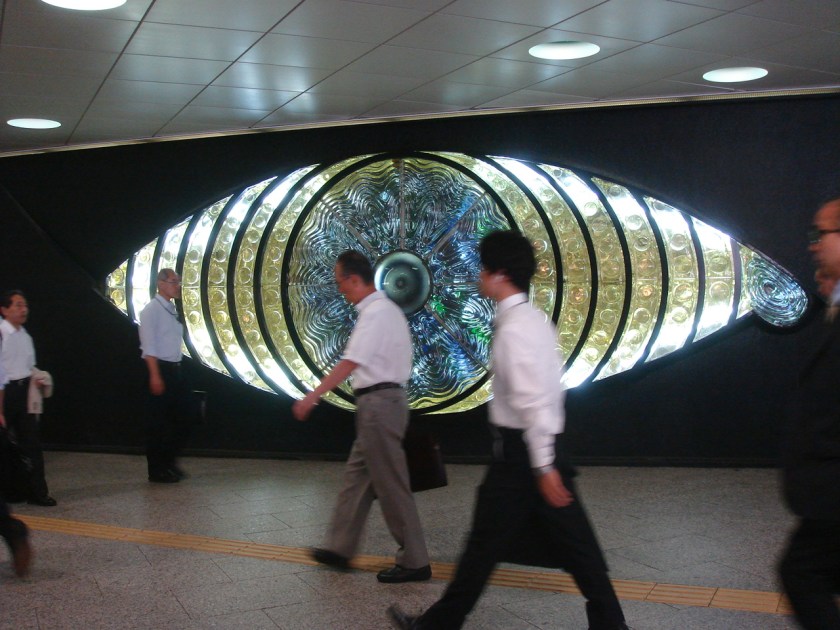
Somebody's watching you... office workers walk past an installation in Shinjuku station, Tokyo

We’ve met with several Japanese surveillance studies researchers whilst out here this time. I mentioned Ogura Toshimaru already the other day, but we also had a long meeting the week before with Hino Kimihiro, a researcher into bohan machizukuri (community security development), and government advisor on security planning. Dr Hino has been carrying out a number of research projects on both ‘designing out crime’ and on the effectiveness and public acceptability of CCTV in Japan. I hadn’t come across this research before as my contacts here were mainly in social sciences and law and Dr Hino tends to publish in urban planning journals and is not connected to other Japanese surveillance researchers. His work is very interesting and reminiscent of that of Martin Gill or Farrington and Welsh in the UK. It is a shame, that just like those researchers who have carried out analyses of CCTV for the UK Home Office, his assessments tend to be ignored by the government. Dr Hino’s latest project is to assess the trials of a new movement recognition system in Kawasaki city. I hope he can come to the January Camera Surveillance workshop at Queen’s University, Ontario, or the April Surveillance & Society conference in London (details coming soon!).

I also met today with Tajima Yasuhiko, a professor of media law in the School of Journalism at Jochi (Sophia) University in Tokyo. Professor Tajima has been one of the most important critical voices in the debate about surveillance in Japan, and has bridged the academic and activist world, being involved with legal action against juki-net and Google StreetView. We had a productive conversation about the politics of surveillance in Japan and the prospects for critical voices to be heard. He wasn’t optimistic that they would be, and neither am I after our meeting at the Prime Minister’s IT Strategic JQ the other day, however I am also convinved that in many ways Japan has not yet gown as coordinated and centralised a route on issues of security and surveillance as has the UK. There is, so far as I can see, no real attempt to link up things like juki-net or other databases and the anshin anzen (or bohan) machizukuri agenda, and i-Japan, national and local police, and wider community security agendas do not really coordinate at all. This is due to the lack of an obvious ‘threat’ like that of terrorism in the UK, around which such coordination can occur. The government half-heartedly tries to get people worried about North Korea, but really they aren’t, and ‘ageing society’, whilst a phrase used to justify almost anything (including central databases) is a worry, it does not generate the fear that comes with the war on terror.

We also considered the relative weakness of Japanese civil liberties organisations and the failure of the mainstream media to pick up on issues of privacy and surveillance. There seems to be some effort now to try to coordinate various organisations to push for an explicit constitutional protection for privacy (rather than the rather vague inclusion of such an idea in a wider notion of the ‘pursuit of happiness’), but whilst I can see that being happily accepted after the government has got its central database(s), I can’t see it being done in time to alter either this trajectory or the way in which the database(s) are built.

China – the ultimate surveillance state?

Most societies are surveillance societies of one kind or another and to a greater or lesser extent, but there are very few comprehensive surveillance states, i.e: nations where the government is really interested in what you are doing and thinking and has the will and the resources to find out. Iran has a pretty serious network of petty officials, informers and spies who enforce both moral and legal norms; Burma has a regime of fear and military rule; and several states, usually those with less comprehensive control, have vicious and arbitrary systems of punishment (like Sudan). However few have the combination of wealth, technological resources, a complete lack of concern for outside opinion, and state will to keep control on any moves to greater political diversity as that possessed by China.

According to a report in Xinhua today, China’s police have in the last few years installed more than 2.75 million cameras in public space, largely in urban areas, and are now moving to install cameras in rural locations too, “linked to police stations, community police service posts and farmer security guards in rural areas to establish a comprehensive security network”.

As Naomi Klein’s report last year showed, helped by willing western companies and law enforcement agencies, China is becoming a vast laboratory for surveillance and social control. The aim is a fully integrated system that can police real world and online behaviour. The ruling Communist Party, whilst opening up the economy is determined to prove, contrary to US assertions, that you can indeed have a free market system and still have complete one-party authoritarian control. And as anyone who has ever tried to have a discussion on Chinese politics with Chinese students or visiting academics, the control extends deep into the education system, with ‘normal’ patriotism preventing the development of all but the most banal of views counter to the approved picture.

It is probably sometimes worth remembering that however bad the UK or Japan or the USA or any other democratic state seems to have become in this regard, China still takes the prize for the world’s most comprehensive surveillance society.

Varieties of anti-surveillance activism in Japan

Although some progressive activists would like it to be otherwise, anti-surveillance feeling is not confined to the left, indeed in many countries, like the USA, libertarian individualist right-wing anti-surveillance activism is perhaps more common. And it seems that such a position is not unusual in Japan either.

Having returned from a weekend of hot springs, fine sake-tasting and eating way too much, today we met with the Mayor of the Suginami ward of Tokyo, Hiroshi Yamada, a prominent figure in the anti-juki-net campaign, and a also one of the leaders of a group of right-wing figures trying to promote a new nationalist grouping at that end of the Japanese political spectrum. But this new right is not at all a simple matter of ‘back to the 1930s’ that some commentators would have you believe. Yes, this group – which also includes the Mayors of major cities including Yokohama and Nagoya as well as popular journalists like Yoshiko Sakurai – has very conservative, revisionist views, on Japanese history, but in many ways they have far more in common with the new US libertarian right in their rejection of large state and high taxes, and in other areas too, for example Sakurai has rather unscientific views on climate change!

Part of the this libertarian outlook is the rejection of state intrusion into the private lives of individuals. Mayor Yamada saw the juki-net system as part of unwelcome movement towards a more top-down society, concentrating power at the centre. He was very clear that the state’s ability to collect information on the individual should be based on what the individual wanted to give up, not on what the state thought it needed (this is very much the opposite of what the Prime Minister’s IT Strategic HQ said to us last week). He was also most concerned about the risks posed by large databases, both as an attractive target to external hackers and to corrupt use from inside operators. Yamada is not opposed to what he calls IT shakai (IT society), but the use of IT should be based on what is useful to individuals, and of course what is actually he needed, he argued, would often be less expensive than the massive computerisation schemes favoured by the current administration as part of their i-Japan strategy. In this sense, he said he would oppose any move to unnecessary centralised databases and certainly to any possible national ID register or card.

In most respects, what Mayor Yamada said could probably have been said by any left-wing civil liberties activist in the UK, or by conservative right opponents of intrusive state like Conservative ex-Shadow Cabinet Minister, David Davis. Perhaps many aspects of what is felt to be wrong with surveillance society do not correlate neatly with old left-right divisions. This view was shared by Toshimaru Ogura, a Toyama University professor and major figure in left-wing anti-surveillance activism whom we met with just afterwards, along with campaigning journalist, Midori Ogasawara again. Just as the Convention on Modern Liberty event earlier in the year showed for the UK, there are many different varieties of anti-surveillance feeling in Japan, and whilst opponents may disagree with each other, and may even find other aspects of the politics of their erstwhile collaborators utterly distasteful, they do collaborate, even if it is only for short periods.

Professor Ogura’s analysis, as that of Ogasawara and indeed of Kanshi-no! whom we met the other day, is much more focused on the way in which surveillance excludes and discriminates – against union members, activists, gaikokujin (foreigners) and so on – and also the ways in which it favours the interests not just of the state but capital. We’ll be talking to groups who deal with the concerns of these excluded people in the last week we are here. Privacy is important, but Ogura’s analysis is concerned with the disproportionate effects of surveillance. It is not just that privacy is affected but that particular groups’ and individuals’ rights are damaged more than others, and those people are not generally the ‘ordinary taxpayers’ to whom Yamada and the libertarian right are trying to appeal.

Like me, Professor Ogura is also particularly interested in the way in which particular corporations and business coalitions pushing technological ‘solutions’ to social and organisational problems can have a profound influence the way government makes decisions. Such coalitions would still be there however large government was, and in some ways, without a government large enough to stand up to the private sector, a different kind of more purely market-driven surveillance society would emerge. In that sense, it is what government does, and to whom it responds, that is more important that more arbitrary questions of ‘size’.

There’s a lot more to consider here too, in particular the extent to which any of the things we consider under the umbrella of ‘surveillance’ are actually and actively part of some coordinated state (or other) plan. I’m starting to develop a sense of this here, but I will leave those thoughts to another post.

(Thank-you to Mayor Hirioshi Yamada, Professor Ogura Toshimaru and again, to Midori Ogasawara for being so generous with their valuable time).

Locational Privacy

PDF file

The Electronic Frontier Foundation has a very good little report on locational privacy, “the ability of an individual to move in public space with the expectation that under normal circumstances their location will not be systematically and secretly recorded for later use.”

As usual for EFF, it is written in clear, understandable language and is free-to-access and download.

* I’m going to be away up to the mountains for a couple of days, so there won’t be any more posts here until Sunday at the earliest… next week is a slow one here in Japan as it is O-bon, the Buddhist festival of the dead, and many people go back to their family home and offices are generally closed for some or all of the week. I won’t be doing much in the way of interviewing, but I still have quite a few interviews and visits from the last two weeks to write up.

At the IT Strategic Headquarters

Yesterday we visited the Prime Minister’s IT Senryaku Honbu (IT Strategic Headquarters). (This has actually been the only national-level government agency that has agreed to speak to us, and some of the reasons for refusal have been rather telling, not least that of Houmusho (the Ministry of Justice), which claimed that they had nothing to do with privacy and so on, which betrays a level of ignorance about the effects of their own policies that is probably more the result of bureaucratic sectionalism and literalism than anything else but is nevertheless interesting!). The IT Strategic HQ is responsible for developing the ‘i-Japan’ strategy, the latest incarnation of what has at various times been called ‘Information Society Japan’ and ‘e-Japan’ policy. They are also the agency that wrote the most recent Japanese data protection laws, which I wrote about a couple of weeks ago.

We were treated to a prepared presentation on the latest incarnation of the i-Japan strategy, in which the ‘i’ seems to stand for ‘inclusion’ and ‘innovation’ but not apparently for ‘interactive’, which one might expect from its use elsewhere in computing. However it was the brief interview we had afterwards that was more enlightening.

In short, the government has acknowledged that what they originally wanted out of juki-net has failed due to opposition, despite the supreme court victory that ruled that the current cut-down version was constitutional. However, as Kanshi-no! argued, they are not going to back down that easily. The movement towards the creation of centralised government databases will continue, and there most likely will eventually be a fully configured identification system (and card) and rather alarmingly, the new i-Japan strategy makes it quite clear that laws that currently prevent this from happening will simply be changed or removed. They do not want opposition groups, nor indeed the current global recession, to be able to hold up or change these plans.

However the main thrust of development of centralised databases has shifted away from juki-net and the jyuminhyo (residents’ registration) system, towards national insurance, health and pensions. This is, as the agency than runs juki-net, Lasdec, suggested to us – and I am now beginning to think that this suggestion was rather more of a loaded hint than I had first thought – by far the most data-rich area of government records and therefore in many ways more suitable for being the basis of an architecture of central registration and identification. The database that the government intends to create in this area will also have the possibility for citizens to add in (voluntarily, they say), information from private sources, such as bank account and other financial details. Of course this could be more ‘convenient’ in terms of benefits and taxes, but it also puts an enormous amount of previously private data in the government’s hands and presents a huge temptation to identity fraud and theft from both outside and, more importantly inside the state bureaucracy (and let’s not forget, most identity fraud is an inside job).

It gets more worrying still as despite the advanced stage of these plans, the government has apparently still not decided exactly who will have access to this database, and the police in particular, as well as private insurance companies, are still considered as potential users. It seems that although the IT Strategic HQ might have developed data protection in Japan but they do not appear to understand its principles of necessity, proportionality and consent – indeed I asked them about these principles and they really had no serious reply. Instead they claimed that people in Japan wanted to have these central databases because the current fragmented system had led to poor security and data losses, and in any case, ageing society and the pensions crisis meant this had to be done. I have noticed that in Japan, ‘ageing society’ like ‘terrorism’ in the UK, seems to have become the spectre evoked to silence potential criticism.

There are many other issues too: the government is also trying to introduce a voluntary system of Electronic Health Records (EHR), but this is not as developed as the Connecting for Health centralised database that is still experiencing significant problems in its introduction in the UK; and there are some rather less controversial social inclusion measures included the provision of computers for schools and so on. However my overall impression after leaving the IT Strategic HQ was of a government that was determined to press ahead with centralised collection and control of personal information regardless of the views of citizens or of whether it is really necessary even to achieve the policy aims they have. And this won’t change as the result of a change in government either. If, as seems likely, the Liberal Democratic Party (LDP or Jyuminshuto) are voted out, the Democratic Party of Japan (DPJ or Minshuto) which will succeed them, has already said that it will create a central database.

(Thank-you to the officials of the IT Strategic Headquarters for their time).

The new Japanese ‘jury’ system

The Guardian Comment is Free site asked me to do a (very quick) comment piece on the new Japanese ‘jury’ system and it’s now online here. I had to cut my original down to around 600 words and they edited it a little more to fit, and added an awful photo (where on earth they got it I am not quite sure…). Here’s the full version…

Disorder in the Court

Japan’s courts are not usually the subject of massive popular interest in the country. Salacious details of criminal cases fill the pages of the popular weekly magazines and provide fodder for cheap TV shows, but the court system itself is seen as distant, formal and, above all, dull.

The courts have long been seen as a a rubber-stamping exercise for cases already decided by confession in police cells. Japan’s 95% confession rate has been attributed to a cultural sense of shame, or to the thorough and minutely detailed dossiers of public prosecutors, but according to Amnesty International, the psychological pressure of up to 23 days of isolation and constant questioning (not to mention intimidation and physical violence) might provide a better explanation. In recent years, the issue of coerced confessions has been increasingly recognised in Japan, and the most recent example was the freeing in June this year of Toshikazu Sugaya, a man who DNA evidence has now shown could not have been guilty of the killing of a 4-year old girl, a crime that he confessed to in police cells and of which he was consequently convicted of in 1990.

Added to this is a growing feeling that the courts were too remote from people. So in 2004, a new law was passed to introduce a new method of adjudication for some criminal trials beginning in May 2009. Now the first trial using this new system, a case of murder involving elderly neighbours, has just started in Tokyo. Some have characterised this saiban-in as a ‘jury’ system, but it is actually a ‘lay-judge’ system. Whereas in the UK, twelve ordinary people are called by the courts to hear evidence and make a judgement on the guilt of the accused, in the new Japanese system six citizens join three professional judges. They not only hear evidence, but are also able to question witnesses and help decide the sentence. Verdicts are majority decisions but have to include at least one of the professional judges.

It seems an onerous task. So it is not surprising that many who were originally short-listed for lay-judge duty but did not make the final six for the first trial, are relieved to have escaped not because, as is so common in the UK, they found it inconvenient, but because of the burden of responsibility they felt. This has particular cultural components. Strongly-stated opinions and absolutes are not favoured in Japan, and people like to keep options open. The selection process itself was remarkably complex and involved summoning an initial 100 candidates, some of which were excused on grounds of infirmity or age, and more were then deselected after detailed questioning on their views and attitudes. Even court officials are now admitting that they may have overdone it.

But why this particular, strange, hybrid system? The answer is that it had form. Japan had an almost identical system from 1928 to 1943. During the Taisho period that saw a brief flowering of a more democratic culture in Japan, progressives had tried to introduce a full Anglo-American style twelve-person jury, however, judges, and conservative and nationalist politicians opposed this initiative and forced a compromise: the saiban-in system.However according to research by Takashi Maruta, the lay-judges still actually challenged the professional judges in many serious cases refusing to accept the confession and dossiers of evidence and preferring to rely on oral testimony of the accused and witnesses in court. Even in its compromised form such a volatile system offended traditionalist judges (who like many state representatives saw their power as deriving from the Emperor and therefore ultimately, divine sources), lawyers and was hardly suited to the militarist regime that gained control in the 1930s, and was eventually stopped.

But opposition seems rather different this time around. In the UK, civil libertarians have been fighting to defend jury systems, but in Japan civil liberties arguments have been marshalled by protestors against the new system. Opponents argue that the selection process violates privacy by forcing citizens’ personal views to be exposed, and is also authoritarian because citizens cannot refuse to serve unless they have health reasons. Some have even likened the system to a lynch-mob, because of course Japan still uses the death penalty.

However dig deeper, and underlying these arguments are reactionary and conservative concerns and the once-again rising influence of nationalists, in other words very similar conditions to those of the late 1920s: defence of the ‘professionalism’ of judges, and the arguments about the quasi-sacred integrity and necessary distance of courts from popular influence. More generally though, even though this system is the result of a bill passed five years ago, it seems part of an air of populist desperation from the increasingly unpopular ruling Liberal Democratic Party that faces defeat for the first time in decades in the general election at the end of this month.

However, if nothing else, the controversy over the system has excited Japanese people about the court system, and not just in bloody tales of murder and mayhem, and whatever happens in the future, any disorder in the court that results in interest and engagement in criminal justice has to be a good thing.