In another chapter in the current struggle over the means of visual representation, the UK Court of Appeal has made an important ruling that could affect the future of police surveillance tactics. In a case brought by anti-arms trade protestor, Andrew Wood (no relation!), the judges ruled that the Metropolitan Police should destroy photographs taken of Mr Wood at the AGM of giant dataveillance conglomerate, Reed Elsevier ( the BBC calls them a ‘publisher’ but that’s a rather archaic and inaccurate term for what Reed Elsevier does, which is to collect, analyse, organise and trade in personal and business data of all kinds). Reed Elsevier had been involved with running arms trade exhibitions through a subsidiary at the time.
The ruling argued that the police should not take and retain pictures of people who were not suspected of any current wrongdoing, but whom the police considered might do so in the future. According to the BBC, the Met had argued that its actions “were reasonable in helping officers to detect crimes that may have occurred in the past or may do so in the future.” But that is exactly the kind of blanket risk-management-based way of thinking that allows almost any preemptive or precautionary mass surveillance to be justified, and it is quite right that the Court should have ruled that it should be controlled. It is about time that a ruling like this was made.
The one cautionary note here is that the Met will be appealing this to the House of Lords, and no doubt beyond if that fails, so watch this space…
Following in the footsteps of leading urbanists like Mike Davis and Michael Sorkin, is a project led by Dr Jeremy Nemeth, an assistant professor at University of Colorado. which traces the degradation, securitization and privatization of what we used to optimistically refer to as ‘public space’. This project aims to map and quantify the space in three contemporary cities (New York, Los Angeles and San Fransisco) now restricted in the name of security. The website is online now, and their findings are summarized on the front page:
“Even before [the 9/11] terror attacks, owners and managers of high-profile public and private buildings had begun to militarize space by outfitting surrounding streets and sidewalks with rotating surveillance cameras, metal fences and concrete bollards. In emergency situations, such features may be reasonable impositions, but as threat levels fall these larger security zones fail to incorporate a diversity of uses and users.
Utilizing an innovative method developed by our interdisciplinary team, we find that over 17% of total space within our three study sites is closed entirely or severely limits public access. The ubiquity of these security zones encourages us to consider them a new land use type.”
(thanks to Dr Nemeth for the corrections to my original misattribution of his excellent project)
Tenacious FoI and ‘institutional discovery’ work both in and out of the US courts by the Electronic Frontier Foundation has resulted in the FBI releasing lots of information about its enormous dataveillance program, based around the Investigative Data Warehouse (IDW).
the FBI now has a data warehouse with over a billion unique documents or seven times as many as are contained in the Library of Congress;
it is using content management and datamining software to connect, cross-reference and analyse data from over fifty previously separate datasets included in the warehouse. These include, by the way, both the entire US-VISIT database, the No-Fly list and other controversial post-9/11 systems.
The IDW will be used for both link and pattern analysis using technology connected to the Foreign Terrorist Tracking Task Force (FTTTF) prgram, in other words Knowledge Disovery in Databases (KDD) software, which will through connecting people, groups and places, will generate entirely ‘new’ data and project links forward in time as predictions.
EFF conclude that datamining is the future for the IDW. This is true, but I would also say that it was the past and is the present too. Datamining is not new for the US intelligence services, indeed many of the techniques we now call datamining were developed by the National Security Agency (NSA). There would be no point in the FBI just warehousing vast numbers of documents without techniques for analysing and connecting them. KDD may well be more recent for the FBI and this phildickian ‘pre-crime’ is most certainly the future in more ways than one…
There is a lot that interests me here (and indeed, I am currently trying to write a piece about the socio-techncial history of these massive intelligence data analysis systems), but one issue is whether this complex operation will ‘work’ or whether it will throw up so many random and worthless ‘connections’ (the ‘six-degrees of Kevin Bacon’ syndrome) that it will actually slow-down or damage actual investigations into real criminal activities. That all depends on the architecture of the system, and that is something we know little about, although there are a few hints in the EFF report…
News from various sources has revealed that the United State, the European Union and the United Kingdom are all preparing to invest further large sums in advanced biometrics and surveillance research.
According to an anonymous message to Slashdot, in the USA, Department of Justice requisitions for the coming year show “$233.9 million in funding for an ‘Advanced Electronic Surveillance’ project, and $97.6 million to establish the ‘Biometric Technology Center.'” The former is largely to deal with the problems of intercepting Voice-over-Internet Protocol (VoIP) communications – like Skype. The latter is what Slashdot calls a “vast database of personal data including fingerprints, iris scans and DNA which the FBI calls the Next Generation Identification” for the FBI. In other words, the architecture of the proposed ‘Server in the Sky’ system, which The Guardian revealed last year – for some notes on this and other systems under development, see here.
Meanwhile Owen Bowcott in The Guardian today has a story which puts together various bits and pieces from the EU’s FP7 Security theme research budget and UK security investment. In the UK, there is to be £15 million spent on updating UK biometric security for embassies, and more interestingly other unspecified ‘surveillance’ purposes, and in addition, rolling out of facial recognition systems to more UK airports. As we know, the controlled environments of airports where people are required to look at cameras, are one of the few place where this technology works properly.
This provides a rather tenuous link to the headline of the Guardian story which is an EU-funded study into brain-scanning (yet again) called Humabio (Human Monitoring and Authentication using Biodynamic Indicators and Behaviourial Analysis). There are lots of these about, and one of them may work sooner or later, but it is worth pointing out that people have been putting out ‘we will soon have brain scanning’ stories since the 1980s and like, nuclear fusion, it always seems to be 5 or 10 years in the future. Brain-scanning seems to be the technology of the future… always has been, always will be?
One of the things that I have been following over the past few months has been the effect of the recession on security and surveillance. One of the observations I have made is that those investing in security at this time are turning more and more to surveillance in preference to expensive human guards.
The Journal, the regional newspaper of the north-east of England (and my local paper), has a report today which seems to add more weight to this hypothesis, arguing that “the economic downturn, which has had a devastating effect on the construction industry, has led to a growing trend of companies cutting costs by replacing building site security guards with hi-tech CCTV systems”.
However, like the last time I reported on a similar story from Boston in the USA, there is perhaps less to it than meets the eye. The piece is another business section puff-piece for a local company, this time Newcastle-based UK Biometrics, largely a fingerprint ID outfit, on the basis that it is claiming “a 10-fold increase in enquiries for its sideline technology, CCTV cameras which can be accessed via remote devices”. It turns out that the suggested reason for this also comes from the company. This doesn’t make them incorrect, however I tend to treat all local business news stories with a certain degree of scepticism.
There is also a fundamental problem with the reasoning for such decisions, if they are indeed being made, which is one of the big issues with CCTV more generally, which is that cameras, even if they ‘work’ (and what that means is controversial enough), do not provide an equivalent service to a human guard. It is not necessarily a question of better or worse, it is just not the same. CCTV is also nothing if there is no response to the images that are seen. Without operators, analysts and people on the ground to act on the images, there is little point in even thinking that CCTV systems will ‘replace’ what a guard does. If only the machines are watching, there is only the illusion of security; an empty show.
Whilst finishing up my work in Rio de Janeiro yesterday, I came across this interesting bunch of people, mv-brasil, who appear to be a Brazilian nationalist movement, with much in common with organisations like the British National Party or the various right-wing groups in the USA. Their website contains the usual odd mixture of anti-globalisation, evangelical Christian (they campaign against Halloween) and anti-United Nations / New World Order stuff with the added anti-Americanism. There of course is the usual rather uncomfortable fact of the ‘Brazilian Christian’ nationalist being a representative of a colonial power that invaded the country and took it from the indigenous people, but they roll over this one with some nods to Indian rights when it suits their cause, most notably when it comes to the Amazon.
A t-shirt with anti-internationalisation and privatisation of the Amazon slogan
One of the T-shirts for sale makes reference to this, being against ‘internationalisation and privatisation’ of the Amazon by the USA. It is a conspiracy theory I’ve come across before when I was doing some research on the SIVAM program – which provides some actual evidence for contentions that there is a secret American program to control the rainforest. I had someone tell me here in complete good faith that it was a ‘fact’ that several Amazonian tribes already thought that they were part of the USA and flew the US flag! This is combined with the fact the UN and international environmental organisations are very concerned about the destruction of the rainforest and the perceived lack of effort by successive Brazilian administrations to stop it. Put all this together and you have the ingredients for nationalist paranoia.
So what is SIVAM? And why would I be interested in it anyway? The reason is that SIVAM is a surveillance system. Announced at the Earth Summit in 1992, and finally completed in 2002 and fully operationial from 2004, the Sistema de Vigilância da Amazônia (SIVAM) is a multipurpose, multi-agency network of satellite, aerial and ground surveillance and response that aims to monitor the illegal traffic of drugs and forest animals and plants, control national borders and those of indigenous peoples’ lands, and prevent the further destruction of protected areas of forest. A good technical account in English can be found in Aviation Today from 2002, and there is an interesting article on its construction here.
Donald Rumsefld visits the SIVAM control centre, 23 March 2005 (Wikimeda Commons)
The problem is that, although an initiative of various Brazilian government agencies including the environment and Indian affairs ministries, the federal police and the army, SIVAM is supported and funded by the USA – most of the initial $1.39Bn US cost came through a grant from the U.S. Export-Import Bank, and the consortium that supplies the equipment includes giant US military supplier, Raytheon – amongst many others from Brazil to Sweden. The visit of former President George W. Bush’s right-hand man and then Secretary of State for Defense, Donald Rumsfeld, to the SIVAM control centre in 2005, was widely reported in Bazil. It was of course interpreted by many as further evidence of Brazil’s ceding of control of the Amazon to the USA, or even presaging a US invasion of the Amazon, as Senator Norm Coleman discovered on a fact-finding mission later that year.
Latin American countries have every right to be suspicious of US motives: the Monroe Doctrine; George Kennan’s Cold War ‘grand area’ vision; the support for dictators like Augosto Pinochet; the invasions of Panama and Grenada; Plan Columbia and the widespread use of military ‘advisors’… the list goes on. And it is certainly the case that US strategic surveillance plans for ‘Full Spectrum Dominance’ and the like, have have long included ‘leveraging’ any system in which they are involved from the International Space Station to things like SIVAM. So of course they will have a strategic interest, and no doubt SIVAM data will find its way to US military C4ISR centres, but this does not amount to a plan to invade Brazil or take control of the Amazon.
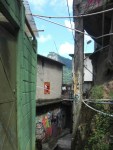
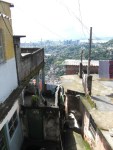
One of our most interesting visits last week was to the favela of Morro dos Prazeres, north-west of Santa Teresa. Prazeres has one of the most astonishing views of Rio of any neighbourhood, with an almost 360 degree panorama of the city, it’s perspective to the south only interupted by the statue of Christ the Redeemer, which is hardly a bad view in itself! You might think that the last thing that favelados would care about was the view but they are well aware of the beauty of their location – the assumption that the poor an desperate would not care about such things is a rather patronising misconception. Elisa, the leader of the community association, at least, seems most proud of this asset and says that like many people she wouldn’t want to live anywhere else even if she won the lottery!
But Prazeres does have serious problems. For a start, it is a ‘hot’ favela, occupied by drug traffickers, who control ‘law and order’ in the place. There is therefore no ongoing police presence, although as with many such communities, the community association does have a relationship of sorts with local military police commanders through organised coffee mornings at which problems are discussed. Luckily, despite or because of the almost complete control of a particular gang which is well integrated into the community (i.e.: they are relatives of the more law-abiding members), there are not many problems with violence and the police, ‘thank God’ (says Elisa), have not raided the favela recently, as they have many others.
In fact, as we were visiting Prazeres, as the taxi driver rather anxiously pointed out as he dropped us a safe distance away, BOPE (military police special operations) were ‘invading’ two other favelas next to it, the very hot Morro de Correoa, and Sao Carlos. The operations left eight dead, and we think what we had assumed initially were fireworks was probably the sound of small arms fire in the Sao Carlos operation. However, when we asked a PM at a nearby police post whether Prazeres was safe to enter, he seemed rather blase and relaxed about the whole thing…
Elisa was another very impressive woman. In the absence of men – who, in the favelas are in many cases, either involved in the gangs, working outside, or unemployed and alcoholic – it seems that a whole generation of strong, courageous women has emerged to try to develop their communities from the bottom up. In the past they have benefited from various attempts by previous mayors to provide development for the favelas. Unlike some places, Prazeres does not have a school built during the regimes of populist left-wing Governor, Leonel Brizola (who seems to be fondly recalled in by almost all those we have talked to in the poorer communities). However there was a lot of intervention as part of the Favela Bairro (Favela Community) program of former Mayor, Cesar Maia, and it is this normalisation or the favelas through infrastructure, social and economic development, education, health and social services that Elisa said are the only long-term solution to the problems of Prazeres. The creche in particular is a source of continual delight to her, and her face lit up whenever it is mentioned.
With social development and education, Elisa argued, eventually the ‘cold’ and uncaring gangs will recruit fewer kids, and they will wither slowly away. Confrontation however, only strengthens them by driving more young people to support the ‘insider’ traffickers against the ‘outsider’ police. They must, she said, work like little ants, with lots of small efforts adding up together to long-term success… then perhaps the anthill of Prazeres will function as a normal community.
There’s no doubt that academic research and military intelligence have a more tangled history than some would imagine, although in many countries in recent years ‘imperial disciplines’ like geography and anthropology have been through a long process of reevaluation and rejection the values that gave them birth. In the USA, however, geography remains intimately connected to the state and more particularly to current US military projects, indeed since 9/11 such ‘patriotic’ research has become more rather than less common.
z magazine has a very interesting article on a growing furore around first of a new US government cartography / geography program called the Bowman Expeditions. This half a million dollar project, México Indígena, has been mapping indigenous lands in Oaxaca, Mexico, where a popular insurgency has been growing in recent years. Local organisations under the umbrella of the Union of Organizations of the Sierra Juárez of Oaxaca (UNOSJO) have rejected the activities of the expedition and claim they were duped by researchers.
A slide from a Powerpoint from the project reveals ideological connections to US military goals, but the links are material too.
And it seems they were right to do so: the grant scheme is associated with the U.S. Army’s Foreign Military Studies Office (FMSO), which seems to be largely associated with so-called ‘open source intelligence’, in other words ‘leveraging’ academic mapping projects for military purposes, in particular the ‘cultural terrain’ for potential future counter-insurgency purposes, learning the lessons of failures in Afghanistan and Iraq. The academics involved, Jerome Dobson and Peter Herlihy from the University of Kansas, just down the road from FMSO, are now furiously backpedaling as previous denials are shown to be evasive and disingenuous…
We’ve been so busy these past two days that I have not had time to update the blog with all the visits and interviews we have been doing. I will try to do so over the weekend… Just to summarise, we’ve been to another favela, Morro dos Prazeres and met with the leader of the community association; the HQs of the Policia Civil and the Guarda Municipal. We visited the State Secretariat for Public Security twice, once to talk to people from the office of the Secretary, and once to visit the CCTV control room and talk to the director. And finally we talked to two politicians from different eras – the ex-Governor, and also Security Minister under Leonel Brisola, lawyer and academic, Nilo Batista (and also his wife, sociologist, Vera Malaguti Batista) and Deputado Estaduel, Alessandro Mollon, a leading campaigner for human rights and real public security in the state legislature and various members of his team.
Next week, on Monday, we will be going back to Morro Santa Marta to talk to BOPE Commandante Priscilla; and then I will be spending the rest of the day between the neighbourhood association of wealthy Laranjeiras and that of a nearby favela, also ‘pacified’, Tavares de Bastos, and its BOPE battalion. On Tuesday I am giving a talk on my project at the Federal University of Rio de Janeiro, and hopefully on Wednesday or Thursday morning we might just get to talk to Major Eduardo Paes, and someone from the state’s Ministry of Cities, as well as the already fixed appointment with the influential NGO, Viva Rio.
Then it’s Easter and I have to go home… I have to come back. I feel like I have barely started here. I need to do more interviews at national level, and the survey work I was hoping to do has been squeezed out by the interview schedule. In any case, the level of comparative study I am doing means I cannot explore, literally and metaphorically, all the avenues and back-alleys that I would like. And there is so much going on here that is interesting and important in terms of the complex relationships around social justice, crime and disorder, (in)security, surveillance and social control.
According to new market research by ABI, summarised by Business Wire, video surveillance remains a growth industry despite the recession, posting 10% growth figures recently. The report also claims that the overall size of the video surveillance industry (which of course it just a portion of the overall security and surveillance sector) will increase to $41 Billion US by 2014 (assuming there is the predicted global economic recovery, of course).
As I have written before, there are two somewhat contradictory trends for this sector in the current recession . The first is the insecurity that results from economic crisis, which coupled with actual rises in crime that also tend to follow, leads to increased investment in security and surveillance. This would tend to suggest a growing market in hard times. However, the other is the increasing mismatch between high security and trade flows. Increased security and surveillance imposes costs on those trying to move and sell goods and services, and this is particularly true of cross-border trade in a time of paranoia about controlling flows of risky people. This could result in a free trade versus security stand-off that might lead to a declining security market. Of course, breaking down the differences further, high tech surveillance is often used in place of physical security and is frequently seen as a substitute for it, so a reaction against higher security might actually lead to more surveillance… either way, the surveillance technology suppliers win.



 So what is SIVAM? And why would I be interested in it anyway? The reason is that SIVAM is a surveillance system. Announced at the Earth Summit in 1992, and finally completed in 2002 and fully operationial from 2004, the






 ubisurv