A sane response on the number of cameras

Here is an eminently sane and sensible response to the ‘debate’ on the number of cameras in Britain from Paul Lewis in The Guardian. Not much more to say really other than I strongly suspect that he reads this blog!

Actually, equally sane if rather ruder, is Charlie Brooker, also in The Guardian. He argues as bitterly as usual, that the attitude of the Labour government to its information relationship with its citizens represents nothing but contempt. I strongly suspect he may be right.

How many people are being arrested for taking pictures in public in Britain?

It seems that what is going on is a battle to control the power of visibility, the power to make images. The British state, and other ‘responsible’ bodies (generally commercial organisations) are attempting to make us increasingly transparent whilst at the same time reducing the ability of ordinary people to render the state transparent…

I’m seeing more and more local and self-reported stories of ordinary people being harassed and arrested in Britain, for taking photographs in public. Today BoingBoing is reporting on this Manchester man who was arrested because the police thought he might be photographing sewer gratings. I reported last year on the case of an online acquaintance who was arrested and humiliated over several days in London. It is increasingly not even police but the growing multitude of ‘plastic police’ – Police Community Support Officers (PCSOs), neighbourhood wardens and private security guards – who are at the forefront of this tendency. But because most of these stories are never taken up by the national – or even local – media, it is difficult to have a good idea of how widespread this has become.

This is even before we have seen the effects of the new Counter-Terrorism Act 2008 which under Section 76, gives power to the police to prevent people from taking pictures. Most of the arrests have come under Section 44 or 58 of the Terrorism Act 2000 which allow the police to stop and search photographers and in the latter case, to arrest people for possessing material (generally photographs in this case) likely to be of use in the commission of an act of terrorism.

At the same time of course, there has been a huge expansion of CCTV particularly by the state. It seems that what is going on is a battle to control the power of visibility, the power to make images. The British state, and other ‘responsible’ bodies (generally commercial organisations) are attempting to make us increasingly transparent whilst at the same time reducing the ability of ordinary people to render the state transparent, in other words to hold the state accountable. A situation of rowing asymmetry is developing with regards to the visual image. This renders the whole public rationale for CCTV expansion highly questionable. We already know that CCTV operatives are spending more of their time searching for these kinds of social and public order offenses rather than actual crime.

This tends to support the argument that I have been making that several democratic countries, with Britain and Italy at the forefront, are drifting into a kind of ‘soft fascism’, a creeping totalitarianism that is presented as reasoned and reasonable. It allows supporters to claim that opponents are being ‘extreme’ and underestimating the ‘real danger’, that all of these measure are ‘for our own good’. Yet we have arrived at a point where even untrained, ill-educated street-level minions of the state can now decide whether wee are allowed to take pictures in public. When people like ex-MI5 chief, Stella Rimington are saying that we are in danger of heading towards a police state, even the cynics, and the ‘nothing to hide, nothing to fear’ crowd, should be taking some notice.

How many cameras are there in Britain? (2)

Well, Aaronovitch’s piece came out. It’s not even as interesting as I had thought it would be, and my account yesterday says all that needs to be said in response, except to note that he even managed to get my surname wrong and that of the character in Clive’s book, which is more than ironic for an attack on inaccuracy! Journalists, eh? Gotta love ’em…

To be fair to The Times, it has been getting better recently on this issue, and they carried a very good interview with the Information Commissioner, Richard Thomas, last week, which was in marked contrast to their sniping at him a few years ago. It also shows a depth of understanding and the political maturity needed to recognise what is important in the debate on surveillance.

How many cameras are there in Britain?

The truth is that no-one knows exactly how many cameras there are in Britain or indeed in any country in the world

I’ve been having an interesting little private exchange with a David Aaronovitch of The Times newspaper, who seems to think he has uncovered a terrible conspiracy… and I think I am about to be accused (tomorrow) of being ‘cavalier’ with the truth and of misleading the public. Interestingly enough this is going to be in the same newspaper that was the only one that tried to rubbish the Information Commissioner back in 2006 when we published our Report on the Surveillance Society and indeed were actively lobbying against his reappointment. I suppose someone has to argue the establishment case…

What David has been e-mailing me about is the validity of figures concerning the number of CCTV cameras in Britain that journalists have been happily spreading about for the last ten years. These figures are the ‘4.2million CCTV cameras in Britain’, and the ‘person can be captured on 300 different cameras in a day.’ He seems to think that it is an urgent matter of national importance if these old figures aren’t ‘accurate’ or apply to the average person. Well, they were and are purely indicative – they aren’t ‘accurate’ and never were, and the latter one doesn’t apply to a typical Briton and neither Clive Norris, whose figures they are, nor myself, nor any other credible surveillance studies academic that I know, has ever claimed that they are and do.

The first figure derives from what Professor Norris openly described as a ‘guesstimate’ in his working paper with Mike McCahill on CCTV in London that was done for the EU’s UrbanEye project. Based on a casual count of cameras in one small neighbourhood in London in around 2000 (not the City of London where cameras were much more concentrated even then) it aimed to get a very loose handle on the scale of the spread of CCTV in Britain. The police at the time claimed that the real figure was in hundreds of thousands, but they were only talking about public cameras, and they had just as little idea of the extent of CCTV.

The other figure that of 300 cameras a day came from a little fictional vignette that Professor Norris and Dr Gary Armstrong wrote for their book, The Maximum Surveillance Society, which came out back in 1999. It was simply designed to illustrate how many cameras a person could possibly be caught be in any one day. I was thinking it would actually be very hard for this to be that likely even now, except perhaps in the very core of global cities like London, but then there are over 300 cameras on the university campus where I am currently, and I haven’t even started on all the private cameras, the public cameras in the city, the traffic cameras, the cameras in the buses, banks, shops, cafes, restaurants, bars, in the hotel etc. etc. I would estimate that I am caught by around 100 cameras when I am out and about here and this isn’t even a city that considers itself to be particularly ‘under surveillance.’

The truth is that no-one knows exactly how many cameras there are in Britain or indeed in any country in the world. We deliberately used words like ‘may’ or ‘can be’ in reference to these figures in our Report on the Surveillance Society because they are so rough, so inaccurate – and we were quite clear that this was not in any case a report about CCTV; if anything we tried to downplay CCTV and get to other technologies and techniques, such as dataveillance and RFID, and more importantly the way connections and links are being made, and boundaries blurred. ‘Millions’ may be about as accurate as we can guess for the UK. But does it matter if there are 1 million, 4.2 million or 10 million? Not hugely. It matters as one crude indicator of a surveillance society, but even then, the number of cameras is a very crude measure and more cameras does not necessarily mean more comprehensive coverage or better pictures, or more ‘control’. For example, would it be worse or better if I was only seen by one camera in a day, but that camera was there all the time and I was constantly being assessed on my performance (as for example is the case with many workers in call centres)? The Guardian today seems to understand this – in its report on the high-tech control room in Westminster, it clearly states that ‘no-one knows’ how many cameras there are (before quoting some even more made-up figure than ours!).

I know the media likes its easy numbers, but an old saying about not being able to see the wood for the trees comes to mind… As a researcher, I am more interested in characteristics of the wood than the specific number of trees. Now if there were no trees at all or very few, that would matter. And in my current comparative project it has some importance as one of the many indicators of what constitutes a surveillance society that I am looking into. So in a couple of year’s time I may have more of an idea of from any cameras there really are in Britain. One of the things I am trying to do during my current project is develop better ways of assessing ‘how much surveillance’ there is, and what it means. Because that is the important issue – meaning. Does it matter if there were 1/6 or 1/7 or 1/8 of the population of the former East Germany who were recruited as informers? You’ll find all those as educated guesses in the literature. What matters was that there was a culture of informing that pervaded every action. It was a society that became increasingly based on deception and distrust.

The key questions with CCTV are:

  1. first of all, why are there any cameras, and particular any cameras in public space, at all? Surely there was a line crossed when the first use of CCTV occurred. What was the reasoning?
  2. why did CCTV spread so quickly to so many places, and was so little contested?
  3. why is CCTV now considered so ‘normal’ in Britain?
  4. connected to this, why do the myths of CCTV’s effectiveness continue to be spread when all of the evidence shows a small and very limited impact on crime?
  5. what kind of a society does pervasive CCTV create? what are the social effects? what kind of social and cultural responses are there?

etc.

Unfortunately the media doesn’t seem to like depth or uncertainty. Maybe that was our real mistake – to overestimate the intelligence of the media. I have asked them for a right of reply – I am more than happy to debate the issue in public. Let’s see if that happens…


Austin no longer the coolest city in the USA

The latest city to fall for the current wave of government enthusiasm for surveillance that is sweeping the USA is, unfortunately, the city of Austin… Sorry Austin – unless you people do something about this, you are off my list of cool cities…

Austin, Texas… lone island of sanity and liberalism in a less-than-liberal state. With its laid-back attitude, massive urban bat population, superb music scene and reputation for weirdness, it must for some time have been a candidate for coolest city in the States.

Austin... no longer cool

Well no longer. The latest city to fall for the current wave of government enthusiasm for surveillance that is sweeping the USA is, unfortunately, the city of Austin, whose authorities have voted to install a CCTV system. The local newspaper, The Daily Texan, jauntily informs us that the city has voted to sacrifice privacy for security: that does not sound like the attitude of a confident, hip place. Sorry Austin – unless you people do something about this, you are off my list of cool cities!

Seriously, though: Austin is not a city with an especially high crime rate, nor has it seen any massive recent increase in crime – even if CCTV was any good at reducing crime, which we know from the multiple assessments done in the UK and elsewhere that it isn’t. Yet Police Chief Art Acevedo is quoted as praising CCTV in the UK, specifically in London. Perhaps he has been reading too much of the hype and hasn’t read the British government’s own assessments of CCTV (conducted under the auspices of the Home Office)?

So why the sudden urge to install cameras? Could it be because of the lure of federal funding from the Department of Homeland Security? It could be. Austin has acquired $350,000 to install cameras, and what set of city fathers turns down cash (whatever it is for)? That was one of the main lessons of the expansion of CCTV in Britain in the 1990s and of course cities are now paying the long-term price of their enthusiasm as they struggle to find the money to monitor and maintain their camera systems. Chief Acevedo seems to have no worries about this though – this techno-evangelist is already talking about automation and computer recognition systems. He really sounds like a guy who has started to believe the sales pitches at all those law enforcement technology trade fairs…

Newcastle University CCTV comment

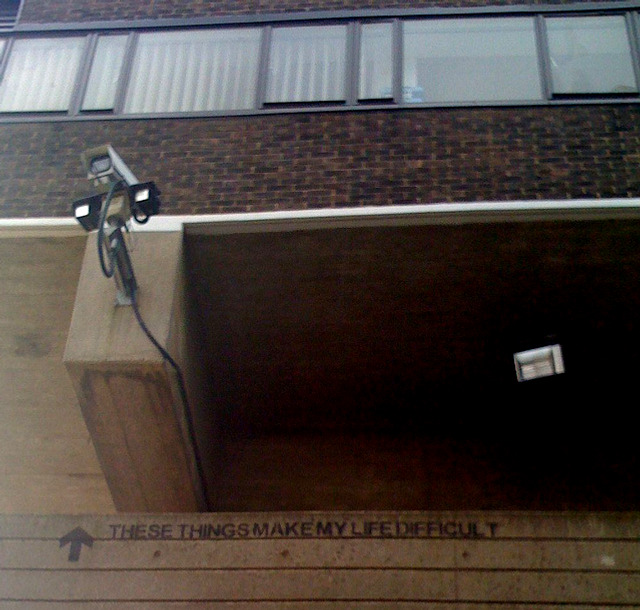
Not a million miles away from my office at Newcastle University, back in the UK, this stencil has appeared (“nothing to do with me, guv, I was in Brazil, honest…”)

Claremont Bridge, camera and comment (photo: Jon Swords)

Chicago: the future of US CCTV?

…despite Britain’s reputation as a surveillance society… the USA is now eclipsing the UK. The post-9/11 surveillance surge has seen to that.

Back in the USA again. Chicago has been featuring a lot this week for its CCTV system. Newspapers generally offered glowing assessments of its capabilities based around homey anecdotes of pretty harmless incidents ‘solved’ by CCTV – in this case the stories, for example those in the Chicago Sun-Times and the New York Times, featured a theft from a Salvation Army kettle, which sounds like it is straight from a Mayoral press release. It is depressingly poor journalism and once again, all very reminiscent of the situation in the UK in the 1990s before academic and even government assessments dampened the enthusiasm for CCTV. There’s also a depressing naivety (and factual incorrectness) about the insistence from the authorities and from some ‘experts’ that these cameras have nothing to do with human rights like privacy as they are all in public spaces.

But there is one very important difference. Chicago, with massive investment from the Department for Homeland Security, has gone much further than most UK cities, not only in coverage but also in capabilities. First of all, Daley and police-chief Orozco have promised that “We’re going to grow the system until we eventually cover one end of the city to the other” in other words they do want, as the Chicago Sun-Times subheading claims, ” a camera on every street corner.”

The particular innovation that the city is pushing here is the linking up of the law-enforcement aspects with emergency services through something called Computer-Aided Dispatch (CAD). This is system that uses a live Geographic Information System to match camera location to reported incident location, so that when an incident is called in via 911, the nearest cameras can immediately turn to picture the scene. This is part of what Chicago calls ‘Operation Virtual Shield’, a fibre-optic cable system which links the cameras with other biological and chemical weapons-detection system in a “homeland security grid.’’

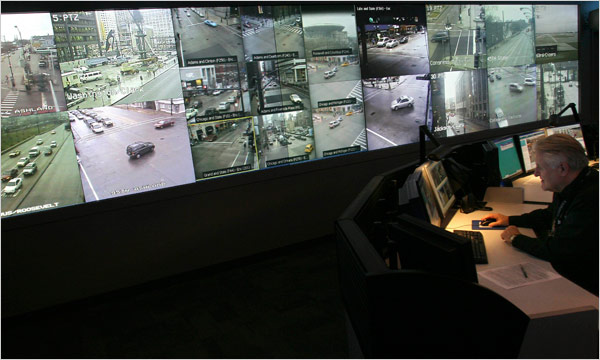
The Chicago control room (New York Times)

As part of the work we did for our latest book, Jon Coaffee Pete Rogers and I visited and analysed several different cities in the UK to assess their emergency-response and surveillance systems. While most had intentions to use the cameras for more active emergency-response purposes and particular local police were starting to try to install override systems for the multiple local camera systems that exist in the UK in the case of citywide emergencies (like a mass evacuation). And in particular, Manchester (whose high-tech control room looks like the Chicago one as seen in the NYT (picture above) and also often features in media PR for CCTV) has gone further down the Chicago route than most. But they still don’t come close. Britain’s systems are fragmented, ageing, generally not integrated with other functions and certainly don’t link to other kinds of sensors. Britain has introduced some stupid authoritarianism like the infamous ‘shouting cameras’ mostly as part of the Respect (sic) Zones initiative. But despite Britain’s reputation as a surveillance society I suspect that in terms of advanced integrated cameras systems, the USA is now eclipsing the UK. The post-9/11 surveillance surge has seen to that.

There’s two other points worth noting here. The first is that Chicago is bidding for the Olympics in 2016. I can almost hear multiple researchers in surveillance studies around the world, releasing a collective ‘of course!’. Mega-events like the Olympics, the World Cup – there will be a fantastic conference on this theme in November this year in Vancouver – or other non-sporting ones like world summits or the G-8 conference are often the trigger for the introduction of repressive measures and new surveillance systems. This was true in Japan (where state CCTV was first introduced because of the soccer World Cup in 2002), in South Africa (for various major world summits), and in Athens for the Olympics in 2004. Mayor Daley wants the city to be 100% free from the possibility of terrorist attack. Laving aside the actual impossibility of that desire, how far will he go to get there?

Well, the last Olympic venue, Beijing, might give some indication. For it is actually the plans in authoritarian, non-democratic China that seem most similar to what is going on in Chicago. Even the names have an eerie reminiscence: China’s Golden Shield, Chicago’s Virtual Shield. That is trivial, however the substance is not. The Chinese government, as Naomi Klein has written, is installing massive and comprehensive camera systems in every major city in China. It is also, of course, linking this system into its infamous Internet monitoring operation, with the ultimate aim of being able to track individuals in real and virtual space. Of course, the US, like most other nations is now trying to control Internet use too and the NSA already keeps massive data banks of communications traffic information as well as doing real-time monitoring as recent revelations have, once again, shown. But, it’s different in the USA isn’t it? The USA wouldn’t link up all these systems, would it? The Land of the Free? The home of democracy? I wouldn’t bet against it…

Could the US fiscal stimulus lead to a surveillance surge?

Largely unnoticed in commentary on US President Obama’s fiscal stimulus plan has been the $4Bn for the Justice Department. Now there are various very worthy programs nominated for funding including quite a large chunk to combat violence against women, but also a lot of cash washing around for rather more vague aims, in particular the $2Bn (i.e.: half the cash injection) for the Edward Byrne Justice Assistance Grant (JAG) program “to fund grants for state and local programs that combat crime”.

The JAG program has already providing funding for many cities to install cameras as part of ‘demonstration programs’, as well as covert surveillance capabilities. However $2Bn is a massive increase in funding and will allow some rather more ambitious schemes to be funded. With the current popularity of CCTV cameras as a catch-all solution in the USA (regardless of negative assessments of their effectiveness elsewhere – see ACLU’s recent convenient US-focused summary), could one side-effect of the stimulus package be a massive ‘surveillance surge’ in the USA? After all, this is exactly what happened in the UK in the 1990s when central state funding through the ‘City Challenge’ program sparked a mania for installing city-centre CCTV systems – see the editorial and the articles by Will Webster, Pete Fussey and Roy Coleman in the special issue of Surveillance & Society on CCTV.

Those concerned with civil liberties and the intensifying push for videosurveillance in the USA should keep a careful eye on applications to the JAG program.

Gentrification and Control in the Old Centre of Sao Paulo

Yesterday, I met up with Brazilian surveillance researcher, Marta Kanashiro, and she showed me around the Luz area of the old centre of Sao Paulo, where she has been working. Luz was once a grand colonial district around the railway station designed by British architect, Charles Driver, in brick and iron, but it lost its importance in the mid-Twentieth Century as the station ceased to be the terminal for the coffee trade. The area acquired notoriety as home to a police headquarters where opponents of the dictatorship where tortured, and as a centre for prostitution, violence and drugs.

In more recent years there has been a real effort by the city authorities to reclaim the area which, despite being in many ways a laudable project, has been controversial both for its effects on the poor, and for its treatment of memory and the particular history of the place. On one side of Parque da Luz, the formal gardens in front of the station, is the Museum of Portuguese language, yet on other side of the station, all memory of the victims of police oppression and torture has been erased with the restoration of the police building.

In the park itself, the park authorities installed CCTV (the story of which can be read in Marta’s article in Surveillance & Society), but they haven’t tried to drive out the prostitutes, many of whom were still standing forlornly under the tall trees in the driving rain as we visited. However, according to Marta, they have tried to persuade the women to dress more respectably in keeping with the desired new image of the the neighbourhood! At one point the prostitute’s union was more involved in the management of the park, as were other community organisations, however the building in the centre of the park where these groups used to meet is now closed for refurbishment and it is unclear whether it will still be available in the same way afterwards. Another building in the corner of the part, next to the rather ramshackle security rooms, has already been restored, and where once the plans and documents about the park were on public display, now the place is prettier but empty.

The Luz regeneration has plenty in common with revanchist redevelopment in many other big cities around the world, and there are big questions about what happens to the already excluded population of the area as the regeneration spreads. There are two contrasting visions for the centre from two different but very similar-sounding organisations: Viva O Centro and Forum Centro Vivo. Both want regeneration – everyone does – but they have entirely different approaches to how it should be done. The former is an association of mainly businesses and police, similar to the Business Improvement Districts (BIDs) which are common in US and British city centres. It is behind a lot of the current redevelopment and has the ear of the city authorities. The latter is a group of academics and community activists who want a more democratic and participatory process, and who hold a lot of local events, cultural and political. They also accuse Viva O Centro of either actively or tacitly encouraging intimidation and violence (which has certainly taken place) against the poor population of the area. It is another reason why the attempt to erase of the memory of the brutality of the dictatorship is so important: it is a memory that needs to be constantly refreshed as the actions are echoed and repeated.

(A very big ‘thank-you’ to Marta Kanashiro for her time and patience! All mistakes in this account, as usual, are my own…)

Some things are just wrong

It is disturbing that… the default position for state officials seems to be that surveillance is a normal, even required part of everyday life.

Ok, there are some things about surveillance that are arguable, some things that are good, but some things are just wrong.

The Guardian today is reporting the story of Nick Gibson who is taking over the tenancy of a pub in Islington in north London. The police have insisted that he will not receive the licence he needs to run the pub unless he installs CCTV and is prepared to hand over footage to them whenever they want. Mr Gibson complained to his Member of Parliament, Emily Thornberry (not Thornhill as The Guardian claims), but she is apparently a spineless New Labour loyalist who has no time for niceties like civil liberties. She refused to represent him on the grounds that other local residents ‘want more CCTV’.

It is one thing to want to install CCTV if you run a business. Your customers can chose whether to patronise your establishment or not. It is however, entirely another matter to be quasi-legally blackmailed into installing it by police. There is no law that mandate the installation of surveillance cameras an in fact there is no statutory basis for CCTV at all in the UK – it is something that the Lords committee report on surveillance recommended as a matter of urgency. The police are simply abusing their right to impose licensing conditions to make local policy. The installation of CCTV is not a matter of ‘common-sense’, it is an ethical judgement, and police should not be be able to override the ethical judgement of individuals by edict in this way.

This is a very worrying case, because it shows that there is a kind of cozy ‘common-sense’ authoritarianism developing in the UK. It is disturbing that despite all the research, including that of the Home Office and the Association of Chief Police Officers, showing that CCTV has very limited utility, the default position for state officials seems to be that surveillance is a normal, even required part of everyday life.