


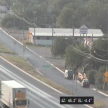
The US-Mexican border has been a pretty good barometer of the levels of paranoia, waste and stupidity around immigration and surveillance for quite some time now. Now the El Paso Times of Texas reports on the stupendous failure of one massive initiative that was supposed to spread the burden of watching the border by installing webcams (and associated infrastructure) for US citizens to watch online and report anything suspicious.
Around $2 Million US was sunk into the program, yet it had few tangible outcomes. The figures, released under the Texas Public Information Act show that despite 1,894,288 hits on the website, there have been just 3 arrests out of a projected 1200, and only 8 incidents reported in total out of a projected 50,000.
What made me laugh was the comment from the office of Governor Rick Perry, who initiated the scheme, that the only problem was the way in which the scheme´s success had been assessed – there is a quote from a spokesperson that is a classic of government evasion: apparently, ¨the progress reports need to be adjusted to come in line with the strategy¨!
The only sensible comment on the whole debacle comes from Scott Stewart, a surveillance and security expert from Stratfor, who notes as all surveillance experts already know, that cameras are not that effective at deterring or stopping crime, and blames our naive faith in technological solutions that ¨can provide us with a false sense of security¨.
This isn´t just about whether cameras work though.
Of course there are wider issues about the fairness of US relations with Mexico which, under NAFTA, effectively mean that the US uses Mexico as a source of cheap labour and land for manufacturing and the free flow of goods, but does not permit the free flow of people. However for studies of surveillance, it is also about whether encouraging virtual voyeurism is either socially desirable or effective in reducing crime. In terms of effectiveness, of course Bruce Schneier has been arguing for quite a while that most security schemes are inefficient and counterproductive and there was an excellent paper by John Mueller of Ohio State University exploding the statistical myths around security measures in the War on Terror.
But this Open-Circuit Television (OCTV) – not the the usual Closed-Circuit Television (CCTV) we are used to in malls and big cities – is also about ´responsibilizing´citizens, trying to turn ordinary people into civic spies. Luckily, whilst people love to watch, they generally refuse to behave as states would want and do not willingly become agents of surveillance – as this scheme and the experiment in the London borough of Shoreditch with such participatory surveillance schemes, which was similarly successful amongst viewers but achieved no measurable result and was shelved, show.
Note: Hille Koskela of the University of Helsinki, who works mainly on webcams, has been following the Texas border watch scheme and will be presenting a paper on it at our Surveillance, Security and Social Control in Latin America sumposium here in Curitiba in March… I look forward to hearing her analysis.





 ubisurv