India has launched its first major military surveillance satellite, RISAT-2, a platform for high-resolution Synthetic Aperture Radar (SAR), which puts it up there with the kind of things that the USA were launching over 10 years ago. Of course although, as The Times of India comment shows, being part of the club of orbital space powers is a consideration, the main motivations are most immediately, dealing with the threat of Pakistani Islamic extremists, and in the long term, regional competition with China, which has its own active satellite launch (and satellite-killing) program. One thing which about which the paper is entirely correct is that Indian high tech is more advanced than China’s and this home-grown satellite marks a small but significant shift in global surveillance power towards India. Whether, for a country still struggling with massive poverty and inequality, it is what anyone ‘needs’ or is any more than an expensive strategic symbol is another question.
It has been revealed that the British government has been passing information gathered by the police on citizens to private companies. The Guardian todayshowed that data on climate change protestors found its way from the police to the ridiculously-renamed Department for Business, Enterprise and Regulatory Reform (BERR) to power company, E-ON.
Now, of course the government can argue that electricity supply is a matter of ‘resilience’, ‘contingency planning’ and ‘national security’, but then how can they justify it being in private corporate hands in the first place? How exactly can companies whose primary aim is to provide ‘shareholder value’ at all costs, many of whom are transnationals that have no commitment to the UK, be treated as if they were state organisations, and be given data from state databases? The boundaries between public and private are being increasingly eroded, and once, again it is the relationship between citizen and state which suffers.
The government cannot just give data, especially data which was collected in very questionable ways for highly dubious reasons in the first place, to whoever it thinks might find it useful. This kind of action shows that the the state is now quite often simply the servant of private enterprise, and the police no better than an adjunct to private security. It makes a mockery of regulation of surveillance power and data protection, and does nothing for our already-weakened trust in the state’s ability to protect our rights or or information.
I’ve been looking over the government’s proposals for consultation on the reform on the Regulation of Investigatory Powers Act 2000 (RIPA), officially published on Friday. There’s actually very little that they suggest, apart from some minor and largely voluntary controls on the use of RIPA for trivial purposes by Local Authorities. The Times rang me up and asked me to knock off 500 words (in about an hour!) for a comment on the proposals… which I did… and here it is, unedited*:
Reforming RIPA
Back in the year 2000, opposition was developing to a new piece of legislation, the Regulation of Investigatory Powers Bill. But the controversy over the Bill which became the Regulation of Investigatory Powers Act 2000 (RIPA) was all about provisions to bring electronic communications (e-mail) under the same regulatory regime as telephone and telex, and to demand encryption keys.
What was relatively uncontroversial then were the provision for the regulation of covert surveillance by Local Authorities. Now, councils are accused of abusing the RIPA for trivial purposes, such as dog fouling or littering, or using oppressive or intrusive methods that are not proportional or appropriate to the alleged offences, such as covert monitoring of children to establish where parents involved in an application for school places lived. And much seems to have been inefficient too: a survey of Britain’s 182 Local Authorities found that they have used RIPA surveillance on over 10,000 occasions, yet only 9% resulted in prosecution or enforcement action. But it is not just local government. The Surveillance Commissioner has criticized national ministries like DEFRA and agencies including Ofcom and the Charities Commission over their misuse of RIPA**.
Officials respond that RIPA merely restricts and records what organisations were already doing. Most of the surveillance, they argue, is of the level of two men in a car watching a known fly-tipping site, and that even this requires onerous form-filling – four pages for each request. And even the statistics mislead, because there simply were no statistics on surveillance by these organisations before RIPA.
If RIPA has enabled us to see both the levels and abuse of surveillance powers, it has done us this favour at least. But the Surveillance Commissioner found generalized lax practice, a lack of proper justifications and proportionality, and little training or accountability: RIPA is being used because the powers exist, not because there is any pressing justification to use surveillance in this manner.
RIPA was always expansionary in that it allowed more than was intended. It was also a rag-bag; even the original e-mail surveillance provisions were cut and pasted from another bill. Like so much of the legislation from this government, it was poorly drafted and justified in parliament at the time by reference to issues (like national security) which little relevance to what most of the Act was about. And its appeals body, the Investigatory Powers Tribunal, is practically invisible, as the House of Lords Constitution Committee report on surveillance argued recently.
The Constitution Committee went a lot further than the government in this consultation document, arguing that surveillance powers should be reserved for the investigation of serious criminal offences and that should judicial oversight for all surveillance carried out by public authorities. Instead here, the government merely suggests moving sign-off powers higher up within the organizations. The Lords also suggested that there should have been proper provision for public accountability and post-legislative scrutiny in RIPA. Instead, this review is taking place due largely to government embarrassment over the constant stream of revelations.
Yet the government seems intent on extending surveillance and other powers still further; there has been a proliferation of databases, agencies, laws, and quasi-police. The new Communications Bill will extend surveillance powers over the Internet still further. The consultation document also reminds us in one section that there is still no meaningful regulation of the now ubiquitous CCTV cameras: they are outside of RIPA and, it seems, out of control. RIPA is merely one aspect of a very British tendency to manage things through surveillance before other means – which is a good working definition of a ‘surveillance society’. This has to be controlled, and in a rather more thoughtful and systematic way than these knee-jerk reviews in response to media concern.
*The edited version has now been published by The Times as ‘A very British tendency…’ They have just trimmed the attempt to broaden the argument at the end!
**This is what you get for writing something very quickly – in the editing, I compressed stuff that had originally said that Ofcom and the Charities Commission were using RIPA and that various organisations had been criticised into one sentence that implied that they were the organisations being criticised. Neither have been so criticised by the Surveillance Commissioner and I apologise to both for suggesting that they were.
The Department of Sociology at City University in London is offering the UK’s first Masters in Surveillance Studies. The MA is being run by up-and-coming scholar, Gavin Smith, in a department that also has some top people in the general area like Frank Webster. Definitely worth a look!
There is an excellent new report on facial recognition now available for free download. The report is written by my one-time co-author on the subject, Lucas Introna of Lancaster University, and new Surveillance & Society advisory board member, Helen Nissenbaum of New York University.
The report is aimed primarily at people who developing policy on, or thinking of commissioning or even using facial recognition and therefore concentrates on the practical questions (does it work? what are its limitations?) however it does not neglect the moral and political issues of both overt and covert use. What is quite interesting for me is how little the technical problems with the systems have changed since Lucas and I wrote our piece back in 2004; the ability of facial recognition to work in real-world situations as opposed to controlled environments still appears limited by environmental and systemic variables like lighting, the size of the gallery of faces and so on.
The report is probably the best non-technical summary available and is perfect for non-specialists who want to understand what is the state-of-the-art in facial recognition and the range of issues associated with the technology. Very much recommended.
Marina Hyde in the Guardian last week wrote a very interesting piece on the ongoing fallout from the death of Ian Tomlinson at the G20 protests in London. She argued that the appearance of mobile telephone camera foogtage, which revealed more about the way the police treated the passerby, showed that this kind of inverse surveillance (or what Steve Mann calls ‘sousveillance’) was the way to fight the increase of surveillance in British society.
I’ve been suggesting this as one possible strategy for many years too, however what Hyde didn’t really deal with is the other side of the coin: the fact that the authotorities in Britain already know that this is a potential response and are trying to cut down on the use of photographic equipment in public places. Anti-terrorism laws already make it illegal to photograph members of the armed forces, and in the new Counter-Terrorism Act, there is a provision to allow the police to isue an order preventing photography in particular circumstances. Further, it is now regarded as suspicious by police to be seen taking an interest in surveillance cameras.
The bigger issue here is the fight for control of the means of visibility, and the legitimate production of images. The British state is slowly trying to restrict the definition of what is considered to be ‘normal’ behaviour with regards to video and photography. In the new normality, state video is for the public good, but video by the public is potential terrorism; police photographing demonstrators is important for public order, but demonstrators photographing police is gathering material potentially of use in the preparation of a terrorist act.
However, I am not 100% in favour of the proliferation of cameras, whoever is wielding them. I think it’s essential that we, at this moment in time, turn our cameras on an overintrusive and controlling state. However a society in which we all constantly film each other is not one in which I would feel comfortable living either. A mutual surveillance society in which cameras substitute for richer social interactions and social negotiation, is still a surveillance society and still a society of diminished privacy and dignity. I worry that sousveillance, rather than leading to a reduction in the intrusiveness of the state, will merely generate more cameras and more watchers, and merely help reinforce a new normality of being constantly observed and recorded.
Whilst finishing up my work in Rio de Janeiro yesterday, I came across this interesting bunch of people, mv-brasil, who appear to be a Brazilian nationalist movement, with much in common with organisations like the British National Party or the various right-wing groups in the USA. Their website contains the usual odd mixture of anti-globalisation, evangelical Christian (they campaign against Halloween) and anti-United Nations / New World Order stuff with the added anti-Americanism. There of course is the usual rather uncomfortable fact of the ‘Brazilian Christian’ nationalist being a representative of a colonial power that invaded the country and took it from the indigenous people, but they roll over this one with some nods to Indian rights when it suits their cause, most notably when it comes to the Amazon.
A t-shirt with anti-internationalisation and privatisation of the Amazon slogan
One of the T-shirts for sale makes reference to this, being against ‘internationalisation and privatisation’ of the Amazon by the USA. It is a conspiracy theory I’ve come across before when I was doing some research on the SIVAM program – which provides some actual evidence for contentions that there is a secret American program to control the rainforest. I had someone tell me here in complete good faith that it was a ‘fact’ that several Amazonian tribes already thought that they were part of the USA and flew the US flag! This is combined with the fact the UN and international environmental organisations are very concerned about the destruction of the rainforest and the perceived lack of effort by successive Brazilian administrations to stop it. Put all this together and you have the ingredients for nationalist paranoia.
So what is SIVAM? And why would I be interested in it anyway? The reason is that SIVAM is a surveillance system. Announced at the Earth Summit in 1992, and finally completed in 2002 and fully operationial from 2004, the Sistema de Vigilância da Amazônia (SIVAM) is a multipurpose, multi-agency network of satellite, aerial and ground surveillance and response that aims to monitor the illegal traffic of drugs and forest animals and plants, control national borders and those of indigenous peoples’ lands, and prevent the further destruction of protected areas of forest. A good technical account in English can be found in Aviation Today from 2002, and there is an interesting article on its construction here.
Donald Rumsefld visits the SIVAM control centre, 23 March 2005 (Wikimeda Commons)
The problem is that, although an initiative of various Brazilian government agencies including the environment and Indian affairs ministries, the federal police and the army, SIVAM is supported and funded by the USA – most of the initial $1.39Bn US cost came through a grant from the U.S. Export-Import Bank, and the consortium that supplies the equipment includes giant US military supplier, Raytheon – amongst many others from Brazil to Sweden. The visit of former President George W. Bush’s right-hand man and then Secretary of State for Defense, Donald Rumsfeld, to the SIVAM control centre in 2005, was widely reported in Bazil. It was of course interpreted by many as further evidence of Brazil’s ceding of control of the Amazon to the USA, or even presaging a US invasion of the Amazon, as Senator Norm Coleman discovered on a fact-finding mission later that year.
Latin American countries have every right to be suspicious of US motives: the Monroe Doctrine; George Kennan’s Cold War ‘grand area’ vision; the support for dictators like Augosto Pinochet; the invasions of Panama and Grenada; Plan Columbia and the widespread use of military ‘advisors’… the list goes on. And it is certainly the case that US strategic surveillance plans for ‘Full Spectrum Dominance’ and the like, have have long included ‘leveraging’ any system in which they are involved from the International Space Station to things like SIVAM. So of course they will have a strategic interest, and no doubt SIVAM data will find its way to US military C4ISR centres, but this does not amount to a plan to invade Brazil or take control of the Amazon.
Over the last two weeks, we’ve talked to all kinds of police. We’ve talked to officers, both senior and junior from the Policia Militar (PM), the state-level equivalent of the French ‘gendarmerie’ or Italian ‘carabinieri’, including some who have been rebranded as ‘Policia Communitaria’; we’ve met guys from BOPE (the Rio-specific special operations group within the PM here) – and hopefully we will meet their Commander today; we’ve interviewed the Subchefe of the Policia Civil (PC), the detectives, again based at state-level; and we’ve visited the headquarters of the Guarda Municipal (GM), the relatively recently-formed city police. I haven’t talked to the firefighters, another military-state legacy, who are still an armed force, although a report from the State parliament in January recommended that they be disarmed. Back when I was in Brasilia, I also had a meeting with the Policia Federal (PF), the Brazilian ‘FBI’, another post-dictatorship development, who operate at federal level.
It is a confusing organisational landscape, and not just for me. Throughout the interviews with all the different representatives, very different perspectives emerged on what is important in policing, which force is more important and for what purpose, to what extent the current system works, and what would be the best way forward. Corruption was also something that came up time and time again, with everyone arguing that their force was improving and dealing with this, but hinting that there was still a problem with other kinds of police. There was lots of talk of ‘new generations’ of officers free from the taint of the past. But at the same time it was quite clear on the ground that people from all social classes still do not trust any of the police in general, even when they have established quite positive personal working relationships with officers in their own community.
Cesar Couto Lima, Diretor de Operacoes of the Guarda Municipal
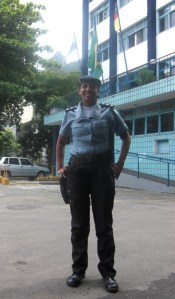
The GM are less than twenty years old and they ‘know their place’ in the hierarchy of police: at the bottom. They are not true ‘professional police’ in the sense that they have only three months basic training, followed by some specialist extra work. They are really somewhere between police and a private security force that just happens to be employed by the city – their commanders at the top level are however, ex-PM. They do, however, have a growing field of responsibility, acting both as a kind of protective and preventative force on the ground in the city centre and as a street-level agency of the ‘eyes on the street’ form of surveillance.
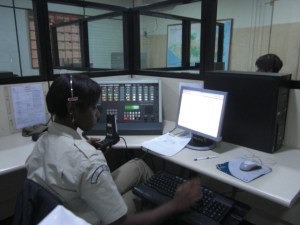
Operator in the Guarda Municpal emergency control room
They also act as the emergency services co-ordination, and this role will increase and be better integrated and funded in future. They are largely disarmed, though not because as many believe, the law prevents them from being armed. This is a strategic decision based on keeping a clear line between them and the PM. This is also the reason why they have a different uniform (in Rio a kind of unflattering beige) from the PM (blue). In our interview with the Director of Operations, Cesar Couto Lima, we were told that in the past, the uniforms had been the same colour but that this had been changed under the last mayor, Cesar Maia, to prevent GM officers from being shot by criminals in the mistaken belief that they were PM. They now have a very low rate of injury and death. The Dir Ops also wants to increase the numbers and in the very long term for the GM to be the be the main police force of a disarmed and less violent city.
It is a fine aspiration, however the new Mayor Eduardo Paes, has apparently suggested that the uniform is changed back to blue and that there should be more arming of the GM. The Dir Ops is utterly opposed to both, and I think he sees it as a deliberate ploy to give the impression of more PM around – the State Secretary for Security has already announced a plan to increase the numbers of PM in Rio by thousands, as we found out when we visited his office. The officers we met at the GM were generally pleasant, relaxed people, however the GM is not immune from corruption. I have heard allegations of extortion from street traders, the poor and criminals, in much the same way as gets reported of the two main forces, and indeed of death threats to officers who refuse to get involved with such practices. Any generalised or regular arming of the GM would only increase the temptation to act on the new power in an irregular way, and also, with so many weapons in the hands of relatively poorly paid and untrained officers lead to greater numbers of killings and a further channel for criminals to obtain weapons.
Ricardo Martins, the Subchefe of the Policia Civil would also like to see a demilitarisation of the police in the long-term. He argued that basically, the PM should be gradually abolished and absorbed into a purely civil police. He was also strongly in favour of more ‘intelligence-led’ and surveillance-based solutions, rather than force of arms or numbers. According to him, the expansion of the video surveillance system in the city was essential and absolutely necessary if the city was to be ready for the 2012 soccer World Cup (to be held across Brazil) and more particularly for the 2016 Olympics, for which the city is a frontrunner. All the senior officers an officials with whom we talked agreed that currently it was nowhere near ready. The GM also agreed with the expansion of CCTV, although they seemed to think that they would have a greater role in operating the systems in future, talking of plans for neighbourhood control rooms integrated with the emergency services control system. Neither the PC, nor more importantly, the Superintendente de Commando e Controle of the State, Claudio de Almeida Neto, gave any indication that this was the direction in which things were proceeding. Indeed the Superintendente was quite clear that there was a greater centralisation, co-ordination and professionalisation of video surveillance operations taking place through his office and his control room, which is in the old ‘Centro do Brasil’ railway station. The office of the Secretary of State for Security seemed not to be that interested in surveillance at all, and commented that it was very expensive, which suggests that the funds for the expansion of the video surveillance system that all expect, whoever they think will be running it, may not be quite as lavish as they believe or would want. I will write more about this later. The PC, however has the reputation of being the most corrupt of all the forces. Subchefe Martins pointed to the internal investigations branch as evidence of the effectiveness of their fight against corruption. Other interviewees were not as easily impressed!
Capitao Pricilla, Head of Santa Marta Community Police initiative
So where should policing in Rio go? One way forward was obvious when we interviewed Capitao Pricilla, the current ‘star’ of the PM, who heads up the Community Policing initiative in Morro Santa Marta. Capitao Pricilla is a PR-dream: attractive, articulate, intelligent, convincing in her arguments, and clearly dedicated to her work with the community. She is everything you would hope a new generation of younger PM officers would be, and she clearly stated that she is part of a new generation. And she is popular too. As we talked with her, officers would constantly come over just to say ‘hello’ and older women in particular, would treat her like a TV celebrity. Now, of course I am wary of the way in which such charisma would make her an obvious choice to head such an operation, which is much promoted as ‘the way forward’ in the media. However there have been many ‘ways forward’ before which have come to nothing and Rio is constantly making and destroying innovative initiatives before they even have a chance to have a real effect. The Santa Marta initiative probably cannot be replicated in many favelas, like Prazeres, where there is a more intimate relationship with the ‘parallel power’ of the traffickers. But Capitao Pricilla seems like the real deal. Let’s hope that she and officers like her get the support they need and are not undermined by the violence and corrupt practices of so many of their colleagues. It’s a utopian hope perhaps, and Rio is still going to need the other far more aggressive hand of the other attempt to get around corrupt practice in the PM, the BOPE – about whom I will write more after our visit today – as much as it needs the helping hand of Community Policing initiatives for a while. It is that large and less articulate mass of PM and PC officers who have no interest in doing anything different, and the equally corrupt politicians who prevent change for their own selfish reasons, that are the main barrier to any organisational change.
From today, private lives in the UK will be a little less private, as EU Directive 2006/24/EC becomes part of national law.
Traffic data on e-mail, website visits and Internet telephone calls now have to be recorded and retained by Internet Service Providers (ISPs). Specifically, the Directive mandates the retention of: the source of a communication; the destination of a communication; the date, time and duration of a communication; the type of communication; the type and identity of the communication device; and the location of mobile communication equipment.
This is coming into force despite the fact that many countries and ISPs still object to the directive. It has to be said that many ISPs are objecting on grounds of cost rather than any ethical reason. German courts are yet to determine the constitutionality of the directive and Sweden is not going to implement it at all.
As with many of these kinds of laws, it was rushed through on a wave of emotion after a particular ‘trigger event’ – in this case, the 7/7 bombings in London in 2005. There was a whole lot of devious practice in the Council of Ministers to get it passed too – if the Directive had been considered as a policing and security matter, it would still have needed unanimity, which means that the objections of Germany and Sweden would have vetoed the Directive. Instead, it was reclassified as ‘commercial’ on the grounds that it was about the regulation of corporations, and commerical matters need only a majority vote. How convenient…
The Home Office in Britain says our rights are safe because of RIPA, which is hardly cause for rejoicing. My main concerns, apart from the fact that this is yet another moment in the gradual erosion of private life, are that:
1. police access will rapidly become routine rather than specific, and this could be extended to many other public authorities – the original drafts of the Communications Bill would have extended the right of access to such data to all RIPA-empowered organisations (which includes most public authorities);
2. the data will be used illicitly by ISP employees for criminal purposes (remember that most identity thefts are inside jobs) – the records will be a blackmailers delight;
3. there will more ‘losses’ of this data by ISPs and others who have access to it. Remember the accidental revelation of user data by AOL in the USA?
We’ve been so busy these past two days that I have not had time to update the blog with all the visits and interviews we have been doing. I will try to do so over the weekend… Just to summarise, we’ve been to another favela, Morro dos Prazeres and met with the leader of the community association; the HQs of the Policia Civil and the Guarda Municipal. We visited the State Secretariat for Public Security twice, once to talk to people from the office of the Secretary, and once to visit the CCTV control room and talk to the director. And finally we talked to two politicians from different eras – the ex-Governor, and also Security Minister under Leonel Brisola, lawyer and academic, Nilo Batista (and also his wife, sociologist, Vera Malaguti Batista) and Deputado Estaduel, Alessandro Mollon, a leading campaigner for human rights and real public security in the state legislature and various members of his team.
Next week, on Monday, we will be going back to Morro Santa Marta to talk to BOPE Commandante Priscilla; and then I will be spending the rest of the day between the neighbourhood association of wealthy Laranjeiras and that of a nearby favela, also ‘pacified’, Tavares de Bastos, and its BOPE battalion. On Tuesday I am giving a talk on my project at the Federal University of Rio de Janeiro, and hopefully on Wednesday or Thursday morning we might just get to talk to Major Eduardo Paes, and someone from the state’s Ministry of Cities, as well as the already fixed appointment with the influential NGO, Viva Rio.
Then it’s Easter and I have to go home… I have to come back. I feel like I have barely started here. I need to do more interviews at national level, and the survey work I was hoping to do has been squeezed out by the interview schedule. In any case, the level of comparative study I am doing means I cannot explore, literally and metaphorically, all the avenues and back-alleys that I would like. And there is so much going on here that is interesting and important in terms of the complex relationships around social justice, crime and disorder, (in)security, surveillance and social control.




 So what is SIVAM? And why would I be interested in it anyway? The reason is that SIVAM is a surveillance system. Announced at the Earth Summit in 1992, and finally completed in 2002 and fully operationial from 2004, the

 ubisurv