A tale of two communities…

We visited two very different communities today, Santa Marta and Santa Teresa, but despite their differences, in both places we met with an equally impressive community representative.

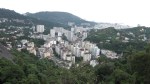
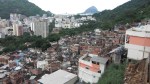
Morro Santa Marta is a relatively small favela that climbs the steep slope below the peak known as Dona Marta (which is why the favela is often incorrectly called ‘Dona Marta’), above Botafogo, and just on the other side of the hill from the much wealthier neighbourhood of Laranjeiras. Santa Marta is well-known largely because it is perceived as a success story, indeed as we were being taken around he community, journalists from Globo TV were embarking on a month-long series of features and interviews with different members of the community, and representatives were scouting the place as a location for the ‘Red Bull Down’ urban downhill mountain biking series (see this description of a related event in Puerto Rico)… in short, Santa Marta is fashionable.

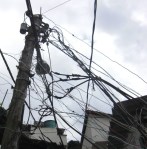
It is also the target for a number of state interventions; indeed I don’t think I have seen as many different workers from as many different agencies in one place at one time anywhere in Brazil. There were transportation workers on the newly-finished cliff railway, there were workers from the planning department shoring up recently-constructed houses to prevent landslides, there were electric company workers struggling to make sense of the maze of cables, there were refuse workers, and at the base of the favela there was a load of people from the new Motorola-sponsored Digital Santa Marta initiative that is wirelessing the whole neighbourhood. It seemed that various government interests badly want Santa Marta to continue improving, and that a lot is riding on this.

However, as we soon discovered, there is a more complex and fragile reality underlying the business and the superficially sheen of hype. Our guide for the morning was Sonia Oliveira, one of the directors of the community association, and a resident for many years. As we ascended the railway with her, we met her son, and other people, like Luis Gustavo, who she had known since he was a baby… it was clear that Sonia was well-known and well-liked. And who wouldn’t like her? Sonia is a strong woman with a calm, determined presence and an insight matched by the realism of experience.

The key to Santa Marta’s success so far has been the combination of many years of careful community work, combined more recently with a determined effort by a particular battalion of the BOPE (military police special operations) to drive out drug traffickers and secure the community, under Commandate Priscilla, who we will hopefully meet next week. It is not as if the community is any more sympathetic to the police than anyone else in Rio, but the relationship between the people involved here is clearly a special one. And whilst the police still do not understand the community fully – there are still frequent complaints of harassment of young men and the closing down of parties – there is some evidence that they are learning and changing to a small but important extent. One problem now is that the wider context of the ‘choque de ordem’, which is basically a rather more aggressive version of the famous New York ‘zero tolerance’ policy, is threatening to roll back these small improvements in trust and understanding. The police hassle unlicensed stall-holders, which is how most favelados make their living, they stop taxi drivers for checks of insurance and licensing, and of course, they threaten, and indeed carry out the threats, to demolish illegally constructed buildings – which is of course, potentially any piece of the favela. However, for Sonia, the over-assertiveness of ‘choque de ordem’ policing is outweighed by a far greater another fear – which is what happens if the political climate changes, or financial or strategic reviews mean that the BOPE are forced to withdraw from Santa Marta. If they do, she argues, the traffickers will return, and it will be worse than before, as not only will they take control of the community, but they will ‘punish’ it for collaborating with the authorities.

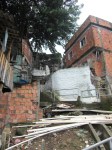
And things must continue here. In many ways they have hardly started. There might be a lot of activity but the favela remains lacking in infrastructure, especially sewage and healthcare. Most of the self-built constructions remain precarious and a severe risk to their inhabitants and those below in the case of heavy rains and consequent landslides. And the understanding of neighbouring communities is far from guaranteed. One might think that neighbours would be grateful that the traffickers are gone and even make efforts to integrate Santa Marta further into the city, but Laranjeiras in particular has been causing all sorts of problems for the favela, in particular over the construction of a school and creche at the top of the neighbourhood. The problem was basically that the school can be seen over the top of the hill, and this led to the fear that Santa Marta would begin to spread over the top and down to the back gates of the expensive apartments and villas of this rather exclusive community inhabited by people like Governor Sergio Cabral. In fact, unlike several other favelas, Santa Marta is not expanding at all. It is becoming a more mature and controlled community, and it is rather ironic that it is at this stage of its development, that it becomes an object of fear and concern for its richer neighbours. The argument has been resolved for now, and the school stays, indeed it is the temporary home of the battalion and the community police, who get a good overview of the neighbourhood from its commanding position. The lack of expansion of Santa Marta has not stopped the State from starting the construction of a wall along its west side. As Sonia says, there is no need to make favelados feel like they are living in a ghetto…

Paulo Oscar Saad was against the building of the school, indeed he is against the expansion of any illegal community into the hills of the area, but in truth this is the only real substantive grounds for disagreement between the leader of the Santa Teresa community association and those in Santa Marta. Santa Teresa is however, an entirely different place. Once a hillside retreat for the rich, its crumbling mansions have for a while now been occupied by an eclectic mixture of artists, academics and other bourgeois but generally progressive people. For many years it served as a kind of cultural centre for the surrounding poorer neighbourhoods, including the many favelas, with favelados mixing with the artists in the bohemian bars and cafes.

However, this mixture has been undermined by three main developments. The first is the aforementioned illegal building, which threatens the very stability of the hillsides which support Santa Teresa. It isn’t just what one would recognise as ‘favelas’ either; many of the illegal buildings are constructed by relatively or even very wealthy people, and often on land reforested precisely to prevent landslides after two previously disastrous deluges in the 1960s and 1980s. The second is the change in the nature and intensity of crime in Santa Teresa. The neighbourhood had always put up with a certain amount of petty theft and pickpocketing, but the arrival of cocaine (and more recently, crack) and in particular the arming of the drug gangs has led to an increase in both actual serious crime and fear. Finally, the gentrification of Santa Teresa is threatening to destroy the easy-going and bohemian atmosphere of the hillside on which it is based. It is an old story, seemingly destined to be endlessly repeated in similar communities all over the world. The old bars and cafes close, and the new upmarket establishments exclude the poor either overtly by policy or implicitly through price. The fear of crime has also driven many residents into the arms of private security companies, who have gated several dead-end streets and equipped them with guardposts. The signs say they are legal; the Community Association says that they are not. In fact the latter are correct. Paulo, like some other I have talked to here, is sure that the private security companies are intimately linked to the militias and indeed to the criminal gangs, all of which reinforce each other in an ongoing spiral of criminality and securitisation. However it is not as if the police (of any kind) or the politicians can be trusted to deal with the situation. According to the community association leader, the police are entirely corrupt and the politicians are fashion-driven media slaves. The only hope lies in bottom-up community power, yet the community is increasingly divided, and even the remaining assets that make Santa Teresa what it is are being cashed in: the wonderful antique tram system that rattles up the hillside is being privatised and its future is uncertain…

It seems that both community leaders are scared of losing what they have and battling to keep their neighbourhoods alive, inclusive and connected, but both are being hampered by uncertainty and contradictory policies and developments at levels which they cannot seems to influence. The future of Rio depends on people like this being supported not undermined by the state at its various levels (which still do not appear to know what each is doing, let alone look like working together). Oh, and I almost didn’t mention surveillance… that’s because like almost everyone else on the ground here, surveillance is seen as a frippery of the rich and something which has no practical use or meaning for the reality of their lives. There is also a strong sense of freedom too: and things like CCTV are seen as a definite infringement of that liberty. The more I get to know people and places here, the more I am certain that Brazil is nothing like a surveillance society and the changes that it would take to become one would be almost inconceivable in scale and cost.

Note: there are photos of Santa Teresa in the next post and there will be more later this week.

The Shock of Order: Building and Demolition in Rio de Janeiro

I may have been slightly worried about the most recent drugs war that was going on as I arrived, but as usual this appears to have been exaggerated by the press who largely serve the richer, middle-class community, and who appear to want to have their fears stoked on a regular basis. The ‘war’ is a trafficker conflict that involves traffickers based in the large favela of Rocinha, who belong to the Comando Vermelho (CV, Red Command) the oldest and largest of the prison-based umbrella groups of Rio drug traffickers, attacking another favela, Ladeira dos Tabajaras, whose traffickers are backed by the ‘Amigos Dos Amigos’ (ADA, ‘Friends of Friends’). This kind of thing is happening on and off all the time, but what made it a concern of the paranoid middle class in this case, was geography: in order to get to Ladeira dos Tabajaras, the Rocinha gang had to go through the rich high-rise area of Copacabana… to say that it is exaggerated is not to say that it is not dangerous: 8 people have so far been killed, but they are all traffickers and, I believe, all killed following police raids into the favelas.

It is probably no coincidence that this display of force by the Rocinha traffickers is happening just as the city government of Rio has started to implement a policy of the current Mayor, Eduardo Paes, known as ‘choque de ordem’ (the ‘shock of order’), which involves sorties into communities like Rocinha largely to enforce planning regulations by destroying recent illegally built constructions, which are pushing the favelas even further up into the hills. In the last few days, this policy has resulted in the demolition of one particular controversial building, the Minhocão in Rocinha. This was due to start on the 17th, but was halted by a judicial decision, before going ahead in recent days.

There is more than a degree of irony here. The purpose of these demolitions is supposedly to enforce urban planning regulations and ‘protect Rio’. The Secretary for Public Order, Rodrigo Bethlem, is quoted by O Dia as saying (in my translation):

“We cannot permit an entrepreneur to come into Rocinha to build and make easy money by exploiting people. We cannot allow Rio De Janeiro to be destroyed by speculators, who want to make money without following any rules and who aim only at profit.”

Yet, I only have to glance out of my window here to see the towers of the Centro, built by wealthy speculators, which have almost completely destroyed the beautiful Parisian-style boulevards and belle epoque architecture that used to be ‘Rio’. And turning the other way, the coastline it dominate by the secure condominiums long the beaches, which I am pretty sure were not constructed out of the kindheartedness of developers, and whose development no doubt involved corruption at higher levels of urban government. Looking uphill, I can see the often dubiously if not illegally-constructed houses of the rich that cut into the edges of the National Park.

Can we look forward to the demolition of all of these disfigurements of Rio? Of course not… and the reason is obvious. The demolitions in Rocinha are about power projection. Local state policy towards the favelas goes in waves that alternate between socio-economic solutions and violent authoritarianism. For all its negative aspects, many people who are concerned with social justice here recall with some nostalgia the progressive populism of Leonel Brizola who was mayor in the 1980s. His administrations installed infrastructure, built schools and improved houses in the poorest areas.

The current administration of Eduardo Paes is taking a very different and harder line, concentrating on law and order, a stance which was laid out clearly during the Pan-American Games when the police effectively occupied several of the favelas in an Israeli-style security operation. There would be nothing wrong with this if it were backed by some kind of progressive social imagination too – some favelas like Dona Marta, which I will be visiting later this week, have apparently been transformed through a combination of strong control and surveillance with real social improvements.

Instead there are apparently plans to further marginalise favela residents by building a wall along the major highway from the international airport into the city, so that all the city’s elite can feel so much more secure, and of course, visitors will not have to even see the favelas (some or Rio’s most miserable) which line the route… there’s more than a whiff of Israeli tactics about this too. Whether by building or by demolition, urban planning seems to be currently used as a weapon against the favelas and their inhabitants.

The downside of Brasilia

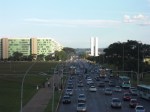
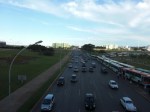
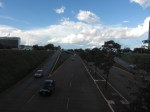
on foot, you are immediately confronted by the unpleasant reality of what is to the pedestrian effectively a huge expanse of carpark and highway separating the areas you might want to be. The functional split between the ‘zones’ only makes this worse.

Again, this is urbanism rather than surveillance, but here are some more musings and pictures on the urban form of Brasilia. Yesterday, I posted a lot of conventionally attractive shots of the buildings around the monumental axis of Brasilia. However, leaving aside the wider question of whether Brasilia outside of the planned centre functions as a city, there is a rather less beautiful side to the core.

This mainly has to do with the practical consequences of the philosophy behind the plan and particularly with functional separation and transport. As I noted when I first arrived, the city is dominated by roads. 5-lane highways run down either side of the monumental axis, and it is crossed by two major motorways in deep cuttings, with all the attendant slipways. These probably look very attractive as bold curving lines on a plan. They may even function if you are traveling by car (or bus). But on foot, you are immediately confronted by the unpleasant reality of what is to the pedestrian effectively a huge expanse of carpark and highway separating the areas you might want to be. The functional split between the ‘zones’ only makes this worse. Say you are in the hotel zone that I was staying in and you want to go out for a meal and a drink. Well, that’s 30-minutes walk to the nearest residential centre (where most of the evening options are located). Sure, you can take a taxi, but why should you have to? All the sports clubs are in separate ‘club zones’ even further away from either hotel, commercial or residential districts.

Now, okay, so the residential districts have most of their facilities (not including clubs) within walking distance – I said in my first impressions blog entry that I could actually imagine living here with a young family. And I still could. Natives of Brasilia are fanatical about the place. The residential districts work. You don’t really have to go anywhere near the soulless and secured shopping centres or take your chances running across massive motorways with uncaring drivers trying their best to ignore you. There is a simple metro system which runs between the districts and the centre (though it was largely closed for the building of new stations when I was there). You can walk around, between and under the blocks. They don’t appear to be totally obsessed with security in the manner of Sao Paulo or indeed most other large Brazilian cities. The blocks have concierges but not fences, walls and gates. Most of the windows do not even have bars.

But there is a reason and a price for this too. The residential zones are simply not socially mixed. Just about everyone who lives in the big blocks is a government or big corporate office employee. The ordinary workers and the poor live elsewhere entirely, in one of the satellite cities of Brasilia, and are bussed in and out via the busy central bus station every day. At the bus station, you find glimpses of the ‘ordinary Brazil’ – the cheap lanchonetes and pastelerias (in fact probably the best pasteleria I have found in Brazil so far)!, sidewalk vendors of DVDs and knock-off jewelry, the beggars, the hungry and the desperate. In many ways I felt more comfortable there than in the dry Le Corbusian dreamspaces of the government buildings.

Anyway, here’s some pictures of the ‘real Brasilia’ – or what it looks like if you stop focusing on the architecture and take a wider view!

In Brasilia: monumental space and… hip-hop?

I am now in Brasilia, where I have a number of interviews with parliamentarians, and officials from government Ministries and the federal police. The hotel I am staying in is right off the main monumental axis, in the northern hotel district. It is in some ways, the total opposite of where I was in Sampa, being masterplanned, spacious and with visible greenery. But it is a masterplan typical of Le Corbusier and his acolytes, that seems totally lacking in any flexibility or consideration for people not traveling by what they thought would be mankind’s liberation: the private car. So it is almost impossible to walk to a decent bar or cheap restaurant in the evening. You have to get a cab (or a bus if you know where you are going), to another ‘district’ for such things. The spaces are large and clearly designed to be monumental, but actually they fail in both being genuinely impressive and in being accessible. That is not to say that there are not some amazing buildings – of course there are many of Oscar Niemeyer’s greatest creations – but it is a place that looks better from the godlike view of the plan, or the selective gaze of the tourist brochure, than being within it as an ordinary person.

The taxi from the airport took a route through some of the contemporaneously planned and built residential districts. If it wasn’t for the semi-tropical vegetation, it could have been the Netherlands… long lines of similar 60s housing blocks, broken into neighbourhoods, each with its own little row of shops and restaurants, and divided by little parks and other community facilities. The blocks show quite a lot of variation in design and are certainly not all exactly the same, nor are they so large that they become inhuman in scale. With all the trees, and the facilities within walking distance, this really did seem like it wouldn’t be a bad – if not really an exciting – place to live. Which is exactly what I feel about many places in the Netherlands! For today, calm and unexciting is exactly what I need!

Strangely enough however, almost the first thing I came across when I got here was a local-government organised (and state petrochemicals company, Petrobras-sponsored) hip-hop festival, right on the main axis in the shadow of the TV Tower. So as the sun went down (if we could have seen it through the clouds) and the lights of the city blinked behind the hemispheres and towers of the Parliament building, I was getting down (well, tapping my feet) to some phat beats and conscious lyrics about the hardship and violence of life in the ‘periferia’ from the likes of Liberdade Condicional, and other favela stars. This, if nothing else so far, made me feel rather more hopeful for the future. For this evening only, the periferia had come right into the centre and was, symbolically at least, at the heart of Brazilian democracy.

Leaving Sao Paulo

It’s my last morning here in Sao Paulo. I have to say that, with the greatest respect to my friend and Sao Paulo native, Rodrigo, I am not going to be sorry to leave. A lot of what I thought when I arrived here hasn’t changed. This is big, dirty, noisy, exhilarating city with an unapologetic commercial drive, and all the divisions and human debris that this creates. In many ways, it reminds me of Osaka in Japan, but the extremes are greater. The problem is that the huge divisions can’t be ignored if you are in any way sensitive to human suffering, and the suffering here cries out from every raw-smelling homeless man sleeping on the street, from the ragged kids sorting through rubbish at night, from the women selling themselves in the parks, stations – well, everywhere. Certainly, these things are part of city life in many places in the world, and there are many far, far poorer places, but there is something profoundly saddening, depressing, about the gulf between the helicopter-chauffeured elite and the people on the street in O Centro, and especially in the ignorance and indifference – which I have not only been told about but have seen. By the end of just one week, during which I have tried to be as much a part of the place as I could, when I have spent time talking to everyone from human rights groups to people in ordinary bars, I feel like retreating, curling into a ball in the corner of my room.

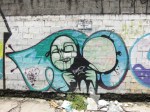
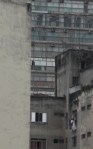
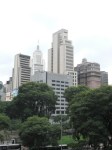
So thank-you, Sampa, but I am not sorry to be leaving. Here are some pictures of the hundreds I took, of aspects booth good and bad…

Utopian urbanism

…it is the adventurous, progressive, social democratic spirit of the New Deal and the World’s Fair that it is most worth revisiting now…

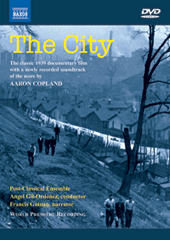
Naxos´ rerelease of The City
Naxos' rerelease of The City

A post which has little to do with surveillance and security today, but much more to do with another of my interests, in urban futures…

The predominantly classical music company, Naxos, has issued a new version of the classic 1939 documentary, The City, which was released to coincide with the New York World´s Fair. The film is a superb piece of work in many areas – a great script by the legendary urbanist, Lewis Mumford, based on his book, The Culture of Cities, luscious cinematography by Ralph Steiner and and Willard van Dyke and, the reason why Naxos is involved, a brilliant score by Aaron Copeland, which has been re-recorded for this release. It is already available for free download from the Internet Archive (a treasure house of historical material), but of course you won´t get the specially rerecorded score or the extra documentaries that accompany the anyway relatively inexpensive re-release.

A past vision of an urban utopia...

Despite its serious message, the film ultimately shares the optimistic atmosphere of the World’s Fair – see, for example, Andrew F. Wood’s lovely site full of those influential images of progress that so shaped the rest of Twentieth Century’s idea of what the future would look like and then later, should have looked like. Today, it has acquired a new relevance, produced as it was out of that amazing surge of energy in US society resulting from Roosevelt’s solution to the Great Depression, the New Deal. Mumford´s admonition that “the age of rebuilding is here. We must remold our old cities and build new communities, better suited to our needs” (see this article about the movie) has never been more pertinent. As of 2007, we entered an age when the majority of the world’s population is living in cities that are already divided by extremes of wealth and poverty (especially here in Brazil), and a global recession is developing, which should cause humanity to rethink its priorities.

The 1930s saw the best and worst of the drive to utopianism. Some of those paths resulted in the holocaust and the gulags, some led to the unsustainable consumer capitalism we are still trying to revive, but it is the adventurous, progressive, social democratic spirit of the New Deal and the World’s Fair that it is most worth revisiting now.

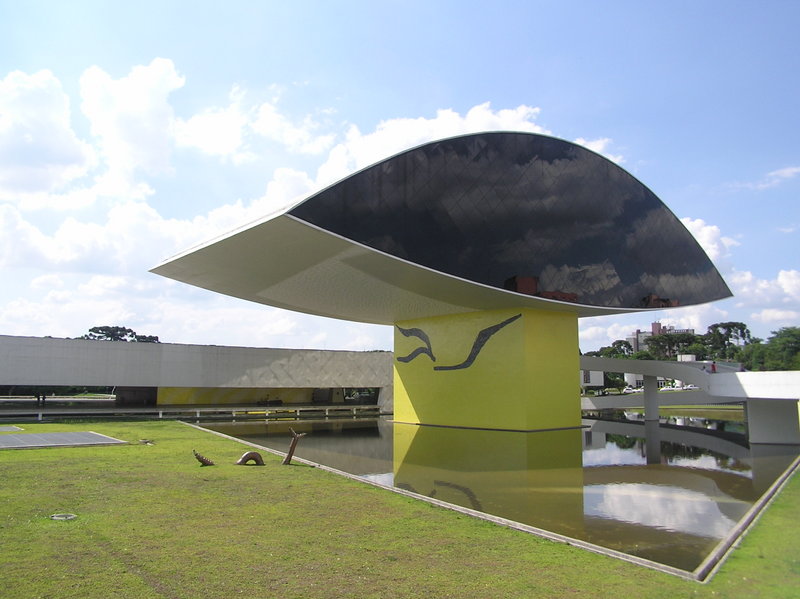
The Niemeyer Museum in Curitiba

Here in Brazil, another nation, like the USA, which struggled throughout the Twentieth Century to fashion itself into a democratic utopia, we can also see this spirit embodied in the gorgeous curves of Oscar Niemeyer‘s fluid Brazilian modernism. Lewis Mumford may be long gone, but Niemeyer is still with us at 101 years old, and still working with the same commitment.

It is a sobering thought that it will not be long before there is no-one left from that generation of urbanists, the generation that was committed to invention, beauty and social progress. Here’s to them…

(thanks to Janet Forbes of York University, Toronto, whose post to a mailing list inspired this reverie)