Anti-surveillance clothing

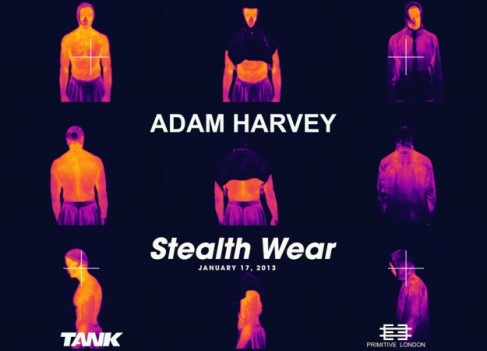
I just received notice of a fashion show: not the kind of thing I used to blog here back when I was blogging regularly – hello again BTW, this will be the first post in a revival of this blog, apart from anything else I miss the combination of disciplined regularity and almost random new directions that blogging brings – anyway, the fashion show is by a New York artist, Adam Harvey, who will present various items designed to counter surveillance of different kinds.

stealth-wear-487x351

There has been a growth in both surveillance and anti-surveillance clothing over the past few years. Back in the 2000s, we saw items like the Bladerunner GPS-enabled jacket – supposedly to enable parents to keep track of their kids but which would probably be more likely to tell them which bus they’d left it on or which friend they’d lent it to – and even earlier, Steve Mann‘s lab had been creating artifacts that combined engineering and art to subvert or reflect surveillance in ways both serious and humorous. More recently we’ve seen anti-surveillance make-up – another art project. But while artists have explored anti-surveillance and sousveillance, the general trend does seem to be towards clothing enabled for surveillance or at least connection into systems which require surveillance of the item or its wearer as part of some augmented reality / ubiquitous computing scenario.

Surveillant Landscapes

There is a fascinating little piece on Bldg Blog about ‘security geotextiles’ and other actual and speculative surveillance systems that are built in to, underlie or encompass whole landscapes. The argument seems to support what I have been writing and speaking about recently on ‘vanishing surveillance’ (I’ll be speaking about it again in Copenhagen a the first Negotiating (In)visibilities conference in February): the way in which, as surveillance spreads and becomes more intense, moving towards ubiquitous, pervasive or ambient surveillance, that its material manifestations have a tendency to disappear.

There is a standards kind of alarmism that the piece starts with and the assumption that such things are malevolent does strike one as an initial impression, perhaps not surprising given that the piece is inspired by yet another security tech developement – this time a concealed perimeter surveillance system from Israeli firm, GMax. Perhaps if it had begun with urban ubiquitous sensory systems in a universal design context, it might have taken a very different direction. However, what’s particularly interesting about the piece is that it doesn’t stop there, but highlights the possibilities for resistance and subversion using the very same ubiquitous technologies.

But whether hegemonic or subversive, the overall trajectory that post outlines of a move towards a machine-readable world, indeed a world reconfigured for machines, is pretty much indisputable…

A buried and ultimately invisible magnetic passive perimeter security system, from Israeli security company, G-Max.

(Thanks to Torin Monahan for alerting me to this)

War on Terror corrupts US justice

On January 1st this year, US President Obama signed into law the National Defense Authorization Act (NDAA) that, amongst other many other provisions, allows for the US military to indefinitely detain without trial anyone suspected of terrorists acts inside the United States and, the same for anyone captured in battle wherever it is in the world. Even the UK’s provisions, which were widely criticised, were nothing like this, indeed the argument was not about indefinite detention at all, but simply over how many days someone suspected of terrorism should be allowed to be detained without trial: 14 or 28. That’s some way short of indefinite.

Of course, the infinitely compromising and slippery Obama is trying to have his cake and eat by promising that he will not actually allow this power to be used except in strict accordance with the constitution. That may provide some temporary relief for US citizens accused of terrorism, at least and until a more gung-ho President is elected or Obama gives in to demands that he must use it – something military sources are looking forward to, it seems. However the provisions on the treatment of foreign captives effectively provide a legal footing in domestic law for the extrajudicial actions of former President Bush’s establishment of Guantanemo Bay and the associated global network of extraordinary rendition and torture / interogation sites. They undoubtedly contravene the Geneva Conventions (see 75 UNTS 135, for example)and several other aspects of International Law, notably the International Covenant on Civil and Political Rights.

But, this is far from the only current assault on the rights of those who remain innocent in law of any criminal act in the USA. In New York, for example, the New York Police Department in conjunction with the CIA was last year revealed as operating a secret surveillance program against Muslims, titled ‘Ancestries of Interest’. It is unlikely to be the only such program. Like Obama’s indefinite detention provision, this is a perversion of the constitutional rights of US citizens. US police forces from the FBI downwards are not generally permitted to use undercover agents without there being some kind of specific allegation or exisiting evidence of crime. Essentially, this makes a whole community subject to categorical suspicion and permanent infiltration and investigation. It seems that every level of policing and justice in the USA from investigation to trial to sentencing has been indelibly stained by the War on Terror.

But this has all happened several times before of course, and happily not everyone has forgotten their history. Now black Christian pastors who remember the FBI/NSA COINTELPRO operations of the 1960s against black radical and civil rights groups,  are reportedly joining with Islamic groups in opposing the NYPD’s racist and islamophobic surveillance program. Along with the challenges being mounted to Obama’s new law by ACLU and others, there are signs that Obama is no longer being given the benefit of the doubt by many of the groups who supported him first time around. How successful any of these moves will be is anyone’s guess but solidarity that moves beyond American Islamic groups having to defend themselves against the howling mob is something of a step forward.

Make like a Dandy Highwayman to beat Face Recognition Software

Spoofing biometrics has become a mini-industry, as one would expect as the technologies of recognition become more pervasive. And not all of these methods are high-tech. Tsutomu Matsumoto’s low tech ‘gummy fingerprint‘ approach to beating fingerprint recognition is already quite well-known, for example. I’ve also seen him demonstrate very effective iris scan spoofing using cardboard irises.

Facial recognition would seem the most obvious target for such spoofing given that it is likely to be the system most used in public or other open spaces. And one of the most ingenious systems I have seen recently involves a few very simple tips. Inspired by the increasing hostility of legal systems to masks and head coverings, CV Dazzle claims to be an ‘open-source’ camouflage system for defeating computer vision.

Among the interesting findings of the project, which started as part of the Interactive Telecommunications Program at NYU, is that the more complex and high-fashion disguise-type attempts to beat facial recognition did not work as well as the simpler flat camouflage approaches. The solution suggested thus involves many of the same principles as earlier forms of camouflage: breaking up surface patterns and disguising surface topography. It uses startling make-up techniques which look a bit like 80s New Romantic face painting as deployed by Adam and the Ants – hence the title of this post! The system concentrates especially on key areas of the face which are essential to most facial recognition software systems such as the area around the bridge of the nose, cheekbones and eye socket depth.

Results from the CV Dazzle project

So, will we see a revival of the Dandy Highwayman look as a strategy of counter-surveillance? Or more likely, will social embarrassment and the desire to seem ‘normal’ mean that video surveillance operators have a relatively easy life?

Adam Ant in the early 80s

Negotiating (In)visibilities

There’s an interesting new research network called ‘Negotiating (In)visibilies‘, one of those fascinating interdisciplinary collaborations (or collisions) that spans architcture, urban studies, cultural studies, arts and information (and probably). I’ve been asked to be an advisor and will also be giving one of the keynotes at what looks to be a really great opening confererence in Copenhagen, February 1-2 2012. Should be fun!

Will 2012 be the year of the drone?

My first post of 2012 – and, yes, my New’s Year’s Resolution is to blog regularly again – is not about a new subject. Unmanned Aerial Vehicles (UAVs) or drones, are already on their way to being a standard tool of national security and increasingly of policing too. However, given decreasing price of small Micro-Unmanned Aerial Vehicles (MAVs), it was also inevitable that NGOs, activist and citizen groups and even individuals, would soon start to operate them as a form of sousveillance or counter-surveillance, or simply as surveillance.

Some Occupy protestors in Europe and the USA had already made use of commercially available MAVs to broadcast footage of protest. And, the BBC reports today that the Sea Shepherd Conservation Society, the radical direct action anti-whaling group, will this year use an Osprey drone aircraft to monitor Japanese whaling fleets operating in the southern oceans. Sea Shepherd has always been technically adventurous (and PR savvy), operating radar-invisible speedboats and even a submarine in the past.

But it all suggests that drones have made the leap from military to policing to civil use with remarkable speed, and I suggest that in 2012 we will see the proliferation of MAVs operated by non-government users. Let’s just see how fast governments now try to outlaw drones in response…

Sea Shepherd activists test their drone


CFP: RGS-IBG 2012

Royal Geographical Society-Insitute of British Geographers (RGS-IBG) Annual Conference, Edinburgh UK, 3-5th July 2012.

Call for papers, sponsored by the Surveillance Studies Network / Surveillance & Society

“Surveillant Geographies”

Convened by David Murakami Wood (Queen’s University, Ontario) and Steve Graham (Newcastle University)

In this era of risk and security, surveillance is intensifying, expanding, rescaling and reterratorializing. New  organisational practices, new technologies and new spaces of surveillance are replacing, adding to or overlaying existing forms. Surveillance is becoming something that is far removed from the binaries of State/Citizen, Public/Private or Self/Other. Surveillance is both being globalized and at the same time enables neoliberal economic globalization and military power projection. But beyond this there is a complex and contingent spatiality and temporality to surveillance. Nation-states and national cultures still matter, however, the most significant differences are not national. Surveillance is increasingly not only targeted at the unwilling masses, but is something embraced by a mobile global elite to ensure the predictability and safety of in the spaces in which they live and work. Specialized marketing combined with revanchist redevelopment are generating material and virtual sociospatial forms that come with surveillance ‘built in’. At the same time, globalization means a shift to more fragmented, uneven and dangerous spaces for many, where what is not seen matters as much as what is. There is an emerging geography of secure and surveilled enclaves counterposed to spaces of exclusion and disappearance, at every scale. Surveillance is also becoming a feature of everyday interpersonal practice through social media and consumer culture, and this too has complex relationships with the construction of space.

We invite submissions on any aspect of the geographies of surveillance. Key topics could include:

The globalization, reterritorialization and rescaling of surveillance
Critiques of dominant theorizations of surveillance, and new directions from / in geography
Comparative studies of surveillance
The political economy of surveillance
Surveillance, intelligence and the ‘war on terror’
Emerging geographies of surveillance, e.g. social networks, online gameworlds etc.
Historical geographies of surveillance
Surveillance and culture(s)
Reaction and resistance to surveillance
Geographies of openness, transparency and exteriority
Geographies of closure, privacy and interiority

Please send a title and short abstract (max. 250 words) by Friday 20th January 2012 to the session organisers, David Murakami Wood (dmw@queensu.ca) and Steve Graham (steve.graham@ncl.ac.uk)

Occupy the Internet!

I’ve been writing for several years now about the creeping attempts by nominally democratic governments to control or even close the Internet (see here for example). This week the biggest such step for some time occurs as the world’s most powerful democracy, the USA, begins a new process of introducing such controls. There are two bills before the House of Representatives (the Stop Online Piracy Bill, SOPA) and the Senate (the Protect IP act), which essentially do the same thing (although the House bill goes further): assert a wide-ranging heavy-handed jurisdiction on the Internet even beyond US borders.

Of course, the US bills do not do this as China does, in the name of political and social order, but in the name of commerce. The bills are supposedly about protecting American intellectual property, however their effect is likely to be severely chilling to free expression and the dissemination of ideas and to innovation, social and economic. The bills, amongst many other provisions, will allow corporation to sue website owners and ISPs for even unknowingly hosting or communicating copyrighted materials illicitly.

As Michael Geist has shown, SOPA in particular also asserts US jurisdiction over vast swathes of the Internet on the grounds that any site whose name is registered with a US registrar is considered a ‘US site’ regardless of the location of its server and given that name-registration of top-level (.com, .org, .net etc)  names is entirely controlled from within the USA, the provisions mean that every top-level domain is considered to be ‘US’. Further it claims that IP addresses (the numerical address of site) within the whole North American region (ARIN) which includes Canada, Mexico and the Caribbean, are also ‘domestic’ for the purposes of this law. Basically, the USA is asserting a kind of Munro-doctrine for the Internet.

I wrote, half-jokingly, some time ago that the US state invented the Internet, but they don’t like how it’s being used and now they want it back: this is the demand in writing. The big problem in opposing this is of course the fact that US citizens have already been thoroughly bombarded with propaganda that has told them that they are ‘under threat’ from pirates and hackers and even cyberwar – and that openness makes them insecure. They’ve been told that the Wikileaks model of accountability through openness and transparency is an attack on the USA. In an age of economic insecurity, no doubt the protection of American jobs will also be wheeled out as an excuse.

But this is quite simply another manifestation of immoral corporate greed. Intellectual Property is in itself a kind of information-age enclosure, a concept that, while it may have some use in limited forms, has become so far-reaching that it is ludicrous, and through which financial and legal strength can simply steamroller traditional or alternative visions of fairness, sharing and openness – even though these things have been shown to be vital in real innovation. If this is an infowar, I know which side I am on, and which side you should be on, and it is not the side of Protect IP and SOPA and the negative politics of closure, it is with Anonymous and the Pirate Party, with open flows, open source and open access. We have to tell them that they can’t have the Internet back, it’s ours now. We have to occupy the Internet, to build around these attempts to stifle innovation and sharing and we have to do it now.

In the meantime, you can express your displeasure here: http://americancensorship.org/

See also: The Internet Must Be Defended! Part 1, Part 2, Part 3, Part 4.

Rio police invade favelas ahead of FIFA World Cup and Olympics

As I, along with many others, predicted as soon as it was announced that Rio de Janeiro would host the two most globally important sports mega-events, the Rio authorities have launched a major drive to occupy and ‘pacify’ a growing number of the most significant favelas (informal settlements) in the city.

The rationale behind this is to drive out the gangs which control many of these communities. To this end a series of special police units has been created, the UPPs, which attempt to gain control of the settlements. Early experiments were in three favelas, one of which, Santa Marta, I visited in early 2009, when, along with Paola Barreto Leblanc, I conducted interviews with community association leaders and police.

Just last week the police moved into the largest favela, Rocinha. Unusually with police raids of this kind, there was little overt violence and ‘collateral damage’. This is certainly an improvement on some previous operations. However, not everyone was that impressed. This video from ITN News shows the stage-managed nature of the event, which seems to have been largely a demonstration of the ability of the Rio authorities to produce security on demand. As the reporter notes, only one person was arrested which means that hundreds of gang members (in this case of the Amigos dos Amigos, AdA, or ‘Friends of Friends’) will either have fled or remain in the favela.

The plan is apparently for the net to be widened still further, with Sergio Cabral, the Governor, claiming that 40 UPPs will be established, including very soon in the Mare Complex, 16 favelas with over 130,000 in all, which is vital to the preparation for the mega-events as it is close to the international aiport and other major transport links from Rio to the economic hub of Brazil, Sao Paulo. Many AdA members from Rocinha may have fled to the Mare Complex and at some point the pacification is bound to be become violent and less media-friendly. There are also, at least two other alliances of gangs who occupy other important favelas.

The current authorities have also started to emphasize the ‘community-building’ intention of these pacification measures, but it should not be forgotten that almost the first act that Cabral and his sidekick, the Mayor of Rio, Eduardo Paes, implemented on coming to office was to cancel the internationally-praised slum-upgrading program, favela bairro (see some thoughts I had on this after my interviews in 2009) of the former Mayor Cesar Maia, which was aimed at a much deeper and longer-term improvements not just at appeasing middle class voters and impressing the International Olympic Committee and FIFA. We will also see whether, like in Santa Marta, the initial community building efforts are undermined (or perhaps aided) by the installation of surveillance cameras

Oxford taxi cabs will record your every word…

Just when you thought that having just about your every move recorded in the UK was bad enough, Oxford City Council, which runs the city I once called home, has decided that all taxi cabs in the city will record both sound and vision, and these records will be kept for up to 28 days, just in case.

People often ask me ‘where do you draw the line?’. Well, you absolutely draw the line at recording private conversations without a specific justification. Generalized audio surveillance is not just a step over the line, it leaps over the line, lands far beyond it and keeps running.

This is just wrong. No qualification.

It seems that despite having got rid of one government with authoritarian surveillance tendencies, the same impulses are alive and well in local government in Britain. Perhaps the councillors who voted for this would first like to have audio surveillance in their offices, cars and houses, you know: just in case…