Most people will probably have heard the announcement that Rio de Janeiro has been awarded the 2016 Olympic Games. While I am pleased that Brazil has beaten the USA in particular in this race in the sense that it shows a slight shift in global power balances towards the global south, I am very concerned as to how the current right-wing administration of both the city and region of Rio will deal with the ‘security’ issues around this mega-event. The Pan-American Games, which Rio hosted in 2007 led to the violent occupation by military police of several particularly troubled favelas (informal settlements), and the new administration has already shown its authoritarian tendencies with the Giuliani- wannabe ‘choque de ordem’ (shock of order) policies that involve building demolition, crackdowns on illegal street vendors (i.e. the poor) and more recently, the building of walls around certain favelas, and most recently the unwelcome imposition of CCTV cameras on favelas that were just starting to enjoy improvements in trust between police and community. The favelas that line the main highways into the city from the international airport were already slated for such ghettoization, and the Olympics will only make this more likely to happen and more quickly – just as has happened in South Africa, similarly afflicted by race and class-based social conflict, during the various international meetings and summits there in recent years. Foreign delegates and tourists don’t like to see all that nasty poverty, do they?
I will write more on this later (I am on the road right now…).
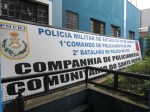
Leading the new Community Police efforts in Santa Marta was Capitao Pricilla, an indomitable and well-liked young female officer of the Military Police, one of several rising female officers with a new approach, and we heard from residents how trust was being rebuilt between police and community because of her. At the same time, there were storm clouds on the horizon as the city administration was insistent on cracking down still further with its policies of choque de ordem (the shock of order), which involved harassing illegal street vendors from the favelas, and demolishing illegally-built buildings, and also building walls along the edges of some favelas. The word ‘ghetto’ was mentioned on more than one occasion by our interviewees and in more casual conversations.
Now, just last month, the Military Police have decided to install seven CCTV cameras in Santa Marta, in different areas of the community. This has prompted complaints of invasion of privacy, an there have already, my sources report, been protests about this in he favela, but it seems that this is coming from further up the chain of command than Capitao Pricilla and the community police. She isn’t mentioned at all by the article in O Globo, despite being a bit of a PR star, and instead the justification for the cameras is given by one Coronel José Carvalho, who also stated that there are plans to put cameras into the other two areas currently being targeted for development, the famous Cidade de Deus, and the much less well-known and more distant favela of Batan. This also contradicts what I was being told by the Commnder of the police central CCTV control room we visited, which is quoted as being one of the places where the cameras will be monitored. What is interesting is the cameras seem to be being treated by police almost as a tool of urban warfare: a Major Orderlei Santos talks about their experimental use for determine the deployment of officers in the favela.
Could the old macho, male, approach to policing as a war on the poor be trumping the new trust being developed by community policing? I hope not, but everything points that way.
(thanks once again to Paola and David for keeping me in touch…)
The Guardian today has an interesting report on how women are getting to more senior positions in the police in Rio de Janeiro and changing the way policing is done as a result. I reported on my own observation of this back in April, an whilst there are many bright young female officers who want to do things differently, the top echelons of Brazilian policing are still a long way from being feminized and these young guns may not ever get much higher up to where policy is made. There’s also suspicions that such officers are being used largely for their PR value and to defend the police against being just another macho gang.
Of course, there’s more going on than just in the police. A whole generation of men lost to the drugs war has left women in more influential positions within community organisations in the favelas of Rio – we met several during our research. Considering the lack of effective state surveillance and the relative increase in power and local knowledge of these women both in community associations and the police in Brazil, I jokingly referred to them as ‘not so much Big Brother as Big Mothers’…
Over the last two weeks, we’ve talked to all kinds of police. We’ve talked to officers, both senior and junior from the Policia Militar (PM), the state-level equivalent of the French ‘gendarmerie’ or Italian ‘carabinieri’, including some who have been rebranded as ‘Policia Communitaria’; we’ve met guys from BOPE (the Rio-specific special operations group within the PM here) – and hopefully we will meet their Commander today; we’ve interviewed the Subchefe of the Policia Civil (PC), the detectives, again based at state-level; and we’ve visited the headquarters of the Guarda Municipal (GM), the relatively recently-formed city police. I haven’t talked to the firefighters, another military-state legacy, who are still an armed force, although a report from the State parliament in January recommended that they be disarmed. Back when I was in Brasilia, I also had a meeting with the Policia Federal (PF), the Brazilian ‘FBI’, another post-dictatorship development, who operate at federal level.
It is a confusing organisational landscape, and not just for me. Throughout the interviews with all the different representatives, very different perspectives emerged on what is important in policing, which force is more important and for what purpose, to what extent the current system works, and what would be the best way forward. Corruption was also something that came up time and time again, with everyone arguing that their force was improving and dealing with this, but hinting that there was still a problem with other kinds of police. There was lots of talk of ‘new generations’ of officers free from the taint of the past. But at the same time it was quite clear on the ground that people from all social classes still do not trust any of the police in general, even when they have established quite positive personal working relationships with officers in their own community.
Cesar Couto Lima, Diretor de Operacoes of the Guarda Municipal
The GM are less than twenty years old and they ‘know their place’ in the hierarchy of police: at the bottom. They are not true ‘professional police’ in the sense that they have only three months basic training, followed by some specialist extra work. They are really somewhere between police and a private security force that just happens to be employed by the city – their commanders at the top level are however, ex-PM. They do, however, have a growing field of responsibility, acting both as a kind of protective and preventative force on the ground in the city centre and as a street-level agency of the ‘eyes on the street’ form of surveillance.
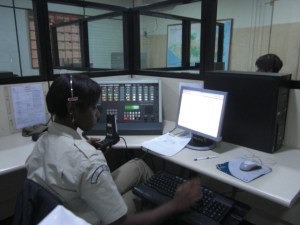
Operator in the Guarda Municpal emergency control room
They also act as the emergency services co-ordination, and this role will increase and be better integrated and funded in future. They are largely disarmed, though not because as many believe, the law prevents them from being armed. This is a strategic decision based on keeping a clear line between them and the PM. This is also the reason why they have a different uniform (in Rio a kind of unflattering beige) from the PM (blue). In our interview with the Director of Operations, Cesar Couto Lima, we were told that in the past, the uniforms had been the same colour but that this had been changed under the last mayor, Cesar Maia, to prevent GM officers from being shot by criminals in the mistaken belief that they were PM. They now have a very low rate of injury and death. The Dir Ops also wants to increase the numbers and in the very long term for the GM to be the be the main police force of a disarmed and less violent city.
It is a fine aspiration, however the new Mayor Eduardo Paes, has apparently suggested that the uniform is changed back to blue and that there should be more arming of the GM. The Dir Ops is utterly opposed to both, and I think he sees it as a deliberate ploy to give the impression of more PM around – the State Secretary for Security has already announced a plan to increase the numbers of PM in Rio by thousands, as we found out when we visited his office. The officers we met at the GM were generally pleasant, relaxed people, however the GM is not immune from corruption. I have heard allegations of extortion from street traders, the poor and criminals, in much the same way as gets reported of the two main forces, and indeed of death threats to officers who refuse to get involved with such practices. Any generalised or regular arming of the GM would only increase the temptation to act on the new power in an irregular way, and also, with so many weapons in the hands of relatively poorly paid and untrained officers lead to greater numbers of killings and a further channel for criminals to obtain weapons.
Ricardo Martins, the Subchefe of the Policia Civil would also like to see a demilitarisation of the police in the long-term. He argued that basically, the PM should be gradually abolished and absorbed into a purely civil police. He was also strongly in favour of more ‘intelligence-led’ and surveillance-based solutions, rather than force of arms or numbers. According to him, the expansion of the video surveillance system in the city was essential and absolutely necessary if the city was to be ready for the 2012 soccer World Cup (to be held across Brazil) and more particularly for the 2016 Olympics, for which the city is a frontrunner. All the senior officers an officials with whom we talked agreed that currently it was nowhere near ready. The GM also agreed with the expansion of CCTV, although they seemed to think that they would have a greater role in operating the systems in future, talking of plans for neighbourhood control rooms integrated with the emergency services control system. Neither the PC, nor more importantly, the Superintendente de Commando e Controle of the State, Claudio de Almeida Neto, gave any indication that this was the direction in which things were proceeding. Indeed the Superintendente was quite clear that there was a greater centralisation, co-ordination and professionalisation of video surveillance operations taking place through his office and his control room, which is in the old ‘Centro do Brasil’ railway station. The office of the Secretary of State for Security seemed not to be that interested in surveillance at all, and commented that it was very expensive, which suggests that the funds for the expansion of the video surveillance system that all expect, whoever they think will be running it, may not be quite as lavish as they believe or would want. I will write more about this later. The PC, however has the reputation of being the most corrupt of all the forces. Subchefe Martins pointed to the internal investigations branch as evidence of the effectiveness of their fight against corruption. Other interviewees were not as easily impressed!
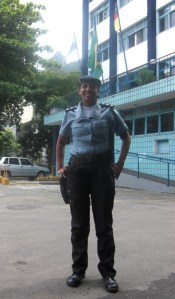
Capitao Pricilla, Head of Santa Marta Community Police initiative
So where should policing in Rio go? One way forward was obvious when we interviewed Capitao Pricilla, the current ‘star’ of the PM, who heads up the Community Policing initiative in Morro Santa Marta. Capitao Pricilla is a PR-dream: attractive, articulate, intelligent, convincing in her arguments, and clearly dedicated to her work with the community. She is everything you would hope a new generation of younger PM officers would be, and she clearly stated that she is part of a new generation. And she is popular too. As we talked with her, officers would constantly come over just to say ‘hello’ and older women in particular, would treat her like a TV celebrity. Now, of course I am wary of the way in which such charisma would make her an obvious choice to head such an operation, which is much promoted as ‘the way forward’ in the media. However there have been many ‘ways forward’ before which have come to nothing and Rio is constantly making and destroying innovative initiatives before they even have a chance to have a real effect. The Santa Marta initiative probably cannot be replicated in many favelas, like Prazeres, where there is a more intimate relationship with the ‘parallel power’ of the traffickers. But Capitao Pricilla seems like the real deal. Let’s hope that she and officers like her get the support they need and are not undermined by the violence and corrupt practices of so many of their colleagues. It’s a utopian hope perhaps, and Rio is still going to need the other far more aggressive hand of the other attempt to get around corrupt practice in the PM, the BOPE – about whom I will write more after our visit today – as much as it needs the helping hand of Community Policing initiatives for a while. It is that large and less articulate mass of PM and PC officers who have no interest in doing anything different, and the equally corrupt politicians who prevent change for their own selfish reasons, that are the main barrier to any organisational change.
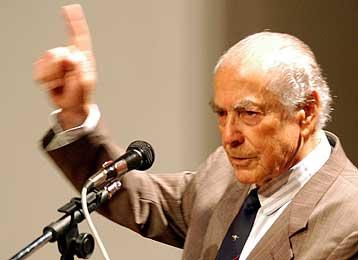
One question that has been preoccupying my thoughts recently has been the question of why the simple things are not being done in Rio to address the problems of the favelas: sanitation, education, healthcare etc… many of the people we have talked to look back to the regime of Leonel Brizola, the Governor of the State of Rio de Janeiro from 1983 to 1987 and then again from 1991 to 1994. Brizola was a left-progressive populist, a social democrat and a former opponent of the dictatorship who had had to live in exile for much of the 1970s. Sadly he died in 2004, but we had the opportunity this week to talk to his former Secretary of State for Public Security, and also briefly Governor himself from 1994-5, Nilo Batista.
We met Professor Batista in the Instituto Carioca de Crimonologia (ICC), an independent research organisation, which he runs (and funds from his legal work), along with his wife, sociologist, Vera Malaguti Batista. The Institute is housed in a sleek modern building up in the hills of Santa Teresa, from whose picture windows the city below is all but invisible and the bay appears almost as it was when Europeans first arrived. However, the concerns of the Institute are very much with the reality of the city today.
We had a long and wide-ranging conversation, which would be impossible to recount in detail here, but the basis of it was an understanding of Brazilian society, and in particular that of Rio, based on the ongoing legacies of the past, in particular slavery and authoritarianism. Vera Malaguti’s book, O Medo na Cidade do Rio de Janeiro: dois tempos de uma historia (Fear in the City of Rio de Janeiro: one story in two periods) examines previous periods of revolt by Africans in Brazil and argues that the often unspoken elite fear of the africanisation of Brazil. They argue that repressive public security strategies today are founded in this same fundamental fear, driven by the media that serves the powerful middle classes who aspire to elite values and lifestyles.
In opposition they place Brizola and that brief (and they argue, unrepeated) period at the end of the dictatorship when social justice and in particular, education, were priorities and favelas were provided with services in the same way as any other neighborhood. The security strategy of Brizola and Batista was effectively one of anti-stigmatisation. They argue that since then, media-driven fear and repression has been far more the norm and this had undermined the progress made under Brizola.The current public security-based strategy of the Governor Cabral and the ‘choque de ordem’ of Giuliani-wannabe Mayor Eduardo Paes, is one example. By concentrating on ‘pacifying’ one or two places as examples (Santa Marta and Cidade de Deus at present) without being able to afford the same strategy elsewhere, it constitutes simply a public relations exercise, and elsewhere repression without development continues as normal.
The Batistas are passionate and well-motivated, but there are many who argue that this picture of a progressive Brizola regime subsequently undermined by repressive policies is at the very least, a limited view. It was, after all, under Brizola that the traffickers grew in power and acquired weapons; the mid-eighties was the key period here as the cocaine trade grew from almost nothing to being the driving force of gang activity in Rio. This isn’t just a view held by political opponents: whilst he certainly does not (and could not with any justification) claim that the rise of the cocaine trade was anything to do with Brizola, Enrique Desmond Arias in Drugs and Democracy in Rio de Janeiro, argues that the personalist populism of Brizola undermined the leadership of the Community Associations in the favelas and left them open to co-option by drug gangs. When we visited the office of the current Secretary of State for Security, Jose Mariano Beltrami, and talked with his representative, it was quite strongly argued that Brizola neglected the issue of the growing arming and violence of drug traffickers, and also did nothing to solve the massive problem of police corruption (on which I will write more later). The current longer-term strategy is now to recruit a lot more Military Police, in the hope that numbers will do what force has not, and enable the gangs to be beaten.
We also visited the office of a leading critic of human rights abuses, Alessandro Mollon, a Deputy in the State parliament. He said that Beltrami is actually shifting, without ever having admitted to it, from a very macho and repressive approach when he first arrived from the southern state of Rio Grande do Sul, to a more considered (but hardly progressive) strategy now, of which the emphasis on police officers on the streets, rather than invasions, is one aspect.
Former Mayor of Rio, Cesar Maia
The claim that Brizola was the last real progressive figure to lead Rio also neglects some others, particularly those who have held the office of the Mayor. Under Cesar Maia (1993-7; 2001-2008), the ‘Favela Bairro’ program had much in common with what Brizola did in social terms. Indeed when we asked the leader of the Morro dos Prazeres Community Association what would be the one thing she wanted above all else, it was ‘more Favela Bairro’. In Dona Marta they also had some time for the former governor, Anthony Garotinho (1999-2002) a frankly quite foolish evangelical populist, currently under investigation for corruption, as is his wife, Rosinha, who was Governor from 2003-7. However, we heard from others that the things that they attribute to Garotinho were actually planned or initiated under previous administrations and just did not see the light until his.
What is certainly the case is that Brizola had a better attitude to the favelados as people, than other administrations, regardless of his mistakes. The current regime certainly seems to be more driven far more by middle-class fears than by social progress, but it is also the constant undermining of the progress of previous administrations like Brizola’s and then later Maia’s terms as Mayor by new waves of media-courting repression that is so depressing in Rio. It happens in every democratic country, but here in Brazil there is the most blatant inequality of any wealthy country still crying out to be addressed. If it was, then most of the issues of ‘crime’ and ‘insecurity’ would start to disappear. It would, as Deputado Mollon also pointed out, be a lot cheaper than the massive amounts of money now going into the hands or private security companies – who, as Professor Batista noted are often run by the families of senior police officers, who therefore have no actual interest in reducing crime and every reason to want to see fear continue to grow.
(With thanks to Nilo Batista, Vera Malaguti Batista, Alessandro Mollon and the staff of the office of Jose Mariano Beltrami for their time and patience. In particular, I hope to return to the Instituto Carioca de Criminologia sometime in the future to talk about the findings of this project, and to submit something to their excellent journal, Discursos Sediciosos: crime, direito e sociedade)
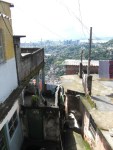
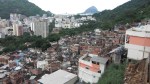
One of our most interesting visits last week was to the favela of Morro dos Prazeres, north-west of Santa Teresa. Prazeres has one of the most astonishing views of Rio of any neighbourhood, with an almost 360 degree panorama of the city, it’s perspective to the south only interupted by the statue of Christ the Redeemer, which is hardly a bad view in itself! You might think that the last thing that favelados would care about was the view but they are well aware of the beauty of their location – the assumption that the poor an desperate would not care about such things is a rather patronising misconception. Elisa, the leader of the community association, at least, seems most proud of this asset and says that like many people she wouldn’t want to live anywhere else even if she won the lottery!
But Prazeres does have serious problems. For a start, it is a ‘hot’ favela, occupied by drug traffickers, who control ‘law and order’ in the place. There is therefore no ongoing police presence, although as with many such communities, the community association does have a relationship of sorts with local military police commanders through organised coffee mornings at which problems are discussed. Luckily, despite or because of the almost complete control of a particular gang which is well integrated into the community (i.e.: they are relatives of the more law-abiding members), there are not many problems with violence and the police, ‘thank God’ (says Elisa), have not raided the favela recently, as they have many others.
In fact, as we were visiting Prazeres, as the taxi driver rather anxiously pointed out as he dropped us a safe distance away, BOPE (military police special operations) were ‘invading’ two other favelas next to it, the very hot Morro de Correoa, and Sao Carlos. The operations left eight dead, and we think what we had assumed initially were fireworks was probably the sound of small arms fire in the Sao Carlos operation. However, when we asked a PM at a nearby police post whether Prazeres was safe to enter, he seemed rather blase and relaxed about the whole thing…
Elisa was another very impressive woman. In the absence of men – who, in the favelas are in many cases, either involved in the gangs, working outside, or unemployed and alcoholic – it seems that a whole generation of strong, courageous women has emerged to try to develop their communities from the bottom up. In the past they have benefited from various attempts by previous mayors to provide development for the favelas. Unlike some places, Prazeres does not have a school built during the regimes of populist left-wing Governor, Leonel Brizola (who seems to be fondly recalled in by almost all those we have talked to in the poorer communities). However there was a lot of intervention as part of the Favela Bairro (Favela Community) program of former Mayor, Cesar Maia, and it is this normalisation or the favelas through infrastructure, social and economic development, education, health and social services that Elisa said are the only long-term solution to the problems of Prazeres. The creche in particular is a source of continual delight to her, and her face lit up whenever it is mentioned.
With social development and education, Elisa argued, eventually the ‘cold’ and uncaring gangs will recruit fewer kids, and they will wither slowly away. Confrontation however, only strengthens them by driving more young people to support the ‘insider’ traffickers against the ‘outsider’ police. They must, she said, work like little ants, with lots of small efforts adding up together to long-term success… then perhaps the anthill of Prazeres will function as a normal community.
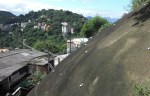
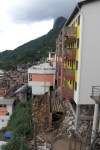
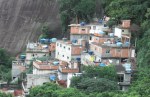
It’s been raining all night and sometimes the rain has been very heavy, pounding on the corrugated plastic roof of my small room. It is making me think more urgently of the favelas and their situation. Following what Paulo Saad was telling me yesterday, I have been reading a very interesting and worrying article by Schuster et al. in a book on landslides. The combination of the climate (heavy rains from January to March) and underlying geology (steep weathered granite slopes and residual soil on top) makes Rio particularly susceptible to landslides. Combined with the prevalence of illegal and unsafe building spreading further to higher and steeper slopes, you have a real recipe for disaster: simple landslides can become debris flows as more material accumulates into the slide and adds to its weight and destructive capacity.
In 1966 and 1967, there were over 1000 deaths from landslides after particularly heavy rain in the Rio area. Santa Teresa was also badly hit by last series of catastrophic landslides to affect Rio in 1988, when the Santa Genoveva Hospital for elderly people was destroyed, killing 34. Altogether 120 people were killed and, perhaps even more worrying for future development, 22,000 were made homeless. According to sources quoted by Schuster et al., this was after less than an hour of particularly heavy rain…
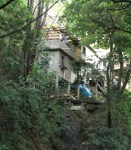
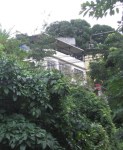
After the late 1960s events that action was taken to reforest the undeveloped slopes around Santa Teresa and reinforce some parts of the hill with concrete channels to direct the flow of water. Building regulations were also strengthened. However, it is in this area that much of the recent illegal building is taking place – and as I mentioned, not just by the desperate and ignorant poor, but also by simply greedy and uncaring middle classes.
Paulo
prevention
risky houses
Illegal villas
New favela
Flood works
Reference
Robert L. Schuster, Daniel A. Salcedo and Luis Valenzuela. Overview of catastrophic landslides in South America in the twentieth century, pp.1-34 in Catastropic Landslides: Effects, Occurrences, Mechanisms. ed. Stephen G. Evans and Jerome V. DeGraf, Geological Society of America, 2002.
We visited two very different communities today, Santa Marta and Santa Teresa, but despite their differences, in both places we met with an equally impressive community representative.
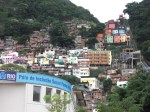
Morro Santa Marta is a relatively small favela that climbs the steep slope below the peak known as Dona Marta (which is why the favela is often incorrectly called ‘Dona Marta’), above Botafogo, and just on the other side of the hill from the much wealthier neighbourhood of Laranjeiras. Santa Marta is well-known largely because it is perceived as a success story, indeed as we were being taken around he community, journalists from Globo TV were embarking on a month-long series of features and interviews with different members of the community, and representatives were scouting the place as a location for the ‘Red Bull Down’ urban downhill mountain biking series (see this description of a related event in Puerto Rico)… in short, Santa Marta is fashionable.
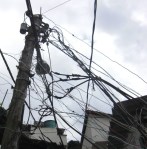
It is also the target for a number of state interventions; indeed I don’t think I have seen as many different workers from as many different agencies in one place at one time anywhere in Brazil. There were transportation workers on the newly-finished cliff railway, there were workers from the planning department shoring up recently-constructed houses to prevent landslides, there were electric company workers struggling to make sense of the maze of cables, there were refuse workers, and at the base of the favela there was a load of people from the new Motorola-sponsored Digital Santa Marta initiative that is wirelessing the whole neighbourhood. It seemed that various government interests badly want Santa Marta to continue improving, and that a lot is riding on this.
However, as we soon discovered, there is a more complex and fragile reality underlying the business and the superficially sheen of hype. Our guide for the morning was Sonia Oliveira, one of the directors of the community association, and a resident for many years. As we ascended the railway with her, we met her son, and other people, like Luis Gustavo, who she had known since he was a baby… it was clear that Sonia was well-known and well-liked. And who wouldn’t like her? Sonia is a strong woman with a calm, determined presence and an insight matched by the realism of experience.
The key to Santa Marta’s success so far has been the combination of many years of careful community work, combined more recently with a determined effort by a particular battalion of the BOPE (military police special operations) to drive out drug traffickers and secure the community, under Commandate Priscilla, who we will hopefully meet next week. It is not as if the community is any more sympathetic to the police than anyone else in Rio, but the relationship between the people involved here is clearly a special one. And whilst the police still do not understand the community fully – there are still frequent complaints of harassment of young men and the closing down of parties – there is some evidence that they are learning and changing to a small but important extent. One problem now is that the wider context of the ‘choque de ordem’, which is basically a rather more aggressive version of the famous New York ‘zero tolerance’ policy, is threatening to roll back these small improvements in trust and understanding. The police hassle unlicensed stall-holders, which is how most favelados make their living, they stop taxi drivers for checks of insurance and licensing, and of course, they threaten, and indeed carry out the threats, to demolish illegally constructed buildings – which is of course, potentially any piece of the favela. However, for Sonia, the over-assertiveness of ‘choque de ordem’ policing is outweighed by a far greater another fear – which is what happens if the political climate changes, or financial or strategic reviews mean that the BOPE are forced to withdraw from Santa Marta. If they do, she argues, the traffickers will return, and it will be worse than before, as not only will they take control of the community, but they will ‘punish’ it for collaborating with the authorities.
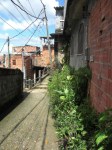
And things must continue here. In many ways they have hardly started. There might be a lot of activity but the favela remains lacking in infrastructure, especially sewage and healthcare. Most of the self-built constructions remain precarious and a severe risk to their inhabitants and those below in the case of heavy rains and consequent landslides. And the understanding of neighbouring communities is far from guaranteed. One might think that neighbours would be grateful that the traffickers are gone and even make efforts to integrate Santa Marta further into the city, but Laranjeiras in particular has been causing all sorts of problems for the favela, in particular over the construction of a school and creche at the top of the neighbourhood. The problem was basically that the school can be seen over the top of the hill, and this led to the fear that Santa Marta would begin to spread over the top and down to the back gates of the expensive apartments and villas of this rather exclusive community inhabited by people like Governor Sergio Cabral. In fact, unlike several other favelas, Santa Marta is not expanding at all. It is becoming a more mature and controlled community, and it is rather ironic that it is at this stage of its development, that it becomes an object of fear and concern for its richer neighbours. The argument has been resolved for now, and the school stays, indeed it is the temporary home of the battalion and the community police, who get a good overview of the neighbourhood from its commanding position. The lack of expansion of Santa Marta has not stopped the State from starting the construction of a wall along its west side. As Sonia says, there is no need to make favelados feel like they are living in a ghetto…
Paulo Oscar Saad was against the building of the school, indeed he is against the expansion of any illegal community into the hills of the area, but in truth this is the only real substantive grounds for disagreement between the leader of the Santa Teresa community association and those in Santa Marta. Santa Teresa is however, an entirely different place. Once a hillside retreat for the rich, its crumbling mansions have for a while now been occupied by an eclectic mixture of artists, academics and other bourgeois but generally progressive people. For many years it served as a kind of cultural centre for the surrounding poorer neighbourhoods, including the many favelas, with favelados mixing with the artists in the bohemian bars and cafes.
However, this mixture has been undermined by three main developments. The first is the aforementioned illegal building, which threatens the very stability of the hillsides which support Santa Teresa. It isn’t just what one would recognise as ‘favelas’ either; many of the illegal buildings are constructed by relatively or even very wealthy people, and often on land reforested precisely to prevent landslides after two previously disastrous deluges in the 1960s and 1980s. The second is the change in the nature and intensity of crime in Santa Teresa. The neighbourhood had always put up with a certain amount of petty theft and pickpocketing, but the arrival of cocaine (and more recently, crack) and in particular the arming of the drug gangs has led to an increase in both actual serious crime and fear. Finally, the gentrification of Santa Teresa is threatening to destroy the easy-going and bohemian atmosphere of the hillside on which it is based. It is an old story, seemingly destined to be endlessly repeated in similar communities all over the world. The old bars and cafes close, and the new upmarket establishments exclude the poor either overtly by policy or implicitly through price. The fear of crime has also driven many residents into the arms of private security companies, who have gated several dead-end streets and equipped them with guardposts. The signs say they are legal; the Community Association says that they are not. In fact the latter are correct. Paulo, like some other I have talked to here, is sure that the private security companies are intimately linked to the militias and indeed to the criminal gangs, all of which reinforce each other in an ongoing spiral of criminality and securitisation. However it is not as if the police (of any kind) or the politicians can be trusted to deal with the situation. According to the community association leader, the police are entirely corrupt and the politicians are fashion-driven media slaves. The only hope lies in bottom-up community power, yet the community is increasingly divided, and even the remaining assets that make Santa Teresa what it is are being cashed in: the wonderful antique tram system that rattles up the hillside is being privatised and its future is uncertain…
It seems that both community leaders are scared of losing what they have and battling to keep their neighbourhoods alive, inclusive and connected, but both are being hampered by uncertainty and contradictory policies and developments at levels which they cannot seems to influence. The future of Rio depends on people like this being supported not undermined by the state at its various levels (which still do not appear to know what each is doing, let alone look like working together). Oh, and I almost didn’t mention surveillance… that’s because like almost everyone else on the ground here, surveillance is seen as a frippery of the rich and something which has no practical use or meaning for the reality of their lives. There is also a strong sense of freedom too: and things like CCTV are seen as a definite infringement of that liberty. The more I get to know people and places here, the more I am certain that Brazil is nothing like a surveillance society and the changes that it would take to become one would be almost inconceivable in scale and cost.
redemption?
public face
Laranjeiras
Santa Marta Digital
police
School
Sonia
tangle
Inside
funicular
wall
Santa Marta
Note: there are photos of Santa Teresa in the next post and there will be more later this week.
Paola and I had a very productive interview with Colonel Mario Sergio de Brito Duarte, the Director President of the Institute for Public Security (ISP) in Rio de Janeiro. The ISP is a state-level organisation with multiple functions including research on public security and the compilation of crime statistics; professional development for the police services (and also more broadly to encourage greater cooperation and coordination between military and civil police); and community involvement and participation in the development of security policy. The Colonel gave us an hour and a half of his time to explain his view on a wide range of issues around crime, security, the problems of the favelas, and the potential for surveillance, social interventions and policing in solving these problems.
As with many senior police (and military) officers with whom I have talked over the years, the Colonel is an educated, thoughtful man who has strong views based in his experiences as a front-line officer with the Policia Militar in Rio (including some years in BOPE, the special operations section) – as detailed in his book, Incursionanda no Inferno (Incursions into the Inferno). Despite how the title may sound, he was far from being gung-ho or authoritarian in his views, emphasising throughout, as with almost everyone I have talked to, that socio-economic solutions will be the only long-term guarantee of public security in Rio. And he certainly had no sympathy for the illegal actions of militias, despite understanding why they emerged and continued to be supported by some sections of the community.
However, it was also clear to him that current policies like Mayor Eduardo Paes’ ‘choque de ordem’ strategy which involves demolitions of illegally-built houses in the favelas, was absolutely necessary as well. He spent some time outlining his view of the history of how drug gangs infiltrated and gained control of many favelas, an in particular the importance of their obtaining high quality small arms – though he was vague on exactly where these arms came from – I have, of course, heard allegations from other interviewees that corrupt soldiers and policemen were one common source of such weapons.
From the point of view of surveillance studies, it was notable how profoundly indifferent the Colonel appeared to be towards he growth of surveillance, and in particular CCTV cameras. He argued that they might be a useful supplement to real policing, but he certainly did not appear to favour a UK-style ‘surveillance society’ – of which, at least in Rio, there seems little sign as yet. He was similarly indifferent towards other central state social interventions like the Programa Bolsa Familia (PBF), and initiatives like ID cards – of course they might help in some way, but he certainly made no attempt to ague, as the UK government has done, that such technology will make a big difference to fighting crime and terrorism (indeed it was interesting that ‘terrorism’ was not mentioned at all – I guess that, when you have to deal with the constant reality of poverty, drugs and fighting between police and gangs, there is no need to conjure phantasms of terror). Even so, the Colonel recognised that the media in Rio did create fantasies of fear to shock the middle classes, and that this sensationalism did harm real efforts to create safer communities.
There was a lot more… but that will have to wait until I have had the whole interview transcribed and translated. In the meantime, my thanks to Colonel Mario Sergio Duarte and to the very nice and helpful ISP researcher Vanessa Campagnac, one of the authors of the analysis of the Rio de Janeiro Victimisation Survey, who talked to us about more technical issues around crime statistics.
I may have been slightly worried about the most recent drugs war that was going on as I arrived, but as usual this appears to have been exaggerated by the press who largely serve the richer, middle-class community, and who appear to want to have their fears stoked on a regular basis. The ‘war’ is a trafficker conflict that involves traffickers based in the large favela of Rocinha, who belong to the Comando Vermelho (CV, Red Command) the oldest and largest of the prison-based umbrella groups of Rio drug traffickers, attacking another favela, Ladeira dos Tabajaras, whose traffickers are backed by the ‘Amigos Dos Amigos’ (ADA, ‘Friends of Friends’). This kind of thing is happening on and off all the time, but what made it a concern of the paranoid middle class in this case, was geography: in order to get to Ladeira dos Tabajaras, the Rocinha gang had to go through the rich high-rise area of Copacabana… to say that it is exaggerated is not to say that it is not dangerous: 8 people have so far been killed, but they are all traffickers and, I believe, all killed following police raids into the favelas.
It is probably no coincidence that this display of force by the Rocinha traffickers is happening just as the city government of Rio has started to implement a policy of the current Mayor, Eduardo Paes, known as ‘choque de ordem’ (the ‘shock of order’), which involves sorties into communities like Rocinha largely to enforce planning regulations by destroying recent illegally built constructions, which are pushing the favelas even further up into the hills. In the last few days, this policy has resulted in the demolition of one particular controversial building, the Minhocão in Rocinha. This was due to start on the 17th, but was halted by a judicial decision, before going ahead in recent days.
There is more than a degree of irony here. The purpose of these demolitions is supposedly to enforce urban planning regulations and ‘protect Rio’. The Secretary for Public Order, Rodrigo Bethlem, is quoted by O Dia as saying (in my translation):
“We cannot permit an entrepreneur to come into Rocinha to build and make easy money by exploiting people. We cannot allow Rio De Janeiro to be destroyed by speculators, who want to make money without following any rules and who aim only at profit.”
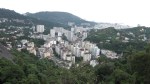
Yet, I only have to glance out of my window here to see the towers of the Centro, built by wealthy speculators, which have almost completely destroyed the beautiful Parisian-style boulevards and belle epoque architecture that used to be ‘Rio’. And turning the other way, the coastline it dominate by the secure condominiums long the beaches, which I am pretty sure were not constructed out of the kindheartedness of developers, and whose development no doubt involved corruption at higher levels of urban government. Looking uphill, I can see the often dubiously if not illegally-constructed houses of the rich that cut into the edges of the National Park.
Can we look forward to the demolition of all of these disfigurements of Rio? Of course not… and the reason is obvious. The demolitions in Rocinha are about power projection. Local state policy towards the favelas goes in waves that alternate between socio-economic solutions and violent authoritarianism. For all its negative aspects, many people who are concerned with social justice here recall with some nostalgia the progressive populism of Leonel Brizola who was mayor in the 1980s. His administrations installed infrastructure, built schools and improved houses in the poorest areas.
The current administration of Eduardo Paes is taking a very different and harder line, concentrating on law and order, a stance which was laid out clearly during the Pan-American Games when the police effectively occupied several of the favelas in an Israeli-style security operation. There would be nothing wrong with this if it were backed by some kind of progressive social imagination too – some favelas like Dona Marta, which I will be visiting later this week, have apparently been transformed through a combination of strong control and surveillance with real social improvements.
Instead there are apparently plans to further marginalise favela residents by building a wall along the major highway from the international airport into the city, so that all the city’s elite can feel so much more secure, and of course, visitors will not have to even see the favelas (some or Rio’s most miserable) which line the route… there’s more than a whiff of Israeli tactics about this too. Whether by building or by demolition, urban planning seems to be currently used as a weapon against the favelas and their inhabitants.














 ubisurv