I’ve been invited back to the British Parliament (yes, I know – I’m surprised they keep asking me back too!). This time it is to address a meeting of the Parliamentary & Scientific Committee on the subject of “Security Technology and Individual Freedom” in April, just after I get back from Brazil.
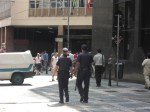
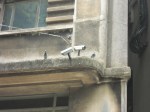
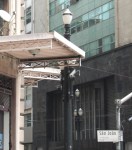
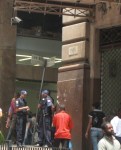
I spent some time on the Sao Paulo metro system yesterday so I tried to get some pictures of security and surveillance underground… Some things I would have loved to have got pictures of: the military policemen stalking a groups of favela kids through the crowds; the very tired and twitchy officer who looked to be absolutely itching for a fight, who got on the Metro after me; the perfect shot of two policemen standing under a camera. But I didn’t get those ones, so my words will have to do. The main reason is that I have a healthy instinct for self-preservation and taking pictures of men with guns – particularly when they are caressing the handgrip and trigger like it was an intimate part of their anatomy as the twitchy officer was – is a sure way to end up attracting unwelcome and possibly fatal attention. The officers in the stations did notice me taking pictures pretty quickly too – which perhaps suggests both the pervasiveness and the effectiveness of trained human surveillance. Anyway, I only have two shots, one of which was an experiment in a longer take, which didn’t quite come off so I might have to try this again…
movement
entrance
I am sure I will have more to say today tomorrow on this after I have met up with Marta Kanashiro, the scholar of surveillance studies from the State University of Campinas.
Brazil can’t really be called a surveillance society… talk of surveillance is just science fiction. It doesn’t mean anything to the people at the bar.
Back at the bar last night I got talking with the regulars – in the limited way I can manage to in Portuguese – about all sorts of things particularly the upcoming carnival – I’m invited – and the football: Brazil beat Italy yesterday in a friendly match. But it was how these ordinary guys – one is a factory worker, one works in an office, and another runs his own one-man business that seems to do anything and everything to do with IT – talked about fear and danger, security and safety, in the city that really interested me. We got talking about where they lived, and the centre of Sao Paulo and how they felt in each place. I told them what I had been advised about not going out at night here, and despite the fact that we were all out at night, Milton, the IT guy, a chunky black man in his 40s, agreed that this wasn’t bad advice for the centre. The area, he said, was full of thieves and drug-addicts, and whilst anyone would be safe amongst friends (and here he gestured expansively to include me and practically everyone else at the bar), even he wouldn’t want to spend much time alone. Milton is from out east – he’s a Corinthians fan; the centre-west is Palmeiras territory, and the red Metro line goes from one to the other – and in his own neighbourhood he says he doesn’t have much to worry about, although of course he has security. Everyone has security. You have to. Joao, the fat, slightly lugubrious office worker, nods in silent agreement.
I tell them I’d quite like to talk to some women. This prompts laughter and a lot of nudging and punching of arms: of course you do, don’t we all? No, no, I mean I’m interested in what women think about all this – what about her? I ask, gesturing to a handsome black women probably about the same age as Milton. Carla? No, you don’t want to talk to her. Not without paying. Open your eyes! (he makes an eye-opening signal with his right hand). Of course I could see that Carla wasn’t just here for fun. And that’s exactly why I wanted to talk to her. She agreed with the guys about the danger, but added that it was much worse for her, not because she was working nights, but because she was black. Being a black woman in Brazil is not good. Everyone, she said, pinching the skin of her forearm, just sees the colour of your skin. especially if you are on your own. With her white friend, people don’t care. I told her that some people think that Brazil isn’t racist or dangerous for black people. She laughed and not in a happy way. Those people didn’t know her life. I asked her if Lula had changed things – it is something I try to ask everyone at some point – in particular with the Programa Bolsa Familia since Carla had told me she has three kids, one grown up and two still at home. She shook her head. No. Nothing. Nothing has changed. It may be pessimistic or cynical but it’s what everyone seems to be thinking apart from the government and the World Bank.
All this bar talk might be casual and fueled by beer (and it is often difficult to understand exactly what people are saying) but it is a useful corrective to the formal interviews and other research I am doing here. It also tends to add to my growing certainty that Brazil can’t really be called a surveillance society at all in terms of how people experience their lives and relationships with the state. Talk of surveillance is just science fiction. It doesn’t mean anything to the people at the bar. The reality is all about danger (not risk in the bland sociological terminology, but actual danger) and security.
Nor surprisingly there is very little surveillance in the area around the hotel, except the old fashioned kind and you better be sure that people are watching you from the little shops and street corners. However when you head down the Av. Sao Joao into the financial district, it’s a different story. I was cautious about taking obvious pictures of police and security guards, let alone the serious security inside the bank entrances (metal detectors, scanners, guards etc.) because I just don’t know what kind of trouble that would bring, but here’s a flavour.
In the editorial of the latest issue of Surveillance & Society, I speculated that that the global recession would lead to surveillance and security coming up against the demands of capital to flow (i.e. as margins get squeezed, things like complex border controls and expensive monitoring equipment become more obvious costs). This was prompted by news that in the UK, some Local Authorities were laying off staff employed to monitor cameras and leaving their control rooms empty.
However an article in the Boston Globe today says different. The piece in the business section claims that – at least in its area of coverage – the recession is proving to be good business for surveillance firms, especially high tech ones. The reasons are basically that both crime and the costs of dealing with it become comparatively larger in lean periods. The article doesn’t entirely contradict my reasoning: organisations in the USA are also starting to wonder about the costs of human monitoring within the organisation, but instead they are installing automated software monitoring or are outsourcing the monitoring to more sophisticated control rooms provided by security companies elsewhere.
Shouting cameras in the UK (The Register)
They also note that human patrols are in some case being replaced (or at least they can be replaced – it’s unclear exactly how much of the article is PR for the companies involved and how much is factual reporting) by ‘video patrols’, i.e.: remote monitoring combined with reassuring (or instructive) disembodied voices from speakers attached to cameras. Now, we’ve seen this before in the UK as part of New Labour’s rather ridiculous ‘Respect Zones’ plan, but the calming voice of authority from a camera, now what famous novel does that sound like? Actually if it’s not Nineteen Eighty-Four, it is also rather reminiscent of the ubiquitous voice of Edgar Friendly in that odd (but actually rather effective) combination of action movie and Philip K. Dickian future, Demolition Man. The point is that this is what Bruce Schneier has called the ‘security show’. It doesn’t provide any real security, merely the impression that there might be.
How long will it be before people – not least criminals – start to get cynical about the disembodied voice of authority? This then has the potential to undermine more general confidence in CCTV and technological solutions to crime and fear of crime, and could end by increasing both.
The important thing about RFID chips is not that they are the ´Mark of the Beast´ or any other such nonsense but that they are an appalling security risk
A story that has been circulating around the place over the last 48 hours, but which was originally in The Register on February 2nd, was the latest from Chris Paget´s valiant attempts to show that using RFID chips is just about the worst way to safeguard confidential information. This time he drove around San Francisco with a simple antenna and managed to read the unique number (which can be used to gain access to information on the US Department of Homeland Security database) from passports up to 30 feet (around 13m away), but he claims that with more powerful equipment, chips could be read from more than a mile (1.6km) away. There is also a very informative video on the site.
The important thing about RFID chips is not that they are the ´Mark of the Beast´ or any other such nonsense but that they are an appalling security risk…
The claim that Brazil is a surveillance society, or at least uses surveillance in the same fundamental organising way as the UK or Japan does, is based on the bureaucracy of identification around entitlement and taxation, rather than policing and security.
My previous post on the subject of whether Brazil was a surveillance society put one side of an argument I am having with myself and colleagues here: that the use surveillance in Brazil is fundamentally based on individual (and indeed commodified and largely class-based) security, rather than surveillance as fundamental social organising principle (as one might legitimately claim is the case in Britain). Now, I deliberately overstated my case and, even as I was posting, my argument was being contradicted by colleagues in the same room!
So here´s the counter-argument – or at least a significant adjustment to the argument. In most nation-states, entering into a relationship with the state involves forms of surveillance by the state of the person. This relationship is more or less voluntary depending on the state and on the subject of the relationship. In most advanced liberal democracies, the nature of surveillance is based on the nature of citizenship, particularly:
the ability of citizens to establish claims to entitlement, the most fundamental to most being a recourse to the law (to protect person and property), secondly the ability to case a vote, and more something that is generally more recent in most states, the right to some kind of support from the state (educational, medical, or financial);
the ability of the state to acquire funds from citizens through direct or indirect taxation, to support the entitlements of citizens, and to maintain order.
I am not going to consider law and order, or indeed electoral systems, here but rather I will concentrate on the way that surveillance operates in an area I had previously begun to consider: the bureaucracy of identification around state-citizen relations particularly in the areas of entitlement and taxation. The claim that Brazil is a surveillance society, or at least uses surveillance in the same fundamental organising way as the UK or Japan does, is based on this rather than policing and security.
There are two broad aspects: on the one side, taxation, and on the other, entitlement. I´ll deal first with the latter (which I know less about at the moment), in particular in the form of Lula´s Programa Bolsa Família (PBF, or Family Grant Program), one of the cornerstones of the socially progressive politics of the current Brazilian government. The PBF provides a very simple, small but direct payment to families with children, for each child, provided that the children go to school and have medical check-ups.
Of course these requirements in themselves involve forms of surveillance, through the monitoring of school attendance by children – for which there is a particular sub-program of the PBF called Projeto Presença (Project Presence) with its own reporting systems – and epidemiology and surveillance of nutrition through the Ministério de Saúde (Ministry of Health). However underlying the entitlement is massive compulsory collection of personal information through the Cadastro Único para Programas Sociais (CadÚnico, or Single Register for Social Programs), set up by Lula´s first administration to unify the previous multiple, often contradictory and difficult to administer number of social programs. This is, of course a database system, which as the CadÚnico website states, ¨funciona como um instrumento de identificação e caracterização socioeconômica das famílias brasileiras¨ (¨functions as an means of identification and socioeconomic caracterization of Brazilian families¨). Like most Brazilian state financial systems, CadÚnico is operated through the federal bank, the Caixa Econômica Federal (CAIXA). The CadÚnico database is founded on ¨um número de identificação social (NIS) de caráter único, pessoal e intransferível¨ (¨a unique, personal and non-transferable Social Identification Number or NIS¨). I am unclear yet how this NIS will relate to the new unique identification system for all citizens.
The PBF Card
Entitlement is demonstrated with (yet another!) card, the patriotic yellow and green Cartão PBF. Like the CPF card, this is a magnetic strip card rather than a smart card, and is required for all transactions involving the PBF. Also like the CPF, but unlike many other forms of Brazilian ID, it has nothing more than the name of the recipient and the CadÚnico number printed on it. In this case the recipient is generally the mother of the children being claimed for, a progressive and practical measure shared with other family entitlement programs in Brazil.
Happy smiling PBF cardholders!
The PBF card in itself may not be enough to claim as you would still need at least the Registro Geral (national ID) card to prove that you are the named holder of the PBF card. The card itself may be simply designed to generate a sense of inclusion, as the pictures of happy smiling PBF cardholders on the government websites show consistently emphasise, although of course, like so many other markers of entitlement to state support, it could also become a stigma.
The information collection to prove entitlement is quite extensive, and here I have translated roughly from the website:
house characteristics (number of rooms; construction type; water, sewerage and garbage systems);
family composition (number of members, dependents like children, the elderly, those with physical handicaps);
identification and civil documents of each family member;
educational qualification of each family member;
professional qualifications and employment situation;
income; and
family outgoing (rent, transport, food and others).
Although PBF is a Federal program, the information is collected at the level of individual municipalities, and there is thus the potential for errors, differences in collection methods, delays and so on to hamper the correct distribution of the money. So each municipality is required to have a committee called the Instância de Controle Social (Social Control Authority) which, whilst it may sound sinister to anglophone ears, actually refers to the control of civil society over the way that the government carries out its social programs. This is also quite a lot of information of the most personal kind and whilst, unlike in many countries there is no central authority of Commissioner for Data Protection in Brazil, there is particularly for PDF, an Observatório de Boas Práticas na Gestão do Programa Bolsa Família (Observatory for Best Practice in the Management of the PBF), which has a whole raft of measures to safeguard and protect the data, correct errors etc (what has been called habeus data principles). Effectively, this is a case of knowing exactly quis custodis ipsos custodes!
Now of course, such a large database of information about the most vulnerable people in society has the potential to be misused by a less progressive or even fascist government. Marxist analysis of early welfare systems has tended to colour our views of such programs as being solely about the management of labour on behalf of capital and the control of the working classes by the state to prevent them from more revolutionary action. For more recent times in Surveillance Studies, John Gilliom´s book, Overseers of the Poor, showed how much Federal assistance programs in the USA could impact negatively upon the lives of claimants, particularly women, in the Appalachian region, and revealed the everyday forms of resistance and adaptation that such women used to make the programs function better for them. I will have to examine more detailed anthropological studies of the PBF to see whether similar things are true of the Brazilian program. I don´t want to get too much into the effectiveness of this program now, although I am trying to examine the correlation of the PBF with apparently declining crime rates in Brazilian cities, but it is worth noting that the World Bank rates it as one of the most successful ways of dealing with extreme poverty in the world. As a general observation, it does seem that only those who object to redistributive policies full stop (or just dislike Lula himself) or those who think it does not go far enough, have any serious complaint about the PBF. But there is far more to consider here…
although there are many forms of surveillance in evidence, Brazil is not fundamentally a ´surveillance society´
What I am doing here is a broad survey of issues around surveillance. I am trying to get to grips with as wide a range of indicators as possible. One impression I have already – which as an impression may be partly or entirely wrong – is that although there are many forms of surveillance in evidence, Brazil is not fundamentally a ´surveillance society´ in the way that the UK is, or in the rather different way that Japan is: Brazil is much more a ´security society´. This is not to say, for example, that there are not many CCTV cameras in the country: Marta Kanashiro´s article in Surveillance & Societylast year indicated that there are well over a million cameras (the total is hard to estimate because of the number of illegal installations).
However, surveillance here is very much tied into security. It´s not a ´security state´ – although it still retains reminders of its more authoritarian past – the concentration on security is largely private. Industry reports I have found, for example, this one from the Massachussets South America Office, indicate that the security industry is growing at rates of betwen 10 and 15% regardless of wider economic trends. Foreign companies are poised like vultures over the thousands of SME security companies that make up the huge private security sector, and positively salivate over the high crime figures.
If one talks in abstracts and absolutes, investment in security at a national level seems to make a difference to these figures. The Fórum Brasileiro de Segurança Pública (or Fórum Segurança, the Brazilian Forum on Public Safety), an independent network of local groups, experts and members of state and private secuirty organisations, has started to publish an annual report. The second report, available late last year, indicates a strong correlation between increased spending ($35 Billion US in 2007) and the decline in homicides. For example, in Rio there was an increase in spending of 4.4% and a decline in homicides of 4.7%. A summary in English is available here.
The big thing is not so much public space surveillance (although the industry report mentioned above estimates a $1Bn US market for electronic surveillance technology mainly for the private sector), but both fortification (especially the upsurge in the building of secure condominiums) and the increasing numbers of human security operatives. These may be private security, the new Municipal Guards – basically private security now employed by more than 750 local mayors – or even more worryingly, the urban militias, particularly in Rio. Despite the massive investment in public safety highlighted by Fórum Segurança, official police and other state agents of security and safety are still poorly paid, demotivated and not trusted. To remedy their perceived weakness, in particular in dealing with drug trafficking gangs, so-called Autodefesas Comunitárias (ADC, or Community Self-Defence) groups have emerged. These are paramilitaries made up of current and former police, soldiers, firemen and private security, who basically invade favelas to drive out traffickers in the name of safety, but which soon come to dominate the area and create a new kind of violent order. Now a report by the Parliamentary Hearing Commission into the Militias of Rio de Janeiro, has named names (including several local representatives), and various measures are promised.
“whilst Curitiba may not be as divided as its bigger northern neighbour, the pervasiveness of defensive urban architecture is clear”
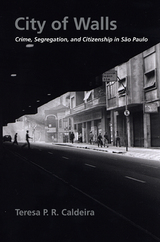
City of Walls by Teresa Caldeira
I have only been here a few days, but some things are already pretty clear. Brazil does not (yet) seem to be as obsessed by surveillance as the UK, but there is a noticeable concern with physical security. The Brazilian urbanist, Teresa Caldeira, called Sao Paulo the ¨City of Walls¨ in her excellent book of the same name, and whilst Curitiba may not be as divided as its bigger northern neighbour, the pervasiveness of defensive urban architecture is clear. Even fairly ordinary suburban houses have high walls, fences and gates, and some boast razor wire or even electric fences on top. Shopping malls and banks have large numbers of private security guards who are not just hanging around doing nothing as they do in the UK, but seem alert and active. When I went to change some traveller´s cheques, the agency could only be accessed one person at a time, via two locked doors with intercoms and an intervening antechamber with a metal detector.
What is the source of the fear? Of course it is the poor, and in particular the favelados (the people who live in the favelas, the informal settlements that line the riverbanks). Even though in Curitiba, there are not so many favelas and they are not so extensive as in the larger cities of Brazil, the favelas are still no-go areas for non-favelados and I have been warned not even to think about entering. Of course I will be later in Rio, but I will have local help (I hope). Whether one thinks that these are people driven to desperation and crime, or as one contact here said, it is because the drug-runners chose to live amongst the favelados because the police will not follow them there, the division between the favelados and the rest of society is obvious. It is also blatantly racial. The favelados are generally darker, although in Curitiba, which is generally a more European and less African part of Brazil, there are also a significant number of favelados of eastern European descent, the families of immigrants who came to work in construction and were later left without work.
The engineering faculty of the Pontifical Catholic University of Parana, home to the Postgraduate School of Urban Management, where I am based for now, is right up against one of the favelas of Curitiba. The large windows at the back have had to have concrete shields fixed across them as some young guys from the favela had started to enjoy testing their guns out on the panes. There are still a few bullet holes visible in the walls! But don’t let me give you the impression that this is a war zone, or that everyone is paranoid and afraid of each other. It doesn’t seem that way either, and I don’t feel any less safe than I did in Washington DC in the early 90s…








 ubisurv