SSN 2014 Barcelona

SURVEILLANCE: AMBIGUITIES AND ASYMMETRIES

HOSTED BY THE UNIVERSITY OF BARCELONA AND SUPPORTED BY THE SURVEILLANCE STUDIES NETWORK

Thursday 24th – Saturday 26th April 2014

Contemporary surveillance is characterised by ambiguities and asymmetries. Surveillance results from different desires and rationales: control, governance, security, profit, efficiency but also care, empowerment, resistance and play.

Furthermore it can have both positive and negative outcomes for individuals and these may lead to intended or unintended consequences. Surveillance is never neutral. Surveillance is always about power and that power is increasingly asymmetric. Surveillance practices are also changing and as ‘smart’ surveillance systems proliferate utilising and generating ‘Big Data’ new forms of ambiguity and asymmetry arise. In this context the conference wishes to explore the key themes.

Check our registration guidelines and fees.

Please contact the conference organisers with any questions: ssn2014barcelona@surveillance-studies.net

Surveillance Studies Summer Seminar – deadline approaches!

Surveillance Studies Summer Seminar
Kingston, Ontario, Canada
16 – 21 May 2011
Application deadline: 11 February 2011
APPLY NOW

The Surveillance Studies Summer Seminar provides an intensive, multi-disciplinary learning experience that addresses key issues of surveillance studies in ways that enhance the participants’ own research projects, as well as providing a unique national and international networking opportunity.

“International and cross-cultural diversity of the participants is one of the strengths of the seminar. Because surveillance studies are related to social justice, equality, and power, it is crucial to have the perspectives from the world of non-English speaking people.” –2007 SSSS participant

“Quality of faculty and attendees was excellent; social events well planned and spaced; location and setting excellent; well-planned and organized throughout.” –2007 SSSS participant

CORE FACULTY:
David Lyon, FRSC, Professor and Queen’s Research Chair, Department of Sociology, and Director of the Surveillance Studies Centre, Queen’s University, Canada

Valerie Steeves, Associate Professor of Criminology, University of Ottawa, Canada

David Murakami Wood, Canada Research Chair (Tier II) in Surveillance Studies and Associate Professor, Department of Sociology, Queen’s University

THE PROGRAMME:

The core of the seminar is group work, each facilitated by a member of seminar faculty. Groups will grapple with key issues in surveillance studies, including issues such as “The researcher as surveillance agent,” “Gaining entry into surveillance sites,” “Making international comparisons,” “Connecting social science with policy and legal fields” and so on. Participants are encouraged to comment, in their statement of interest, on what areas are of particular interest. The rest of the programme is devoted to theoretical, methodological and professional issues, and to open interaction with established scholars in the field. The idea is to “go behind” conference and book performances to discover how and why surveillance researchers do what they do.

There will be no assessed tasks and no credit for enrolling in the seminar, although a letter confirming your completion of the seminar will be provided.

FEES AND SUBSIDIES:

The fee for the 2011 SSSS is $700 CAD. Applicants should pursue funding opportunities before submitting their application.
The Surveillance Studies Centre (SCC) will award up to three Summer Seminar tuition subsidies to non-Queen’s graduate student registrants who can demonstrate financial need. Click here for more information.
The Surveillance Studies Network Global Scholar Award (SSN) will award up to three bursaries of £500 (500 GBP) each to SSSS participants from less developed or developing countries who are in need of financial assistance. Click here for more information.
The deadline to apply for both subsidies is 11 FEBRUARY 2011.


Joan Sharpe
Project Administrator
Surveillance Studies Centre
c/o Dept of Sociology
Queen’s University
Kingston, ON K7L 3N6
Canada
(613) 533-6000, ext. 78867
(613) 533-6499 FAX

Twitter @sscqueens
http://www.sscqueens.org
http://www.newtransparency.org

Surveillance Studies Summer Seminar 2011

If you’re a PhD student (or thereabouts) studying surveillance, you might be interested in the Surveillance Studies Summer Seminar that we run out of the Surveillance Studies Centre here at Queen’s every two years.

The SSSS is “an intensive, multi-disciplinary learning experience that addresses key issues of surveillance studies in ways that enhance the participants’ own research projects, as well as providing a unique national and international networking opportunity”.

The next one will be in from 16 – 21 May 2011, here in Kingston, Ontario, Canada. The tutors will be Professer David Lyon, Professor Val Steeves, and myself. If you want to come, you need to get your application in by 11 February 2011. There are even some funding sources available both internally from the SSC and externally from the Surveillance Studies Network, for those in financial need. More details here

Cyber-Surveillance in Everyday Life: Call for Participation

Call For Participation: Cyber-Surveillance in Everyday Life

Digitally mediated surveillance (DMS) is an increasingly prevalent, but still largely invisible, aspect of daily life. As we work, play and negotiate public and private spaces, on-line and off, we produce a growing stream of personal digital data of interest to unseen others. CCTV cameras hosted by private and public actors survey and record our movements in public space, as well as in the workplace. Corporate interests track our behaviour as we navigate both social and transactional cyberspaces, data mining our digital doubles and packaging users as commodities for sale to the highest bidder. Governments continue to collect personal information on-line with unclear guidelines for retention and use, while law enforcement increasingly use internet technology to monitor not only criminals but activists and political dissidents as well, with worrisome implications for democracy.

This international workshop brings together researchers, advocates, activists and artists working on the many aspects of cyber-surveillance, particularly as it pervades and mediates social life. This workshop will appeal to those interested in the surveillance aspects of topics such as the following, especially as they raise broader themes and issues that characterize the cyber-surveillance terrain more widely:

  • social networking (practices & platforms)
  • search engines
  • behavioural advertising/targeted marketing
  • monitoring and analysis techniques (facial recognition, RFID, video analytics, data mining)
  • Internet surveillance (deep packet inspection, backbone intercepts)
  • resistance (actors, practices, technologies)

A central concern is to better understand DMS practices, making them more publicly visible and democratically accountable. To do so, we must comprehend what constitutes DMS, delineating parameters for research and analysis. We must further explore the way citizens and consumers experience, engage with and respond to digitally mediated surveillance. Finally, we must develop alliances, responses and counterstrategies to deal with the ongoing creep of digitally mediated surveillance in everyday life.

The workshop adopts a novel structure, mainly comprising a series of themed panels organized to address compelling questions arising around digitally mediated surveillance that cut across the topics listed above. Some illustrative examples:

  1. We regularly hear about ‘cyber-surveillance’, ‘cyber-security’, and ‘cyber-threats’. What constitutes cyber-surveillance, and what are the empirical and theoretical difficulties in establishing a practical understanding of cyber-surveillance? Is the enterprise of developing a definition useful, or condemned to analytic confusion?
  2. What are the motives and strategies of key DMS actors (e.g. surveillance equipment/systems/ strategy/”solutions” providers; police/law enforcement/security agencies; data aggregation brokers; digital infrastructure providers); oversight/regulatory/data protection agencies; civil society organizations, and user/citizens?
  3. What are the relationships among key DMS actors (e.g. between social networking site providers)? Between marketers (e.g. Facebook and DoubleClick)? Between digital infrastructure providers and law enforcement (e.g. lawful access)?
  4. What business models are enterprises pursuing that promote DMS in a variety of areas, including social networking, location tracking, ID’d transactions etc. What can we expect of DMS in the coming years? What new risks and opportunities are likely?
  5. What do people know about the DMS practices and risks they are exposed to in everyday life? What are people’s attitudes to these practices and risks?
  6. What are the politics of DMS; who is active? What are their primary interests, what are the possible lines of contention and prospective alliances? What are the promising intervention points and alliances that can promote a more democratically accountable surveillance?
  7. What is the relationship between DMS and privacy? Are privacy policies legitimating DMS? Is a re-evaluation of traditional information privacy principles required in light of new and emergent online practices, such as social networking and others?
  8. Do deep packet inspection and other surveillance techniques and practices of internet service providers (ISP) threaten personal privacy?
  9. How do new technical configurations promote surveillance and challenge privacy? For example, do cloud computing applications pose a greater threat to personal privacy than the client/server model? How do mobile devices and geo-location promote surveillance of individuals?
  10. How do the multiple jurisdictions of internet data storage and exchange affect the application of national/international data protection laws?
  11. What is the role of advocacy/activist movements in challenging cyber-surveillance?

In conjunction with the workshop there will be a combination of public events on the theme of cyber-surveillance in everyday life:

  • poster session, for presenting and discussing provocative ideas and works in progress
  • public lecture or debate
  • art exhibition/installation(s)

We invite 500 word abstracts of research papers, position statements, short presentations, works in progress, posters, demonstrations, installations. Each abstract should:

  • address explicitly one or more “burning questions” related to digitally-mediated surveillance in everyday life, such as those mentioned above.
  • indicate the form of intended contribution (i.e. research paper, position statement, short presentation, work in progress, poster, demonstration, installation)

The workshop will consist of about 40 participants, at least half of whom will be presenters listed on the published program. Funds will be available to support the participation of representatives of civil society organizations.

Accepted research paper authors will be invited to submit a full paper (~6000 words) for presentation and discussion in a multi-party panel session. All accepted submissions will be posted publicly. A selection of papers will be invited for revision and academic publication in a special issue of an open-access, refereed journal such as Surveillance and Society.

In order to facilitate a more holistic conversation, one that reaches beyond academia, we also invite critical position statements, short presentations, works-in-progress, interactive demonstrations, and artistic interpretations of the meaning and import of cyber-surveillance in everyday life. These will be included in the panel sessions or grouped by theme in concurrent ‘birds-of-a-feather’ sessions designed to tease out, more interactively and informally, emergent questions, problems, ideas and future directions. This BoF track is meant to be flexible and contemporary, welcoming a variety of genres.

Instructions for making submissions will be available on the workshop website by Sept 1.

See also an accompanying Call for Annotated Bibliographies, aimed at providing background materials useful to workshop participants as well as more widely.

Timeline:

2010:

Oct. 1: Abstracts (500 words) for research papers, position statements, and other ‘birds-of-a-feather’ submissions

Nov. 15: Notification to authors of accepted research papers, position statements, etc. Abstracts posted to web.

2011:

Feb. 1: Abstracts (500 words) for posters

Mar. 1: Notification to authors of accepted posters.

Apr. 1: Full research papers (5-6000 words) due, and posted to web.

May 12-15 Workshop

Sponsored by: The New Transparency – Surveillance and Social Sorting.

International Program Committee: Jeffrey Chester (Center for Digital Democracy), Roger Clarke (Australian Privacy Foundation), Gus Hosein (Privacy International, London School of Economics), Helen Nissenbaum (New York University),
Charles Raab (University of Edinburgh) and Priscilla Regan (George Mason University)

Organizing Committee: Colin Bennett, Andrew Clement, Kate Milberry & Chris Parsons.

University of Toronto & University of Victoria.

2nd Surveillance in Latin America Symposium

Following the success of the first Surveillance Studies symposium in Brazil last year, here is the call for the next one, this time in Mexico next year.
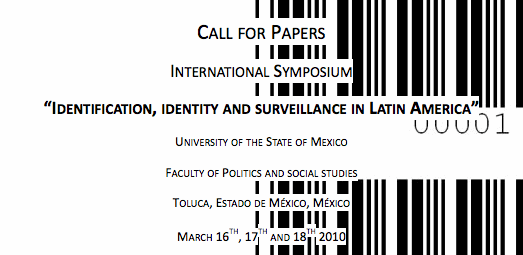
SIMPOSIO MEXICO

Introduction

In modern societies, identification systems have been used as an important mechanism to govern, manage, classify and control populations; in other words, to surveil them. This has meant the employment of certain technologies (passports, national identity letters, RFID, among others), providing interconnected data base systems with information according to specific institutional protocols. In this way, we define identification as visibility and verification of specific details of people’s lives. Likewise, these identification systems have responded to various functions: security, migration control, goods and service administration, as well for territory, space and group access.

The historical, social and politic contexts shape the particular purposes to which each identification system responds. Large-scale surveillance systems to identify the population have been installed in Latin America after decades of colonial, military and single-party governments In addition they have been prompted by increasing multiculturalism in cities, Population growth, migration rates, the perceived rise in terrorism, public security and health risks, as well as the creation of public policies (to aid poverty and unemployment) and globalization.

These conditions have caused the harmonization and articulation of corporations, institutions, technologies and specific protocols for citizen identification in Latin American countries, , depending on each country or region’s particular situation, and its relationship with other regions worldwide. Nevertheless, the Latin American environment allows us to consider the construction of privacy, identities, forms of government and the possibility of resistance policies.

Paper Proposals

In line with this analytic framework, the University of the State of Mexico, Faculty of Politics and Social Studies, hereby invites scholars, analysts and activists in Latin America and worldwide, interested in identification and surveillance, in relation to such matters as cultural or ethnic identities, privacy and data protection, new identification technologies (biometrics, RFID, etc), public policies, security, communication, ethics, law, or modes of critique or resistance; to participate in the International Symposium “Identification, identity and surveillance in Latin America”, by sending a lecture proposal.

Please send an abstract, 300-500 words long, Arial 12, space line 1.5, to the following e-mail: surveillance.studies.mexico@gmail.com, before October 30th 2009. Due to the nature of this event, the abstracts and papers are to be accepted in Spanish, Portuguese and English.

Note: There is no registration fee for this event. All participants are expected to seek their own funding for travel and accommodation. A number of rooms will be reserved with reasonable rates in a nearby hotel. More details to follow.

Main subjects

1. Governmental and corporative policies of identification

2. New technologies for identification and surveillance.

3. Purposes of identification systems in Latin America.

4. Communication and information technologies.

5. Privacy and transparency.

6. Identification, identities and subjectivities.

7. Relationship between global and local, in identification systems.

8. Postcolonial logics and political regimes.

9. Identities, surveillance and resistance.

10. Identification, identity and surveillance in Latin America: new theories?

Important Dates

Call for Papers Publication: July 30th 2009.

Abstract reception deadline: October 30th 2009.

Accepted lectures list publication: December 15th 2010.

Complete paper remittance deadline: February 15th 2010.

Complete program publication: February 28th 2010.

Second Symposium on surveillance in Latin America: March 16th, 17th y 18th 2010. University of the State of Mexico, Faculty of Politics and Social Studies. Toluca, México.

Organizing Committee

Nelson Arteaga Botello

Roberto J. Fuentes Rionda

Faculty of Politics and Social Studies, University of the State of Mexico

Rodrigo Firmito

Postgraduate Program in Urban Management, Pontifical Catholic University of Parana, Curitiba, Brazil

Fernanda Bruno

Postgraduate School of Communication, Federal University of Río de Janeiro, Brasil

Marta Kanashiro

Further Studies Laboratory of Journalism and Knowledge, Technology and Market Group, University of the State of Campinas (UNICAMP), Campinas, Brasil.

Danilo Doneda

De Campos Faculty of Law, Rio de Janeiro, Brasil

André Lemos

Federal University of Bahia, Brasil

With the support of:

David Lyon

David Murakami Wood

Department of Sociology, Queen’s University, Kingston, Ontario, Canada

Proposal reception, Information and Contact

surveillance.studies.mexico@gmail.com

Hille Koskela’s new book

pelkoTop Finnish surveillance studies academic, Hille Koskela, has a new book out, Pelkokierre – pelon politiikka, turvamarkkinat ja kamppailu kaupunkitilasta (‘The Spiral of Fear. Politics of Fear, Security Business, and the Struggle over Urban Space’). It looks like a fine addition to the literature on fear, security and surveillance, but unfortunately I can’t read it – as it’s in Suomi. Great cover though!

It should of course be translated into English and made available by an English-language publisher, but I doubt this will happen. Publishers don’t like to take what they consider to be a risk by publishing academic work from foreign countries, so unless the author is very famous or dead (or preferably both) it doesn’t happen. We tried very hard to get Michalis Lianos’s very important French book on control society published by an English-language publisher, with many supporting letters and so on, but there was no real interest.

Anyway, Hille has sent me a translation of the table of contents, which are:

1. The paradoxes of security

2. Birth of the security society
Relevant theories in sociology, social policy, geography, architecture, media studies, law and IR

3. The ontology of fear
The social production of fear, the spatial and temporal patterns, fear  as a commodity, streetwise semiotics

4. Fear in everyday life
Housing, workplaces, SUVs, public transport, tourism, child rearing,  ‘threatening’ teenagers, high school massacres

5. The architecture of fear
The classic ideas of Jacobs and Newman, contemporary architecture in public and private spaces, gating, surveillance

6. The politics of fear
Legislation (the public order act etc.), national and local security strategies, urban security politics, ‘the war’ on graffiti

7. The economy of fear
Security services, technology and other security products, images of place, crime and fear in the media

8. Towards a culture of tolerance

Japanese surveillance studies researchers

Somebody's watching you... office workers walk past an installation in Shinjuku station, Tokyo

We’ve met with several Japanese surveillance studies researchers whilst out here this time. I mentioned Ogura Toshimaru already the other day, but we also had a long meeting the week before with Hino Kimihiro, a researcher into bohan machizukuri (community security development), and government advisor on security planning. Dr Hino has been carrying out a number of research projects on both ‘designing out crime’ and on the effectiveness and public acceptability of CCTV in Japan. I hadn’t come across this research before as my contacts here were mainly in social sciences and law and Dr Hino tends to publish in urban planning journals and is not connected to other Japanese surveillance researchers. His work is very interesting and reminiscent of that of Martin Gill or Farrington and Welsh in the UK. It is a shame, that just like those researchers who have carried out analyses of CCTV for the UK Home Office, his assessments tend to be ignored by the government. Dr Hino’s latest project is to assess the trials of a new movement recognition system in Kawasaki city. I hope he can come to the January Camera Surveillance workshop at Queen’s University, Ontario, or the April Surveillance & Society conference in London (details coming soon!).

I also met today with Tajima Yasuhiko, a professor of media law in the School of Journalism at Jochi (Sophia) University in Tokyo. Professor Tajima has been one of the most important critical voices in the debate about surveillance in Japan, and has bridged the academic and activist world, being involved with legal action against juki-net and Google StreetView. We had a productive conversation about the politics of surveillance in Japan and the prospects for critical voices to be heard. He wasn’t optimistic that they would be, and neither am I after our meeting at the Prime Minister’s IT Strategic JQ the other day, however I am also convinved that in many ways Japan has not yet gown as coordinated and centralised a route on issues of security and surveillance as has the UK. There is, so far as I can see, no real attempt to link up things like juki-net or other databases and the anshin anzen (or bohan) machizukuri agenda, and i-Japan, national and local police, and wider community security agendas do not really coordinate at all. This is due to the lack of an obvious ‘threat’ like that of terrorism in the UK, around which such coordination can occur. The government half-heartedly tries to get people worried about North Korea, but really they aren’t, and ‘ageing society’, whilst a phrase used to justify almost anything (including central databases) is a worry, it does not generate the fear that comes with the war on terror.

We also considered the relative weakness of Japanese civil liberties organisations and the failure of the mainstream media to pick up on issues of privacy and surveillance. There seems to be some effort now to try to coordinate various organisations to push for an explicit constitutional protection for privacy (rather than the rather vague inclusion of such an idea in a wider notion of the ‘pursuit of happiness’), but whilst I can see that being happily accepted after the government has got its central database(s), I can’t see it being done in time to alter either this trajectory or the way in which the database(s) are built.

I’ve been promoted

It’s official, I’ve been promoted to ‘Reader in Surveillance Studies’ (equivalent to Associate Professor) at Newcastle. Unfortunately I’m leaving very soon, but it was nice to get the recognition of the university, even if I can only hold the title for just one month!

I would just like to say a public thank-you to those who both supported and refereed the application – officially, I don’t know who you all are, but I have my suspicions! And also a big thanks to everyone involved with Surveillance & Society and the Surveillance Studies Network because, to be honest, I would be nowhere without all of you.

The Expansion of Surveillance Studies

I’ve been away in Scotland at a special seminar organised by Mike Nellis, Kirstie Ball and Richard Jones, hence the lack of posts this week. It has been based in the Institute of Advanced Studies at Strathclyde, a place set up to encourage ‘unconstrained thinking’, but to aid this still further, two of the days were on the island of Jura where wireless is still something you listen to. The other people involved were Michael Nagenbourg from Germany, who is also involved with an ongoing project on human implantation with myself and Kirstie, Anders Albrechtslund from Denmark, Mark Renzema from the USA, Francisco Klauser from Switzerland (via Durham!), Kevin Haggerty from Canada and David Wills from England, whose PhD I examined not so long ago. Charles Raab also joined us for the days in Glasgow, although he didn’t come to Jura, and we had a talk from Jim Frazer, a DNA expert.

We were on Jura because it was the place where George Orwell wrote Nineteen Eighty-Four during 1946 and 1947, whilst he was also dying of tuberculosis. We couldn’t visit his cottage (it is a long way beyond the end of the main road), but we spent two days in the company of Ken McLeod, one of my favourite contemporary science fiction writers, whose most recent books, The Execution Channel and The Night Sessions feature surveillance as a key element of both world and plot. The aim seems to have been to rethink everything we thought we knew about surveillance through both traditional seminar session but also through the consideration of scenarios and of course, sf writing, films and even computer games.

And I have to say it has worked. I am not quite sure what conclusions I have come to but I have been shaken out of a kind of complacency that affects us all about what we just ‘do’ and what we take for granted in order to enable this. For me, this has been particularly important because my current project is specifically designed to rethink and shake up ideas around ‘surveillance’ and ‘surveillance society’, but perhaps I have not been radical enough. The tendency of surveillance studies to make ‘imperial moves’ as it grows and inevitably institutionalises to a certain extent (however open access and open source and friendly we try to keep it), is something about which I should be more concerned. In some ways, I have been one of the surveillance studies academics most keen to expand what surveillance studies is and not to limit it to being a subset of sociology. Indeed I criticised Sean Hier and Josh Greenberg’s Surveillance Studies Reader on these grounds in the relaunch issue of Surveillance & Society earlier this year, however I think I was probably somewhat unfair to do so, and what seemed obvious to me about the field may not actually be as unarguable as I had proposed. Of course not everything is surveillance as seems to be the unfortunate starting point of some of the less good stuff in the field, but surveillance studies may not even, as David Lyon has claimed, be able to add something to everything and further, for the sake of academic social relations, maybe it should not…

Surveillance and Resistance

A great new issue of Surveillance & Society is out now on surveillance and resistance, guest edited by Laura Huey and Luis A. Fernandez.

Featuring great new articles…

  • David Bell – Surveillance is Sexy
  • Aaron K. Martin, Rosamunde E. van Brakel and Daniel J. Bernhard – Understanding resistance to digital surveillance: Towards a multi-disciplinary, multi-actor framework
  • Lucas D. Introna and Amy Gibbons Networks and Resistance: Investigating online advocacy networks as a modality for resisting state surveillance
  • Helen Wells and David Wills Individualism and Identity Resistance to Speed Cameras in the UK
  • Andrés Sanchez – Facebook Feeding Frenzy: Resistance-through-Distance and Resistance-through-Persistence in the Societied Network

With a special Review section on the UK House of Lords Constitution Committee Report, Surveillance, Citizens and the State, with responses by Oscar H. Gandy Jr. , N. Katherine Hayles, Katja Franko Aas and Mark Andrejevic

Opinion from Gary T Marx , and a poem from Rez Noir

…and lots of book reviews!