Pigs subvert surveillance

It is not just human beings who are subjects of surveillance. Animals are increasingly under surveillance too, indeed there are techniques of surveillance and tracking used on animals that are designed to achieve levels of control that (for the most part) would not be tolerated for human beings. Animals are tagged, filmed, implanted, tracked, and even used and adapted for surveillance (see Amber Marks’s book, Headspace, for example) for all kinds of reasons from the economic to the environmental. However, this great story from a BBC kids’ news program demonstrates that some animals can ‘fight back’ in ways that are inventive and heartening.

Many farms now limit the food consumption of individual pigs through the use of electronic Radio-frequency Identification (RFID) collars and gates: once the pig has gone through the gate, the collar communicates with a computerised food distribution system which will provide the pig with what is deemed ‘enough’ for the pig. When the pig has eaten and left the feed stall, it cannot get back in for more because the system knows which collar has already been through the gate.

However, apparently pigs in several locations have independently learnt how to get round this surveillance system. Some pigs hate the collars so much that they rip them off. These pigs then don’t get to eat of course, but other pigs have learnt that if they pick up the collars they can go through the gate a second time – and they have even taught other pigs how to this…

Never mind ‘Big Brother’ and Nineteen Eighty-Four, it’s another Orwell phrase (from Animal Farm) that comes to mind here: “Four legs good, two legs bad”…!

(Thanks to Aaron Martin for this)

Manchester Airport trials virtual strip-search system

Rapiscan image (BBC)

You would think after 4 years of trials at Heathrow, that British airports would now be able to work out whether or not they could and more importantly, should, use the various varieties of body scanners that are now available. However Manchester Airport is holding another trial starting from now at its Terminal 2. At least it will give a chance for the public to say what they think. The scans are remote – i.e.: the officer observing the images is not on the airport floor, which prevents the kind of scenario we mentioned in our Report on the Surveillance Society of lewd remarks directed at passengers. Personally, I am rather less concerned about this rather abstract view of my body being seen briefly as I pass through an airport than I am about my financial details and personal life being traded between private companies, or about being under constant video surveillance in ordinary public space in the city. However, the images, although ghostly, are detailed enough that genitals, deformities, medical implants and so on can be seen, and if this story is to be believed it would seem that there is no provision for women’s images to be seen by a women alone and men’s only by a man. This will make it entirely unacceptable to some people, in particular members of certain religious groups. But the scans are – at least, for now – voluntary, in that passengers can refuse and have a traditional pat-down search instead.

However, this technology won’t be staying in the airports for long. I reported back in July on stories that terahertz wave scanning could soon be made to fit into portable cameras. That raises a whole different set of social, political and ethical questions…

(Thanks to Simon Reilly for sending me the link)

New York City expanding surveillance infrastructure

The New York Times reports that $24M US has been assigned from the Department of Homeland Security to expand the city’s CCTV camera system from downtown to midtown Manhattan (the area between 30th and 60th Streets). This of course is justified by Mayor Bloomberg on the grounds of security, with a large number of iconic buildings in the midtown area. However, it bears repeating that firstly, the 9/11 attacks did not come from the streets, and secondly, London already had a comprehensive CCTV system at the time of the 7/7 attacks and whilst they provided lots of pictures for the news media afterwards, they did not in any way prevent the attacks, and it is difficult to see how such a system could prevent any determined attacker. It may make people feel safer, at least temporarily, however even at that symbolic level, there’s likely to be as many people who feel uneasy about the idea of constant monitoring or the loss of privacy (although from my experience of the UK, the actual monitoring is far from constant or comprehensive, and most people also get used to that too). But, whatever the people of New York do feel – and there will many different reactions – they shouldn’t get the impression that they are getting actual ‘security’ (whatever that is) here. This isn’t a message many people like to hear, it seems, least of all those in government…

Call for Papers: 4th Surveillance & Society Conference, 2010

A GLOBAL SURVEILLANCE SOCIETY?

THE FOURTH BIANNUAL SURVEILLANCE & SOCIETY CONFERENCE

Supported by the LIVING IN SURVEILLANCE SOCIETIES (LISS) COST Action, and the SURVEILLANCE STUDIES NETWORK

City University London, UK

April 13 – 15, 2010

CALL FOR PAPERS

OVERVIEW

Surveillance has become a ubiquitous feature of living in the global north, with citizens routinely monitored by a range of sophisticated technologies. Increasing levels of surveillance are typically justified and legitimated by threats of terrorism, fear of crime and disorder, as info/entertainment tools for the curious and through discourses emphasizing public and private service improvement. In spite of this, little is known about the effect of surveillance on individuals, society, the democratic polity, nation states in the developed and developing world, and the evolving nature of humanity.

THEMES

This conference calls for papers which examine the many facets of surveillance and globality. In particular, we welcome papers which address:

  • Living in the surveillance age
  • Surveillance, difference and discrimination
  • Attitudes and experiences of the watcher and watched
  • The development and diffusion of surveillance technologies
  • Surveillance technology in practice
  • The political economy of surveillance
  • The business of surveillance
  • The surveillance of consumers and workers
  • Public policy, regulation and surveillance
  • The philosophy of surveillance and philosophical perspectives on surveillance
  • Surveillance, intelligence and war
  • Surveillance, sovereignty and the nation state
  • Surveillance and the production of space

FEES AND GENERAL INFORMATION

This is a non-residential conference and participants will need to make their own arrangements for accommodation (we will provide advice for this in due course). The Conference will be held in and around the Oliver Thompson Lecture Theatre and Foyer, City University London, UK. London is a powerful, global city at the sharp end of surveillance processes, protocols and debates and thus provides delegates with an apt cultural context for the exploration of the above themes.

The conference web site will be up and running from early October 2009 providing full details of the emerging conference programme (i.e. schedule, plenary speakers etc.), maps, accommodation advice, evening dinner information, payment details and an electronic registration form.

The Conference Fee is £200 per person, which includes attendance, refreshments, lunch and an optional £25 two year membership of the Surveillance Studies Network. The membership fee will be used to promote the charitable activities of the Surveillance Studies Network, support the continued publication of the Journal of Surveillance and Society and give other benefits to members.

There will be a formal conference dinner on the evening of April 14th at an additional charge of £50.

SUBMISSION OF ABSTRACTS AND NOTIFICATION OF ATTENDANCE

If you wish to present a paper, please submit your 300-word abstract and an accompanying set of three keywords to Lisa, the conference administrator, by November 7th 2009 (email: surveillance_conference@live.co.uk) and please also include the following information so that we can contact you:

• Name

• Country of residence

• Institutional affiliation

• Institutional address

• Telephone number

• Email address

• 300-word abstract and list of three keywords

If you are thinking of attending but do not wish to give a paper, please send us the above information clearly stating that you do not wish to present a paper.

There will be two special issues of Surveillance and Society following this conference. The issues will be spaced to allow time for papers in different states of completion at the conference itself, to be submitted – please see the ‘Event Timetable’ section below. When you submit your abstract, please specify whether you intend to submit your paper to one of these issues.

POSTGRADUATE INFO

We are hoping to offer ten reduced fee places for postgraduate students wishing to give a paper or present a poster display of their research. If you wish to apply for this, please register our interest as soon a possible and send a 300 word abstract to Lisa (or indicate that you wish to present a poster), the conference administrator by 7th November 2009 (email: surveillance_conference@live.co.uk). Allocation of these strictly limited places will be based on the quality of the abstract/research description submitted and not on a first-come-first-served basis.

If you wish to attend, but do not wish to deliver a paper, please indicate this by the November 7th 2009.

EVENT TIMETABLE

2009

September 3rd – Statement of intent issued

September 28th – Full call for papers issued

October 7th – Website goes live

November 7th – Deadline for the submission of abstracts

November 23rd – Second Call issued – with list of key speakers. Electronic booking form available and formal registration and payment begins

December 18th – Final deadline for the submission of abstracts

2010

March 15th – Deadline for the electronic submission of full papers

March 15th – Final deadline for registration and payment for all conference attendees without late booking surcharge

March 24th – Papers published on Web available to all registered conference delegates

April 13th – 15th – Conference

June 30th – Deadline for submission to Surveillance and Society Conference Special Issue 1

Sept 30th – Deadline for submission to Surveillance and Society Conference Special Issue 2

Dec – Publication of Surveillance and Society Conference Special Issue 1

2011

Feb/March 2011 – Publication of Surveillance and Society Conference Special Issue 2

Please register your interest NOW!

We look forward to hearing from you.

Thanks,

Dr Gavin Smith

Professor Clive Norris

Dr Kirstie Ball

Dr David Murakami Wood

Dr Will Webster

Gordon Brown stalls on UK ID cards issue

Despite the news stories saying that he had made a significant announcement on ID cards, the British Prime Minister, Gordon Brown, said absolutely nothing new interesting on the subject in his speech on future Labour policy yesterday. As Henry Porter comments on The Guardian website, whilst his announcement that ID cards would not be compulsory in the (increasingly unlikely) event of another Labour term was greeted with enthusiasm by the party faithful, this is not any kind of change in policy and nothing concrete was said about the National Identity Register (i.e.: the database, the important bit!). While the Conservative Party may be limited and rather disingenuous in their apparent opposition to the ‘surveillance state’, Labour appears to be merely self-congratulatory and complacent.

Hoist by their own petard…

I always enjoy stories where those who advocate surveillance and say things like ‘nothing to hide, nothing to fear’ are then caught by surveillance (see for example, this story). In the first place, it shows how bogus and hypocritical that insidious argument is, but in the second place, it can be just really funny. So this week’s amusing surveillance story is provided by a local TV story posted on YouTube, which supposedly shows a team of Lakehead, Florida, cops who were supposed to be raiding the house of suspected drug-dealer, indulging in a nine-hour Nintendo Wii bowlathon… all caught on the householder’s home CCTV system – and now spreading virally all over the world. Ooops…

There are serious issues here though. Of course there is the whole question of 4th Ammendment violation (if you are in the USA), but more generally it raises the question of whether the use of surveillance can itself become a method of resistance to surveillance and of holding the state, private corporations, and indeed other citizens, to account, or whether a society of mutual and reciprocal surveillance (or a ‘transparent society’, as David Brin called it) is one in which we want to live. As surveillance becomes more and more ubiquitous, and in the absense of mass citizen movements to tear down the cameras, it sometimes seems like the only option we have left.

India plans ‘world class’ electronic surveillance for Commonwealth Games

The Times of India reports on the Indian government’s plans to implement comprehensive surveillance for the 2010 Commonwealth Games. One aim seems to be to create the kind of ‘island security’ with which we have become so familiar at these kinds of mega-events: vehicle check-points with automatic license-plate recording and recognition; x-ray machines and other scanners for vehicles (and perhaps people too). They will also massively expand CCTV systems and not just in the actual Games area, but throughout the city of Delhi.There are also, as usual plans to use more experimental surveillance and control techniques (as with the use of sub-lethal sonic weapons in Pittsburgh the other day), in this case a drone surveillance airship,” capable of taking and transmitting high-density visual images of the entire city.”

However, this is not just about the temporary security of the games. As with many other such mega-events, the Indian government appears to be planning to use the Delhi games as a kind of Trojan Horse for the rolling out of similar and more permanent measures in big cities across the country. The Times article claims that the Ministry of Home Affairs intends to expand the measures and “soon the same model is planned to be replicated across the country,” and in particular on use of airships, “similar airships would be launched in other big and vulnerable cities like Mumbai, Bangalore, Kolkata and Chennai.” And there will be an infrastructure too, apparently “the IB [Intelligence Bureau] is silently working to create a command center to monitor all-India intelligence and surveillance.”

Of course the threat of ‘terror groups’ is the justification, and there’s no doubt there is a threat to Indian cities from such groups, particularly those based in Pakistan. However, the Indian public shouldn’t assume that anything done in the name of ‘anti-terrorism’ will: 1. actually work (in the sense of preventing terrorism); or 2. be used for those purposes anyway. This same trend happened  in the UK during the early 1990s, when the threat of the Provisional IRA was the justification, and before most people in Britain had even noticed, a massive (and it seems ever-expanding) patchwork of CCTV camera systems had been created, which were joined by further repressive measures even before 9/11. And did this massive number of cameras stop London being attacked by terrorists? No, it didn’t.  7/7 still happened. But of course we had lots of good pictures after the event for the media… and they are very expensive and don’t even do much to stop regular crime, as a recent meta-study has shown. What would be more effective would be peace and co-operation with Pakistan, a move away from both chauvinistic Hindu and Muslim nationalisms and extremisms which only generate resentment and hatred, and old-fashioned targeted intelligence work on those very few people who are actually planning terrorism – not mass surveillance and the gradual erosion of civil liberties of the entire population based on state fears that some of them might be guilty.

Finally, this is about globalization. The whole way this is promoted by the Indian government is as if there is some international competition to install as much CCTV and security as possible. But the global spread of the surveillance standards and expectations of the rich western elite is a self-fulfilling logic that benefits only the massive global security-industrial complex.

Europe’s new security-industrial complex

neoconopticonThere is a superb and chilling new report out today that utterly demolishes the European Union’s claims to be in any way an  ethical or progressive leader on issues of security and surveillance. The report written by Ben Hayes for the Transantional Institute and Statewatch, documents in some detail the new vision for security in the EU, which the authors describe as a ‘neo-con-opticon.’ The report confirms a lot of things that have been concerning me about the direction and emphasis of EU security research and the increasingly unnacountable and behind closed-doors ways in which security policy is being developed. I asked back in January in an editorial in Surveillance & Society whether surveillance was becoming the new ‘baroque arsenal’, Mary Kaldor’s famous phrase to describe the huge, intricate and complex technocentric security structures of the second Cold War. This report answers that question with a resounding ‘yes’.

The press release quotes from the introduction:

“Despite the often benign intent behind collaborative European research into integrated land, air, maritime, space and cyber-surveillance systems, the EU’s security and R&D policy is coalescing around a high-tech blueprint for a new kind of security. It envisages a future world of red zones and green zones; external borders controlled by military force and internally by a sprawling network of physical and virtual security checkpoints; public spaces, micro-states and mega events policed by high-tech surveillance systems and rapid reaction forces; peacekeeping and crisis management missions that make no operational distinction between the suburbs of Basra or the Banlieue; and the increasing integration of defence and national security functions at home and abroad.

It is not just a case of sleepwalking into or waking up to a surveillance society, as the UK’s Information Commissioner famously warned, it feels more like turning a blind eye to the start of a new kind of arms race, one in which all the weapons are pointing inwards. Welcome to the NeoConOpticon.”

But don’t stop there. You can (well, you must) read the full report here: NeoConOpticon – The EU Security-Industrial Complex

And whilst you are at it, download Tony Bunyan’s equally superb report, The Shape of Things to Come – the EU Future Group, on the EU’s thoroughly undemocratic attempt to bypass public debate and hand internal security and surveillance policy over to the transnational security companies and the police and intelligence services.

(thanks to Rosamunde van Brakel for passing this on)

2nd Surveillance in Latin America Symposium

Following the success of the first Surveillance Studies symposium in Brazil last year, here is the call for the next one, this time in Mexico next year.
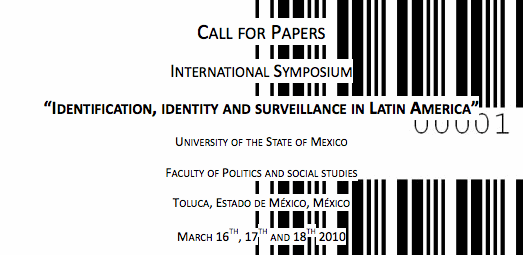
SIMPOSIO MEXICO

Introduction

In modern societies, identification systems have been used as an important mechanism to govern, manage, classify and control populations; in other words, to surveil them. This has meant the employment of certain technologies (passports, national identity letters, RFID, among others), providing interconnected data base systems with information according to specific institutional protocols. In this way, we define identification as visibility and verification of specific details of people’s lives. Likewise, these identification systems have responded to various functions: security, migration control, goods and service administration, as well for territory, space and group access.

The historical, social and politic contexts shape the particular purposes to which each identification system responds. Large-scale surveillance systems to identify the population have been installed in Latin America after decades of colonial, military and single-party governments In addition they have been prompted by increasing multiculturalism in cities, Population growth, migration rates, the perceived rise in terrorism, public security and health risks, as well as the creation of public policies (to aid poverty and unemployment) and globalization.

These conditions have caused the harmonization and articulation of corporations, institutions, technologies and specific protocols for citizen identification in Latin American countries, , depending on each country or region’s particular situation, and its relationship with other regions worldwide. Nevertheless, the Latin American environment allows us to consider the construction of privacy, identities, forms of government and the possibility of resistance policies.

Paper Proposals

In line with this analytic framework, the University of the State of Mexico, Faculty of Politics and Social Studies, hereby invites scholars, analysts and activists in Latin America and worldwide, interested in identification and surveillance, in relation to such matters as cultural or ethnic identities, privacy and data protection, new identification technologies (biometrics, RFID, etc), public policies, security, communication, ethics, law, or modes of critique or resistance; to participate in the International Symposium “Identification, identity and surveillance in Latin America”, by sending a lecture proposal.

Please send an abstract, 300-500 words long, Arial 12, space line 1.5, to the following e-mail: surveillance.studies.mexico@gmail.com, before October 30th 2009. Due to the nature of this event, the abstracts and papers are to be accepted in Spanish, Portuguese and English.

Note: There is no registration fee for this event. All participants are expected to seek their own funding for travel and accommodation. A number of rooms will be reserved with reasonable rates in a nearby hotel. More details to follow.

Main subjects

1. Governmental and corporative policies of identification

2. New technologies for identification and surveillance.

3. Purposes of identification systems in Latin America.

4. Communication and information technologies.

5. Privacy and transparency.

6. Identification, identities and subjectivities.

7. Relationship between global and local, in identification systems.

8. Postcolonial logics and political regimes.

9. Identities, surveillance and resistance.

10. Identification, identity and surveillance in Latin America: new theories?

Important Dates

Call for Papers Publication: July 30th 2009.

Abstract reception deadline: October 30th 2009.

Accepted lectures list publication: December 15th 2010.

Complete paper remittance deadline: February 15th 2010.

Complete program publication: February 28th 2010.

Second Symposium on surveillance in Latin America: March 16th, 17th y 18th 2010. University of the State of Mexico, Faculty of Politics and Social Studies. Toluca, México.

Organizing Committee

Nelson Arteaga Botello

Roberto J. Fuentes Rionda

Faculty of Politics and Social Studies, University of the State of Mexico

Rodrigo Firmito

Postgraduate Program in Urban Management, Pontifical Catholic University of Parana, Curitiba, Brazil

Fernanda Bruno

Postgraduate School of Communication, Federal University of Río de Janeiro, Brasil

Marta Kanashiro

Further Studies Laboratory of Journalism and Knowledge, Technology and Market Group, University of the State of Campinas (UNICAMP), Campinas, Brasil.

Danilo Doneda

De Campos Faculty of Law, Rio de Janeiro, Brasil

André Lemos

Federal University of Bahia, Brasil

With the support of:

David Lyon

David Murakami Wood

Department of Sociology, Queen’s University, Kingston, Ontario, Canada

Proposal reception, Information and Contact

surveillance.studies.mexico@gmail.com

UK opposition plans to roll back ‘the surveillance state’

The Conservative Party Shadow Justice Minister, Dominic Grieve has launched a brief report outlining the opposition’s plans to introduce a new attitude to surveillance in the UK, and reverse many of the current Labour government’s policies. And it is mostly good, insofar as it goes. But, it is where it doesn’t go that is the problem.

The main measures include things we already knew, like a pledge to scrap the National Identity Register (NIR) and ID card scheme, and proposals to limit the proliferation of central databases and control the National DNA Database (NDNAD). However the Tories also want to abolish the Contact Point children’s database, restrict Local Government’s rights under the Regulation of Investigatory Powers Act (RIPA), strengthen the powers and functions of the Information Commissioner’s Office (ICO) and require mandatory Privacy Impact Assessment (PIA) for all new legislation or other state proposals.

So far so good – and these are all things I have proposed myself at various times – but there are also some very weak or pointless elements. First of all, the attitude to the private sector is predictably laissez-faire. Though the report includes a long list of the data losses that plagued the Labour government over the last few years, they fail to note how many of them involved private sector contractors or partners. And their only real mention of the private sector is to suggest that the ICO consults with industry on ‘guidelines’ and the possibility of introducing a ‘kitemark’ (a kind of stamp of approval). These are both pretty much worthless and tokenistic efforts. The Tories, as much as Labour, fail to appreciate that contemporary threats to privacy come as much from the private sector as the public. Unfortunately recognising and dealing with this would require a rather more robust attitude to private business than either of the UK’s two main parties are prepared to muster right now. This, I guess, is the reason why the Tories talk about ‘the surveillance state’ as opposed to ‘the surveillance society’ (the term used by ourselves and the ICO).

Secondly, there is no proposal to do anything to control or roll-back the most obvious and intrusive aspect of the UK’s surveillance society, the vast number of CCTV cameras and systems operated by everyone from the police down to housing associations and schools. In fact there is not a single mention of CCTV or public space surveillance in the report. Rather than missing an elephant in the room, this is more like failing to notice a whale in your bathtub…

Finally, there is the suggestion to introduce a right to privacy as part of a ‘British Bill of Rights’. Certainly what privacy means in British law needs to be clarified and strengthened, but actually this could be done through amending the existing Human Rights Act to make it better reflect the European Court’s already published views on the interpretation of Article 8 of the European Directive. Unfortunately, the Tories are stupidly ideologically opposed to doing anything to strengthen the HRA, and in fact their proposed ‘British Bill of Rights’ is a rag-bag collection of populist proposals that will instead replace the most progressive change to British law for some decades.

Finally, there is no mention of any changes to the pernicious Terrorism Act or Counter-Terrorism Act, that have further undermined the presumption of innocence and other longstanding foundations of British citizenship. There’s no mention of previous legislation that restricted traditional freedoms like the Criminal Justice and Public Order Act. In fact, there’s every reason to believe that the Conservative Party will be just as willing to clamp down on such freedoms in the name of the war on terror, or crime, or anti-social behaviour as the Labour Party, and no reason to suppose that they deal honestly with the underlying issues – which would mean, of course, telling people things that they don’t want to hear.

The full report can be found here.