UK opposition plans to roll back ‘the surveillance state’

The Conservative Party Shadow Justice Minister, Dominic Grieve has launched a brief report outlining the opposition’s plans to introduce a new attitude to surveillance in the UK, and reverse many of the current Labour government’s policies. And it is mostly good, insofar as it goes. But, it is where it doesn’t go that is the problem.

The main measures include things we already knew, like a pledge to scrap the National Identity Register (NIR) and ID card scheme, and proposals to limit the proliferation of central databases and control the National DNA Database (NDNAD). However the Tories also want to abolish the Contact Point children’s database, restrict Local Government’s rights under the Regulation of Investigatory Powers Act (RIPA), strengthen the powers and functions of the Information Commissioner’s Office (ICO) and require mandatory Privacy Impact Assessment (PIA) for all new legislation or other state proposals.

So far so good – and these are all things I have proposed myself at various times – but there are also some very weak or pointless elements. First of all, the attitude to the private sector is predictably laissez-faire. Though the report includes a long list of the data losses that plagued the Labour government over the last few years, they fail to note how many of them involved private sector contractors or partners. And their only real mention of the private sector is to suggest that the ICO consults with industry on ‘guidelines’ and the possibility of introducing a ‘kitemark’ (a kind of stamp of approval). These are both pretty much worthless and tokenistic efforts. The Tories, as much as Labour, fail to appreciate that contemporary threats to privacy come as much from the private sector as the public. Unfortunately recognising and dealing with this would require a rather more robust attitude to private business than either of the UK’s two main parties are prepared to muster right now. This, I guess, is the reason why the Tories talk about ‘the surveillance state’ as opposed to ‘the surveillance society’ (the term used by ourselves and the ICO).

Secondly, there is no proposal to do anything to control or roll-back the most obvious and intrusive aspect of the UK’s surveillance society, the vast number of CCTV cameras and systems operated by everyone from the police down to housing associations and schools. In fact there is not a single mention of CCTV or public space surveillance in the report. Rather than missing an elephant in the room, this is more like failing to notice a whale in your bathtub…

Finally, there is the suggestion to introduce a right to privacy as part of a ‘British Bill of Rights’. Certainly what privacy means in British law needs to be clarified and strengthened, but actually this could be done through amending the existing Human Rights Act to make it better reflect the European Court’s already published views on the interpretation of Article 8 of the European Directive. Unfortunately, the Tories are stupidly ideologically opposed to doing anything to strengthen the HRA, and in fact their proposed ‘British Bill of Rights’ is a rag-bag collection of populist proposals that will instead replace the most progressive change to British law for some decades.

Finally, there is no mention of any changes to the pernicious Terrorism Act or Counter-Terrorism Act, that have further undermined the presumption of innocence and other longstanding foundations of British citizenship. There’s no mention of previous legislation that restricted traditional freedoms like the Criminal Justice and Public Order Act. In fact, there’s every reason to believe that the Conservative Party will be just as willing to clamp down on such freedoms in the name of the war on terror, or crime, or anti-social behaviour as the Labour Party, and no reason to suppose that they deal honestly with the underlying issues – which would mean, of course, telling people things that they don’t want to hear.
The full report can be found here.

Surveillance in Science Fiction

There have been waves of interest in surveillance in fiction, and we are going through another one now, and not just in SF – I am currently writing a piece now on surveillance in post-9/11 fiction (which includes Doctorow, Stross, Macleod and other SF writers), and a discussion of this recently started on a listserv. I posted a quick message, which I will reprint here, as the first part of a catalogue of relevant novels in the genre.

Here’s my incomplete list of essentials in surveillance SF in roughly chronological order, which will be added to in future. The problem here is that SF abounds with dystopias of social control, and separating out the ones which say something interesting about surveillance is difficult…

Yevgeny Zamyatin – We which is pretty much the basis for George Lucas’s film THX-1138, so far as I can see, although it is not acknowledged. It was also read by Orwell, although for a long time he claimed not to have read it!
Aldous Huxley – Brave New World. Seems far more pertinent than Orwell in many ways, especially in terms of how control is best achieved by giving people what they want…
George Orwell – Nineteen Eighty-Four is of course as chilling and brilliantly-written as ever…
Philip K. Dick – A Scanner Darkly (and indeed most of PKD’s fiction – he is perhaps the best writer ever on paranoia and surveillance from the pulp of Eye in the Sky to more developed works like Ubik – I have a piece out this year in the Review of International American Studies on Dick and surveillance)
Bob Shaw – Other Days, Other Eyes – a superbly poetic technology called ‘slow glass’ forms the basis of this fix-up novel (made from three short stories with a cliched plot spun around it – the original stories are better and more suggestive)
John Brunner – Not just the proto-cyberpunk, The Shockwave Rider, it’s very worth reading the other three of his amazing four dystopic novels of the early 70s Stand on Zanzibar, The Jagged Orbit and The Sheep Look Up
David Brin – Earth. A quite frankly ludicrous pulp plot and Brin can’t write dialogue or characters, but a lot of great surveillance stuff in it that forms the background to his non-fiction, Transparent Society – his other novels have a similar interest in surveillance, if you can put up with his writing!
Paul J. McAuley – Whole Wide World – so far as I know, still the only SF novel to engage successfully with the UK’s CCTV system. It is also beautifully written and a cracking crime novel too. He is perhaps Britain’s most underrated writer… I have a partly-piece written about this, which I have never published!
Arthur C. Clarke and Stephen Baxter – The Light of Other Days. Clarke’s idea written up by the much younger Baxter, this steals a short-story title from Bob Shaw and much of the plot from Isaac Asimov (see below), but then takes it a bit further. Still utter pulp though…
Charles Stross – Glasshouse. This is set on what is supposedly a ‘panoptic’ prison in space, except it turns out it isn’t as panoptic as it is supposed to be…
Cory Doctorow – Little Brother. A teen novel, but the only deliberately written fictional manual for resistance to contemporary surveillance.

Surveillance is also pretty much omnipresent in cyberpunk novels (Gibson, Sterling et al.) but it is not really foregrounded in any of them, although one could mention Islands in the Net by Bruce Sterling as being a good example.

It’s also worth remembering that SF is and has been since the 1930s, a genre that is based primarily in the short-story, not the novel, and there are hundreds of interesting short stories on this theme, of hugely varying quality. Some are classics, like Isaac Asimov’s ‘The Dead Past’ or Bob Shaw’s ‘The Light of Other Days’ (see above – there is an interesting sub-genre of works in which surveillance tech emerges out of efforts to see into the past) or Frederik Pohl’s The Tunnel Under the World’ or Damon Knight’s ‘I See You.’

Kabukicho Renaissance?

Kabukicho is a place that is hard to love. A seedy, crime-infested dive full of ‘massage parlours’, ‘aesthetic salons’, ‘image bars’ and other thinly-disguised forms of brothel. Tokyo has had red-light disticts since the Edo period, of course, and the Yoshiwara was only the most famous. Shinjuku was always one of them, and since the failure of the threatre initiative that gave the neighbourhood its name, Kabukicho has been the best known. Kabukicho is interesting though for many reasons. It had a radical political and cultural history in the 60s and 70s. It was the epicentre of changes that occurred in organised crime in the 80s and 90s, with Chinese gangs replacing the Yakuza as the biggest ‘threat’. And it is now the centre of efforts by the Shinjuku authorities to clean up its image, with the Kabukicho Renaissance policy, and the new Town Manager, and by Tokyo police to crack down on illegal immigration.

Controlling the outsiders

One of the most interesting meetings we had in our last week here in Japan was with two representatives from the Japan Civil Liberties Union (JCLU) and the association to defend the rights of foreign migrant workers. One thing that has always been clear to me from being a gaikokujin (or more casually, just gaijin – foreigner) in Japan is how distinct is this status. I’m a white, western European and therefore at the top of the list of acceptability in foreigners in Japan, but even so I’ve had some interesting experiences, including having two police squad cars and 5 officers deal with the matter of my ‘suspicious’ bicycle (an experience that practically all resident foreigners have had at one time or another), and just the other day I was stopped at the train station by two plain-clothes police officers, who started off quite strong, but then backed down and started mumbling apologies about ‘looking for someone’ when they realised my (Japanese) wife was just behind me. It was pretty obvious that they were conducting an immigration sweep – i.e. just stopping anyone who ‘looked foreign’ to check their immigration status.

This gave me just a tiny taste of what life can be like here for those whose immigration status is problematic. And, as the campaigners told us, this is an increasing number of people who have come to Japan because of the wealth and opportunities and because, whisper it, Japan needs immigrants. Like so many advanced industrial nations, Japan is a hyper-ageing society, with an increasingly unbalanced population pyramid. There are not enough working age Japanese people to support the increasing number of retirees, and government schemes to encourage people to have more children simply haven’t worked. The problem is that successive Japanese governments have refused to recognise the implications. The rules now make provision for ‘skilled’ immigrants, but not for those who are ‘unskilled’ and it is actually those in this latter category that Japan needs. In practice this is demonstrated by the increasing numbers of foreign delivery and construction workers in Tokyo as well as those working in the shadier areas of the ‘night economy’ – doormen, bar staff, masseurs, prostitutes etc.. The same politicians who deny the need for immigrants are probably having their personal ‘needs’ serviced by Filipino or Vietnamese women and this hypocrisy colours all the mainstream political debate about the place of foreigners in Japan, especially in Tokyo where Mayor Ishihara has never disguised his nationalist views in this area.

So, whilst the politicians refuse to deal with reality, the police are enforcing the law as it is. We have spent some time, whilst we are here (and I have gathered data on previous visits) in the night city of Kabukicho in Shinjuku. This time I was taken out to bars in the old post-war neighbourhood of Golden Gai by Professor Tonoma, who formerly led both Shinjuku-ku and Tokyo city planning bodies, and we also talked to Shinjuku community safety officers, and to the Kabukicho Town Manager, who runs the day-to-day operations of the body trying to improve Kabukicho’s image, Kabukicho Renaissance.

Kabukicho of course is famous as the first place that the Tokyo police installed CCTV, ostensibly to deal with Chinese gangs, but according to what we learned from these visits and from talking to the campaigners, as crime has declined (as it has nationally – it’s probably nothing to do with the cameras), the cameras and intensive policing (raids etc.) have been used largely to curb illegal migrant workers. And the authorities seem to make no distinction between the gangsters and the mainly South-east Asian women who work in the bars and massage parlours. They are all visa-overstayers. There is no attempt to treat the women as people in need of help and support at all. Of course this all inflates the crime figures and makes it easy to paint what the police always term ‘foreign crime’ (whatever the exact nature or seriousness of the crime) as a growing threat, as it becomes proportionally a larger part of shrinking crime rates (which were already low by global standards to begin with).

Now there is a new threat to this already massively targeted population. The inclusion of foreigners on the jyuminhyo (residents’ registry), combined with the digitisation and networking of this registry through juki-net, means that the authorities will be able to correlate residency and immigration status much more easily – the residency information for foreigners will be linked to the Houmusho (Ministry of Justice), which has entry records, and now fingerprints and facial photos too, following post-9/11 reforms. Of course, resident skilled foreigners wanted to be in the residents’ registry. They argued that not being on it was itself a form of discrimination and meant further difficulties in terms of things like buying property. However the inclusion of foreigners now opens up new forms of discriminatory practice against those who are already the most disadvantaged in Japanese society, the kinds of foreigners who more high-status ‘official’ foreigners do not generally recognise as kin to them at all.

Japan’s surveillance society, like most, is therefore a profoundly uneven one. Every society has its Others, and surveillance is deployed both to distinguish those Others and to control them. In each of the cities I have been studying the Others are different populations. In London, the Others are (at the moment) the resident Muslim community (or more particularly, ‘radicalised’ young Muslims). Here the surveillance combines repression and ‘caring’ programs to bring the disaffected back into the mainstream. In Rio de Janeiro, the Others are the urban poor, the favelados. They are largely simply excluded – walls protect the rich in their homes, and now walls are being built around the poor communities. In Tokyo, the Others are foreigners, but there are gradations of Otherness, and effectively still aping the western ‘scientific racism’ that it acquired during the Meiji period modernisation at the end of the nineteenth century, Japan’s Others are poor Blacks and Asians (for many on the right here, the Japanese are not ‘Asian’ at all, but something unique). Just as the British state is struggling with the legacy of its particular colonial and post-colonial approach to immigration, and the Brazilian state with a history of years of differentiated citizenship, the Japanese state has still not yet really come to terms with the prospect of the mixing of people at all.

More border madness

I could probably blog all the time just about border surveillance and security issues… Aaron Martin has pointed out the reported latest new development on the Israel-Palestine border, which is an apparently arbitrarily used stamp which allows visitors to visit only the Palestinian territories in the West Bank and not Israel itself. Gaza remain closed to foreign visitors, and effectively an open-air prison camp.

It seems hard to define this as a ‘policy’ since the Israeli government officially deny that any order was given for the new stamp, despite the fact there is witness and photographic evidence of its use. Its purpose seems to be clearly to define for future reference, ‘enemies of Israel’ and to make it as hard as possible for those interested in the welfare of Palestinians to enter Israel.

Vehicle tracking in Japan: N-system

Back in February, I reported from Brazil about the progress of a proposed RFID-based vehicle tracking system, SINIAV. Of course RFID is not at all necessary for tracking. In the UK, the police have used Automatic Numberplate Recognition (ANPR) systems based on roadside cameras since 1993 in London – following the Provisional IRA bombings of the City and Docklands (see the account in my erstwhile collaborator, Jon Coaffee‘s book, Terrorism, Risk and the City – and since 2005, this has been in the process of being expanded into a nationwide network (see also the official Press Release from the Association of Chief Police Officers concerning the launch here).

What is rather less well-known to the outside world is that Japan developed such an automated camera system far earlier, from the early 1980s. The so-called N-system thereafter was gradually expanded to cover almost all major expressways and strategic urban locations in Tokyo and Osaka. Kabukicho, the entertainment district in Shinjuku, which I have spent some time studying over the last few years and will write about more tomorrow, is surrounded by N-system cameras and it is, I estimate, impossible to drive into this area without your license plate being recorded. These cameras are in addition to the 50 CCTV cameras that cover just about every street within the district. N-system is supposed to have played a major role on snaring suspects from the apocaylptic cult, Aum Shinrikyo, which carried out the Sarin gas attacks on the Tokyo underground in 1995, and who also assassinated top policemen and judges. Aum, now renamed ‘Aleph’, has been under official state surveillance ever since.

The Japanese police are not very forthcoming about N-system, let alone the details of how long data is kept and what it is used for. However one particular lawyer’s office in Tokyo did a very good investigation of the constitutional, legal and practical aspects of N-system back in the late 90s, and the updated pages are available here, including a nice little animation explaining how the system works.

We will hopefully be talking to them before we leave Tokyo. We still have time for a few more interviews here including the East Japan Railways security research lab, the Japanese consumers’ association, the organisation for the welfare of foreign workers, and the Suginami ward community safety people. And I will also just about have time to shoot down to Kobe to talk to Professor Kiyoshi Abe, a friend and collaborator, who is also one of the leading surveillance researchers here.

Japanese surveillance studies researchers

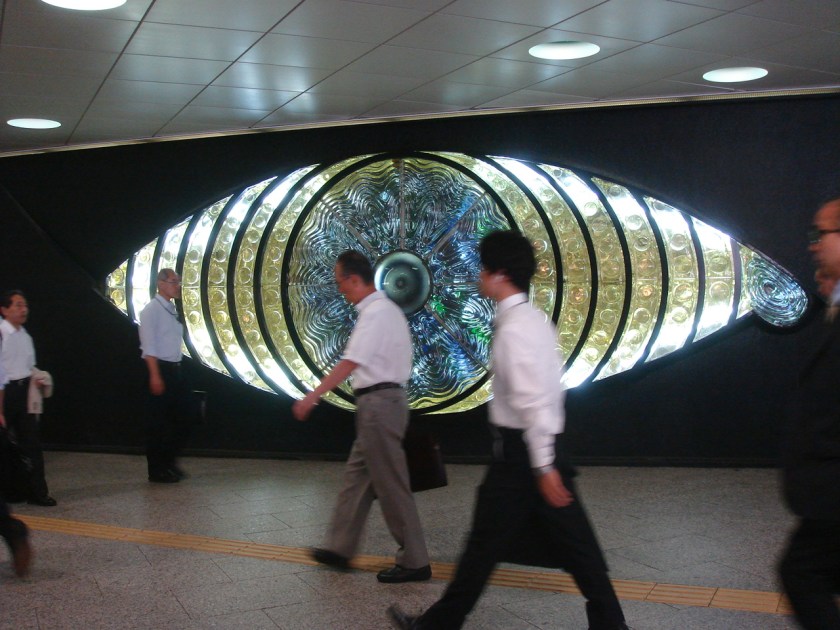
Somebody's watching you... office workers walk past an installation in Shinjuku station, Tokyo

We’ve met with several Japanese surveillance studies researchers whilst out here this time. I mentioned Ogura Toshimaru already the other day, but we also had a long meeting the week before with Hino Kimihiro, a researcher into bohan machizukuri (community security development), and government advisor on security planning. Dr Hino has been carrying out a number of research projects on both ‘designing out crime’ and on the effectiveness and public acceptability of CCTV in Japan. I hadn’t come across this research before as my contacts here were mainly in social sciences and law and Dr Hino tends to publish in urban planning journals and is not connected to other Japanese surveillance researchers. His work is very interesting and reminiscent of that of Martin Gill or Farrington and Welsh in the UK. It is a shame, that just like those researchers who have carried out analyses of CCTV for the UK Home Office, his assessments tend to be ignored by the government. Dr Hino’s latest project is to assess the trials of a new movement recognition system in Kawasaki city. I hope he can come to the January Camera Surveillance workshop at Queen’s University, Ontario, or the April Surveillance & Society conference in London (details coming soon!).

I also met today with Tajima Yasuhiko, a professor of media law in the School of Journalism at Jochi (Sophia) University in Tokyo. Professor Tajima has been one of the most important critical voices in the debate about surveillance in Japan, and has bridged the academic and activist world, being involved with legal action against juki-net and Google StreetView. We had a productive conversation about the politics of surveillance in Japan and the prospects for critical voices to be heard. He wasn’t optimistic that they would be, and neither am I after our meeting at the Prime Minister’s IT Strategic JQ the other day, however I am also convinved that in many ways Japan has not yet gown as coordinated and centralised a route on issues of security and surveillance as has the UK. There is, so far as I can see, no real attempt to link up things like juki-net or other databases and the anshin anzen (or bohan) machizukuri agenda, and i-Japan, national and local police, and wider community security agendas do not really coordinate at all. This is due to the lack of an obvious ‘threat’ like that of terrorism in the UK, around which such coordination can occur. The government half-heartedly tries to get people worried about North Korea, but really they aren’t, and ‘ageing society’, whilst a phrase used to justify almost anything (including central databases) is a worry, it does not generate the fear that comes with the war on terror.

We also considered the relative weakness of Japanese civil liberties organisations and the failure of the mainstream media to pick up on issues of privacy and surveillance. There seems to be some effort now to try to coordinate various organisations to push for an explicit constitutional protection for privacy (rather than the rather vague inclusion of such an idea in a wider notion of the ‘pursuit of happiness’), but whilst I can see that being happily accepted after the government has got its central database(s), I can’t see it being done in time to alter either this trajectory or the way in which the database(s) are built.

Varieties of anti-surveillance activism in Japan

Although some progressive activists would like it to be otherwise, anti-surveillance feeling is not confined to the left, indeed in many countries, like the USA, libertarian individualist right-wing anti-surveillance activism is perhaps more common. And it seems that such a position is not unusual in Japan either.

Having returned from a weekend of hot springs, fine sake-tasting and eating way too much, today we met with the Mayor of the Suginami ward of Tokyo, Hiroshi Yamada, a prominent figure in the anti-juki-net campaign, and a also one of the leaders of a group of right-wing figures trying to promote a new nationalist grouping at that end of the Japanese political spectrum. But this new right is not at all a simple matter of ‘back to the 1930s’ that some commentators would have you believe. Yes, this group – which also includes the Mayors of major cities including Yokohama and Nagoya as well as popular journalists like Yoshiko Sakurai – has very conservative, revisionist views, on Japanese history, but in many ways they have far more in common with the new US libertarian right in their rejection of large state and high taxes, and in other areas too, for example Sakurai has rather unscientific views on climate change!

Part of the this libertarian outlook is the rejection of state intrusion into the private lives of individuals. Mayor Yamada saw the juki-net system as part of unwelcome movement towards a more top-down society, concentrating power at the centre. He was very clear that the state’s ability to collect information on the individual should be based on what the individual wanted to give up, not on what the state thought it needed (this is very much the opposite of what the Prime Minister’s IT Strategic HQ said to us last week). He was also most concerned about the risks posed by large databases, both as an attractive target to external hackers and to corrupt use from inside operators. Yamada is not opposed to what he calls IT shakai (IT society), but the use of IT should be based on what is useful to individuals, and of course what is actually he needed, he argued, would often be less expensive than the massive computerisation schemes favoured by the current administration as part of their i-Japan strategy. In this sense, he said he would oppose any move to unnecessary centralised databases and certainly to any possible national ID register or card.

In most respects, what Mayor Yamada said could probably have been said by any left-wing civil liberties activist in the UK, or by conservative right opponents of intrusive state like Conservative ex-Shadow Cabinet Minister, David Davis. Perhaps many aspects of what is felt to be wrong with surveillance society do not correlate neatly with old left-right divisions. This view was shared by Toshimaru Ogura, a Toyama University professor and major figure in left-wing anti-surveillance activism whom we met with just afterwards, along with campaigning journalist, Midori Ogasawara again. Just as the Convention on Modern Liberty event earlier in the year showed for the UK, there are many different varieties of anti-surveillance feeling in Japan, and whilst opponents may disagree with each other, and may even find other aspects of the politics of their erstwhile collaborators utterly distasteful, they do collaborate, even if it is only for short periods.

Professor Ogura’s analysis, as that of Ogasawara and indeed of Kanshi-no! whom we met the other day, is much more focused on the way in which surveillance excludes and discriminates – against union members, activists, gaikokujin (foreigners) and so on – and also the ways in which it favours the interests not just of the state but capital. We’ll be talking to groups who deal with the concerns of these excluded people in the last week we are here. Privacy is important, but Ogura’s analysis is concerned with the disproportionate effects of surveillance. It is not just that privacy is affected but that particular groups’ and individuals’ rights are damaged more than others, and those people are not generally the ‘ordinary taxpayers’ to whom Yamada and the libertarian right are trying to appeal.

Like me, Professor Ogura is also particularly interested in the way in which particular corporations and business coalitions pushing technological ‘solutions’ to social and organisational problems can have a profound influence the way government makes decisions. Such coalitions would still be there however large government was, and in some ways, without a government large enough to stand up to the private sector, a different kind of more purely market-driven surveillance society would emerge. In that sense, it is what government does, and to whom it responds, that is more important that more arbitrary questions of ‘size’.

There’s a lot more to consider here too, in particular the extent to which any of the things we consider under the umbrella of ‘surveillance’ are actually and actively part of some coordinated state (or other) plan. I’m starting to develop a sense of this here, but I will leave those thoughts to another post.

(Thank-you to Mayor Hirioshi Yamada, Professor Ogura Toshimaru and again, to Midori Ogasawara for being so generous with their valuable time).

Locational Privacy

PDF file

The Electronic Frontier Foundation has a very good little report on locational privacy, “the ability of an individual to move in public space with the expectation that under normal circumstances their location will not be systematically and secretly recorded for later use.”

As usual for EFF, it is written in clear, understandable language and is free-to-access and download.

* I’m going to be away up to the mountains for a couple of days, so there won’t be any more posts here until Sunday at the earliest… next week is a slow one here in Japan as it is O-bon, the Buddhist festival of the dead, and many people go back to their family home and offices are generally closed for some or all of the week. I won’t be doing much in the way of interviewing, but I still have quite a few interviews and visits from the last two weeks to write up.