Death of the dojunkai apartments

As I mentioned the other day, after the Kanto daishinsai (Great Kanto Earthquake) of 1923, there were many changes to planning and architecture in Tokyo, in particular a series of experiments with introducing western-style elements into the city, including wider streets to accommodate trams (streetcars), and new concrete mass housing influenced by the modern movement.

Dojunkai, a special organisation under the Interior Ministry, was set to provide such things. Between 1924 and 1936, this agency built 16 apartment blocks out of ferroconcrete and wood in Tokyo and Yokohama. The best known were those in Daikanyama (near Shibuya) and on Omotesando Avenue in Aoyama. The latter were controversially demolished in 2003 by the Mori Building Company Ltd to make way for their soulless Omotesando Hills shopping complex.

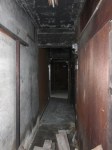
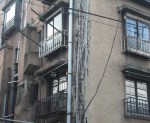
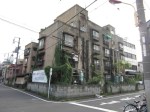
Much less celebrated however, were the Dojunkai appartments in Nippori (not Minowa as most people seem to think) in Aarakawa-ku, just round the corner from where I am staying. They’ve been empty and crumbling for a while, but now the writing is very literally on the wall, saying that they will be demolished too. It’s a sad moment: another episode in the slow death of the utopian urban ideal of the Twentieth Century. It’s also a reflection of the very high land prices in Tokyo and relative lack of value in what is on the land at any time (see this article for a good summary of the difficulty of any architectural preservation in Tokyo).

Anyway, not only are they valuable historical buildings, they are also degenerating rather stylishly so, at the very least, I thought I should get in and take some pictures before it was too late. So I did – much to the surprise of a crew of local authority workers who were surveying the place as I came out. Here are some of the shots. I didn’t (yet) go into any of the indvidual apartments – all those I tried were locked and some chained too – though I might try to in the early morning this week before anyone is around.

Tokyo Elections and Urban Development

Pretty much as predicted, the LDP lost badly in the Assembly elections for Tokyo. They ended up with only 38 seats to the Democratic Party of Japan’s (DPJ) 54. The LDP will continue to be part of the largest bloc in the Assembly thanks to the 22 seats held by the Komeito, the party of the Soka Gakkai, a lay organisation of the large Nichiren Shoshu evangelical Buddhist sect. The Komeito have almost single-handedly kept the LDP in power in Japan for years now, and seem to have no point to their existence at all, apart from ensuring that laws on religious organisations are kept as light as possible. Nevertheless, even as a bloc, the LDP / Komeito no longer have a majority in the 127-seat Assembly.

Under pressure, unpopular LDP Prime Minister, Aso Taro, has now called elections to the national Diet for August 30th. Normally one would expect a wipe-out of the LDP, but that’s not how Japanese politics works. With very strong rural and regional support, the LDP will most likely win again, but a different faction will get their man (and it will most probably be a man) into the PM’s office. There has been a non-LDP government before, but it happens so infrequently as to be almost unheard of…

Whilst Aso is unpopular and LDP’s response to the recession has been both predictably unimaginative and unsustainable (in short, “more concrete!”), this wasn’t just about national issues, despite what LDP spokespeople in Tokyo would have us believe. There are some serious economic and urban development issues in Tokyo. More people seem to have lost patience with long-standing Governor Ishihara, who is backed by the LDP on the whole, and in particular the almost collapse of Ishihara’s subsidies for Tokyo banks affected by the global collapse of financial services, and the latest mega-scheme to free up land for private sector redevelopment, the proposed move of the famous Tsukiji fishmarket from its convenient and historic location at the edge of fashionable and expensive Ginza to some remote toxic waste dump in the middle of nowhere. 20 years ago, even 5 years ago, such ridiculous schemes to aid private capital were routinely forced through, but in the current climate, this may not be possible. Finally, like Rio de Janeiro, where I was earlier in the year, Tokyo is candidate city for the 2016 Olympics with all the financial (and social and security) implications that bidding for and hosting such a mega-event implies, and people are starting to wonder whether the city can afford it.

Still, the relentless march of redevelopment continues elsewhere: the old Koma Theatre in Kabukicho, which I predicted would be targeted by developers as soon as they started trying to secure the area with CCTV cameras and intensified policing a few years back, is now almost demolished (pictures soon)… apparently Shinjuku’s red light district is now officially safe for more mainstream and less obviously dirty forms on capitalism.

Secure Cities

Following in the footsteps of leading urbanists like Mike Davis and Michael Sorkin, is a project led by Dr Jeremy Nemeth, an assistant professor at University of Colorado. which traces the degradation, securitization and privatization of what we used to optimistically refer to as ‘public space’. This project aims to map and quantify the space in three contemporary cities (New York, Los Angeles and San Fransisco) now restricted in the name of security. The website is online now, and their findings are summarized on the front page:

“Even before [the 9/11] terror attacks, owners and managers of high-profile public and private buildings had begun to militarize space by outfitting surrounding streets and sidewalks with rotating surveillance cameras, metal fences and concrete bollards. In emergency situations, such features may be reasonable impositions, but as threat levels fall these larger security zones fail to incorporate a diversity of uses and users.

Utilizing an innovative method developed by our interdisciplinary team, we find that over 17% of total space within our three study sites is closed entirely or severely limits public access. The ubiquity of these security zones encourages us to consider them a new land use type.”

(thanks to Dr Nemeth for the corrections to my original misattribution of his excellent project)

The downside of Brasilia

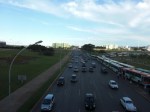
on foot, you are immediately confronted by the unpleasant reality of what is to the pedestrian effectively a huge expanse of carpark and highway separating the areas you might want to be. The functional split between the ‘zones’ only makes this worse.

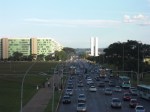
Again, this is urbanism rather than surveillance, but here are some more musings and pictures on the urban form of Brasilia. Yesterday, I posted a lot of conventionally attractive shots of the buildings around the monumental axis of Brasilia. However, leaving aside the wider question of whether Brasilia outside of the planned centre functions as a city, there is a rather less beautiful side to the core.

This mainly has to do with the practical consequences of the philosophy behind the plan and particularly with functional separation and transport. As I noted when I first arrived, the city is dominated by roads. 5-lane highways run down either side of the monumental axis, and it is crossed by two major motorways in deep cuttings, with all the attendant slipways. These probably look very attractive as bold curving lines on a plan. They may even function if you are traveling by car (or bus). But on foot, you are immediately confronted by the unpleasant reality of what is to the pedestrian effectively a huge expanse of carpark and highway separating the areas you might want to be. The functional split between the ‘zones’ only makes this worse. Say you are in the hotel zone that I was staying in and you want to go out for a meal and a drink. Well, that’s 30-minutes walk to the nearest residential centre (where most of the evening options are located). Sure, you can take a taxi, but why should you have to? All the sports clubs are in separate ‘club zones’ even further away from either hotel, commercial or residential districts.

Now, okay, so the residential districts have most of their facilities (not including clubs) within walking distance – I said in my first impressions blog entry that I could actually imagine living here with a young family. And I still could. Natives of Brasilia are fanatical about the place. The residential districts work. You don’t really have to go anywhere near the soulless and secured shopping centres or take your chances running across massive motorways with uncaring drivers trying their best to ignore you. There is a simple metro system which runs between the districts and the centre (though it was largely closed for the building of new stations when I was there). You can walk around, between and under the blocks. They don’t appear to be totally obsessed with security in the manner of Sao Paulo or indeed most other large Brazilian cities. The blocks have concierges but not fences, walls and gates. Most of the windows do not even have bars.

But there is a reason and a price for this too. The residential zones are simply not socially mixed. Just about everyone who lives in the big blocks is a government or big corporate office employee. The ordinary workers and the poor live elsewhere entirely, in one of the satellite cities of Brasilia, and are bussed in and out via the busy central bus station every day. At the bus station, you find glimpses of the ‘ordinary Brazil’ – the cheap lanchonetes and pastelerias (in fact probably the best pasteleria I have found in Brazil so far)!, sidewalk vendors of DVDs and knock-off jewelry, the beggars, the hungry and the desperate. In many ways I felt more comfortable there than in the dry Le Corbusian dreamspaces of the government buildings.

Anyway, here’s some pictures of the ‘real Brasilia’ – or what it looks like if you stop focusing on the architecture and take a wider view!

In Brasilia: monumental space and… hip-hop?

I am now in Brasilia, where I have a number of interviews with parliamentarians, and officials from government Ministries and the federal police. The hotel I am staying in is right off the main monumental axis, in the northern hotel district. It is in some ways, the total opposite of where I was in Sampa, being masterplanned, spacious and with visible greenery. But it is a masterplan typical of Le Corbusier and his acolytes, that seems totally lacking in any flexibility or consideration for people not traveling by what they thought would be mankind’s liberation: the private car. So it is almost impossible to walk to a decent bar or cheap restaurant in the evening. You have to get a cab (or a bus if you know where you are going), to another ‘district’ for such things. The spaces are large and clearly designed to be monumental, but actually they fail in both being genuinely impressive and in being accessible. That is not to say that there are not some amazing buildings – of course there are many of Oscar Niemeyer’s greatest creations – but it is a place that looks better from the godlike view of the plan, or the selective gaze of the tourist brochure, than being within it as an ordinary person.

The taxi from the airport took a route through some of the contemporaneously planned and built residential districts. If it wasn’t for the semi-tropical vegetation, it could have been the Netherlands… long lines of similar 60s housing blocks, broken into neighbourhoods, each with its own little row of shops and restaurants, and divided by little parks and other community facilities. The blocks show quite a lot of variation in design and are certainly not all exactly the same, nor are they so large that they become inhuman in scale. With all the trees, and the facilities within walking distance, this really did seem like it wouldn’t be a bad – if not really an exciting – place to live. Which is exactly what I feel about many places in the Netherlands! For today, calm and unexciting is exactly what I need!

Strangely enough however, almost the first thing I came across when I got here was a local-government organised (and state petrochemicals company, Petrobras-sponsored) hip-hop festival, right on the main axis in the shadow of the TV Tower. So as the sun went down (if we could have seen it through the clouds) and the lights of the city blinked behind the hemispheres and towers of the Parliament building, I was getting down (well, tapping my feet) to some phat beats and conscious lyrics about the hardship and violence of life in the ‘periferia’ from the likes of Liberdade Condicional, and other favela stars. This, if nothing else so far, made me feel rather more hopeful for the future. For this evening only, the periferia had come right into the centre and was, symbolically at least, at the heart of Brazilian democracy.

Leaving Sao Paulo

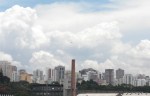
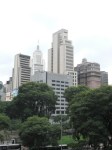
It’s my last morning here in Sao Paulo. I have to say that, with the greatest respect to my friend and Sao Paulo native, Rodrigo, I am not going to be sorry to leave. A lot of what I thought when I arrived here hasn’t changed. This is big, dirty, noisy, exhilarating city with an unapologetic commercial drive, and all the divisions and human debris that this creates. In many ways, it reminds me of Osaka in Japan, but the extremes are greater. The problem is that the huge divisions can’t be ignored if you are in any way sensitive to human suffering, and the suffering here cries out from every raw-smelling homeless man sleeping on the street, from the ragged kids sorting through rubbish at night, from the women selling themselves in the parks, stations – well, everywhere. Certainly, these things are part of city life in many places in the world, and there are many far, far poorer places, but there is something profoundly saddening, depressing, about the gulf between the helicopter-chauffeured elite and the people on the street in O Centro, and especially in the ignorance and indifference – which I have not only been told about but have seen. By the end of just one week, during which I have tried to be as much a part of the place as I could, when I have spent time talking to everyone from human rights groups to people in ordinary bars, I feel like retreating, curling into a ball in the corner of my room.

So thank-you, Sampa, but I am not sorry to be leaving. Here are some pictures of the hundreds I took, of aspects booth good and bad…

Finding my feet and losing my head in Sao Paulo

It is my firm belief, yet to be disproved, that any urbanist worthy of the name can find a decent bar within 24 hours of their arrival in any city on the world, and preferably less. Read Ernest Hemingway’s Paris: A Moveable Feast. It’s Chapter 1. No-one knew bars like Hemingway. In Sao Paulo, as in Paris even today, it would be impossible to fail this challenge. I found mine this evening right next to a more famous bar at the corner of Sao Joao and Ipiranga which has started to believe its own mythology and therefore lost everything that once made it a bar worth celebrating in song, and I settled in to watch and learn.

I’ve already got so used to joking with barmen and concierges about my poor Portuguese that it’s almost like an icebreaker. The bar was haphazard, white tiles, and giant freezers which got the beer down to an appreciably glacial degree of cool, decent salgados and two grades of chili source to accompany them (hot and really hot – no-one has the first choice, of course).

Bars are human sociality at their most basic, their most primate-like. I once worked on a zoological expedition studying monkeys in Kalimantan, and there is very little I’ve seen in bars that I haven’t seem being done by other primates (apart from the serving of cold beers, which explains most of what happens in bars that you don’t see in monkey groups). The forced-together bonhomie, the silence amongst the mostly male clientele as some particularly fine example of the female of the species walks by (and that happens an awful lot in Brazil), the arguments about sport and politics, the group-dominance by alpha-males – at least in the absence of any alpha-females – it’s all there and it’s all – excepting the beer and the salgados – monkey.

It makes one depressed and optimistic at the same time. You know that anywhere that humans go, somewhere in the universe, there’s going to be a bar just like this. And yet, it makes you wonder whether we will ever manage to solve the enigma of cities, a solution that will bring in those shadowy figures who lurk just beyond the reach of the bright lights of the bar – the stick-thin figure of the beggar-woman who passed me twice this evening, the guy selling lottery tickets at the last minute, the prostitutes and thieves who have been driven to these ends because of the city, because their existence and the existence of the city don’t quite seem to coincide in the same way, the same spacetime. There’s a reason good urbanists need to find a good bar. It isn’t always for the same reasons as everyone else.

Utopian urbanism

…it is the adventurous, progressive, social democratic spirit of the New Deal and the World’s Fair that it is most worth revisiting now…

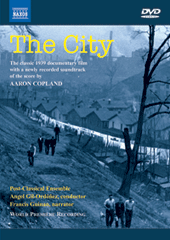
Naxos´ rerelease of The City
Naxos' rerelease of The City

A post which has little to do with surveillance and security today, but much more to do with another of my interests, in urban futures…

The predominantly classical music company, Naxos, has issued a new version of the classic 1939 documentary, The City, which was released to coincide with the New York World´s Fair. The film is a superb piece of work in many areas – a great script by the legendary urbanist, Lewis Mumford, based on his book, The Culture of Cities, luscious cinematography by Ralph Steiner and and Willard van Dyke and, the reason why Naxos is involved, a brilliant score by Aaron Copeland, which has been re-recorded for this release. It is already available for free download from the Internet Archive (a treasure house of historical material), but of course you won´t get the specially rerecorded score or the extra documentaries that accompany the anyway relatively inexpensive re-release.

A past vision of an urban utopia...

Despite its serious message, the film ultimately shares the optimistic atmosphere of the World’s Fair – see, for example, Andrew F. Wood’s lovely site full of those influential images of progress that so shaped the rest of Twentieth Century’s idea of what the future would look like and then later, should have looked like. Today, it has acquired a new relevance, produced as it was out of that amazing surge of energy in US society resulting from Roosevelt’s solution to the Great Depression, the New Deal. Mumford´s admonition that “the age of rebuilding is here. We must remold our old cities and build new communities, better suited to our needs” (see this article about the movie) has never been more pertinent. As of 2007, we entered an age when the majority of the world’s population is living in cities that are already divided by extremes of wealth and poverty (especially here in Brazil), and a global recession is developing, which should cause humanity to rethink its priorities.

The 1930s saw the best and worst of the drive to utopianism. Some of those paths resulted in the holocaust and the gulags, some led to the unsustainable consumer capitalism we are still trying to revive, but it is the adventurous, progressive, social democratic spirit of the New Deal and the World’s Fair that it is most worth revisiting now.

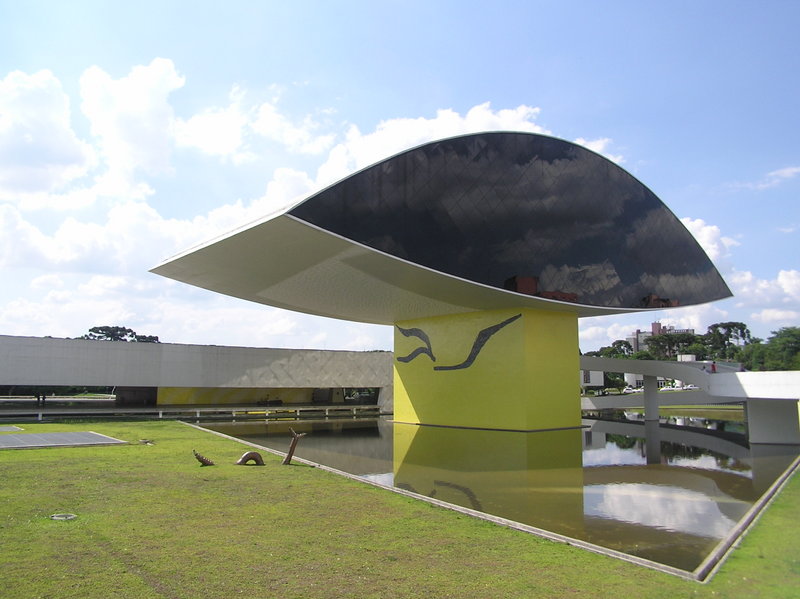
The Niemeyer Museum in Curitiba

Here in Brazil, another nation, like the USA, which struggled throughout the Twentieth Century to fashion itself into a democratic utopia, we can also see this spirit embodied in the gorgeous curves of Oscar Niemeyer‘s fluid Brazilian modernism. Lewis Mumford may be long gone, but Niemeyer is still with us at 101 years old, and still working with the same commitment.

It is a sobering thought that it will not be long before there is no-one left from that generation of urbanists, the generation that was committed to invention, beauty and social progress. Here’s to them…

(thanks to Janet Forbes of York University, Toronto, whose post to a mailing list inspired this reverie)