Surveillance cameras in the favelas (2)

A couple of weeks ago, I found out that the military police had installed surveillance cameras in the favela of Santa Marta, in Rio de Janeiro, Brazil, which I visited back in April. This is the first time such police cameras have been put into such informal settlements in Rio. My friend and colleague, Paola Barreto Leblanc, sent me this link to these youtube broadcasts from a local favela TV company, in which residents discuss their (largely negative) views of the cameras.

There is also a poster that has been put up around the area produced by the Community Association and other local activist and civil society groups – see here – which reads as follows in English:

SANTA MARTA , THE MOST WATCHED PLACE IN RIO

At the end of August, the inhabitants of Santa Marta were surprised to learn from newspapers and TV that nine surveillance cameras would be installed in different areas of the favela. A fear of being misinterpreted paralysed the community.

Many of the people of the city, and some in the Moro itself support this initiative.  However, we are a pacified favela, so why do they keep treating us as dangerous?

Walls, three kinds of police, 120 soldiers, cameras – this is no exaggeration.  When will we be treated as ordinary citizens instead of being seen as suspects?

Wall: 2 million Reais, Cameras, half a million Reais. How many houses could this amount of money build? How many repairs to the water and sewage system?

The last apartments built in Santa Marta are 32 square metres. The Popular Movement for Housing [an NGO] says that the minimum size should be 42 square metres. Other initiatives have gone with 37 square metres. So why don’t we stand up and demand this minimum standard? This should be our priority!

When will the voice of the inhabitants of this community be heard?

We need collective discussion and debate.

Fear is paralysing this community and preventing criticism. But the exercise of our rights is the only guarantee of freedom.

“Peace without a voice is fear”

We want to discuss our priorities. We want to know about and be involved in the urban development project in Santa Marta.

We will only be heard and respected if we unite.

Think, talk, reflect, debate, get involved…

Project Indect and the NeoConOpticon

Following the release of the NeoConOpticon report, Ben Hayes of Statewatch has set up an interesting blog monitoring EU security policy, called (ahem…) Notes on the European Security Research Program. One the first post (and a follow-up) concerned one particular EU 7th Framework Program-funded project called Indect, which seems to think that it is a great idea to have an Enemy of the State-style comprehensive surveillance system across Europe. It appears to be filmed in Poland – you think the Poles at least would have learned from almost half a century of totalitarian rule…

There are of course, hundreds of these security projects being funded by the EU that Ben’s report detailed (with a tiny, tiny number of alternative or critical ones, and of course some token nods to simple ethical concerns like privacy within some of the projects). One that finished in 2007 was the SAFEE project that proposed (amongst other things) to put cameras in the back of every aircraft seat so that passengers’ facial expressions could be monitored automatically for signs off threat… it’s unclear how many of these ever get beyond the research stage – and I hope most don’t – but if they do, the future of the EU is one of a tightly controlled society of people constantly monitored even at the most personal level in case they step out of line. The great thing about the NeoConOpticon report is that it puts all of these things together rather than treating them in isolation. I wonder if the individual researchers involved would think differently if they actually considered their work in this context and in the context of the political architecture of security that is being built in the EU.

Anyway, here’s the PR video for Indect, for those who are interested in such things. It’s typical of the genre: a dumbed-down, hyped-up, over-macho, TV-detective series pastiche with a ridiculous voice-over and music. No doubt it goes down a storm at sales events.

Anyway, keep an eye on Ben’s blog. I will be.

Racial profiling hits a new low

Just when you think that state surveillance in supposedly free countries could not sink any lower, it has been revealed that UK Border Agency is finding a pilot project into using DNA and isotope analysis to determine the origin of asylum-seekers. This is not a joke or a scare-story. It is a real project. Science Insider has the details here. The Agency is refusing to say who is doing this research for them, nor has it provided any references to studies that show that what they are proposing will work. It appears that most scientists working in the area think it is based on entirely faulty premises and there is no reason to believe it will work. That’s only a minor objection compared to the political and ethical ones of course. As the story in Science Insider points out the Border Agency seem to be making a fundamental (and totally racist) error in assuming that ethnicity and nationality are synonymous. And this research would probably not got past any university ethics committee, which makes one wonder what kind of screening or ethical procedures the Border Agency used, and indeed who would carry out such an obviously unsound piece of research. It’s another example of increasingly unaccountable arms-length agencies (which have proliferated in recent years) using the ‘technical’ as an excuse to bypass what should be a matter of high-level policy, and indeed something that so obviously harks back to the bad days of Europe’s racist and genocidal past that it beggars belief that any sane official would have let this get further than a suggestion in a meeting.

(thanks to Andy Gates for pointing me to the story)

Surveillance cameras in the favelas…

Well, my fears have it seems, been vindicated already. Earlier this year, as part of my case-study on surveillance in Brazil, I visited the community of Santa Marta, a favela (informal settlement) in Rio de Janeiro. Santa Marta is interesting because of the amount of investment and effort that has been expended in occupying, pacifying and developing the place, by the new gubernatorial administration of Eduardo Paes, who has simultaneously cancelled Favela Bairro, the widely praised and more extensive favela development programs of his predecessor, Cesar Maia.

Leading the new Community Police efforts in Santa Marta was Capitao Pricilla, an indomitable and well-liked young female officer of the Military Police, one of several rising female officers with a new approach, and we heard from residents how trust was being rebuilt between police and community because of her. At the same time, there were storm clouds on the horizon as the city administration was insistent on cracking down still further with its policies of choque de ordem (the shock of order), which involved harassing illegal street vendors from the favelas, and demolishing illegally-built buildings, and also building walls along the edges of some favelas. The word ‘ghetto’ was mentioned on more than one occasion by our interviewees and in more casual conversations.

Now, just last month, the Military Police have decided to install seven CCTV cameras in Santa Marta, in different areas of the community. This has prompted complaints of invasion of privacy, an there have already, my sources report, been protests about this in he favela, but it seems that this is coming from further up the chain of command than Capitao Pricilla and the community police. She isn’t mentioned at all by the article in O Globo, despite being a bit of a PR star, and instead the justification for the cameras is given by one Coronel José Carvalho, who also stated that there are plans to put cameras into the other two areas currently being targeted for development, the famous Cidade de Deus, and the much less well-known and more distant favela of Batan. This also contradicts what I was being told by the Commnder of the police central CCTV control room we visited, which is quoted as being one of the places where the cameras will be monitored. What is interesting is the cameras seem to be being treated by police almost as a tool of urban warfare: a Major Orderlei Santos talks about their experimental use for determine the deployment of officers in the favela.

Could the old macho, male, approach to policing as a war on the poor be trumping the new trust being developed by community policing? I hope not, but everything points that way.

(thanks once again to Paola and David for keeping me in touch…)

Kabukicho Renaissance?

Kabukicho is a place that is hard to love. A seedy, crime-infested dive full of ‘massage parlours’, ‘aesthetic salons’, ‘image bars’ and other thinly-disguised forms of brothel. Tokyo has had red-light disticts since the Edo period, of course, and the Yoshiwara was only the most famous. Shinjuku was always one of them, and since the failure of the threatre initiative that gave the neighbourhood its name, Kabukicho has been the best known. Kabukicho is interesting though for many reasons. It had a radical political and cultural history in the 60s and 70s. It was the epicentre of changes that occurred in organised crime in the 80s and 90s, with Chinese gangs replacing the Yakuza as the biggest ‘threat’. And it is now the centre of efforts by the Shinjuku authorities to clean up its image, with the Kabukicho Renaissance policy, and the new Town Manager, and by Tokyo police to crack down on illegal immigration.

Controlling the outsiders

One of the most interesting meetings we had in our last week here in Japan was with two representatives from the Japan Civil Liberties Union (JCLU) and the association to defend the rights of foreign migrant workers. One thing that has always been clear to me from being a gaikokujin (or more casually, just gaijin – foreigner) in Japan is how distinct is this status. I’m a white, western European and therefore at the top of the list of acceptability in foreigners in Japan, but even so I’ve had some interesting experiences, including having two police squad cars and 5 officers deal with the matter of my ‘suspicious’ bicycle (an experience that practically all resident foreigners have had at one time or another), and just the other day I was stopped at the train station by two plain-clothes police officers, who started off quite strong, but then backed down and started mumbling apologies about ‘looking for someone’ when they realised my (Japanese) wife was just behind me. It was pretty obvious that they were conducting an immigration sweep – i.e. just stopping anyone who ‘looked foreign’ to check their immigration status.

This gave me just a tiny taste of what life can be like here for those whose immigration status is problematic. And, as the campaigners told us, this is an increasing number of people who have come to Japan because of the wealth and opportunities and because, whisper it, Japan needs immigrants. Like so many advanced industrial nations, Japan is a hyper-ageing society, with an increasingly unbalanced population pyramid. There are not enough working age Japanese people to support the increasing number of retirees, and government schemes to encourage people to have more children simply haven’t worked. The problem is that successive Japanese governments have refused to recognise the implications. The rules now make provision for ‘skilled’ immigrants, but not for those who are ‘unskilled’ and it is actually those in this latter category that Japan needs. In practice this is demonstrated by the increasing numbers of foreign delivery and construction workers in Tokyo as well as those working in the shadier areas of the ‘night economy’ – doormen, bar staff, masseurs, prostitutes etc.. The same politicians who deny the need for immigrants are probably having their personal ‘needs’ serviced by Filipino or Vietnamese women and this hypocrisy colours all the mainstream political debate about the place of foreigners in Japan, especially in Tokyo where Mayor Ishihara has never disguised his nationalist views in this area.

So, whilst the politicians refuse to deal with reality, the police are enforcing the law as it is. We have spent some time, whilst we are here (and I have gathered data on previous visits) in the night city of Kabukicho in Shinjuku. This time I was taken out to bars in the old post-war neighbourhood of Golden Gai by Professor Tonoma, who formerly led both Shinjuku-ku and Tokyo city planning bodies, and we also talked to Shinjuku community safety officers, and to the Kabukicho Town Manager, who runs the day-to-day operations of the body trying to improve Kabukicho’s image, Kabukicho Renaissance.

Kabukicho of course is famous as the first place that the Tokyo police installed CCTV, ostensibly to deal with Chinese gangs, but according to what we learned from these visits and from talking to the campaigners, as crime has declined (as it has nationally – it’s probably nothing to do with the cameras), the cameras and intensive policing (raids etc.) have been used largely to curb illegal migrant workers. And the authorities seem to make no distinction between the gangsters and the mainly South-east Asian women who work in the bars and massage parlours. They are all visa-overstayers. There is no attempt to treat the women as people in need of help and support at all. Of course this all inflates the crime figures and makes it easy to paint what the police always term ‘foreign crime’ (whatever the exact nature or seriousness of the crime) as a growing threat, as it becomes proportionally a larger part of shrinking crime rates (which were already low by global standards to begin with).

Now there is a new threat to this already massively targeted population. The inclusion of foreigners on the jyuminhyo (residents’ registry), combined with the digitisation and networking of this registry through juki-net, means that the authorities will be able to correlate residency and immigration status much more easily – the residency information for foreigners will be linked to the Houmusho (Ministry of Justice), which has entry records, and now fingerprints and facial photos too, following post-9/11 reforms. Of course, resident skilled foreigners wanted to be in the residents’ registry. They argued that not being on it was itself a form of discrimination and meant further difficulties in terms of things like buying property. However the inclusion of foreigners now opens up new forms of discriminatory practice against those who are already the most disadvantaged in Japanese society, the kinds of foreigners who more high-status ‘official’ foreigners do not generally recognise as kin to them at all.

Japan’s surveillance society, like most, is therefore a profoundly uneven one. Every society has its Others, and surveillance is deployed both to distinguish those Others and to control them. In each of the cities I have been studying the Others are different populations. In London, the Others are (at the moment) the resident Muslim community (or more particularly, ‘radicalised’ young Muslims). Here the surveillance combines repression and ‘caring’ programs to bring the disaffected back into the mainstream. In Rio de Janeiro, the Others are the urban poor, the favelados. They are largely simply excluded – walls protect the rich in their homes, and now walls are being built around the poor communities. In Tokyo, the Others are foreigners, but there are gradations of Otherness, and effectively still aping the western ‘scientific racism’ that it acquired during the Meiji period modernisation at the end of the nineteenth century, Japan’s Others are poor Blacks and Asians (for many on the right here, the Japanese are not ‘Asian’ at all, but something unique). Just as the British state is struggling with the legacy of its particular colonial and post-colonial approach to immigration, and the Brazilian state with a history of years of differentiated citizenship, the Japanese state has still not yet really come to terms with the prospect of the mixing of people at all.

Community Safety in Suginami

Following our meeting with the Mayor the other day, we went back to Suginami-ku to talk to the community safety people, who are part of the Disaster Management section. Suginami is interesting because, as far back as 2004, it was the first Local Authority in Japan to introduce a special bohan kamera jourei (security camera ordinance) which is based in part at least on principles of data protection and privacy. And until neighbouring Setegaya-ku introduced their own ordinance last year, they were, so far as I know, the only such authority. The ordinance followed public consultation which showed that although people generally thought CCTV was effective (95%), a significant minority of 34% were concerned about privacy, and 72% thought that regulation was needed. These figures seem to be significantly more in favour of privacy and regulation of CCTV than the nationwide survey done by Hino Kimihiro, however he asked different questions leading to answers that are not directly comparable.

Suginami is one of the areas of Tokyo that has the other kind of CCTV system introduced by the Tokyo Metropolitan Police after 2002, help points where people press a button if they feel in danger and speak to someone from the police. The help points have both CCTV camera and an alarm / red flashing light if the caller says it is an emergency.

However the Suginami community safety officers said that these cameras have not proved very effective and in fact they cause a lot of problems, because children tend to press the button for fun, and run away – meaning that there are many false alarms.

Suginami has some of the same kind of array of ‘blue-light’ volunteer patrols as Arakawa-ku. In Suginami, there is a fleet of mini-patoka (mini patrol cars) and motorbikes, used by 15 retired police officers. These are mainly about visibility leading to deterrence and increased community confidence, as the volunteers ex-officers have no special powers nor do they carry side-arms or handcuffs or any other conventional ‘police’ equipment. Suginami does not have the small community safety stations like Arakawa-ku, although they do also have the same problem of local koban (police boxes) being closed. However where Suginami really stands out is in the sheer number of volunteers they have involved in their community patrols, organised through the local PTAs, shoutenkai (shopkeepers’ associations) and choukai (community associations). There are 140 groups with 9600 people actively involved in one way or another in community safety just in Suginami.

Suginami is a relatively wealthy ward and the kinds of problems that concern Arakawa (mainly minor street crime and snatch-thefts) are not such big issues here.  The main concern in this ward seems to be burglary and furikomi – the practice of gangsters and other criminals calling old people and pretending to be a relative or representative of a relative and persuading them to transfer money to a particular ATM (which you can do in Japan – it would be impossible in the UK). Furikomi is a very interesting phenomenon in that it seems to be a product of family, social and technological changes. Many older people who would have lived with family in traditional Japanese society are now living alone. They are lonely and miss the intimacy of family contact, so they tend to welcome unexpected calls from relatives who may now be living almost anywhere in Japan. These older people are also technologically literate and able to use mobile phones, ATMs and computers. The combination of this technological skill, dispersed families, and psychological vulnerability makes for a ripe target for fraudsters, and Suginami estimate that 40% of all crime in the ward is some form of furikomi.

In many ways, increasing concern for privacy is also a product of this change in lifestyles and family structure, as well as building techniques – western-style walls and better sound insulation mean that you can’t always know what is going on in the next room anymore, let alone in your neighbours’ apartments or houses. This also makes burglary rather easier, as once the thief has got past the initial walls or doors, no-one can hear or see very much. The intense and intimate ‘natural surveillance’ that used to characterise ordinary Japanese communities is disappearing. But the Suginami community safety officers see the possibility of revitalising such natural surveillance, and protecting privacy, without going down the route of impersonal, technologically-mediated surveillance. In many ways, this is quite heartening – if, of course, you are of a communitarian mindset. Such supportive, mutually monitored and very inward-looking communities can be stifling to those who do not fit and exclusionary to those from outside… and, not coincidentally, one of our last interviews was with a leading support group for foreign migrants in Japan, who have a very different perspective on all of these developments. That will be in my next post, which may not be until Saturday as we’re going off to Kansai for a couple of days…

(Thank-you to the Disaster Management section for their time and patience).

Vehicle tracking in Japan: N-system

Back in February, I reported from Brazil about the progress of a proposed RFID-based vehicle tracking system, SINIAV. Of course RFID is not at all necessary for tracking. In the UK, the police have used Automatic Numberplate Recognition (ANPR) systems based on roadside cameras since 1993 in London – following the Provisional IRA bombings of the City and Docklands (see the account in my erstwhile collaborator, Jon Coaffee‘s book, Terrorism, Risk and the City – and since 2005, this has been in the process of being expanded into a nationwide network (see also the official Press Release from the Association of Chief Police Officers concerning the launch here).

What is rather less well-known to the outside world is that Japan developed such an automated camera system far earlier, from the early 1980s. The so-called N-system thereafter was gradually expanded to cover almost all major expressways and strategic urban locations in Tokyo and Osaka. Kabukicho, the entertainment district in Shinjuku, which I have spent some time studying over the last few years and will write about more tomorrow, is surrounded by N-system cameras and it is, I estimate, impossible to drive into this area without your license plate being recorded. These cameras are in addition to the 50 CCTV cameras that cover just about every street within the district. N-system is supposed to have played a major role on snaring suspects from the apocaylptic cult, Aum Shinrikyo, which carried out the Sarin gas attacks on the Tokyo underground in 1995, and who also assassinated top policemen and judges. Aum, now renamed ‘Aleph’, has been under official state surveillance ever since.

The Japanese police are not very forthcoming about N-system, let alone the details of how long data is kept and what it is used for. However one particular lawyer’s office in Tokyo did a very good investigation of the constitutional, legal and practical aspects of N-system back in the late 90s, and the updated pages are available here, including a nice little animation explaining how the system works.

We will hopefully be talking to them before we leave Tokyo. We still have time for a few more interviews here including the East Japan Railways security research lab, the Japanese consumers’ association, the organisation for the welfare of foreign workers, and the Suginami ward community safety people. And I will also just about have time to shoot down to Kobe to talk to Professor Kiyoshi Abe, a friend and collaborator, who is also one of the leading surveillance researchers here.

Japanese surveillance studies researchers

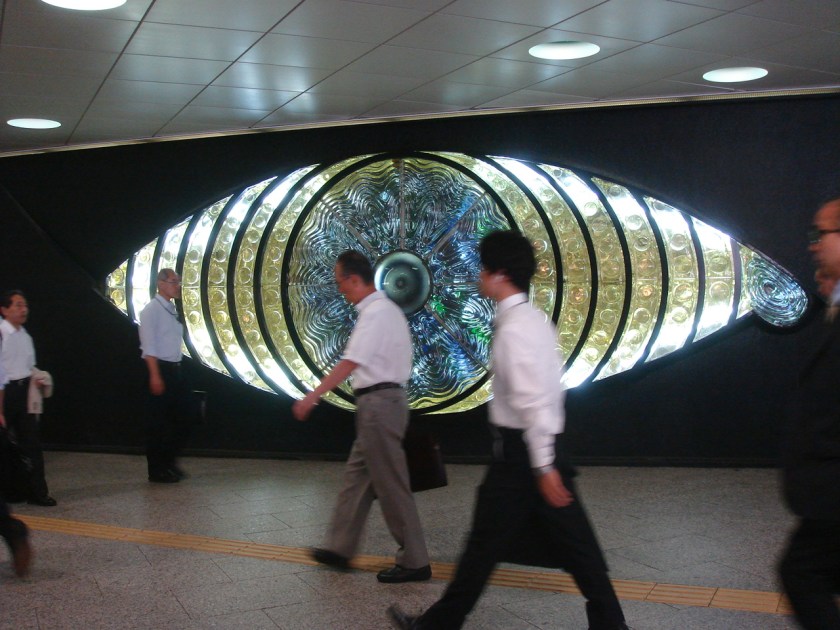
Somebody's watching you... office workers walk past an installation in Shinjuku station, Tokyo

We’ve met with several Japanese surveillance studies researchers whilst out here this time. I mentioned Ogura Toshimaru already the other day, but we also had a long meeting the week before with Hino Kimihiro, a researcher into bohan machizukuri (community security development), and government advisor on security planning. Dr Hino has been carrying out a number of research projects on both ‘designing out crime’ and on the effectiveness and public acceptability of CCTV in Japan. I hadn’t come across this research before as my contacts here were mainly in social sciences and law and Dr Hino tends to publish in urban planning journals and is not connected to other Japanese surveillance researchers. His work is very interesting and reminiscent of that of Martin Gill or Farrington and Welsh in the UK. It is a shame, that just like those researchers who have carried out analyses of CCTV for the UK Home Office, his assessments tend to be ignored by the government. Dr Hino’s latest project is to assess the trials of a new movement recognition system in Kawasaki city. I hope he can come to the January Camera Surveillance workshop at Queen’s University, Ontario, or the April Surveillance & Society conference in London (details coming soon!).

I also met today with Tajima Yasuhiko, a professor of media law in the School of Journalism at Jochi (Sophia) University in Tokyo. Professor Tajima has been one of the most important critical voices in the debate about surveillance in Japan, and has bridged the academic and activist world, being involved with legal action against juki-net and Google StreetView. We had a productive conversation about the politics of surveillance in Japan and the prospects for critical voices to be heard. He wasn’t optimistic that they would be, and neither am I after our meeting at the Prime Minister’s IT Strategic JQ the other day, however I am also convinved that in many ways Japan has not yet gown as coordinated and centralised a route on issues of security and surveillance as has the UK. There is, so far as I can see, no real attempt to link up things like juki-net or other databases and the anshin anzen (or bohan) machizukuri agenda, and i-Japan, national and local police, and wider community security agendas do not really coordinate at all. This is due to the lack of an obvious ‘threat’ like that of terrorism in the UK, around which such coordination can occur. The government half-heartedly tries to get people worried about North Korea, but really they aren’t, and ‘ageing society’, whilst a phrase used to justify almost anything (including central databases) is a worry, it does not generate the fear that comes with the war on terror.

We also considered the relative weakness of Japanese civil liberties organisations and the failure of the mainstream media to pick up on issues of privacy and surveillance. There seems to be some effort now to try to coordinate various organisations to push for an explicit constitutional protection for privacy (rather than the rather vague inclusion of such an idea in a wider notion of the ‘pursuit of happiness’), but whilst I can see that being happily accepted after the government has got its central database(s), I can’t see it being done in time to alter either this trajectory or the way in which the database(s) are built.

Varieties of anti-surveillance activism in Japan

Although some progressive activists would like it to be otherwise, anti-surveillance feeling is not confined to the left, indeed in many countries, like the USA, libertarian individualist right-wing anti-surveillance activism is perhaps more common. And it seems that such a position is not unusual in Japan either.

Having returned from a weekend of hot springs, fine sake-tasting and eating way too much, today we met with the Mayor of the Suginami ward of Tokyo, Hiroshi Yamada, a prominent figure in the anti-juki-net campaign, and a also one of the leaders of a group of right-wing figures trying to promote a new nationalist grouping at that end of the Japanese political spectrum. But this new right is not at all a simple matter of ‘back to the 1930s’ that some commentators would have you believe. Yes, this group – which also includes the Mayors of major cities including Yokohama and Nagoya as well as popular journalists like Yoshiko Sakurai – has very conservative, revisionist views, on Japanese history, but in many ways they have far more in common with the new US libertarian right in their rejection of large state and high taxes, and in other areas too, for example Sakurai has rather unscientific views on climate change!

Part of the this libertarian outlook is the rejection of state intrusion into the private lives of individuals. Mayor Yamada saw the juki-net system as part of unwelcome movement towards a more top-down society, concentrating power at the centre. He was very clear that the state’s ability to collect information on the individual should be based on what the individual wanted to give up, not on what the state thought it needed (this is very much the opposite of what the Prime Minister’s IT Strategic HQ said to us last week). He was also most concerned about the risks posed by large databases, both as an attractive target to external hackers and to corrupt use from inside operators. Yamada is not opposed to what he calls IT shakai (IT society), but the use of IT should be based on what is useful to individuals, and of course what is actually he needed, he argued, would often be less expensive than the massive computerisation schemes favoured by the current administration as part of their i-Japan strategy. In this sense, he said he would oppose any move to unnecessary centralised databases and certainly to any possible national ID register or card.

In most respects, what Mayor Yamada said could probably have been said by any left-wing civil liberties activist in the UK, or by conservative right opponents of intrusive state like Conservative ex-Shadow Cabinet Minister, David Davis. Perhaps many aspects of what is felt to be wrong with surveillance society do not correlate neatly with old left-right divisions. This view was shared by Toshimaru Ogura, a Toyama University professor and major figure in left-wing anti-surveillance activism whom we met with just afterwards, along with campaigning journalist, Midori Ogasawara again. Just as the Convention on Modern Liberty event earlier in the year showed for the UK, there are many different varieties of anti-surveillance feeling in Japan, and whilst opponents may disagree with each other, and may even find other aspects of the politics of their erstwhile collaborators utterly distasteful, they do collaborate, even if it is only for short periods.

Professor Ogura’s analysis, as that of Ogasawara and indeed of Kanshi-no! whom we met the other day, is much more focused on the way in which surveillance excludes and discriminates – against union members, activists, gaikokujin (foreigners) and so on – and also the ways in which it favours the interests not just of the state but capital. We’ll be talking to groups who deal with the concerns of these excluded people in the last week we are here. Privacy is important, but Ogura’s analysis is concerned with the disproportionate effects of surveillance. It is not just that privacy is affected but that particular groups’ and individuals’ rights are damaged more than others, and those people are not generally the ‘ordinary taxpayers’ to whom Yamada and the libertarian right are trying to appeal.

Like me, Professor Ogura is also particularly interested in the way in which particular corporations and business coalitions pushing technological ‘solutions’ to social and organisational problems can have a profound influence the way government makes decisions. Such coalitions would still be there however large government was, and in some ways, without a government large enough to stand up to the private sector, a different kind of more purely market-driven surveillance society would emerge. In that sense, it is what government does, and to whom it responds, that is more important that more arbitrary questions of ‘size’.

There’s a lot more to consider here too, in particular the extent to which any of the things we consider under the umbrella of ‘surveillance’ are actually and actively part of some coordinated state (or other) plan. I’m starting to develop a sense of this here, but I will leave those thoughts to another post.

(Thank-you to Mayor Hirioshi Yamada, Professor Ogura Toshimaru and again, to Midori Ogasawara for being so generous with their valuable time).