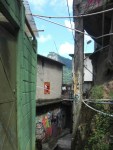
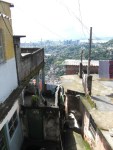
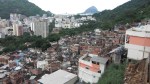
One of our most interesting visits last week was to the favela of Morro dos Prazeres, north-west of Santa Teresa. Prazeres has one of the most astonishing views of Rio of any neighbourhood, with an almost 360 degree panorama of the city, it’s perspective to the south only interupted by the statue of Christ the Redeemer, which is hardly a bad view in itself! You might think that the last thing that favelados would care about was the view but they are well aware of the beauty of their location – the assumption that the poor an desperate would not care about such things is a rather patronising misconception. Elisa, the leader of the community association, at least, seems most proud of this asset and says that like many people she wouldn’t want to live anywhere else even if she won the lottery!
But Prazeres does have serious problems. For a start, it is a ‘hot’ favela, occupied by drug traffickers, who control ‘law and order’ in the place. There is therefore no ongoing police presence, although as with many such communities, the community association does have a relationship of sorts with local military police commanders through organised coffee mornings at which problems are discussed. Luckily, despite or because of the almost complete control of a particular gang which is well integrated into the community (i.e.: they are relatives of the more law-abiding members), there are not many problems with violence and the police, ‘thank God’ (says Elisa), have not raided the favela recently, as they have many others.
In fact, as we were visiting Prazeres, as the taxi driver rather anxiously pointed out as he dropped us a safe distance away, BOPE (military police special operations) were ‘invading’ two other favelas next to it, the very hot Morro de Correoa, and Sao Carlos. The operations left eight dead, and we think what we had assumed initially were fireworks was probably the sound of small arms fire in the Sao Carlos operation. However, when we asked a PM at a nearby police post whether Prazeres was safe to enter, he seemed rather blase and relaxed about the whole thing…
Elisa was another very impressive woman. In the absence of men – who, in the favelas are in many cases, either involved in the gangs, working outside, or unemployed and alcoholic – it seems that a whole generation of strong, courageous women has emerged to try to develop their communities from the bottom up. In the past they have benefited from various attempts by previous mayors to provide development for the favelas. Unlike some places, Prazeres does not have a school built during the regimes of populist left-wing Governor, Leonel Brizola (who seems to be fondly recalled in by almost all those we have talked to in the poorer communities). However there was a lot of intervention as part of the Favela Bairro (Favela Community) program of former Mayor, Cesar Maia, and it is this normalisation or the favelas through infrastructure, social and economic development, education, health and social services that Elisa said are the only long-term solution to the problems of Prazeres. The creche in particular is a source of continual delight to her, and her face lit up whenever it is mentioned.
With social development and education, Elisa argued, eventually the ‘cold’ and uncaring gangs will recruit fewer kids, and they will wither slowly away. Confrontation however, only strengthens them by driving more young people to support the ‘insider’ traffickers against the ‘outsider’ police. They must, she said, work like little ants, with lots of small efforts adding up together to long-term success… then perhaps the anthill of Prazeres will function as a normal community.
We’ve been so busy these past two days that I have not had time to update the blog with all the visits and interviews we have been doing. I will try to do so over the weekend… Just to summarise, we’ve been to another favela, Morro dos Prazeres and met with the leader of the community association; the HQs of the Policia Civil and the Guarda Municipal. We visited the State Secretariat for Public Security twice, once to talk to people from the office of the Secretary, and once to visit the CCTV control room and talk to the director. And finally we talked to two politicians from different eras – the ex-Governor, and also Security Minister under Leonel Brisola, lawyer and academic, Nilo Batista (and also his wife, sociologist, Vera Malaguti Batista) and Deputado Estaduel, Alessandro Mollon, a leading campaigner for human rights and real public security in the state legislature and various members of his team.
Next week, on Monday, we will be going back to Morro Santa Marta to talk to BOPE Commandante Priscilla; and then I will be spending the rest of the day between the neighbourhood association of wealthy Laranjeiras and that of a nearby favela, also ‘pacified’, Tavares de Bastos, and its BOPE battalion. On Tuesday I am giving a talk on my project at the Federal University of Rio de Janeiro, and hopefully on Wednesday or Thursday morning we might just get to talk to Major Eduardo Paes, and someone from the state’s Ministry of Cities, as well as the already fixed appointment with the influential NGO, Viva Rio.
Then it’s Easter and I have to go home… I have to come back. I feel like I have barely started here. I need to do more interviews at national level, and the survey work I was hoping to do has been squeezed out by the interview schedule. In any case, the level of comparative study I am doing means I cannot explore, literally and metaphorically, all the avenues and back-alleys that I would like. And there is so much going on here that is interesting and important in terms of the complex relationships around social justice, crime and disorder, (in)security, surveillance and social control.
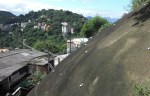
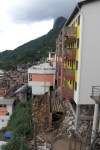
It’s been raining all night and sometimes the rain has been very heavy, pounding on the corrugated plastic roof of my small room. It is making me think more urgently of the favelas and their situation. Following what Paulo Saad was telling me yesterday, I have been reading a very interesting and worrying article by Schuster et al. in a book on landslides. The combination of the climate (heavy rains from January to March) and underlying geology (steep weathered granite slopes and residual soil on top) makes Rio particularly susceptible to landslides. Combined with the prevalence of illegal and unsafe building spreading further to higher and steeper slopes, you have a real recipe for disaster: simple landslides can become debris flows as more material accumulates into the slide and adds to its weight and destructive capacity.
In 1966 and 1967, there were over 1000 deaths from landslides after particularly heavy rain in the Rio area. Santa Teresa was also badly hit by last series of catastrophic landslides to affect Rio in 1988, when the Santa Genoveva Hospital for elderly people was destroyed, killing 34. Altogether 120 people were killed and, perhaps even more worrying for future development, 22,000 were made homeless. According to sources quoted by Schuster et al., this was after less than an hour of particularly heavy rain…
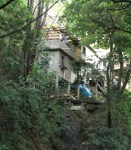
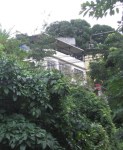
After the late 1960s events that action was taken to reforest the undeveloped slopes around Santa Teresa and reinforce some parts of the hill with concrete channels to direct the flow of water. Building regulations were also strengthened. However, it is in this area that much of the recent illegal building is taking place – and as I mentioned, not just by the desperate and ignorant poor, but also by simply greedy and uncaring middle classes.
Paulo
prevention
risky houses
Illegal villas
New favela
Flood works
Reference
Robert L. Schuster, Daniel A. Salcedo and Luis Valenzuela. Overview of catastrophic landslides in South America in the twentieth century, pp.1-34 in Catastropic Landslides: Effects, Occurrences, Mechanisms. ed. Stephen G. Evans and Jerome V. DeGraf, Geological Society of America, 2002.
We visited two very different communities today, Santa Marta and Santa Teresa, but despite their differences, in both places we met with an equally impressive community representative.
Morro Santa Marta is a relatively small favela that climbs the steep slope below the peak known as Dona Marta (which is why the favela is often incorrectly called ‘Dona Marta’), above Botafogo, and just on the other side of the hill from the much wealthier neighbourhood of Laranjeiras. Santa Marta is well-known largely because it is perceived as a success story, indeed as we were being taken around he community, journalists from Globo TV were embarking on a month-long series of features and interviews with different members of the community, and representatives were scouting the place as a location for the ‘Red Bull Down’ urban downhill mountain biking series (see this description of a related event in Puerto Rico)… in short, Santa Marta is fashionable.
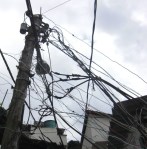
It is also the target for a number of state interventions; indeed I don’t think I have seen as many different workers from as many different agencies in one place at one time anywhere in Brazil. There were transportation workers on the newly-finished cliff railway, there were workers from the planning department shoring up recently-constructed houses to prevent landslides, there were electric company workers struggling to make sense of the maze of cables, there were refuse workers, and at the base of the favela there was a load of people from the new Motorola-sponsored Digital Santa Marta initiative that is wirelessing the whole neighbourhood. It seemed that various government interests badly want Santa Marta to continue improving, and that a lot is riding on this.
However, as we soon discovered, there is a more complex and fragile reality underlying the business and the superficially sheen of hype. Our guide for the morning was Sonia Oliveira, one of the directors of the community association, and a resident for many years. As we ascended the railway with her, we met her son, and other people, like Luis Gustavo, who she had known since he was a baby… it was clear that Sonia was well-known and well-liked. And who wouldn’t like her? Sonia is a strong woman with a calm, determined presence and an insight matched by the realism of experience.
The key to Santa Marta’s success so far has been the combination of many years of careful community work, combined more recently with a determined effort by a particular battalion of the BOPE (military police special operations) to drive out drug traffickers and secure the community, under Commandate Priscilla, who we will hopefully meet next week. It is not as if the community is any more sympathetic to the police than anyone else in Rio, but the relationship between the people involved here is clearly a special one. And whilst the police still do not understand the community fully – there are still frequent complaints of harassment of young men and the closing down of parties – there is some evidence that they are learning and changing to a small but important extent. One problem now is that the wider context of the ‘choque de ordem’, which is basically a rather more aggressive version of the famous New York ‘zero tolerance’ policy, is threatening to roll back these small improvements in trust and understanding. The police hassle unlicensed stall-holders, which is how most favelados make their living, they stop taxi drivers for checks of insurance and licensing, and of course, they threaten, and indeed carry out the threats, to demolish illegally constructed buildings – which is of course, potentially any piece of the favela. However, for Sonia, the over-assertiveness of ‘choque de ordem’ policing is outweighed by a far greater another fear – which is what happens if the political climate changes, or financial or strategic reviews mean that the BOPE are forced to withdraw from Santa Marta. If they do, she argues, the traffickers will return, and it will be worse than before, as not only will they take control of the community, but they will ‘punish’ it for collaborating with the authorities.
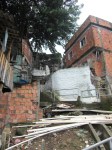
And things must continue here. In many ways they have hardly started. There might be a lot of activity but the favela remains lacking in infrastructure, especially sewage and healthcare. Most of the self-built constructions remain precarious and a severe risk to their inhabitants and those below in the case of heavy rains and consequent landslides. And the understanding of neighbouring communities is far from guaranteed. One might think that neighbours would be grateful that the traffickers are gone and even make efforts to integrate Santa Marta further into the city, but Laranjeiras in particular has been causing all sorts of problems for the favela, in particular over the construction of a school and creche at the top of the neighbourhood. The problem was basically that the school can be seen over the top of the hill, and this led to the fear that Santa Marta would begin to spread over the top and down to the back gates of the expensive apartments and villas of this rather exclusive community inhabited by people like Governor Sergio Cabral. In fact, unlike several other favelas, Santa Marta is not expanding at all. It is becoming a more mature and controlled community, and it is rather ironic that it is at this stage of its development, that it becomes an object of fear and concern for its richer neighbours. The argument has been resolved for now, and the school stays, indeed it is the temporary home of the battalion and the community police, who get a good overview of the neighbourhood from its commanding position. The lack of expansion of Santa Marta has not stopped the State from starting the construction of a wall along its west side. As Sonia says, there is no need to make favelados feel like they are living in a ghetto…
Paulo Oscar Saad was against the building of the school, indeed he is against the expansion of any illegal community into the hills of the area, but in truth this is the only real substantive grounds for disagreement between the leader of the Santa Teresa community association and those in Santa Marta. Santa Teresa is however, an entirely different place. Once a hillside retreat for the rich, its crumbling mansions have for a while now been occupied by an eclectic mixture of artists, academics and other bourgeois but generally progressive people. For many years it served as a kind of cultural centre for the surrounding poorer neighbourhoods, including the many favelas, with favelados mixing with the artists in the bohemian bars and cafes.
However, this mixture has been undermined by three main developments. The first is the aforementioned illegal building, which threatens the very stability of the hillsides which support Santa Teresa. It isn’t just what one would recognise as ‘favelas’ either; many of the illegal buildings are constructed by relatively or even very wealthy people, and often on land reforested precisely to prevent landslides after two previously disastrous deluges in the 1960s and 1980s. The second is the change in the nature and intensity of crime in Santa Teresa. The neighbourhood had always put up with a certain amount of petty theft and pickpocketing, but the arrival of cocaine (and more recently, crack) and in particular the arming of the drug gangs has led to an increase in both actual serious crime and fear. Finally, the gentrification of Santa Teresa is threatening to destroy the easy-going and bohemian atmosphere of the hillside on which it is based. It is an old story, seemingly destined to be endlessly repeated in similar communities all over the world. The old bars and cafes close, and the new upmarket establishments exclude the poor either overtly by policy or implicitly through price. The fear of crime has also driven many residents into the arms of private security companies, who have gated several dead-end streets and equipped them with guardposts. The signs say they are legal; the Community Association says that they are not. In fact the latter are correct. Paulo, like some other I have talked to here, is sure that the private security companies are intimately linked to the militias and indeed to the criminal gangs, all of which reinforce each other in an ongoing spiral of criminality and securitisation. However it is not as if the police (of any kind) or the politicians can be trusted to deal with the situation. According to the community association leader, the police are entirely corrupt and the politicians are fashion-driven media slaves. The only hope lies in bottom-up community power, yet the community is increasingly divided, and even the remaining assets that make Santa Teresa what it is are being cashed in: the wonderful antique tram system that rattles up the hillside is being privatised and its future is uncertain…
It seems that both community leaders are scared of losing what they have and battling to keep their neighbourhoods alive, inclusive and connected, but both are being hampered by uncertainty and contradictory policies and developments at levels which they cannot seems to influence. The future of Rio depends on people like this being supported not undermined by the state at its various levels (which still do not appear to know what each is doing, let alone look like working together). Oh, and I almost didn’t mention surveillance… that’s because like almost everyone else on the ground here, surveillance is seen as a frippery of the rich and something which has no practical use or meaning for the reality of their lives. There is also a strong sense of freedom too: and things like CCTV are seen as a definite infringement of that liberty. The more I get to know people and places here, the more I am certain that Brazil is nothing like a surveillance society and the changes that it would take to become one would be almost inconceivable in scale and cost.
redemption?
public face
Laranjeiras
Santa Marta Digital
police
School
Sonia
tangle
Inside
funicular
wall
Santa Marta
Note: there are photos of Santa Teresa in the next post and there will be more later this week.
Paola and I had a very productive interview with Colonel Mario Sergio de Brito Duarte, the Director President of the Institute for Public Security (ISP) in Rio de Janeiro. The ISP is a state-level organisation with multiple functions including research on public security and the compilation of crime statistics; professional development for the police services (and also more broadly to encourage greater cooperation and coordination between military and civil police); and community involvement and participation in the development of security policy. The Colonel gave us an hour and a half of his time to explain his view on a wide range of issues around crime, security, the problems of the favelas, and the potential for surveillance, social interventions and policing in solving these problems.
As with many senior police (and military) officers with whom I have talked over the years, the Colonel is an educated, thoughtful man who has strong views based in his experiences as a front-line officer with the Policia Militar in Rio (including some years in BOPE, the special operations section) – as detailed in his book, Incursionanda no Inferno (Incursions into the Inferno). Despite how the title may sound, he was far from being gung-ho or authoritarian in his views, emphasising throughout, as with almost everyone I have talked to, that socio-economic solutions will be the only long-term guarantee of public security in Rio. And he certainly had no sympathy for the illegal actions of militias, despite understanding why they emerged and continued to be supported by some sections of the community.
However, it was also clear to him that current policies like Mayor Eduardo Paes’ ‘choque de ordem’ strategy which involves demolitions of illegally-built houses in the favelas, was absolutely necessary as well. He spent some time outlining his view of the history of how drug gangs infiltrated and gained control of many favelas, an in particular the importance of their obtaining high quality small arms – though he was vague on exactly where these arms came from – I have, of course, heard allegations from other interviewees that corrupt soldiers and policemen were one common source of such weapons.
From the point of view of surveillance studies, it was notable how profoundly indifferent the Colonel appeared to be towards he growth of surveillance, and in particular CCTV cameras. He argued that they might be a useful supplement to real policing, but he certainly did not appear to favour a UK-style ‘surveillance society’ – of which, at least in Rio, there seems little sign as yet. He was similarly indifferent towards other central state social interventions like the Programa Bolsa Familia (PBF), and initiatives like ID cards – of course they might help in some way, but he certainly made no attempt to ague, as the UK government has done, that such technology will make a big difference to fighting crime and terrorism (indeed it was interesting that ‘terrorism’ was not mentioned at all – I guess that, when you have to deal with the constant reality of poverty, drugs and fighting between police and gangs, there is no need to conjure phantasms of terror). Even so, the Colonel recognised that the media in Rio did create fantasies of fear to shock the middle classes, and that this sensationalism did harm real efforts to create safer communities.
There was a lot more… but that will have to wait until I have had the whole interview transcribed and translated. In the meantime, my thanks to Colonel Mario Sergio Duarte and to the very nice and helpful ISP researcher Vanessa Campagnac, one of the authors of the analysis of the Rio de Janeiro Victimisation Survey, who talked to us about more technical issues around crime statistics.
I may have been slightly worried about the most recent drugs war that was going on as I arrived, but as usual this appears to have been exaggerated by the press who largely serve the richer, middle-class community, and who appear to want to have their fears stoked on a regular basis. The ‘war’ is a trafficker conflict that involves traffickers based in the large favela of Rocinha, who belong to the Comando Vermelho (CV, Red Command) the oldest and largest of the prison-based umbrella groups of Rio drug traffickers, attacking another favela, Ladeira dos Tabajaras, whose traffickers are backed by the ‘Amigos Dos Amigos’ (ADA, ‘Friends of Friends’). This kind of thing is happening on and off all the time, but what made it a concern of the paranoid middle class in this case, was geography: in order to get to Ladeira dos Tabajaras, the Rocinha gang had to go through the rich high-rise area of Copacabana… to say that it is exaggerated is not to say that it is not dangerous: 8 people have so far been killed, but they are all traffickers and, I believe, all killed following police raids into the favelas.
It is probably no coincidence that this display of force by the Rocinha traffickers is happening just as the city government of Rio has started to implement a policy of the current Mayor, Eduardo Paes, known as ‘choque de ordem’ (the ‘shock of order’), which involves sorties into communities like Rocinha largely to enforce planning regulations by destroying recent illegally built constructions, which are pushing the favelas even further up into the hills. In the last few days, this policy has resulted in the demolition of one particular controversial building, the Minhocão in Rocinha. This was due to start on the 17th, but was halted by a judicial decision, before going ahead in recent days.
There is more than a degree of irony here. The purpose of these demolitions is supposedly to enforce urban planning regulations and ‘protect Rio’. The Secretary for Public Order, Rodrigo Bethlem, is quoted by O Dia as saying (in my translation):
“We cannot permit an entrepreneur to come into Rocinha to build and make easy money by exploiting people. We cannot allow Rio De Janeiro to be destroyed by speculators, who want to make money without following any rules and who aim only at profit.”
Yet, I only have to glance out of my window here to see the towers of the Centro, built by wealthy speculators, which have almost completely destroyed the beautiful Parisian-style boulevards and belle epoque architecture that used to be ‘Rio’. And turning the other way, the coastline it dominate by the secure condominiums long the beaches, which I am pretty sure were not constructed out of the kindheartedness of developers, and whose development no doubt involved corruption at higher levels of urban government. Looking uphill, I can see the often dubiously if not illegally-constructed houses of the rich that cut into the edges of the National Park.
Can we look forward to the demolition of all of these disfigurements of Rio? Of course not… and the reason is obvious. The demolitions in Rocinha are about power projection. Local state policy towards the favelas goes in waves that alternate between socio-economic solutions and violent authoritarianism. For all its negative aspects, many people who are concerned with social justice here recall with some nostalgia the progressive populism of Leonel Brizola who was mayor in the 1980s. His administrations installed infrastructure, built schools and improved houses in the poorest areas.
The current administration of Eduardo Paes is taking a very different and harder line, concentrating on law and order, a stance which was laid out clearly during the Pan-American Games when the police effectively occupied several of the favelas in an Israeli-style security operation. There would be nothing wrong with this if it were backed by some kind of progressive social imagination too – some favelas like Dona Marta, which I will be visiting later this week, have apparently been transformed through a combination of strong control and surveillance with real social improvements.
Instead there are apparently plans to further marginalise favela residents by building a wall along the major highway from the international airport into the city, so that all the city’s elite can feel so much more secure, and of course, visitors will not have to even see the favelas (some or Rio’s most miserable) which line the route… there’s more than a whiff of Israeli tactics about this too. Whether by building or by demolition, urban planning seems to be currently used as a weapon against the favelas and their inhabitants.
Sport and surveillance might not seem the most closely linked topics, but there are intersections and these are increasing in number. Sports ‘mega-events’ are often the trigger for surveillance surges, with the introduction of new technologies and practices. Because of the use of drugs and other medical techniques to illicitly aid performance the practice of sport is now a subject of constant suspicion and the body of sportspeople are the sites of intense scrutiny (drugs testing, biological passports etc.). And finally, sports fans are subject to all kinds of controls and monitoring.
In this last area, the Brazilian government has recently announced a national ID card scheme for football fans… this is of course in addition to the new national ID card that everyone in Brazil will have to carry anyway.
However, in common with many commentators here, Brazilian football researcher, Oliver Seitz, does not believe the plan will or should happen. He makes a penetrating comparison to the very similar proposals in the UK in the 1980s and also notes that, whatever the problems of violence in Brazilian stadiums, they are not the main problem, which is the crumbling and unsafe infrastructure of football stadia. The one recent tragedy in Brazilian football, when 7 fans died after falling through rotten seating at Fonte Nova, he says “only happened because the stadium was literally falling to pieces. In that situation, the identification wallet it would not have saved the victims”.
He is quite right. As usual this appears to be a case of a technological ID solution to a problem that has nothing to do with what identification. To paraphrase Seitz’s conclusion, Brazilian supporters are treated like animals, so they behave like animals, and under this plan, it will be no different, except that they will be officially identified animals!
(Thanks to a dedicated Corinthians fan, Rodrigo Firmino, for this story – which is one with which I am catching up after my holiday!)
There is no reason why with the same infrastructural, social and economic support as anyone else in society would expect, that the favelas could not become truly beautiful without being cruel…
I am trying to think of something not too banal or cliched to say about Rio de Janeiro. It is rather difficult when I am sitting in my room in this artist’s house in Santa Teresa with its balcony overlooking the whole city centre and the bay and Niteroi on the other side, with bossa nova drifting up from the room below…
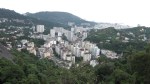
Being on a hill though, Santa Teresa is as good a place as any to try to get an initial feel for the geography of the place. Whatever you have read about Rio, however many pictures or films you have seen, it is still impossible not to feel utterly astonished, and in many ways delighted, by the place. Rio is unquestionably the most beautiful city I have ever been in. The shapes of the hills, the curves of the coast, the collision of architectures, the forest which comes right down into the city itself. Flying in, you could see its sprawl (this is a city of over 10 million people), but from the inside it is all small neighbourhoods, and more importantly all edges. One never seems to be entirely in one place in Rio, rather one constantly walks the boundary between city and forest, wealth and poverty, high rise and favela…
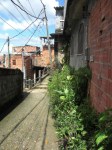
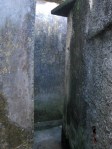
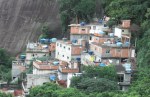
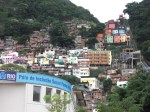
Because the poverty and the favelas are also inescapable. Unlike in San Paulo, where the favelas are located more on the periphery and can therefore be ignored by the rich, in Rio the rich and poor neighbourhoods are locked together like the fingers of clasped hands – but are they locked in mutual dependence or a death grip? The richer areas tend to run up the flattest land, whilst the favelas cling to the steeper slopes above and below. The disturbing thing for anyone who would try to form any swift opinion, is how beautiful the favelas are seen from my bird’s eye view. Rio’s beauty is matched by its cruelty, and even its cruelty is beautiful. The houses of the favelas follow the precarious topology of the hills, they pile onto each other, tiny alleys and stairs running in between. Self-constructed, they take the most natural forms that available resources allow, and in many ways are therefore the most human-looking places one can imagine. They most resemble the ancient towns of Greek islands or the Italian coasts, what Donald Ritchie called the ‘crammed mosaic’ of Tokyo neighbourhoods or Cornish fishing villages – the kinds of places that inspire deep feelings of the most intimate community.
But these are places of the most miserable poverty, crime and violence. From the bird’s eye view, you can’t smell the shit flowing in the streets, or see the tired, desperate faces of the inhabitants. It is because the architectural form, whilst it evolves from necessity, is not the cause of the socio-economic problems. Form does not, contrary to a still quite prevalent but regressive moral imagination, lead to a necessary moral or social outcome. The old rightist way of dealing with the ‘favela problem’, which was shared with leftist modernism, was the blank slate. Wipe out the favelas, put the people somewhere else, and everything will be okay. They were wrong. There is no reason why with the same infrastructural, social and economic support as anyone else in society would expect, that the favelas could not become truly beautiful without being cruel, why they could not come to be seen equally much as examples of the perfection of human settlement as Santorini or the old town of Lisbon, Mousehole or Mejiro…
The big question is how they get there. Rio’s multiple edges, its ubiquitous boundaries, are in many ways the most secure borders. The favelas are oppressed both by the most intimate micro-authoritarian internal control of the drug trafficking gangs, the uncaring external ‘prison-wardening’ and exploitation of the police and vigilante groups, and the utter fear and disgust of the richer classes who often see the favelados as nothing but criminals. I can’t suggest easy solutions to the fundamental problems, but part of what I am going to do over the next two weeks is to talk to a whole variety of people about the issues of surveillance and control and how some forms of surveillance should be broken or released and some should be made to work for people, not against them.
I’m off to Rio de Janeiro on Thursday… as most people will be aware, Rio is far a long way from the romantic Hollywood-generated image of sun-kissed decadence. It is perhaps the most extremely divided city in the world. The richest parts have a higher standard of living than almost anywhere else and the poorest parts barely cling to the hillsides and to any kind of an existence. I have been reading Enrique Desmond Arias’ enlightening Drugs and Democracy in Rio de Janeiro (amongst many other books) in preparation, and right on cue, a major drugs war has apparently broken out between trafficking gangs in the Copacabana area…
I am going to be interviewing state and community representatives, and carrying out mapping exercises to assess the state of surveillance and security in several different neighbourhoods of varying social classes. The drug war is making me a little nervous, but in many ways it is an ideal time to be asking the kinds of questions I need to ask. Of course reading a book like Arias’, you tend to get anthropology-envy, but I just have to remember that my study is a very different kind of research. I am still trying to get a feel for the kinds of indicators that would enable us to make serious comparisons between the intensities and forms of surveillance across cultures and nations – and I am still very much at the beginning of the project. Some of these indicators might seem common sense and obvious but some are not, and some may not even be in any way ‘measurable’…
My fantastic temporary Research Assistant is Paola Barreta Leblanc – she has created a mash-up of my current schedule here (it will get more complex!).
For the last three days, I’ve been at the Surveillance, Security and Social Control in Latin America symposium, organised by Rodrigo Firmino at PUCPR (with help from Fernanda Bruno, Marta Kanashiro, Nelson Arteaga Botello and myself). The conference was the first to be held on surveillance in Brazil and will be the start of a new network of surveillance researchers in Brazil and more widely across Latin America.
All of the presenters had something interesting to say and I learned a lot from the event, however it is worth noting some individual presentations and sessions that were really insightful. There were great keynotes from David Lyon, Luiz Antonio Machado da Silva and Nelson. Two sessions stood out for me: one on Rhetorics of Crime and Media which had an exceptional central presentation by Paola Barreta Leblanc, a film-maker and currently a student of Fernanda Bruno’s. Her paper (and films) on the way in which we impose narrative onto CCTV images argued cogently that we see CCTV with a (Hollywood) cinema-trained eye and consequently overestimate (or over-interpret) what we are seeing. The other papers in the session were also good, in particular Elena Camargo Shizuno on Brazilian police journal of the 1920s and how they trained the vision of middle and upper-class Brazilians of the time through a combination of reportage, fiction, and advocacy. The session as a whole left me with many new questions and directions of thought.
The other really sparky session was on the last day and was on the Internet and Surveillance. The first paper was from was Marcelo de Luz Batalha on police repression of community and activist networks at the State University of Campinas, which linked nicely into concerns I have been following here on the surveillance of activist networks in the UK. Then there was Hille Koskela’s theoretically sophisticated and searching paper on the Texas-Mexico border webcam system (that I noted back in January) which explored the ways in which this participatory surveillance system both succeeded and failed in inculcating an attitude of patriotic anti-outsider watchfulness and responsibilization of citizens. Finally there was an interesting if not entirely successful film from Renata Marquez and Washington Cancado which used Charles and Ray Eames’ famous Powers of Ten, one of my favourite bits of pop-science ever, as an inspiration for an exploration of the uneven gaze of Google. They provoked some very interesting thoughts on the ‘myopia’ of the new ‘god-like’ view we are afforded through interactive global mapping systems. I think their approach could be very fruitful but it is still missing some key elements – having talked to them, I am convinced they will turn this into something really excellent. I have asked them and Paula to submit their work to Surveillance & Society’s special on Performance, New Media and Surveillance, because I think both are exactly the kind of explorations we are looking for. If Fernanda Bruno’s excellent paper on participatory crime-mapping has been part of this session, it would have been perfect! See Fernanda’s thoughts on the seminar over at her blog – she was also Twittering throughout the event but I’m afraid I just can’t get on with Twitter!
Other memorable papers included Danilo Doneda’s on the new Brazilian ID system, which sparked our post-conference considerations on where to go with this new network, which will probably be a project on Identification, Citizenship and Surveillance in Latin America. Nelson Arteaga Botello has already generously agreed to host the next symposium on this theme in Mexico City next March! Fernando Rogerio Jardim gave a passionate paper on the the SINIAV vehicle tracking pilot in Sao Paulo and I was most impressed with the careful Gavin Smith-style CCTV control-room ethnography by one of Rodrigo Firmino’s students, Elisa Trevisan, and Marta Kanashiro and Andre Lemos both gave insightful presentations too – I’ve already come to expect both care and insight from Marta in the short time that I’ve known her. I hope we’ll be able to work more closely together in the future. Let’s see…
The event as a whole was a great start for the study of surveillance in Latin America, despite the disappointing lack of Spanish-language interest. This is just the beginning, and the new networks of scholars here will grow. I was just happy to be there a the start and play a small role. As for my keynote, I took the opportunity to do something a bit different and instead of doing my usual tech-centred stuff, I gave a talk on the emotional response to surveillance and how this might form the basis for reconstructing (anti-)surveillance ethics and politics. I have no idea whether it really worked or what people got out of it…













 ubisurv