CNBB 2009 Campaign on 'Fraternity and Public Security'
One organisation I haven’t mentioned much since I have been in Brazil is one of the most important, influential and yet always controversial: the Catholic Church. Brazil was one of the centres of the Liberation Theology movement and these activist priests, unlike the church hierarchy in many Catholic countries, never sided with the dictatorships. Liberation Theology remains a major influence and movement within the Brazilian church and it is no surprise to see the fraternal organisation of the Conferência Nacional dos Bispos do Brasil (National Conference of Bishops of Brazil or CNBB) taking their campaign theme for this year as Public Security.
However, at the same time, the Church in Brazil seems to be clamping down on dissent and on those priests who are too outspoken on behalf of the poor and the victims of violence and insecurity. Today, the BBC is reporting that Father Luiz Couto, who is from the north-east and a colleague of President Lula (he’s a Workers’ Party federal deputy), has been suspended by the Church for advocating the use of condoms for public health and having a liberal attitude to gay rights.
Couto has however also been for many years a serious campaigner against unofficial ‘death squads’ and Autodefesas Communitárias. It seems to be at the very least bad timing by the church to suspend him just after announcing their year of campaigning on public security. He has my support and my sympathy. The Church needs to live up to what the CNBB are proposing this year and focus more on the realities of the big social questions that bedevil Brazil and not shoot themselves in the foot by suspending their best members over what should be matters of opinion on personal morality.
on foot, you are immediately confronted by the unpleasant reality of what is to the pedestrian effectively a huge expanse of carpark and highway separating the areas you might want to be. The functional split between the ‘zones’ only makes this worse.
Again, this is urbanism rather than surveillance, but here are some more musings and pictures on the urban form of Brasilia. Yesterday, I posted a lot of conventionally attractive shots of the buildings around the monumental axis of Brasilia. However, leaving aside the wider question of whether Brasilia outside of the planned centre functions as a city, there is a rather less beautiful side to the core.
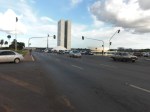
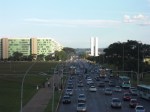
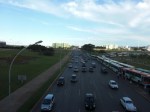
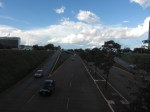
This mainly has to do with the practical consequences of the philosophy behind the plan and particularly with functional separation and transport. As I noted when I first arrived, the city is dominated by roads. 5-lane highways run down either side of the monumental axis, and it is crossed by two major motorways in deep cuttings, with all the attendant slipways. These probably look very attractive as bold curving lines on a plan. They may even function if you are traveling by car (or bus). But on foot, you are immediately confronted by the unpleasant reality of what is to the pedestrian effectively a huge expanse of carpark and highway separating the areas you might want to be. The functional split between the ‘zones’ only makes this worse. Say you are in the hotel zone that I was staying in and you want to go out for a meal and a drink. Well, that’s 30-minutes walk to the nearest residential centre (where most of the evening options are located). Sure, you can take a taxi, but why should you have to? All the sports clubs are in separate ‘club zones’ even further away from either hotel, commercial or residential districts.
Now, okay, so the residential districts have most of their facilities (not including clubs) within walking distance – I said in my first impressions blog entry that I could actually imagine living here with a young family. And I still could. Natives of Brasilia are fanatical about the place. The residential districts work. You don’t really have to go anywhere near the soulless and secured shopping centres or take your chances running across massive motorways with uncaring drivers trying their best to ignore you. There is a simple metro system which runs between the districts and the centre (though it was largely closed for the building of new stations when I was there). You can walk around, between and under the blocks. They don’t appear to be totally obsessed with security in the manner of Sao Paulo or indeed most other large Brazilian cities. The blocks have concierges but not fences, walls and gates. Most of the windows do not even have bars.
But there is a reason and a price for this too. The residential zones are simply not socially mixed. Just about everyone who lives in the big blocks is a government or big corporate office employee. The ordinary workers and the poor live elsewhere entirely, in one of the satellite cities of Brasilia, and are bussed in and out via the busy central bus station every day. At the bus station, you find glimpses of the ‘ordinary Brazil’ – the cheap lanchonetes and pastelerias (in fact probably the best pasteleria I have found in Brazil so far)!, sidewalk vendors of DVDs and knock-off jewelry, the beggars, the hungry and the desperate. In many ways I felt more comfortable there than in the dry Le Corbusian dreamspaces of the government buildings.
Anyway, here’s some pictures of the ‘real Brasilia’ – or what it looks like if you stop focusing on the architecture and take a wider view!
Not surveillance-related, but here’s some of the many, many pictures that I took whilst getting very sunburnt walking around the big open spaces under the huge skies of Brasilia last week. There are a couple more pictures of the Parliament complex in my report from my meeting there last week. My first set of photos of Niemeyer’s work from Sao Paulo can be found here.
I had a great meeting at the architecturally stunning Camara dos Deputados (the Brazilian equivalent of the British House of Commons or the House of Representatives in the USA), which almost made up for the fact that it was the only one of the three scheduled interviews that I had arranged that actually went ahead… it really does look like I will have to come back.
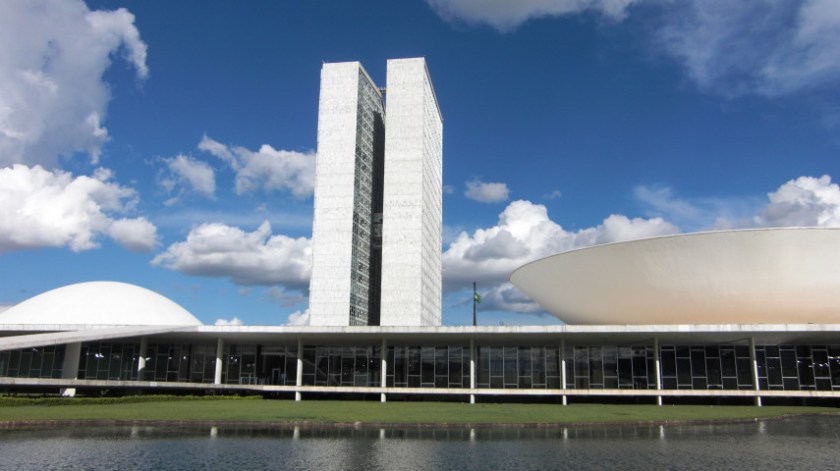
The parliamentary buildings in Brasilia, originally laid out by Lucio Costa. The Camara dos Deputados, by Oscar Niemeyer, is to the right.
This meeting took place in the Comissao de Direitos Humanos e Minorias (the Commission for Human Rights and Minorities) and was with Federal Deputy and committee member, Pompeo de Mattos, the secretary of the Commission, Marcio Marques de Araujo, and Hebe Guimareas-Dalgaard, who works in the International Relations office and who served as translator.
The meeting covered all sorts of background issues around security in Brazil, and concentrated on Deputado de Mattos’s specialities in this area, which are in justice and drug-trafficking issues. Again, I won’t do more than summarize a few immediately important things here. There was a lot of talk of police corruption and some hair-raising stories of the ways in which military police officers in particular has become involved in selling equipment and ammunition, and of course the autodefesas communitarias that I have mentioned before. Interestingly though, it was the deputy’s opinion that the military police, despite having a ‘culture of violence’ inherited from their role as enforcers of the military dictatorship, were less corrupt (in an everyday way) than the civil police. The latter are even lower down the police food-chain and correspondingly more poorly paid and equipped.
The inadequacies of the civil police has led many Mayors of larger towns and cities to introduce so-called ‘Municipal Guards’ – basically private security given some official status. They have few powers but are basically there to increase the visibility of security, a kind of prophylactic community policing. The problem is however that the official police and the massive private security sector are thoroughly intermixed already. Many officers moonlight as private security guards, which leads to all kinds of conflicts of interest.
Deputado de Mattos was certainly not obsessed with the inadequacies of the police however. Serious and organized crime associated with drug-trafficking paralyzes the everyday life of poorer areas of large cities in Brazil. Despite the fears of the rich over crime, it is the poorest that suffer most. He described the drug gangs as being the major obstacle to any positive change in Brazilian cities. However he didn’t see any militaristic solution – fighting a war against the drug gangs would only lead to more violence. The only solution to the problems of both crime and the poverty from which it emerges is social inclusion. The favelados must be provided with the same opportunities and infrastructure as everyone else. The need schools, hospitals, transport, and so on. Programs like Bolsa Familia, however well-intentioned, make no fundamental difference, he argued – contradicting, as most people with whom I have talked have done, the assessment of external organisations like the World Bank.
However providing such opportunities is not easy, and not just because of the costs. The drug-gangs actively resist any attempt by the state to introduce services, to the extent of intimidating or even killing construction workers. And this shouldn’t be in any way romanticized as some kind of popular resistance of the poor to the imposition of unwanted state interference – this is an attempt to maintain the rule of fear and violence. Somehow, one can never get away from the security issue in Brazil.
Leaving the Camara dos Deputados, looking past the parliamentary buildings up towards the Esplanada dos Ministerios, with all the government Ministries lined up in identical blocks.
(Thanks to Deputado Pompeo de Mattos, who as you will see if you check out his website is quite a character. He is fiercely proud of his southern ‘gaucho’ roots, and writes poetry to that effect. He is also – and I don’t say this very often of politicians – a genuinely nice guy. Thanks also to Marcio Marques de Araujo and to Hebe Guimares-Dalgaard without whom the meeting would have been impossible).
Both human rights advocates and the police seem to be strongly in favour of the new RIC system as a means of social inclusion and to replace the chaotic and corrupt identification system based in individual Brazilian states at present, which allows anyone with any other form of ID to get a state Registro Geral card in each different state.
Departamento de Policia Federal, Brasilia
I have just come back from a very productive interview with Romulo Berredo, from the Director-General’s office at the Departamento de Policia Federal (DPF), who are the Brazilian equivalent of the FBI. There was a lot covered and I couldn’t hope to reproduce it all here. There were however a number of immediately interesting aspects.
The first was more evidence that the whole basis on which identity cards and database issues are being considered here is entirely different from the UK. Now I know this represents a police, and a state, view, but so far, both Brazilian human rights advocatesand the police seem to be strongly in favour of the new Registro de Identidade Civil (RIC) system. This is both as a means of social inclusion and to replace the chaotic and corrupt identification system based in individual Brazilian states at present, which allows anyone with any other form of ID to get a state Registro Geral card in each different state. It is fairly easy to acquire 27 different identities in Brazil at present. And identification is important here. The great fear that many people seem to have – indeed it was called a ‘cultural’ characteristic by Berredo – is not the use of identification by the state as a form of control or intrusion but as a guarantee against the anonymity that would allow abuses by the state or indeed by other malicious persons. It provides a metaphysical and material kind of certainty and stability. The legacy of the last dictatorship was not so much an East German-style nightmare of knowledge and order but of corrupt and arbitrary rule.
It is this latter legacy which also drives the divisions between the different police forces in Brazil. The states-based Policia Militar (Military Police) and Policia Civil are both tainted in different ways by associations with authoritarian rule, and the former particularly with extra-legal execution and torture, and they continue to be regarded with caution, suspicion or even hatred by many Brazilians. The other police forces are also suspicious of the growing role of the DPF, which is often seen in terms of a power struggle not rational subsidiarity. Ironically then it is the states-based police forces that are dragging their heels over plans to create the kinds of national databases of criminal information that the UK has, and not for any libertarian reasons. In fact the DPF seem far more concerned with protecting human rights and defending the idea of citizenship, and because they are tasked with anti-corruption investigations have even arrested Senators and Judges, something unheard of even ten years ago. Of course those very same Senators and Judges are now fighting back, in a manner rather similar to Berlusconi in Italy, trying to alter the law to give immunities and protections. For example, handcuffing of arrested suspects was always normal until it happened to a Senator arrested for corruption. The Senate suddenly became interested in the ‘human rights’ of arrested suspects and passed a law limiting the use of handcuffs! Corruption at every level is still an enormous problem here, though Berredo argued that it was largely associated with those who had retained power from the years of the dictatorship.
The concentration on inclusion and joining-up government where it is clearly much needed does however lead to some gaps in thinking. The creation of new databases brings with it new duties and new potential problems of data-handling. As the privacy and data-protection law expert, Danilo Doneda, pointed out to me the other day, Brazil is in an almost unique position in not having any kind of regulator for privacy and information / data rights. He argued it was because the authorities just don’t see the need. Berredo confirmed this. He claimed that the DPF were trusted by the public – and relative to other police forces, that is certainly true! – and that they had to carry out their duties appropriately or they would lose that trust. It sounds nice, but it isn’t a good-enough (or legally-sound) basis for the protection of data-rights.
It all confirmed once again that Brazil is not yet a surveillance society – the state does not yet have the capabilities. There is no national database of fingerprints (even for convicted criminals) for example. But as Berredo said, it is moving in that direction. He was keen that there should be be limits. I liked the fact that he used this word. ‘Limits’ is a word that I found that the neither the UK government nor the European Commission seem to like, and they seem very unwilling to say what limits might be. However Berredo was quite clear that a technologically-driven surveillance future in which individuals could be tracked – he used the example of Google Latitude – was not one which he wanted to see. He recognised that he was both a policemen (at work) and a private citizen (at home) and that he, as much as anyone else, valued his privacy.
(Thank-you very much to Delegado Romulo Barredo of the DPF, for his openness, time and patience, and also to Agent Alessandre Reis, for his help)
I am now in Brasilia, where I have a number of interviews with parliamentarians, and officials from government Ministries and the federal police. The hotel I am staying in is right off the main monumental axis, in the northern hotel district. It is in some ways, the total opposite of where I was in Sampa, being masterplanned, spacious and with visible greenery. But it is a masterplan typical of Le Corbusier and his acolytes, that seems totally lacking in any flexibility or consideration for people not traveling by what they thought would be mankind’s liberation: the private car. So it is almost impossible to walk to a decent bar or cheap restaurant in the evening. You have to get a cab (or a bus if you know where you are going), to another ‘district’ for such things. The spaces are large and clearly designed to be monumental, but actually they fail in both being genuinely impressive and in being accessible. That is not to say that there are not some amazing buildings – of course there are many of Oscar Niemeyer’s greatest creations – but it is a place that looks better from the godlike view of the plan, or the selective gaze of the tourist brochure, than being within it as an ordinary person.
The taxi from the airport took a route through some of the contemporaneously planned and built residential districts. If it wasn’t for the semi-tropical vegetation, it could have been the Netherlands… long lines of similar 60s housing blocks, broken into neighbourhoods, each with its own little row of shops and restaurants, and divided by little parks and other community facilities. The blocks show quite a lot of variation in design and are certainly not all exactly the same, nor are they so large that they become inhuman in scale. With all the trees, and the facilities within walking distance, this really did seem like it wouldn’t be a bad – if not really an exciting – place to live. Which is exactly what I feel about many places in the Netherlands! For today, calm and unexciting is exactly what I need!
Strangely enough however, almost the first thing I came across when I got here was a local-government organised (and state petrochemicals company, Petrobras-sponsored) hip-hop festival, right on the main axis in the shadow of the TV Tower. So as the sun went down (if we could have seen it through the clouds) and the lights of the city blinked behind the hemispheres and towers of the Parliament building, I was getting down (well, tapping my feet) to some phat beats and conscious lyrics about the hardship and violence of life in the ‘periferia’ from the likes of Liberdade Condicional, and other favela stars. This, if nothing else so far, made me feel rather more hopeful for the future. For this evening only, the periferia had come right into the centre and was, symbolically at least, at the heart of Brazilian democracy.
It’s my last morning here in Sao Paulo. I have to say that, with the greatest respect to my friend and Sao Paulo native, Rodrigo, I am not going to be sorry to leave. A lot of what I thought when I arrived here hasn’t changed. This is big, dirty, noisy, exhilarating city with an unapologetic commercial drive, and all the divisions and human debris that this creates. In many ways, it reminds me of Osaka in Japan, but the extremes are greater. The problem is that the huge divisions can’t be ignored if you are in any way sensitive to human suffering, and the suffering here cries out from every raw-smelling homeless man sleeping on the street, from the ragged kids sorting through rubbish at night, from the women selling themselves in the parks, stations – well, everywhere. Certainly, these things are part of city life in many places in the world, and there are many far, far poorer places, but there is something profoundly saddening, depressing, about the gulf between the helicopter-chauffeured elite and the people on the street in O Centro, and especially in the ignorance and indifference – which I have not only been told about but have seen. By the end of just one week, during which I have tried to be as much a part of the place as I could, when I have spent time talking to everyone from human rights groups to people in ordinary bars, I feel like retreating, curling into a ball in the corner of my room.
So thank-you, Sampa, but I am not sorry to be leaving. Here are some pictures of the hundreds I took, of aspects booth good and bad…
I spent some time on the Sao Paulo metro system yesterday so I tried to get some pictures of security and surveillance underground… Some things I would have loved to have got pictures of: the military policemen stalking a groups of favela kids through the crowds; the very tired and twitchy officer who looked to be absolutely itching for a fight, who got on the Metro after me; the perfect shot of two policemen standing under a camera. But I didn’t get those ones, so my words will have to do. The main reason is that I have a healthy instinct for self-preservation and taking pictures of men with guns – particularly when they are caressing the handgrip and trigger like it was an intimate part of their anatomy as the twitchy officer was – is a sure way to end up attracting unwelcome and possibly fatal attention. The officers in the stations did notice me taking pictures pretty quickly too – which perhaps suggests both the pervasiveness and the effectiveness of trained human surveillance. Anyway, I only have two shots, one of which was an experiment in a longer take, which didn’t quite come off so I might have to try this again…
movement
entrance
I am sure I will have more to say today tomorrow on this after I have met up with Marta Kanashiro, the scholar of surveillance studies from the State University of Campinas.
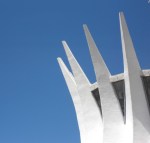
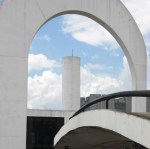
As a fan of utopian urbanism, I couldn’t very well come to Brazil without checking out some of the great Oscar Niemeyer’s work. Next week I will be in Brasilia, but this week in Sao Paulo, I took a few hours out to visit the Memorial da America Latina, a cultural complex built on an old factory site. The overall plan is not that impressive and the whole complex looks a little worn out, but the it was the detail of Niemeyer’s individual buildings that fascinated me, and the external detail at that. The interiors are cool and compelling, but in some you are not allowed to take pictures, and most of the others are filled with ‘stuff’ that reduces the impact of the space.
In Brazil, the almost universal perception amongst the middle and upper classes is that human rights defenders are simply defending criminals…
I spent some time yesterday talking to people from the justice program at Conectas, a collection of organisations that works on the unpopular issue of human rights in Brazil. Conectas also has a global south program that works more broadly in the developing world, and publishes the excellent journal, Sur.
I say that human rights is unpopular, which may sound surprising, but talking to the valiant lawyers and organisers at the Instituto Pro Bono, which provides lawyers to those who can’t afford them, mainly prisoners, and Artigo 1o, which brings civil actions against the state on behalf of prisoners killed or injured by police and prison staff, I was immediately reminded of the depth of the social divisions, and the sheer mutual ignorance of people in different social classes here in Brazil.
In part, I was told, the gap has to do with the experience of the dictatorship that came to and end from 1985. Human rights had grown in opposition to the dictatorship, and once the end came, many wealthier people started to wonder why people still needed these apparently strange and special rights in a ‘free society’. The almost universal perception amongst the middle and upper classes is that human rights defenders are simply defending criminals, end of story. The Artigo 1o staff told me that they regularly receive hate-mail and threatening or angry telephone calls. The Instituto Pro Bono is still battling to have its lawyers even accepted in courts in many states in Brazil. Bar associations are opposing them on the grounds that they take business away from defence lawyers! Neither organisation gets any more than a tiny proportion of its income from Brazil; most comes from the European Union and the USA.
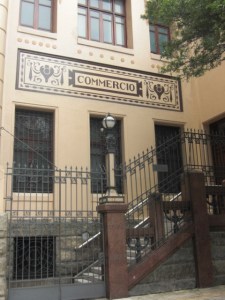
Almost everything you need to know about what drives Sao Paulo (Nineteenth Century business federation building in the heart of the city - the other side of the entrance says INDUSTRIA)
Partly too there is a partially Catholic Christian legacy of accepting one’s ‘natural’ social place and waiting for what one deserves after death. However there are also questions of geography. And sociospatial variety leads to different relationships and different attitudes by the ruling classes in different parts of the country. In Sao Paulo, the poorer areas, and the favelas – I was reminded of course that there are both and many, many very poor people are not living in illegal settlements – are largely peripheral. This means that they can be ignored by the rich. Sao Paulo is also a mercantile city absolutely dedicated to making money and many of the rich seem to regard the masses of poor as simply ‘failed entrepreneurs’ whose fate is their own fault. This contrasts with Rio, where rich and poor are thrust right up against each other, with favelas running right into the heart of the city. The poverty cannot be ignored, but instead it is crushed, repressed by the actions of groups like the Autodefesas Comunitárias, (illegal ‘community self-defence’ groups).
Welcome to the other Sao Paulo! ("REVENGE - Intruders will die" says the graffiti)
Of course such mass violence does occur in Sao Paulo too – Artigo 1o is currently looking for funding (not a lot in relative terms BTW – please contact me if you have about $6000 US to spare!) to publish their report into the mass battles between police and organisations of ex-prisoners and criminals, which resulted in the extra-legal execution of hundreds of people by the police. However, in general, the staff of Artigo 1o argued, the relationships are different.
(there was a lot more, but I will write about issues around security and surveillance later)





















































 ubisurv