Tenacious FoI and ‘institutional discovery’ work both in and out of the US courts by the Electronic Frontier Foundation has resulted in the FBI releasing lots of information about its enormous dataveillance program, based around the Investigative Data Warehouse (IDW).
the FBI now has a data warehouse with over a billion unique documents or seven times as many as are contained in the Library of Congress;
it is using content management and datamining software to connect, cross-reference and analyse data from over fifty previously separate datasets included in the warehouse. These include, by the way, both the entire US-VISIT database, the No-Fly list and other controversial post-9/11 systems.
The IDW will be used for both link and pattern analysis using technology connected to the Foreign Terrorist Tracking Task Force (FTTTF) prgram, in other words Knowledge Disovery in Databases (KDD) software, which will through connecting people, groups and places, will generate entirely ‘new’ data and project links forward in time as predictions.
EFF conclude that datamining is the future for the IDW. This is true, but I would also say that it was the past and is the present too. Datamining is not new for the US intelligence services, indeed many of the techniques we now call datamining were developed by the National Security Agency (NSA). There would be no point in the FBI just warehousing vast numbers of documents without techniques for analysing and connecting them. KDD may well be more recent for the FBI and this phildickian ‘pre-crime’ is most certainly the future in more ways than one…
There is a lot that interests me here (and indeed, I am currently trying to write a piece about the socio-techncial history of these massive intelligence data analysis systems), but one issue is whether this complex operation will ‘work’ or whether it will throw up so many random and worthless ‘connections’ (the ‘six-degrees of Kevin Bacon’ syndrome) that it will actually slow-down or damage actual investigations into real criminal activities. That all depends on the architecture of the system, and that is something we know little about, although there are a few hints in the EFF report…
The complex landscape of the US judicial system has thrown up a ruling on the police use of GPS tracking devices completely at odds with the recent ruling handed down by the appeals court in Wisconsin. The New York appeals court ruled 4-3 that police GPS tracking should require a warrant. Judge Lipmann’s words on the case, quoted by the New York Times, are particularly interesting as it appears that he wa taking a long view of potential harm in making his decision. He said:
“One need only consider what the police may learn, practically effortlessly, from planting a single device. The whole of a person’s progress through the world, into both public and private spatial spheres, can be charted and recorded over lengthy periods possibly limited only by the need to change the transmitting unit’s batteries. Disclosed in the data retrieved from the transmitting unit, nearly instantaneously with the press of a button on the highly portable receiving unit, will be trips the indisputably private nature of which takes little imagination to conjure: trips to the psychiatrist, the plastic surgeon, the abortion clinic, the AIDS treatment center, the strip club, the criminal defense attorney, the by-the-hour motel, the union meeting, the mosque, synagogue or church, the gay bar and on and on. What the technology yields and records with breathtaking quality and quantity, is a highly detailed profile, not simply of where we go, but by easy inference, of our associations — political, religious, amicable and amorous, to name only a few — and of the pattern of our professional and avocational pursuits. When multiple GPS devices are utilized, even more precisely resolved inferences about our activities are possible. And, with GPS becoming an increasingly routine feature in cars and cell phones, it will be possible to tell from the technology with ever increasing precision who we are and are not with, when we are and are not with them, and what we do and do not carry on our persons — to mention just a few of the highly feasible empirical configurations.”
This long term thinking has to be applauded. Sometimes imagination is necessary in the law, and particularly when the issue is one of socio-technical changes. The technological determinism of ‘if it exists, then it must be used’ is a way of thinking that has to be challenged. The question now for the USA is if either of these case or others will find their way to the federal courts. Until then, US citizens and police do not really know where they stand and the constitutional questions remain open.
CNET’s ‘Technically Incorrect’ blog leads me to a rather disturbing story in the Chicago Tribune last week about a ruling from a court in Wisconsin, USA. The judges in the appeal court decided that police use of covert GPS tracking devices is equivalent to the naked eye and therefore is not covered by US constitutional prohibitions (in the 4th amendment) on search and seizure. Whilst the local representative claimed that “GPS tracking is an effective means of protecting public safety”, ACLU argued that in fact this is an unwarranted extension of surveillance powers: “the idea that you can go and attach anything you want to somebody else’s property without any court supervision, that’s wrong.”
Now the case itself involved a man suspected of stalking, itself a form of surveillance and not something anyone would want to encourage or defend, however, once again, ends do not justify the means, particularly when the implications of the use of such means are so profound. The ruling illustrates the widespread inability of judges (and lawmakers more broadly) to deal effectively the way in which new technologies change the game or perhaps the inability of constitutional protections to protect effectively in an age of vastly improved technologies of visibility.
In fact the judges in this case themselves expressed some disquiet about their ruling. I can sympathise with them – it is far from obvious how to interpret new surveillance technologies with the constition and laws available. One would think, after the wiretapping cases of the 60s and 70s in the USA, that this lesson might have been learned, but it seems courts will continue to take terms like ‘inside’ and ‘outside’ literally – as perhaps they must. But surely if a device is attached to the ‘outside’ of a car or a house, or indeed is not attached at all and is remote, it does not automatically follow that the information that the device collects is not intimate and personal, and indeed not the same as what could only have been obtained in previous decades by direct human intrusion? For example, a device that can effectively ‘see through walls’ is not the same as the naked eye – it is the equivalent of a police officer being inside the house. Whether this applies to a GPS tracker on a car (whether it is really any more or less than an officer sitting outside the house, or following the vehicle) is a moot point – there will be more and more of these cases, as police test the technological limits of the law, and it seems that most countries, not just the USA, still lack the professional (as opposed to the academic) legal thinking to deal with them.
News from various sources has revealed that the United State, the European Union and the United Kingdom are all preparing to invest further large sums in advanced biometrics and surveillance research.
According to an anonymous message to Slashdot, in the USA, Department of Justice requisitions for the coming year show “$233.9 million in funding for an ‘Advanced Electronic Surveillance’ project, and $97.6 million to establish the ‘Biometric Technology Center.'” The former is largely to deal with the problems of intercepting Voice-over-Internet Protocol (VoIP) communications – like Skype. The latter is what Slashdot calls a “vast database of personal data including fingerprints, iris scans and DNA which the FBI calls the Next Generation Identification” for the FBI. In other words, the architecture of the proposed ‘Server in the Sky’ system, which The Guardian revealed last year – for some notes on this and other systems under development, see here.
Meanwhile Owen Bowcott in The Guardian today has a story which puts together various bits and pieces from the EU’s FP7 Security theme research budget and UK security investment. In the UK, there is to be £15 million spent on updating UK biometric security for embassies, and more interestingly other unspecified ‘surveillance’ purposes, and in addition, rolling out of facial recognition systems to more UK airports. As we know, the controlled environments of airports where people are required to look at cameras, are one of the few place where this technology works properly.
This provides a rather tenuous link to the headline of the Guardian story which is an EU-funded study into brain-scanning (yet again) called Humabio (Human Monitoring and Authentication using Biodynamic Indicators and Behaviourial Analysis). There are lots of these about, and one of them may work sooner or later, but it is worth pointing out that people have been putting out ‘we will soon have brain scanning’ stories since the 1980s and like, nuclear fusion, it always seems to be 5 or 10 years in the future. Brain-scanning seems to be the technology of the future… always has been, always will be?
While the vast majority of those monitoring CCTV screens are probably decent people who stick within the legal and ethical guidelines (such as they are), it is worth remembering that pervasive surveillance offers unprecedented opportunities to perverts, stalkers and sex offenders. This is not just secret cameras set up by weirdo voyeurs, it is the people who work with CCTV. This was noted by Clive Norris and collaborators back in the 1990s in Britain in their work on control rooms when they reported on operators making private tapes of women they saw in the street. Yesterday, The Daily Telegraph reported on a case in the US, where two FBI agents spied on girls changing for a charity fashion show for the underprivileged. They have been charged with criminal violation of privacy, which I am glad to see is a crime in the US. But, don’t forget that behind the cameras, if there is anyone these days, is a human being and that human being has as many flaws and secret desires as anyone else.
There is an excellent new report on facial recognition now available for free download. The report is written by my one-time co-author on the subject, Lucas Introna of Lancaster University, and new Surveillance & Society advisory board member, Helen Nissenbaum of New York University.
The report is aimed primarily at people who developing policy on, or thinking of commissioning or even using facial recognition and therefore concentrates on the practical questions (does it work? what are its limitations?) however it does not neglect the moral and political issues of both overt and covert use. What is quite interesting for me is how little the technical problems with the systems have changed since Lucas and I wrote our piece back in 2004; the ability of facial recognition to work in real-world situations as opposed to controlled environments still appears limited by environmental and systemic variables like lighting, the size of the gallery of faces and so on.
The report is probably the best non-technical summary available and is perfect for non-specialists who want to understand what is the state-of-the-art in facial recognition and the range of issues associated with the technology. Very much recommended.
Whilst finishing up my work in Rio de Janeiro yesterday, I came across this interesting bunch of people, mv-brasil, who appear to be a Brazilian nationalist movement, with much in common with organisations like the British National Party or the various right-wing groups in the USA. Their website contains the usual odd mixture of anti-globalisation, evangelical Christian (they campaign against Halloween) and anti-United Nations / New World Order stuff with the added anti-Americanism. There of course is the usual rather uncomfortable fact of the ‘Brazilian Christian’ nationalist being a representative of a colonial power that invaded the country and took it from the indigenous people, but they roll over this one with some nods to Indian rights when it suits their cause, most notably when it comes to the Amazon.
A t-shirt with anti-internationalisation and privatisation of the Amazon slogan
One of the T-shirts for sale makes reference to this, being against ‘internationalisation and privatisation’ of the Amazon by the USA. It is a conspiracy theory I’ve come across before when I was doing some research on the SIVAM program – which provides some actual evidence for contentions that there is a secret American program to control the rainforest. I had someone tell me here in complete good faith that it was a ‘fact’ that several Amazonian tribes already thought that they were part of the USA and flew the US flag! This is combined with the fact the UN and international environmental organisations are very concerned about the destruction of the rainforest and the perceived lack of effort by successive Brazilian administrations to stop it. Put all this together and you have the ingredients for nationalist paranoia.
So what is SIVAM? And why would I be interested in it anyway? The reason is that SIVAM is a surveillance system. Announced at the Earth Summit in 1992, and finally completed in 2002 and fully operationial from 2004, the Sistema de Vigilância da Amazônia (SIVAM) is a multipurpose, multi-agency network of satellite, aerial and ground surveillance and response that aims to monitor the illegal traffic of drugs and forest animals and plants, control national borders and those of indigenous peoples’ lands, and prevent the further destruction of protected areas of forest. A good technical account in English can be found in Aviation Today from 2002, and there is an interesting article on its construction here.
Donald Rumsefld visits the SIVAM control centre, 23 March 2005 (Wikimeda Commons)
The problem is that, although an initiative of various Brazilian government agencies including the environment and Indian affairs ministries, the federal police and the army, SIVAM is supported and funded by the USA – most of the initial $1.39Bn US cost came through a grant from the U.S. Export-Import Bank, and the consortium that supplies the equipment includes giant US military supplier, Raytheon – amongst many others from Brazil to Sweden. The visit of former President George W. Bush’s right-hand man and then Secretary of State for Defense, Donald Rumsfeld, to the SIVAM control centre in 2005, was widely reported in Bazil. It was of course interpreted by many as further evidence of Brazil’s ceding of control of the Amazon to the USA, or even presaging a US invasion of the Amazon, as Senator Norm Coleman discovered on a fact-finding mission later that year.
Latin American countries have every right to be suspicious of US motives: the Monroe Doctrine; George Kennan’s Cold War ‘grand area’ vision; the support for dictators like Augosto Pinochet; the invasions of Panama and Grenada; Plan Columbia and the widespread use of military ‘advisors’… the list goes on. And it is certainly the case that US strategic surveillance plans for ‘Full Spectrum Dominance’ and the like, have have long included ‘leveraging’ any system in which they are involved from the International Space Station to things like SIVAM. So of course they will have a strategic interest, and no doubt SIVAM data will find its way to US military C4ISR centres, but this does not amount to a plan to invade Brazil or take control of the Amazon.
Over the last two weeks, we’ve talked to all kinds of police. We’ve talked to officers, both senior and junior from the Policia Militar (PM), the state-level equivalent of the French ‘gendarmerie’ or Italian ‘carabinieri’, including some who have been rebranded as ‘Policia Communitaria’; we’ve met guys from BOPE (the Rio-specific special operations group within the PM here) – and hopefully we will meet their Commander today; we’ve interviewed the Subchefe of the Policia Civil (PC), the detectives, again based at state-level; and we’ve visited the headquarters of the Guarda Municipal (GM), the relatively recently-formed city police. I haven’t talked to the firefighters, another military-state legacy, who are still an armed force, although a report from the State parliament in January recommended that they be disarmed. Back when I was in Brasilia, I also had a meeting with the Policia Federal (PF), the Brazilian ‘FBI’, another post-dictatorship development, who operate at federal level.
It is a confusing organisational landscape, and not just for me. Throughout the interviews with all the different representatives, very different perspectives emerged on what is important in policing, which force is more important and for what purpose, to what extent the current system works, and what would be the best way forward. Corruption was also something that came up time and time again, with everyone arguing that their force was improving and dealing with this, but hinting that there was still a problem with other kinds of police. There was lots of talk of ‘new generations’ of officers free from the taint of the past. But at the same time it was quite clear on the ground that people from all social classes still do not trust any of the police in general, even when they have established quite positive personal working relationships with officers in their own community.
Cesar Couto Lima, Diretor de Operacoes of the Guarda Municipal
The GM are less than twenty years old and they ‘know their place’ in the hierarchy of police: at the bottom. They are not true ‘professional police’ in the sense that they have only three months basic training, followed by some specialist extra work. They are really somewhere between police and a private security force that just happens to be employed by the city – their commanders at the top level are however, ex-PM. They do, however, have a growing field of responsibility, acting both as a kind of protective and preventative force on the ground in the city centre and as a street-level agency of the ‘eyes on the street’ form of surveillance.
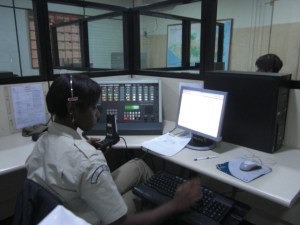
Operator in the Guarda Municpal emergency control room
They also act as the emergency services co-ordination, and this role will increase and be better integrated and funded in future. They are largely disarmed, though not because as many believe, the law prevents them from being armed. This is a strategic decision based on keeping a clear line between them and the PM. This is also the reason why they have a different uniform (in Rio a kind of unflattering beige) from the PM (blue). In our interview with the Director of Operations, Cesar Couto Lima, we were told that in the past, the uniforms had been the same colour but that this had been changed under the last mayor, Cesar Maia, to prevent GM officers from being shot by criminals in the mistaken belief that they were PM. They now have a very low rate of injury and death. The Dir Ops also wants to increase the numbers and in the very long term for the GM to be the be the main police force of a disarmed and less violent city.
It is a fine aspiration, however the new Mayor Eduardo Paes, has apparently suggested that the uniform is changed back to blue and that there should be more arming of the GM. The Dir Ops is utterly opposed to both, and I think he sees it as a deliberate ploy to give the impression of more PM around – the State Secretary for Security has already announced a plan to increase the numbers of PM in Rio by thousands, as we found out when we visited his office. The officers we met at the GM were generally pleasant, relaxed people, however the GM is not immune from corruption. I have heard allegations of extortion from street traders, the poor and criminals, in much the same way as gets reported of the two main forces, and indeed of death threats to officers who refuse to get involved with such practices. Any generalised or regular arming of the GM would only increase the temptation to act on the new power in an irregular way, and also, with so many weapons in the hands of relatively poorly paid and untrained officers lead to greater numbers of killings and a further channel for criminals to obtain weapons.
Ricardo Martins, the Subchefe of the Policia Civil would also like to see a demilitarisation of the police in the long-term. He argued that basically, the PM should be gradually abolished and absorbed into a purely civil police. He was also strongly in favour of more ‘intelligence-led’ and surveillance-based solutions, rather than force of arms or numbers. According to him, the expansion of the video surveillance system in the city was essential and absolutely necessary if the city was to be ready for the 2012 soccer World Cup (to be held across Brazil) and more particularly for the 2016 Olympics, for which the city is a frontrunner. All the senior officers an officials with whom we talked agreed that currently it was nowhere near ready. The GM also agreed with the expansion of CCTV, although they seemed to think that they would have a greater role in operating the systems in future, talking of plans for neighbourhood control rooms integrated with the emergency services control system. Neither the PC, nor more importantly, the Superintendente de Commando e Controle of the State, Claudio de Almeida Neto, gave any indication that this was the direction in which things were proceeding. Indeed the Superintendente was quite clear that there was a greater centralisation, co-ordination and professionalisation of video surveillance operations taking place through his office and his control room, which is in the old ‘Centro do Brasil’ railway station. The office of the Secretary of State for Security seemed not to be that interested in surveillance at all, and commented that it was very expensive, which suggests that the funds for the expansion of the video surveillance system that all expect, whoever they think will be running it, may not be quite as lavish as they believe or would want. I will write more about this later. The PC, however has the reputation of being the most corrupt of all the forces. Subchefe Martins pointed to the internal investigations branch as evidence of the effectiveness of their fight against corruption. Other interviewees were not as easily impressed!
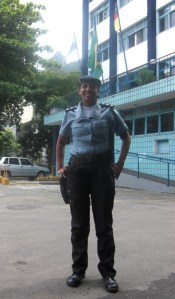
Capitao Pricilla, Head of Santa Marta Community Police initiative
So where should policing in Rio go? One way forward was obvious when we interviewed Capitao Pricilla, the current ‘star’ of the PM, who heads up the Community Policing initiative in Morro Santa Marta. Capitao Pricilla is a PR-dream: attractive, articulate, intelligent, convincing in her arguments, and clearly dedicated to her work with the community. She is everything you would hope a new generation of younger PM officers would be, and she clearly stated that she is part of a new generation. And she is popular too. As we talked with her, officers would constantly come over just to say ‘hello’ and older women in particular, would treat her like a TV celebrity. Now, of course I am wary of the way in which such charisma would make her an obvious choice to head such an operation, which is much promoted as ‘the way forward’ in the media. However there have been many ‘ways forward’ before which have come to nothing and Rio is constantly making and destroying innovative initiatives before they even have a chance to have a real effect. The Santa Marta initiative probably cannot be replicated in many favelas, like Prazeres, where there is a more intimate relationship with the ‘parallel power’ of the traffickers. But Capitao Pricilla seems like the real deal. Let’s hope that she and officers like her get the support they need and are not undermined by the violence and corrupt practices of so many of their colleagues. It’s a utopian hope perhaps, and Rio is still going to need the other far more aggressive hand of the other attempt to get around corrupt practice in the PM, the BOPE – about whom I will write more after our visit today – as much as it needs the helping hand of Community Policing initiatives for a while. It is that large and less articulate mass of PM and PC officers who have no interest in doing anything different, and the equally corrupt politicians who prevent change for their own selfish reasons, that are the main barrier to any organisational change.
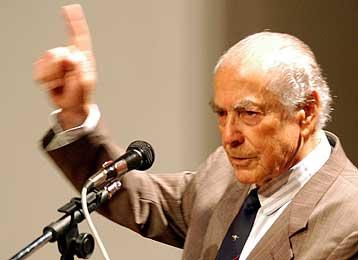
One question that has been preoccupying my thoughts recently has been the question of why the simple things are not being done in Rio to address the problems of the favelas: sanitation, education, healthcare etc… many of the people we have talked to look back to the regime of Leonel Brizola, the Governor of the State of Rio de Janeiro from 1983 to 1987 and then again from 1991 to 1994. Brizola was a left-progressive populist, a social democrat and a former opponent of the dictatorship who had had to live in exile for much of the 1970s. Sadly he died in 2004, but we had the opportunity this week to talk to his former Secretary of State for Public Security, and also briefly Governor himself from 1994-5, Nilo Batista.
We met Professor Batista in the Instituto Carioca de Crimonologia (ICC), an independent research organisation, which he runs (and funds from his legal work), along with his wife, sociologist, Vera Malaguti Batista. The Institute is housed in a sleek modern building up in the hills of Santa Teresa, from whose picture windows the city below is all but invisible and the bay appears almost as it was when Europeans first arrived. However, the concerns of the Institute are very much with the reality of the city today.
We had a long and wide-ranging conversation, which would be impossible to recount in detail here, but the basis of it was an understanding of Brazilian society, and in particular that of Rio, based on the ongoing legacies of the past, in particular slavery and authoritarianism. Vera Malaguti’s book, O Medo na Cidade do Rio de Janeiro: dois tempos de uma historia (Fear in the City of Rio de Janeiro: one story in two periods) examines previous periods of revolt by Africans in Brazil and argues that the often unspoken elite fear of the africanisation of Brazil. They argue that repressive public security strategies today are founded in this same fundamental fear, driven by the media that serves the powerful middle classes who aspire to elite values and lifestyles.
In opposition they place Brizola and that brief (and they argue, unrepeated) period at the end of the dictatorship when social justice and in particular, education, were priorities and favelas were provided with services in the same way as any other neighborhood. The security strategy of Brizola and Batista was effectively one of anti-stigmatisation. They argue that since then, media-driven fear and repression has been far more the norm and this had undermined the progress made under Brizola.The current public security-based strategy of the Governor Cabral and the ‘choque de ordem’ of Giuliani-wannabe Mayor Eduardo Paes, is one example. By concentrating on ‘pacifying’ one or two places as examples (Santa Marta and Cidade de Deus at present) without being able to afford the same strategy elsewhere, it constitutes simply a public relations exercise, and elsewhere repression without development continues as normal.
The Batistas are passionate and well-motivated, but there are many who argue that this picture of a progressive Brizola regime subsequently undermined by repressive policies is at the very least, a limited view. It was, after all, under Brizola that the traffickers grew in power and acquired weapons; the mid-eighties was the key period here as the cocaine trade grew from almost nothing to being the driving force of gang activity in Rio. This isn’t just a view held by political opponents: whilst he certainly does not (and could not with any justification) claim that the rise of the cocaine trade was anything to do with Brizola, Enrique Desmond Arias in Drugs and Democracy in Rio de Janeiro, argues that the personalist populism of Brizola undermined the leadership of the Community Associations in the favelas and left them open to co-option by drug gangs. When we visited the office of the current Secretary of State for Security, Jose Mariano Beltrami, and talked with his representative, it was quite strongly argued that Brizola neglected the issue of the growing arming and violence of drug traffickers, and also did nothing to solve the massive problem of police corruption (on which I will write more later). The current longer-term strategy is now to recruit a lot more Military Police, in the hope that numbers will do what force has not, and enable the gangs to be beaten.
We also visited the office of a leading critic of human rights abuses, Alessandro Mollon, a Deputy in the State parliament. He said that Beltrami is actually shifting, without ever having admitted to it, from a very macho and repressive approach when he first arrived from the southern state of Rio Grande do Sul, to a more considered (but hardly progressive) strategy now, of which the emphasis on police officers on the streets, rather than invasions, is one aspect.
Former Mayor of Rio, Cesar Maia
The claim that Brizola was the last real progressive figure to lead Rio also neglects some others, particularly those who have held the office of the Mayor. Under Cesar Maia (1993-7; 2001-2008), the ‘Favela Bairro’ program had much in common with what Brizola did in social terms. Indeed when we asked the leader of the Morro dos Prazeres Community Association what would be the one thing she wanted above all else, it was ‘more Favela Bairro’. In Dona Marta they also had some time for the former governor, Anthony Garotinho (1999-2002) a frankly quite foolish evangelical populist, currently under investigation for corruption, as is his wife, Rosinha, who was Governor from 2003-7. However, we heard from others that the things that they attribute to Garotinho were actually planned or initiated under previous administrations and just did not see the light until his.
What is certainly the case is that Brizola had a better attitude to the favelados as people, than other administrations, regardless of his mistakes. The current regime certainly seems to be more driven far more by middle-class fears than by social progress, but it is also the constant undermining of the progress of previous administrations like Brizola’s and then later Maia’s terms as Mayor by new waves of media-courting repression that is so depressing in Rio. It happens in every democratic country, but here in Brazil there is the most blatant inequality of any wealthy country still crying out to be addressed. If it was, then most of the issues of ‘crime’ and ‘insecurity’ would start to disappear. It would, as Deputado Mollon also pointed out, be a lot cheaper than the massive amounts of money now going into the hands or private security companies – who, as Professor Batista noted are often run by the families of senior police officers, who therefore have no actual interest in reducing crime and every reason to want to see fear continue to grow.
(With thanks to Nilo Batista, Vera Malaguti Batista, Alessandro Mollon and the staff of the office of Jose Mariano Beltrami for their time and patience. In particular, I hope to return to the Instituto Carioca de Criminologia sometime in the future to talk about the findings of this project, and to submit something to their excellent journal, Discursos Sediciosos: crime, direito e sociedade)
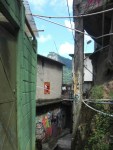
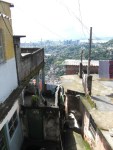
One of our most interesting visits last week was to the favela of Morro dos Prazeres, north-west of Santa Teresa. Prazeres has one of the most astonishing views of Rio of any neighbourhood, with an almost 360 degree panorama of the city, it’s perspective to the south only interupted by the statue of Christ the Redeemer, which is hardly a bad view in itself! You might think that the last thing that favelados would care about was the view but they are well aware of the beauty of their location – the assumption that the poor an desperate would not care about such things is a rather patronising misconception. Elisa, the leader of the community association, at least, seems most proud of this asset and says that like many people she wouldn’t want to live anywhere else even if she won the lottery!
But Prazeres does have serious problems. For a start, it is a ‘hot’ favela, occupied by drug traffickers, who control ‘law and order’ in the place. There is therefore no ongoing police presence, although as with many such communities, the community association does have a relationship of sorts with local military police commanders through organised coffee mornings at which problems are discussed. Luckily, despite or because of the almost complete control of a particular gang which is well integrated into the community (i.e.: they are relatives of the more law-abiding members), there are not many problems with violence and the police, ‘thank God’ (says Elisa), have not raided the favela recently, as they have many others.
In fact, as we were visiting Prazeres, as the taxi driver rather anxiously pointed out as he dropped us a safe distance away, BOPE (military police special operations) were ‘invading’ two other favelas next to it, the very hot Morro de Correoa, and Sao Carlos. The operations left eight dead, and we think what we had assumed initially were fireworks was probably the sound of small arms fire in the Sao Carlos operation. However, when we asked a PM at a nearby police post whether Prazeres was safe to enter, he seemed rather blase and relaxed about the whole thing…
Elisa was another very impressive woman. In the absence of men – who, in the favelas are in many cases, either involved in the gangs, working outside, or unemployed and alcoholic – it seems that a whole generation of strong, courageous women has emerged to try to develop their communities from the bottom up. In the past they have benefited from various attempts by previous mayors to provide development for the favelas. Unlike some places, Prazeres does not have a school built during the regimes of populist left-wing Governor, Leonel Brizola (who seems to be fondly recalled in by almost all those we have talked to in the poorer communities). However there was a lot of intervention as part of the Favela Bairro (Favela Community) program of former Mayor, Cesar Maia, and it is this normalisation or the favelas through infrastructure, social and economic development, education, health and social services that Elisa said are the only long-term solution to the problems of Prazeres. The creche in particular is a source of continual delight to her, and her face lit up whenever it is mentioned.
With social development and education, Elisa argued, eventually the ‘cold’ and uncaring gangs will recruit fewer kids, and they will wither slowly away. Confrontation however, only strengthens them by driving more young people to support the ‘insider’ traffickers against the ‘outsider’ police. They must, she said, work like little ants, with lots of small efforts adding up together to long-term success… then perhaps the anthill of Prazeres will function as a normal community.



 So what is SIVAM? And why would I be interested in it anyway? The reason is that SIVAM is a surveillance system. Announced at the Earth Summit in 1992, and finally completed in 2002 and fully operationial from 2004, the








 ubisurv