Contemporary social sorting techniques look for abnormality, but the norms are increasingly defined by reference to the methods of sorting themselves. Thus not wanting to be under mass surveillance makes you suspicious and a subject of targeted surveillance; research into, or resistance or opposition to surveillance also makes you a suspect…
One particularly interesting point he makes is that the combination of the ubiquity of the mobile phone – there are more phones than people across most of Europe now – with the routine nature of mass state surveillance of telecommunications traffic and mobile phone location, means that not carrying a mobile phone is now grounds for suspicions. One item in the ridiculous German anti-terrorism case against the academic, Andrej Holm, was “the fact that he – allegedly intentionally – did not take his mobile phone with him to a meeting is considered as ‘conspiratorial behavior.'” In te similarly ridiculous arrest of a load of back-to-the-land communards at Tarnac in France, their lack of mobile phones was also considered to be suspicious and evidence of ‘clandestinity.’
This is a key indication of living in a ubiquitous surveillance society – when the norms of surveillance practice start to be seen by the state (or indeed people) as a more general societal norm, and nonconformity is grounds for suspicion. The surveillance society is a self-referential, self-reinforcing one. Contemporary social sorting techniques look for abnormality, but the norms are increasingly defined by the methods of sorting themselves. Thus not wanting to be under mass surveillance makes you suspicious and a subject of targeted surveillance; research into, or resistance or opposition to surveillance also makes you a suspect (as the current London Met poster campaign also shows). The normalisation of surveillance potentially makes suspicious anything that we do that makes state surveillance of more difficult. It is no longer a case of a passive ‘nothing to hide, nothing to fear’, but that not volunteering to be under surveillance makes us ‘abnormal’.
This seriously affects our civil liberties, but it has the potential to affect something more fundamental too – our autonomy, that is the ability to define ourselves as indviduals. Contemporary surveillance societies have started to impose categorisations and indentifications onto people that have nothing to do with how we feel about our identities. These categorisations not only stand for us in specific negotiations with the state (as they always have done in the past), they appear increasingly designed to erase identity (or even the potential for the self-construction of identity) and replace it with an identificatiton, by reinscribing the state categorisation, derived from surveillance, back onto the person and their behaviour.
From today, private lives in the UK will be a little less private, as EU Directive 2006/24/EC becomes part of national law.
Traffic data on e-mail, website visits and Internet telephone calls now have to be recorded and retained by Internet Service Providers (ISPs). Specifically, the Directive mandates the retention of: the source of a communication; the destination of a communication; the date, time and duration of a communication; the type of communication; the type and identity of the communication device; and the location of mobile communication equipment.
This is coming into force despite the fact that many countries and ISPs still object to the directive. It has to be said that many ISPs are objecting on grounds of cost rather than any ethical reason. German courts are yet to determine the constitutionality of the directive and Sweden is not going to implement it at all.
As with many of these kinds of laws, it was rushed through on a wave of emotion after a particular ‘trigger event’ – in this case, the 7/7 bombings in London in 2005. There was a whole lot of devious practice in the Council of Ministers to get it passed too – if the Directive had been considered as a policing and security matter, it would still have needed unanimity, which means that the objections of Germany and Sweden would have vetoed the Directive. Instead, it was reclassified as ‘commercial’ on the grounds that it was about the regulation of corporations, and commerical matters need only a majority vote. How convenient…
The Home Office in Britain says our rights are safe because of RIPA, which is hardly cause for rejoicing. My main concerns, apart from the fact that this is yet another moment in the gradual erosion of private life, are that:
1. police access will rapidly become routine rather than specific, and this could be extended to many other public authorities – the original drafts of the Communications Bill would have extended the right of access to such data to all RIPA-empowered organisations (which includes most public authorities);
2. the data will be used illicitly by ISP employees for criminal purposes (remember that most identity thefts are inside jobs) – the records will be a blackmailers delight;
3. there will more ‘losses’ of this data by ISPs and others who have access to it. Remember the accidental revelation of user data by AOL in the USA?
One question that has been preoccupying my thoughts recently has been the question of why the simple things are not being done in Rio to address the problems of the favelas: sanitation, education, healthcare etc… many of the people we have talked to look back to the regime of Leonel Brizola, the Governor of the State of Rio de Janeiro from 1983 to 1987 and then again from 1991 to 1994. Brizola was a left-progressive populist, a social democrat and a former opponent of the dictatorship who had had to live in exile for much of the 1970s. Sadly he died in 2004, but we had the opportunity this week to talk to his former Secretary of State for Public Security, and also briefly Governor himself from 1994-5, Nilo Batista.
We met Professor Batista in the Instituto Carioca de Crimonologia (ICC), an independent research organisation, which he runs (and funds from his legal work), along with his wife, sociologist, Vera Malaguti Batista. The Institute is housed in a sleek modern building up in the hills of Santa Teresa, from whose picture windows the city below is all but invisible and the bay appears almost as it was when Europeans first arrived. However, the concerns of the Institute are very much with the reality of the city today.
We had a long and wide-ranging conversation, which would be impossible to recount in detail here, but the basis of it was an understanding of Brazilian society, and in particular that of Rio, based on the ongoing legacies of the past, in particular slavery and authoritarianism. Vera Malaguti’s book, O Medo na Cidade do Rio de Janeiro: dois tempos de uma historia (Fear in the City of Rio de Janeiro: one story in two periods) examines previous periods of revolt by Africans in Brazil and argues that the often unspoken elite fear of the africanisation of Brazil. They argue that repressive public security strategies today are founded in this same fundamental fear, driven by the media that serves the powerful middle classes who aspire to elite values and lifestyles.
In opposition they place Brizola and that brief (and they argue, unrepeated) period at the end of the dictatorship when social justice and in particular, education, were priorities and favelas were provided with services in the same way as any other neighborhood. The security strategy of Brizola and Batista was effectively one of anti-stigmatisation. They argue that since then, media-driven fear and repression has been far more the norm and this had undermined the progress made under Brizola.The current public security-based strategy of the Governor Cabral and the ‘choque de ordem’ of Giuliani-wannabe Mayor Eduardo Paes, is one example. By concentrating on ‘pacifying’ one or two places as examples (Santa Marta and Cidade de Deus at present) without being able to afford the same strategy elsewhere, it constitutes simply a public relations exercise, and elsewhere repression without development continues as normal.
The Batistas are passionate and well-motivated, but there are many who argue that this picture of a progressive Brizola regime subsequently undermined by repressive policies is at the very least, a limited view. It was, after all, under Brizola that the traffickers grew in power and acquired weapons; the mid-eighties was the key period here as the cocaine trade grew from almost nothing to being the driving force of gang activity in Rio. This isn’t just a view held by political opponents: whilst he certainly does not (and could not with any justification) claim that the rise of the cocaine trade was anything to do with Brizola, Enrique Desmond Arias in Drugs and Democracy in Rio de Janeiro, argues that the personalist populism of Brizola undermined the leadership of the Community Associations in the favelas and left them open to co-option by drug gangs. When we visited the office of the current Secretary of State for Security, Jose Mariano Beltrami, and talked with his representative, it was quite strongly argued that Brizola neglected the issue of the growing arming and violence of drug traffickers, and also did nothing to solve the massive problem of police corruption (on which I will write more later). The current longer-term strategy is now to recruit a lot more Military Police, in the hope that numbers will do what force has not, and enable the gangs to be beaten.
We also visited the office of a leading critic of human rights abuses, Alessandro Mollon, a Deputy in the State parliament. He said that Beltrami is actually shifting, without ever having admitted to it, from a very macho and repressive approach when he first arrived from the southern state of Rio Grande do Sul, to a more considered (but hardly progressive) strategy now, of which the emphasis on police officers on the streets, rather than invasions, is one aspect.
Former Mayor of Rio, Cesar Maia
The claim that Brizola was the last real progressive figure to lead Rio also neglects some others, particularly those who have held the office of the Mayor. Under Cesar Maia (1993-7; 2001-2008), the ‘Favela Bairro’ program had much in common with what Brizola did in social terms. Indeed when we asked the leader of the Morro dos Prazeres Community Association what would be the one thing she wanted above all else, it was ‘more Favela Bairro’. In Dona Marta they also had some time for the former governor, Anthony Garotinho (1999-2002) a frankly quite foolish evangelical populist, currently under investigation for corruption, as is his wife, Rosinha, who was Governor from 2003-7. However, we heard from others that the things that they attribute to Garotinho were actually planned or initiated under previous administrations and just did not see the light until his.
What is certainly the case is that Brizola had a better attitude to the favelados as people, than other administrations, regardless of his mistakes. The current regime certainly seems to be more driven far more by middle-class fears than by social progress, but it is also the constant undermining of the progress of previous administrations like Brizola’s and then later Maia’s terms as Mayor by new waves of media-courting repression that is so depressing in Rio. It happens in every democratic country, but here in Brazil there is the most blatant inequality of any wealthy country still crying out to be addressed. If it was, then most of the issues of ‘crime’ and ‘insecurity’ would start to disappear. It would, as Deputado Mollon also pointed out, be a lot cheaper than the massive amounts of money now going into the hands or private security companies – who, as Professor Batista noted are often run by the families of senior police officers, who therefore have no actual interest in reducing crime and every reason to want to see fear continue to grow.
(With thanks to Nilo Batista, Vera Malaguti Batista, Alessandro Mollon and the staff of the office of Jose Mariano Beltrami for their time and patience. In particular, I hope to return to the Instituto Carioca de Criminologia sometime in the future to talk about the findings of this project, and to submit something to their excellent journal, Discursos Sediciosos: crime, direito e sociedade)
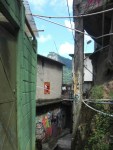
One of our most interesting visits last week was to the favela of Morro dos Prazeres, north-west of Santa Teresa. Prazeres has one of the most astonishing views of Rio of any neighbourhood, with an almost 360 degree panorama of the city, it’s perspective to the south only interupted by the statue of Christ the Redeemer, which is hardly a bad view in itself! You might think that the last thing that favelados would care about was the view but they are well aware of the beauty of their location – the assumption that the poor an desperate would not care about such things is a rather patronising misconception. Elisa, the leader of the community association, at least, seems most proud of this asset and says that like many people she wouldn’t want to live anywhere else even if she won the lottery!
But Prazeres does have serious problems. For a start, it is a ‘hot’ favela, occupied by drug traffickers, who control ‘law and order’ in the place. There is therefore no ongoing police presence, although as with many such communities, the community association does have a relationship of sorts with local military police commanders through organised coffee mornings at which problems are discussed. Luckily, despite or because of the almost complete control of a particular gang which is well integrated into the community (i.e.: they are relatives of the more law-abiding members), there are not many problems with violence and the police, ‘thank God’ (says Elisa), have not raided the favela recently, as they have many others.
In fact, as we were visiting Prazeres, as the taxi driver rather anxiously pointed out as he dropped us a safe distance away, BOPE (military police special operations) were ‘invading’ two other favelas next to it, the very hot Morro de Correoa, and Sao Carlos. The operations left eight dead, and we think what we had assumed initially were fireworks was probably the sound of small arms fire in the Sao Carlos operation. However, when we asked a PM at a nearby police post whether Prazeres was safe to enter, he seemed rather blase and relaxed about the whole thing…
Elisa was another very impressive woman. In the absence of men – who, in the favelas are in many cases, either involved in the gangs, working outside, or unemployed and alcoholic – it seems that a whole generation of strong, courageous women has emerged to try to develop their communities from the bottom up. In the past they have benefited from various attempts by previous mayors to provide development for the favelas. Unlike some places, Prazeres does not have a school built during the regimes of populist left-wing Governor, Leonel Brizola (who seems to be fondly recalled in by almost all those we have talked to in the poorer communities). However there was a lot of intervention as part of the Favela Bairro (Favela Community) program of former Mayor, Cesar Maia, and it is this normalisation or the favelas through infrastructure, social and economic development, education, health and social services that Elisa said are the only long-term solution to the problems of Prazeres. The creche in particular is a source of continual delight to her, and her face lit up whenever it is mentioned.
With social development and education, Elisa argued, eventually the ‘cold’ and uncaring gangs will recruit fewer kids, and they will wither slowly away. Confrontation however, only strengthens them by driving more young people to support the ‘insider’ traffickers against the ‘outsider’ police. They must, she said, work like little ants, with lots of small efforts adding up together to long-term success… then perhaps the anthill of Prazeres will function as a normal community.
The cameras, which are mobile road cameras owned by Westminster City Council, used for multiple tasks including anti-crime activities and protest-monitoring, but they are supposed to be for traffic regulation and as such must conform to technical standards set by the Department for Transport (DfT) -in this case, a 720 x 576 pixel picture size (analogue broadcast standard). Westminster’s are 704 x 576!
This might all seem rather petty were it not for two rather important aspects. First of all the case reminds us how surveillance introduced specifically for one area (traffic management) can creep into other areas for which they were never intended or authorized. This can also work in many directions: some of London’s congestion charge cameras were originally installed as anti-terrorism cameras after the IRA attacks of the early 90s.
Secondly, however it also shows, counter-intuitively, how weak is the regulation of CCTV in the UK. The fact is that the cameras have been stopped because of a technical infringement, and indeed there is in general an extensive and growing list of technical regulations and recommendations for CCTV issued by central Government bureaucracy, yet CCTV remains massively under-regulated when it comes to conformity with human rights and civil liberties, let alone for any consideration of the wider and longer-term social impacts of pervasive video surveillance. The closure of this system highlights the powerlessness of the British people in the face of increasingly authoritarian government, not their strength…
One massively important development back home in Airstrip One, that I somehow missed, as I am here in Brazil, was the announcement of (now officially the worst ever) Home Secretary, Jacqui Smith’s only personal Stasi – sorry, it was just terrorism preparedness training for thousands of workers. It’s easy to get confused especially as this all comes as part of a package of measures designed to counter Islamic radicalism through state propaganda. It’s all part of CONTEST 2, the sequel to the CONTEST strategy that we criticised in our recent book on urban resilience as threatening to turn all British citizens into paranoid spies – for more ridiculous rhetoric along these lines, see the Metropolitan Police poster campaigns. It’s also part of long tradition of volunteerism in British civil defence that goes back to WW2 and even before, and encompasses all that ridiculous advice on hiding behind your sofa in the event of a nuclear attack.
Backing the plan are odd individuals like Maajid Nawaz, who is a former member of Hizb ut-Tahrir, an extremist Islamic group, who seems to have swapped one extremism for another in his support of the British government’s authoritarian stance, in his leadership of the Quilliam Foundation. However, the Conservative Party despite their liberal words on ID cards, actually want to go further than Labour. They claim that we are ‘soft targets’ and that ‘whole community needs to be involved in tackling the danger’. They argue that this would be learning the lessons of Mumbai, but it is quite clear that Mumbai was an attack planned in one country against another, not a homegrown assault, so it seems that they are simply trying to scare us into thinking that we need more McCarthyite tactics.
My first thought about the new terrorism preaparedness training was ‘so where do I sign up? Perhaps the best thing for all critical and progressive people to do would be to sign up and do exactly the opposite of what they want… not that I would ever suggest such a subversive strategy.
Details obtained under the Freedom of Information Act have revealed the extent of the use of the Regulation of Investigatory Powers Act (RIPA) 2000 by Britain’s 182 Local Authorities. The Act has apparently been used to authorise surveillance on over 10,000 occasions for monitoring acts that are mostly trivial. Only 9% of these resulted in any kind of prosecution or enforcement action. This, to me, indicates massive abuse of surveillance by local governments, and they must be controlled. Almost everyone thinks this now, and the government is currently conducting a review of RIPA (due the embarrassment caused by the constant stream of revelations).
This doesn’t go far enough. RIPA is simply bad legislation that was justified in parliament by reference to crime and terrorism. It is poorly overseen and its Tribunal for complaints – yes, there is one, not that anyone knows – is practically invisible. It should be repealed and a more carefully thought out law on the use of surveillance by public bodies with proper provision for judicial oversight, public accountability and post-legislative scrutiny should be introduced.
Rather than being a legitmate political response to an illiberal, repressive, undemocratic and unaccountable growth in surveillance, ‘interest’ in CCTV is now regarded as suspicious in itself…
Boing Boing has news of the latest London Metropolitan Police campaign which is supposedly encouraging people to report their suspicions on terrorist activity, but is in fact just another step on the illiberal, socially divisive and stupid road towards a McCarthyite Britain where British people are expected to spy on each other in the name of security.
Why not check your neighbours' waste bins?
Apart from encouraging people to rifle through their neighbours garbage, the most disturbing thing about this new campaign is the way in which it implies that any interest in CCTV cameras is a potentionally terrorist activity.
See that camera? No, you don't. It's not there.
From the late 1980s onwards, the British state in its usual bumbling, piecemeal and disorganised way, gradually created an increasingly comprehensive monitoring program of British city centres. There was never any strong evidence for the need for this technology, it was never approved by parliament, there was never a single CCTV Act that enabled it.
Now, just as it has become pretty clear that CCTV has very little effect on crime rates (its original justification, let us not forget), the state has started to close down criticism and even interest in or discussion of these surveillance measures. Effectively, we are being officially instructed to ignore the cameras and pretend we don’t see them. Rather than being a legitimate political response to an illiberal, repressive, undemocratic and unaccountable growth in surveillance, ‘interest’ in CCTV is now regarded as suspicious in itself.
At the same time, the British state is increasingly regulating the means of production of visual images by ordinary citizens. The state (and many private companies) can watch us while we have to pretend we don’ t notice, but for ordinary people to take picture or make video in public places, and in particular making images of state buildings or employees like the police (you know, the people who supposedly work for us), is being gradually and by stealth turned into a criminal act. In the past, I have been very careful not to shout about all acts of state surveillance being totalitarian (because very few of them actually are), but there is no other word for these trends. The police are attempting to make themselves the arbiters of how we see society and public places; they are telling us what can and cannot be legitimately the subject of interest and of visual representation.
They are also spending more time now ‘securing secturity’ – protecting the architecture of surveillance that has been built. You can see the private sector recognising this. At equipment fairs I have been to over the last few years, one of the big developments in camera technology has been methods of armouring and protecting the cameras themselves. There seems to be an effort, deliberate or unconscious, to forget the supposed original purpose of such surveillance in protecting us, and instead to concentrate on protecting the surveillance equipment.
This is particularly problematic for researchers like me. We’ll see what happens when I am back in London in May and June when I will be taking a lot of pictures of CCTV as part of my project, which is of course, ironically, sponsored by an official British state research council…
This is massively important because it is based not simply on a financial, political or even an ethical position, but on the database projects’ respect for existing law. They are simply illegal…
A new report for the Joseph Rowntree Reform Trust by a very credible largely Foundation for Information Policy Research (FIPR) team that combines engineers, lawyers, software developers, and political scientists, has concluded that a quarter of the UK public-sector databases are illegal under human rights or data protection law. It also looks at UK involvement in some European database projects and finds all of them questionable too.
The report rates the 46 databases on a traffic light system – green, amber, red – and argues that those rated ‘red’, in particular the National Identity Register and the Communications Database, and are simply unreformable and should be scrapped. This is massively important because it is based not simply on a financial, political or even an ethical position, but on the database projects’ respect for existing law. They are simply illegal, and not just massively expensive, morally questionable or politically undesirable. In fact, a quarter of all the databases were found to contravene the law and more than half were ‘problematic’ (i.e. open to challenge in court) . All of those rated ‘amber’ (29 databases) the authors argue, should be subject to independent review.
There are a number of other major recommendations, including the reassertion of the necessity and proportionality tests contained in DP law, citizens should anonymous rights to access data, more open procurement of systems, and better training processes for civil servants. The most important and radical measures proposed, and entirely correctly in my view, are those concerning the location of data and the whole nature of UK IT development. For the former, the report recommends that the default location for sensitive personal data should be local, with national systems kept to a minimum – this appears to be rather like the ‘information clearing house’ system as opposed to central databases, that we proposed in our Report on the Surveillance Society, but better worded and justified! In the latter case, the authors simply note that fewer than 30% of government IT projects succeed at a cost of 16Bn GBP per annum and that there should never be a general and aimless government IT program, rather there should only ever be specific projects for clearly defined and justified (proportional and necessary) aims.
It is an excellent report and probably unanswerable in its logic. Tellingly, The Guardian report contains no response from any government minister…
Here is yet another episode in what has become a bit of a scrap between David Aaronovitch of The Times and everyone else who knows anything about surveillance (including the news reporters from his own paper). It is making me lose the will to live, but if anyone else is interested, here is Paul Lewis of The Guardian taking David out to count cameras in London.












 ubisurv