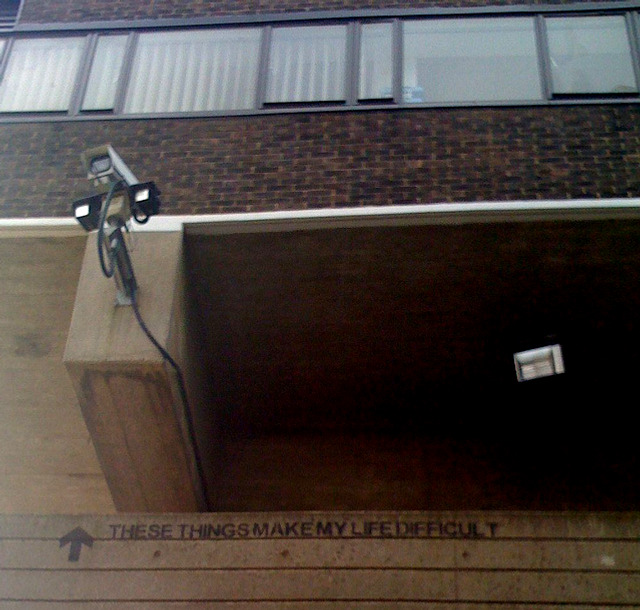
Metropolitan Police Encouraging Stupidity and Suspicion

Rather than being a legitmate political response to an illiberal, repressive, undemocratic and unaccountable growth in surveillance, ‘interest’ in CCTV is now regarded as suspicious in itself…

Boing Boing has news of the latest London Metropolitan Police campaign which is supposedly encouraging people to report their suspicions on terrorist activity, but is in fact just another step on the illiberal, socially divisive and stupid road towards a McCarthyite Britain where British people are expected to spy on each other in the name of security.

Why not check your neighbours' waste bins?

Apart from encouraging people to rifle through their neighbours garbage, the most disturbing thing about this new campaign is the way in which it implies that any interest in CCTV cameras is a potentionally terrorist activity.

See that camera? No, you don't. It's not there.

From the late 1980s onwards, the British state in its usual bumbling, piecemeal and disorganised way, gradually created an increasingly comprehensive monitoring program of British city centres. There was never any strong evidence for the need for this technology, it was never approved by parliament, there was never a single CCTV Act that enabled it.

Now, just as it has become pretty clear that CCTV has very little effect on crime rates (its original justification, let us not forget), the state has started to close down criticism and even interest in or discussion of these surveillance measures. Effectively, we are being officially instructed to ignore the cameras and pretend we don’t see them. Rather than being a legitimate political response to an illiberal, repressive, undemocratic and unaccountable growth in surveillance, ‘interest’ in CCTV is now regarded as suspicious in itself.

At the same time, the British state is increasingly regulating the means of production of visual images by ordinary citizens. The state (and many private companies) can watch us while we have to pretend we don’ t notice, but for ordinary people to take picture or make video in public places, and in particular making images of state buildings or employees like the police (you know, the people who supposedly work for us), is being gradually and by stealth turned into a criminal act. In the past, I have been very careful not to shout about all acts of state surveillance being totalitarian (because very few of them actually are), but there is no other word for these trends. The police are attempting to make themselves the arbiters of how we see society and public places; they are telling us what can and cannot be legitimately the subject of interest and of visual representation.

They are also spending more time now ‘securing secturity’ – protecting the architecture of surveillance that has been built. You can see the private sector recognising this. At equipment fairs I have been to over the last few years, one of the big developments in camera technology has been methods of armouring and protecting the cameras themselves. There seems to be an effort, deliberate or unconscious, to forget the supposed original purpose of such surveillance in protecting us, and instead to concentrate on protecting the surveillance equipment.

This is particularly problematic for researchers like me. We’ll see what happens when I am back in London in May and June when I will be taking a lot of pictures of CCTV as part of my project, which is of course, ironically, sponsored by an official British state research council…

Counting Cameras (yet again)

Here is yet another episode in what has become a bit of a scrap between David Aaronovitch of The Times and everyone else who knows anything about surveillance (including the news reporters from his own paper). It is making me lose the will to live, but if anyone else is interested, here is Paul Lewis of The Guardian taking David out to count cameras in London.

Global CCTV datamining project revealed

As a result of an annual report on datamining sent to the US Congress by the Office of the Director of National Intelligence, a research project, Video Analysis and Content Extraction (VACE), has been revealed. The program is aiming to produce an computer system that will be able to search and analyse video images, especially “surveillance-camera data from countries other than the United States” to identify “well-established patterns of clearly suspicious behavior.”

Conducted by the Office of Incisive Analysis, part of the Intelligence Advanced Research Projects Activity (IARPA), the program has apparently been running since 2001,and is merely one of several post-9/11 research projects aiming to create advanced dataveillance systems to analyse data from global sources. How the USA would obtain the information is not specified…

One could spend a long time listing all the DARPA and IARPA projects that are running, many of which are speculative and come to nothing. The report also mentions the curious Project Reynard that I have mentioned before, which aims to analyse the behaviours of avatars in online gaming environments with the aim of detecting ‘suspicious behaviours’. Reynard is apparently achieving some successful results, but we have no real idea at what stage VACE is, and the report only states that some elements are being tested with real world data. This implies that there is nowhere near a complete system. Nevertheless the mentality behind these projects is worrying. It is hardly the first time that the USA has tried to create what Paul Edwards called a ‘closed world’ and these utopian projects which effectively try to know the whole world in some way (like ECHELON, or the FBI’s proposed Server in the Sky) are an ongoing US state obsession.

It is the particular idea that ‘suspicious patterns of behaviour’ can be identified through constant surveillance and automated analysis, that our behaviour and indeed thoughts are no longer our own business. Because it is thoughts and anticipating action that is the ultimate goal. One can see this, at a finer grain, of programs like Project Hostile Intent, a Department of Homeland Security initiative to analyse ‘microexpressions’, supposedly preconscious facial movements. The EU is not immune from such incredibly intrusive proposals: so-called ‘spy in the cabin’ cameras and microphones in the back of every seat have been proposed by the EU-funded SAFEE project, which is supported by a large consortium of security corporations. The European Commission has already hinted that it might try to ‘require’ airlines to use the system when developed.

No doubt too, because of the close (and largely secret and unaccountable) co-operation of the EU and USA on security issues, all the images and recordings would find their way into these proposes databases and their inhuman agents would check them over to make sure we are all passive, good humans with correct behaviours, expressions and thoughts, whether we are in the real or the virtual world…

How many cameras are there in Britain? (4)

Despite the fact that it really doesn’t ‘work’, the growth of CCTV is almost out of control in Britain, and it is probably only the recession that is holding this growth back at all…

Here is another episode in the ongoing saga that was sparked off by my discussion with David Aaronovitch about supposedly misleading figures used in our Report on the Surveillance Society, leading to his rather weak comment piece in The Times, my pre-emptive response here, and Paul Lewis’ similar piece in The Guardian.

Aaronovitch’s own newspaper, The Times, has now published a story by one of its reporters, Kaya Burgess, in which she counted the cameras on her commute into work, and found there were a total of 281 cameras on her 3.1 mile route, or one camera every 18 metres on average. 108 of these were state-placed and the rest were installed by private operators (shops,homes etc.). As the article points out, and this is something I have been arguing for years, the growth of private cameras is remarkable and of course, almost completely unregulated.

The figure of 281 is remarkably similar to Clive Norris’ little fictional tale of ‘Thomas Kearns’ of 1999 which sparked the ‘we are watched by 300 cameras a day’ stories in the press, and which was the subject of Aaronovitch’s piece. Perhaps we should feel smug, but that still isn’t the point. There never was an ‘accurate’ figure to be correct about. It was a possibility. Now it seems that the possibility has been bypassed by some distance, at least for London. Because remember, Kaya’s journey was merely the journey into work. It was not even a small portion of the day. It did not count cameras at work, or those she might encounter during her working day, nor those her image might be captured by if she went out for a post-work meal and drinks… her 281 might well end up being double that by the end of the day, and she was not doing any of the more ‘unrealistic’ things that Norris’ ‘busy Londoner’ was.

Of course, this density of cameras is by no means uniform across London or across the country, nor is there one central ‘Big Brother’ behind the cameras, no one guard in the tower. We live not in the Panopticon of Jeremy Bentham, made notorious by Michel Foucault’s analysis, but in what contemporary French theorist, Bruno Latour, called, an ‘oligopticon’. In some places we are watched (and even known) intensely and in others hardly at all, and we move through these different zones of varying intensities of surveillance in our days and our lives.

Does that make the huge number and high density of cameras in some places ethically more acceptable? Hardly. Despite the fact that it really doesn’t ‘work’, the growth of CCTV is almost out of control in Britain, and it is probably only the recession that is holding this growth back at all. The Times report also notes that the Local Authority cameras appeared to be placed in clear violation of the existing voluntary CCTV Code of Practice which states that CCTV should be installed in areas of high crime, not just at regular intervals everywhere. Senior police officers I have talked to agree with this. They don’t see the need for cameras on every corner; they want to target crime hot spots effectively and efficiently. And of course, the private cameras aren’t really regulated much, and those on private homes not at all. The important thing, is to have stronger, clearer regulation of CCTV as the House of Lords Constitution Committee recently demanded. This new regulation should control and perhaps even reverse the growth in the number of cameras by specifying much more clearly the circumstances and contexts under which CCTV is appropriate and how it is to be discussed and approved, so that it becomes a possibility to be debated not the normality to be expected.

(thanks to Charles Raab for bringing this piece to my attention and for being fair about The Times!)

A sane response on the number of cameras

Here is an eminently sane and sensible response to the ‘debate’ on the number of cameras in Britain from Paul Lewis in The Guardian. Not much more to say really other than I strongly suspect that he reads this blog!

Actually, equally sane if rather ruder, is Charlie Brooker, also in The Guardian. He argues as bitterly as usual, that the attitude of the Labour government to its information relationship with its citizens represents nothing but contempt. I strongly suspect he may be right.

How many people are being arrested for taking pictures in public in Britain?

It seems that what is going on is a battle to control the power of visibility, the power to make images. The British state, and other ‘responsible’ bodies (generally commercial organisations) are attempting to make us increasingly transparent whilst at the same time reducing the ability of ordinary people to render the state transparent…

I’m seeing more and more local and self-reported stories of ordinary people being harassed and arrested in Britain, for taking photographs in public. Today BoingBoing is reporting on this Manchester man who was arrested because the police thought he might be photographing sewer gratings. I reported last year on the case of an online acquaintance who was arrested and humiliated over several days in London. It is increasingly not even police but the growing multitude of ‘plastic police’ – Police Community Support Officers (PCSOs), neighbourhood wardens and private security guards – who are at the forefront of this tendency. But because most of these stories are never taken up by the national – or even local – media, it is difficult to have a good idea of how widespread this has become.

This is even before we have seen the effects of the new Counter-Terrorism Act 2008 which under Section 76, gives power to the police to prevent people from taking pictures. Most of the arrests have come under Section 44 or 58 of the Terrorism Act 2000 which allow the police to stop and search photographers and in the latter case, to arrest people for possessing material (generally photographs in this case) likely to be of use in the commission of an act of terrorism.

At the same time of course, there has been a huge expansion of CCTV particularly by the state. It seems that what is going on is a battle to control the power of visibility, the power to make images. The British state, and other ‘responsible’ bodies (generally commercial organisations) are attempting to make us increasingly transparent whilst at the same time reducing the ability of ordinary people to render the state transparent, in other words to hold the state accountable. A situation of rowing asymmetry is developing with regards to the visual image. This renders the whole public rationale for CCTV expansion highly questionable. We already know that CCTV operatives are spending more of their time searching for these kinds of social and public order offenses rather than actual crime.

This tends to support the argument that I have been making that several democratic countries, with Britain and Italy at the forefront, are drifting into a kind of ‘soft fascism’, a creeping totalitarianism that is presented as reasoned and reasonable. It allows supporters to claim that opponents are being ‘extreme’ and underestimating the ‘real danger’, that all of these measure are ‘for our own good’. Yet we have arrived at a point where even untrained, ill-educated street-level minions of the state can now decide whether wee are allowed to take pictures in public. When people like ex-MI5 chief, Stella Rimington are saying that we are in danger of heading towards a police state, even the cynics, and the ‘nothing to hide, nothing to fear’ crowd, should be taking some notice.

How many cameras are there in Britain? (2)

Well, Aaronovitch’s piece came out. It’s not even as interesting as I had thought it would be, and my account yesterday says all that needs to be said in response, except to note that he even managed to get my surname wrong and that of the character in Clive’s book, which is more than ironic for an attack on inaccuracy! Journalists, eh? Gotta love ’em…

To be fair to The Times, it has been getting better recently on this issue, and they carried a very good interview with the Information Commissioner, Richard Thomas, last week, which was in marked contrast to their sniping at him a few years ago. It also shows a depth of understanding and the political maturity needed to recognise what is important in the debate on surveillance.

How many cameras are there in Britain?

The truth is that no-one knows exactly how many cameras there are in Britain or indeed in any country in the world

I’ve been having an interesting little private exchange with a David Aaronovitch of The Times newspaper, who seems to think he has uncovered a terrible conspiracy… and I think I am about to be accused (tomorrow) of being ‘cavalier’ with the truth and of misleading the public. Interestingly enough this is going to be in the same newspaper that was the only one that tried to rubbish the Information Commissioner back in 2006 when we published our Report on the Surveillance Society and indeed were actively lobbying against his reappointment. I suppose someone has to argue the establishment case…

What David has been e-mailing me about is the validity of figures concerning the number of CCTV cameras in Britain that journalists have been happily spreading about for the last ten years. These figures are the ‘4.2million CCTV cameras in Britain’, and the ‘person can be captured on 300 different cameras in a day.’ He seems to think that it is an urgent matter of national importance if these old figures aren’t ‘accurate’ or apply to the average person. Well, they were and are purely indicative – they aren’t ‘accurate’ and never were, and the latter one doesn’t apply to a typical Briton and neither Clive Norris, whose figures they are, nor myself, nor any other credible surveillance studies academic that I know, has ever claimed that they are and do.

The first figure derives from what Professor Norris openly described as a ‘guesstimate’ in his working paper with Mike McCahill on CCTV in London that was done for the EU’s UrbanEye project. Based on a casual count of cameras in one small neighbourhood in London in around 2000 (not the City of London where cameras were much more concentrated even then) it aimed to get a very loose handle on the scale of the spread of CCTV in Britain. The police at the time claimed that the real figure was in hundreds of thousands, but they were only talking about public cameras, and they had just as little idea of the extent of CCTV.

The other figure that of 300 cameras a day came from a little fictional vignette that Professor Norris and Dr Gary Armstrong wrote for their book, The Maximum Surveillance Society, which came out back in 1999. It was simply designed to illustrate how many cameras a person could possibly be caught be in any one day. I was thinking it would actually be very hard for this to be that likely even now, except perhaps in the very core of global cities like London, but then there are over 300 cameras on the university campus where I am currently, and I haven’t even started on all the private cameras, the public cameras in the city, the traffic cameras, the cameras in the buses, banks, shops, cafes, restaurants, bars, in the hotel etc. etc. I would estimate that I am caught by around 100 cameras when I am out and about here and this isn’t even a city that considers itself to be particularly ‘under surveillance.’

The truth is that no-one knows exactly how many cameras there are in Britain or indeed in any country in the world. We deliberately used words like ‘may’ or ‘can be’ in reference to these figures in our Report on the Surveillance Society because they are so rough, so inaccurate – and we were quite clear that this was not in any case a report about CCTV; if anything we tried to downplay CCTV and get to other technologies and techniques, such as dataveillance and RFID, and more importantly the way connections and links are being made, and boundaries blurred. ‘Millions’ may be about as accurate as we can guess for the UK. But does it matter if there are 1 million, 4.2 million or 10 million? Not hugely. It matters as one crude indicator of a surveillance society, but even then, the number of cameras is a very crude measure and more cameras does not necessarily mean more comprehensive coverage or better pictures, or more ‘control’. For example, would it be worse or better if I was only seen by one camera in a day, but that camera was there all the time and I was constantly being assessed on my performance (as for example is the case with many workers in call centres)? The Guardian today seems to understand this – in its report on the high-tech control room in Westminster, it clearly states that ‘no-one knows’ how many cameras there are (before quoting some even more made-up figure than ours!).

I know the media likes its easy numbers, but an old saying about not being able to see the wood for the trees comes to mind… As a researcher, I am more interested in characteristics of the wood than the specific number of trees. Now if there were no trees at all or very few, that would matter. And in my current comparative project it has some importance as one of the many indicators of what constitutes a surveillance society that I am looking into. So in a couple of year’s time I may have more of an idea of from any cameras there really are in Britain. One of the things I am trying to do during my current project is develop better ways of assessing ‘how much surveillance’ there is, and what it means. Because that is the important issue – meaning. Does it matter if there were 1/6 or 1/7 or 1/8 of the population of the former East Germany who were recruited as informers? You’ll find all those as educated guesses in the literature. What matters was that there was a culture of informing that pervaded every action. It was a society that became increasingly based on deception and distrust.

The key questions with CCTV are:

  1. first of all, why are there any cameras, and particular any cameras in public space, at all? Surely there was a line crossed when the first use of CCTV occurred. What was the reasoning?
  2. why did CCTV spread so quickly to so many places, and was so little contested?
  3. why is CCTV now considered so ‘normal’ in Britain?
  4. connected to this, why do the myths of CCTV’s effectiveness continue to be spread when all of the evidence shows a small and very limited impact on crime?
  5. what kind of a society does pervasive CCTV create? what are the social effects? what kind of social and cultural responses are there?

etc.

Unfortunately the media doesn’t seem to like depth or uncertainty. Maybe that was our real mistake – to overestimate the intelligence of the media. I have asked them for a right of reply – I am more than happy to debate the issue in public. Let’s see if that happens…

Austin no longer the coolest city in the USA

The latest city to fall for the current wave of government enthusiasm for surveillance that is sweeping the USA is, unfortunately, the city of Austin… Sorry Austin – unless you people do something about this, you are off my list of cool cities…

Austin, Texas… lone island of sanity and liberalism in a less-than-liberal state. With its laid-back attitude, massive urban bat population, superb music scene and reputation for weirdness, it must for some time have been a candidate for coolest city in the States.

Austin... no longer cool

Well no longer. The latest city to fall for the current wave of government enthusiasm for surveillance that is sweeping the USA is, unfortunately, the city of Austin, whose authorities have voted to install a CCTV system. The local newspaper, The Daily Texan, jauntily informs us that the city has voted to sacrifice privacy for security: that does not sound like the attitude of a confident, hip place. Sorry Austin – unless you people do something about this, you are off my list of cool cities!

Seriously, though: Austin is not a city with an especially high crime rate, nor has it seen any massive recent increase in crime – even if CCTV was any good at reducing crime, which we know from the multiple assessments done in the UK and elsewhere that it isn’t. Yet Police Chief Art Acevedo is quoted as praising CCTV in the UK, specifically in London. Perhaps he has been reading too much of the hype and hasn’t read the British government’s own assessments of CCTV (conducted under the auspices of the Home Office)?

So why the sudden urge to install cameras? Could it be because of the lure of federal funding from the Department of Homeland Security? It could be. Austin has acquired $350,000 to install cameras, and what set of city fathers turns down cash (whatever it is for)? That was one of the main lessons of the expansion of CCTV in Britain in the 1990s and of course cities are now paying the long-term price of their enthusiasm as they struggle to find the money to monitor and maintain their camera systems. Chief Acevedo seems to have no worries about this though – this techno-evangelist is already talking about automation and computer recognition systems. He really sounds like a guy who has started to believe the sales pitches at all those law enforcement technology trade fairs…

Newcastle University CCTV comment

Not a million miles away from my office at Newcastle University, back in the UK, this stencil has appeared (“nothing to do with me, guv, I was in Brazil, honest…”)

Claremont Bridge, camera and comment (photo: Jon Swords)