
David Loukidelis, the Information and Privacy Commissioner of British Columbia, speaking today at The Surveillance Games workshop, has made it quite clear that his office does not want the Winter Games to leave a legacy of securitization in the city or indeed, fear (as the Assistant Federal Privacy Commissioner, Chantal Bernier, put it), in the consciousness of its residents. In particular he argued that the 600 (yes, 600) cameras that are being installed at the Olympic venues and beyond should not be allowed to remain after the games. I hope that his office is able to deliver on this view, but I doubt that it will. As Kevin Haggerty and Phil Boyle have noted, security architecture is now an actual deliverable of the Olympics, and as many other researchers have shown, such architecture, including in particular CCTV but also adjusted local or national laws on the thematic and spatial limits of protest and freedom of expression (which, as Michael Vonn of the BCCLA and Chris Shaw, a leading anti-games activist, are describing at this very moment in the conference, are themselves often illegal and unconstitutional) tends not only to persist but to act as a kind of Trojan Horse for an expanded surveillance. And as Vonn’s group has also shown – the city is building a permanent CCTV control centre as part of the security architecture for the Games, and you don’t do that for cameras that are going to be removed.
Category: urbanism
New York City expanding surveillance infrastructure
The New York Times reports that $24M US has been assigned from the Department of Homeland Security to expand the city’s CCTV camera system from downtown to midtown Manhattan (the area between 30th and 60th Streets). This of course is justified by Mayor Bloomberg on the grounds of security, with a large number of iconic buildings in the midtown area. However, it bears repeating that firstly, the 9/11 attacks did not come from the streets, and secondly, London already had a comprehensive CCTV system at the time of the 7/7 attacks and whilst they provided lots of pictures for the news media afterwards, they did not in any way prevent the attacks, and it is difficult to see how such a system could prevent any determined attacker. It may make people feel safer, at least temporarily, however even at that symbolic level, there’s likely to be as many people who feel uneasy about the idea of constant monitoring or the loss of privacy (although from my experience of the UK, the actual monitoring is far from constant or comprehensive, and most people also get used to that too). But, whatever the people of New York do feel – and there will many different reactions – they shouldn’t get the impression that they are getting actual ‘security’ (whatever that is) here. This isn’t a message many people like to hear, it seems, least of all those in government…
The City as Battlesuit
A really stimulating article by Matt Jones over at Future Metro, my new favourite site, which I have only just discovered thanks to David Barnard-Wills. This manages to combine several of my interests: urban futures, surveillance, security, ubicomp, SF and comics, into one tasty package – I’ll have to check out Matt’s own blog too.
Surveillance cameras in the favelas…
Well, my fears have it seems, been vindicated already. Earlier this year, as part of my case-study on surveillance in Brazil, I visited the community of Santa Marta, a favela (informal settlement) in Rio de Janeiro. Santa Marta is interesting because of the amount of investment and effort that has been expended in occupying, pacifying and developing the place, by the new gubernatorial administration of Eduardo Paes, who has simultaneously cancelled Favela Bairro, the widely praised and more extensive favela development programs of his predecessor, Cesar Maia.
Leading the new Community Police efforts in Santa Marta was Capitao Pricilla, an indomitable and well-liked young female officer of the Military Police, one of several rising female officers with a new approach, and we heard from residents how trust was being rebuilt between police and community because of her. At the same time, there were storm clouds on the horizon as the city administration was insistent on cracking down still further with its policies of choque de ordem (the shock of order), which involved harassing illegal street vendors from the favelas, and demolishing illegally-built buildings, and also building walls along the edges of some favelas. The word ‘ghetto’ was mentioned on more than one occasion by our interviewees and in more casual conversations.
Now, just last month, the Military Police have decided to install seven CCTV cameras in Santa Marta, in different areas of the community. This has prompted complaints of invasion of privacy, an there have already, my sources report, been protests about this in he favela, but it seems that this is coming from further up the chain of command than Capitao Pricilla and the community police. She isn’t mentioned at all by the article in O Globo, despite being a bit of a PR star, and instead the justification for the cameras is given by one Coronel José Carvalho, who also stated that there are plans to put cameras into the other two areas currently being targeted for development, the famous Cidade de Deus, and the much less well-known and more distant favela of Batan. This also contradicts what I was being told by the Commnder of the police central CCTV control room we visited, which is quoted as being one of the places where the cameras will be monitored. What is interesting is the cameras seem to be being treated by police almost as a tool of urban warfare: a Major Orderlei Santos talks about their experimental use for determine the deployment of officers in the favela.
Could the old macho, male, approach to policing as a war on the poor be trumping the new trust being developed by community policing? I hope not, but everything points that way.
(thanks once again to Paola and David for keeping me in touch…)
Kabukicho Renaissance?
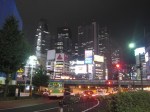
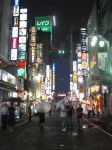
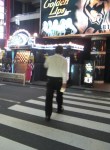
Kabukicho is a place that is hard to love. A seedy, crime-infested dive full of ‘massage parlours’, ‘aesthetic salons’, ‘image bars’ and other thinly-disguised forms of brothel. Tokyo has had red-light disticts since the Edo period, of course, and the Yoshiwara was only the most famous. Shinjuku was always one of them, and since the failure of the threatre initiative that gave the neighbourhood its name, Kabukicho has been the best known. Kabukicho is interesting though for many reasons. It had a radical political and cultural history in the 60s and 70s. It was the epicentre of changes that occurred in organised crime in the 80s and 90s, with Chinese gangs replacing the Yakuza as the biggest ‘threat’. And it is now the centre of efforts by the Shinjuku authorities to clean up its image, with the Kabukicho Renaissance policy, and the new Town Manager, and by Tokyo police to crack down on illegal immigration.



Vehicle tracking in Japan: N-system
Back in February, I reported from Brazil about the progress of a proposed RFID-based vehicle tracking system, SINIAV. Of course RFID is not at all necessary for tracking. In the UK, the police have used Automatic Numberplate Recognition (ANPR) systems based on roadside cameras since 1993 in London – following the Provisional IRA bombings of the City and Docklands (see the account in my erstwhile collaborator, Jon Coaffee‘s book, Terrorism, Risk and the City – and since 2005, this has been in the process of being expanded into a nationwide network (see also the official Press Release from the Association of Chief Police Officers concerning the launch here).
What is rather less well-known to the outside world is that Japan developed such an automated camera system far earlier, from the early 1980s. The so-called N-system thereafter was gradually expanded to cover almost all major expressways and strategic urban locations in Tokyo and Osaka. Kabukicho, the entertainment district in Shinjuku, which I have spent some time studying over the last few years and will write about more tomorrow, is surrounded by N-system cameras and it is, I estimate, impossible to drive into this area without your license plate being recorded. These cameras are in addition to the 50 CCTV cameras that cover just about every street within the district. N-system is supposed to have played a major role on snaring suspects from the apocaylptic cult, Aum Shinrikyo, which carried out the Sarin gas attacks on the Tokyo underground in 1995, and who also assassinated top policemen and judges. Aum, now renamed ‘Aleph’, has been under official state surveillance ever since.
The Japanese police are not very forthcoming about N-system, let alone the details of how long data is kept and what it is used for. However one particular lawyer’s office in Tokyo did a very good investigation of the constitutional, legal and practical aspects of N-system back in the late 90s, and the updated pages are available here, including a nice little animation explaining how the system works.
We will hopefully be talking to them before we leave Tokyo. We still have time for a few more interviews here including the East Japan Railways security research lab, the Japanese consumers’ association, the organisation for the welfare of foreign workers, and the Suginami ward community safety people. And I will also just about have time to shoot down to Kobe to talk to Professor Kiyoshi Abe, a friend and collaborator, who is also one of the leading surveillance researchers here.
CCTV and urban regeneration in Nippori
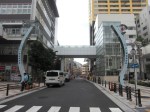
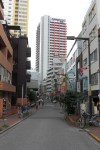
The link between urban regeneration or redevelopment and the introduction of video surveillance has been well documented by many different authors in Britain, in particularly Roy Coleman in Reclaiming the Streets. It seems that the link is strong in Tokyo too. This new CCTV scheme in the front of Nippori railway station in Arakawa-ku is not only clearly part of the social and spatial restructuring of this area, it is an essential part of the new image, with the new entranceway celebrating the security cameras as much as the area’s name. This is the area we were told by Shinjuku officials had only three cameras, whereas in fact it has the princely total of ten! In retrospect the Shinjuku people seemed to be rather condescending towards Arakawa-ku.




Planning and protest in central Tokyo
Tokyo is a constantly changing stew of styles and forms, but don’t be fooled into thinking this is just ‘organic’ change. The capital of Japan is a playground for capital, local and global, and there isn’t much in the way of planning law or practice to stop the developers doing exactly what they want. It’s worth reading Andre Sorensen’s The Making of Urban Japan for a good account in English of why this is.
Inasmuch as the traditional morphology of machi (neighbourhoods) survive, it is largely due to either the unfashionable character of the area putting off developers, temporary lulls in the property market, or the sheer stubbornness of residents in refusing to being intimidated into selling land or putting up with the serial replication of blocks of manshon (typical 5+ storey apartment complexes). Strong property rights and small traditional plots do at least mean that it is more difficult to put together the land in what is called tochi kukaku seiri (land readjusment) to make really large developments which, as a result, tends to be restricted to whole sites that come on the market through things like the privatisation of Japan Railways (although some private developers like Mori Building Co. have managed private massive land readjustment projects like Roppongi Hills that I have researched on previous visits).
Of course the building regulations that do exist tend to favour development too, as they regard any old building as inherently unsafe (because of susceptibility to fire and earthquake) and it is thus very difficult, for example, to get traditional wooden houses repaired let alone new ones built. In addition, since the Edo period regulations have sought to open fire-breaks in the urban structure and increase the width of roads and alleyways – and again, the traditional and wonderfully characterful narrow roji (lanes) are very difficult to maintain as any new building has to be set back to newer road standards. This in turn tends to make the backstreets more accessible to faster-moving traffic and thus gradually dehuamanize and desocialize these places.
So communities have a lot to contend with and, despite the 196os environmental movements and machizukuri (community development) and the 1980s craze for ‘amenity’ (which included the promulgation of a ‘sunlight ordinance’ that was supposed to stop the construction of taller buildings that would block out the sun from neighbouring plots), the developers continue to try to squeeze in unwanted and inappropriately massive structures wherever they can.
We came across this small example of a local neighbourhood campaign to stop a new manshon being built at the edge of the historic (but much damaged) Yanaka district. It might not loo very exciting but you add these developments up all over the city and it goes a long way to explaining why Tokyo is gradually losing the remaining historic and social character that makes it a surprisingly human place to live, despite its size…



Death of the dojunkai apartments
As I mentioned the other day, after the Kanto daishinsai (Great Kanto Earthquake) of 1923, there were many changes to planning and architecture in Tokyo, in particular a series of experiments with introducing western-style elements into the city, including wider streets to accommodate trams (streetcars), and new concrete mass housing influenced by the modern movement.
Dojunkai, a special organisation under the Interior Ministry, was set to provide such things. Between 1924 and 1936, this agency built 16 apartment blocks out of ferroconcrete and wood in Tokyo and Yokohama. The best known were those in Daikanyama (near Shibuya) and on Omotesando Avenue in Aoyama. The latter were controversially demolished in 2003 by the Mori Building Company Ltd to make way for their soulless Omotesando Hills shopping complex.
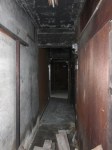
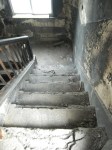
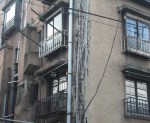
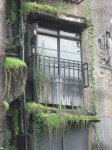
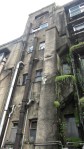
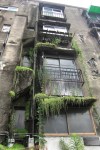
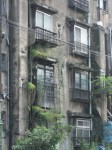
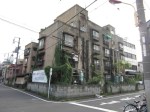
Much less celebrated however, were the Dojunkai appartments in Nippori (not Minowa as most people seem to think) in Aarakawa-ku, just round the corner from where I am staying. They’ve been empty and crumbling for a while, but now the writing is very literally on the wall, saying that they will be demolished too. It’s a sad moment: another episode in the slow death of the utopian urban ideal of the Twentieth Century. It’s also a reflection of the very high land prices in Tokyo and relative lack of value in what is on the land at any time (see this article for a good summary of the difficulty of any architectural preservation in Tokyo).
Anyway, not only are they valuable historical buildings, they are also degenerating rather stylishly so, at the very least, I thought I should get in and take some pictures before it was too late. So I did – much to the surprise of a crew of local authority workers who were surveying the place as I came out. Here are some of the shots. I didn’t (yet) go into any of the indvidual apartments – all those I tried were locked and some chained too – though I might try to in the early morning this week before anyone is around.










Community Safety in Arakawa
Far from the skyscrapers and bright lights of Shinjuku, where we had our last interview on community security and safety development (anzen anshin machizukuri), Arakawa-ku is a defiantly shitamachi (‘low-town’ or working class) area to the north-east of Tokyo just north of Ueno and outside the Yamanote-sen JR railway loop line that has for much of the last 40 years defined the boundaries of the richer parts of the city.
Bordering the Ara river and split by the Sumida river, it was traditionally a marshy place liable to flooding. It was also a place with a large buraku (outcaste) population and Minowa (in the north of the ward) contains the mournful Jokan-ji (or Nagekomi – ‘thrown-away’) temple, where prostitutes who died in the Yoshiwara pleasure district were cremated. The place has been hit hard by disaster. It was levelled twice in the the Twentieth Century, first by 1923 Kanto daishinsai (Great Kanto Earthquake) and then again by the firebombing in the last years of WW2.
Nevertheless, its rough, industrious, hardworking spirit has continued, and these days, despite the march of secure manshon (high-rise housing) down the post-war avenues, it remains a place full of small industrial units, especially recycling businesses and clothing wholesalers and manufacturers in Nippori, small bars and family restaurants, and lots of ordinary housing, even some of the last remaining dojunkai (early concrete public housing) constructed after the earthquake. It’s also the starting point of the last remaining tramway (streetcar line) in Tokyo, the Toden Arakawa-sen. I like it a lot and it’s where my wife and I have lived in Tokyo in the past, and where we still stay when we return (there will be more pictures in a later post).
It was natural then to turn our attention to the place as a case-study area, mainly because it is so different from Shinjuku and the other areas that have gained so much attention from the Tokyo Metropolitan Government’s recent initiatives. We met with three officials from the Community Safety section of the local administration: the boss and two guys who had been seconded from the city police and the fire service respectively. The boss was full of enthusiasm for the direction that Arakawa-ku has taken, which although they don’t use the term ‘machizukuri‘ is far more about real community involvement than some places that do.

Arakawa has no comprehensive CCTV strategy, although the police do consult with the developers of large new buildings on its installation. That’s not to say that they don’t have a certain degree of ‘CCTV envy’ of those places with the latest high-tech gadgets that Arakawa can’t afford, but they are not dazed by the glamour of cameras and are realistic about both the limitations of CCTV and the appropriateness of such systems for their city. Instead they concentrate on using and enhancing the natural surveillance capacities of the local communities. They make a great deal of use of volunteers, retired police officers and ordinary local people, who do their own patrols, including the delightful wan-wan (‘woof-woof’) patrol which, judging from the posters, involves mainly older female residents and very small dogs! Participation in the various community initiatives is encouraged through the use of techniques like professional rakugo (traditional comic monologue) performances in schools and community centres. They also run community patrols in miniature versions of police patoka (patrol cars), which not only look more friendly but unlike the US-style police cars can get through much narrower streets.

However these diverse community projects are being stitched together in quite an innovative way, with the use of small anzen anshin sutashion (security and safety stations), which are a bit like community versions of the police koban, the miniature two-person police boxes which dot the city. Indeed the officials referred to them as minkan koban (‘people’s koban’). These small help stations, staffed mainly by ex-police don’t just provide ‘security’ information, they also deal with social security in the broader sense, offering help for older people with benefits, for example. In almost all cases, they have replaced koban that were closed by the police. So one could argue that this is essentially the local authority being forced to pick up the bill for services that used to be provided by the police and at the same time is actually losing real police service. However, the strategy overall is a valiant attempt to make ‘community safety’ less an issue of exclusionary security and more one of inclusivity and community development, more a natural and intimate part of everyday life that does not involve new forms of external control.
Of course, crime isn’t really a massive issue here anyway. Arakawa has consistently had the second or third lowest crime rates of all the 23 Tokyo wards. But even since the introduction of these initiatives, crime has fallen still further from the relative high point it reached a few years ago. And hardly a CCTV camera in sight…
 ubisurv