The Shock of Order: Building and Demolition in Rio de Janeiro

I may have been slightly worried about the most recent drugs war that was going on as I arrived, but as usual this appears to have been exaggerated by the press who largely serve the richer, middle-class community, and who appear to want to have their fears stoked on a regular basis. The ‘war’ is a trafficker conflict that involves traffickers based in the large favela of Rocinha, who belong to the Comando Vermelho (CV, Red Command) the oldest and largest of the prison-based umbrella groups of Rio drug traffickers, attacking another favela, Ladeira dos Tabajaras, whose traffickers are backed by the ‘Amigos Dos Amigos’ (ADA, ‘Friends of Friends’). This kind of thing is happening on and off all the time, but what made it a concern of the paranoid middle class in this case, was geography: in order to get to Ladeira dos Tabajaras, the Rocinha gang had to go through the rich high-rise area of Copacabana… to say that it is exaggerated is not to say that it is not dangerous: 8 people have so far been killed, but they are all traffickers and, I believe, all killed following police raids into the favelas.

It is probably no coincidence that this display of force by the Rocinha traffickers is happening just as the city government of Rio has started to implement a policy of the current Mayor, Eduardo Paes, known as ‘choque de ordem’ (the ‘shock of order’), which involves sorties into communities like Rocinha largely to enforce planning regulations by destroying recent illegally built constructions, which are pushing the favelas even further up into the hills. In the last few days, this policy has resulted in the demolition of one particular controversial building, the Minhocão in Rocinha. This was due to start on the 17th, but was halted by a judicial decision, before going ahead in recent days.

There is more than a degree of irony here. The purpose of these demolitions is supposedly to enforce urban planning regulations and ‘protect Rio’. The Secretary for Public Order, Rodrigo Bethlem, is quoted by O Dia as saying (in my translation):

“We cannot permit an entrepreneur to come into Rocinha to build and make easy money by exploiting people. We cannot allow Rio De Janeiro to be destroyed by speculators, who want to make money without following any rules and who aim only at profit.”

Yet, I only have to glance out of my window here to see the towers of the Centro, built by wealthy speculators, which have almost completely destroyed the beautiful Parisian-style boulevards and belle epoque architecture that used to be ‘Rio’. And turning the other way, the coastline it dominate by the secure condominiums long the beaches, which I am pretty sure were not constructed out of the kindheartedness of developers, and whose development no doubt involved corruption at higher levels of urban government. Looking uphill, I can see the often dubiously if not illegally-constructed houses of the rich that cut into the edges of the National Park.

Can we look forward to the demolition of all of these disfigurements of Rio? Of course not… and the reason is obvious. The demolitions in Rocinha are about power projection. Local state policy towards the favelas goes in waves that alternate between socio-economic solutions and violent authoritarianism. For all its negative aspects, many people who are concerned with social justice here recall with some nostalgia the progressive populism of Leonel Brizola who was mayor in the 1980s. His administrations installed infrastructure, built schools and improved houses in the poorest areas.

The current administration of Eduardo Paes is taking a very different and harder line, concentrating on law and order, a stance which was laid out clearly during the Pan-American Games when the police effectively occupied several of the favelas in an Israeli-style security operation. There would be nothing wrong with this if it were backed by some kind of progressive social imagination too – some favelas like Dona Marta, which I will be visiting later this week, have apparently been transformed through a combination of strong control and surveillance with real social improvements.

Instead there are apparently plans to further marginalise favela residents by building a wall along the major highway from the international airport into the city, so that all the city’s elite can feel so much more secure, and of course, visitors will not have to even see the favelas (some or Rio’s most miserable) which line the route… there’s more than a whiff of Israeli tactics about this too. Whether by building or by demolition, urban planning seems to be currently used as a weapon against the favelas and their inhabitants.


The beauty and cruelty of Rio de Janeiro

There is no reason why with the same infrastructural, social and economic support as anyone else in society would expect, that the favelas could not become truly beautiful without being cruel…

I am trying to think of something not too banal or cliched to say about Rio de Janeiro. It is rather difficult when I am sitting in my room in this artist’s house in Santa Teresa with its balcony overlooking the whole city centre and the bay and Niteroi on the other side, with bossa nova drifting up from the room below…

Being on a hill though, Santa Teresa is as good a place as any to try to get an initial feel for the geography of the place. Whatever you have read about Rio, however many pictures or films you have seen, it is still impossible not to feel utterly astonished, and in many ways delighted, by the place. Rio is unquestionably the most beautiful city I have ever been in. The shapes of the hills, the curves of the coast, the collision of architectures, the forest which comes right down into the city itself. Flying in, you could see its sprawl (this is a city of over 10 million people), but from the inside it is all small neighbourhoods, and more importantly all edges. One never seems to be entirely in one place in Rio, rather one constantly walks the boundary between city and forest, wealth and poverty, high rise and favela…

Because the poverty and the favelas are also inescapable. Unlike in San Paulo, where the favelas are located more on the periphery and can therefore be ignored by the rich, in Rio the rich and poor neighbourhoods are locked together like the fingers of clasped hands – but are they locked in mutual dependence or a death grip? The richer areas tend to run up the flattest land, whilst the favelas cling to the steeper slopes above and below. The disturbing thing for anyone who would try to form any swift opinion, is how beautiful the favelas are seen from my bird’s eye view. Rio’s beauty is matched by its cruelty, and even its cruelty is beautiful. The houses of the favelas follow the precarious topology of the hills, they pile onto each other, tiny alleys and stairs running in between. Self-constructed, they take the most natural forms that available resources allow, and in many ways are therefore the most human-looking places one can imagine. They most resemble the ancient towns of Greek islands or the Italian coasts, what Donald Ritchie called the ‘crammed mosaic’ of Tokyo neighbourhoods or Cornish fishing villages – the kinds of places that inspire deep feelings of the most intimate community.

But these are places of the most miserable poverty, crime and violence. From the bird’s eye view, you can’t smell the shit flowing in the streets, or see the tired, desperate faces of the inhabitants. It is because the architectural form, whilst it evolves from necessity, is not the cause of the socio-economic problems. Form does not, contrary to a still quite prevalent but regressive moral imagination, lead to a necessary moral or social outcome. The old rightist way of dealing with the ‘favela problem’, which was shared with leftist modernism, was the blank slate. Wipe out the favelas, put the people somewhere else, and everything will be okay. They were wrong. There is no reason why with the same infrastructural, social and economic support as anyone else in society would expect, that the favelas could not become truly beautiful without being cruel, why they could not come to be seen equally much as examples of the perfection of human settlement as Santorini or the old town of Lisbon, Mousehole or Mejiro…

The big question is how they get there. Rio’s multiple edges, its ubiquitous boundaries, are in many ways the most secure borders. The favelas are oppressed both by the most intimate micro-authoritarian internal control of the drug trafficking gangs, the uncaring external ‘prison-wardening’ and exploitation of the police and vigilante groups, and the utter fear and disgust of the richer classes who often see the favelados as nothing but criminals. I can’t suggest easy solutions to the fundamental problems, but part of what I am going to do over the next two weeks is to talk to a whole variety of people about the issues of surveillance and control and how some forms of surveillance should be broken or released and some should be made to work for people, not against them.

The downside of Brasilia

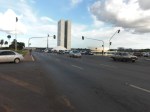
on foot, you are immediately confronted by the unpleasant reality of what is to the pedestrian effectively a huge expanse of carpark and highway separating the areas you might want to be. The functional split between the ‘zones’ only makes this worse.

Again, this is urbanism rather than surveillance, but here are some more musings and pictures on the urban form of Brasilia. Yesterday, I posted a lot of conventionally attractive shots of the buildings around the monumental axis of Brasilia. However, leaving aside the wider question of whether Brasilia outside of the planned centre functions as a city, there is a rather less beautiful side to the core.

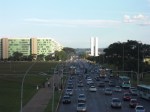
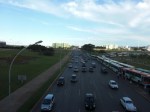
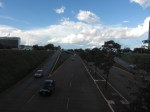
This mainly has to do with the practical consequences of the philosophy behind the plan and particularly with functional separation and transport. As I noted when I first arrived, the city is dominated by roads. 5-lane highways run down either side of the monumental axis, and it is crossed by two major motorways in deep cuttings, with all the attendant slipways. These probably look very attractive as bold curving lines on a plan. They may even function if you are traveling by car (or bus). But on foot, you are immediately confronted by the unpleasant reality of what is to the pedestrian effectively a huge expanse of carpark and highway separating the areas you might want to be. The functional split between the ‘zones’ only makes this worse. Say you are in the hotel zone that I was staying in and you want to go out for a meal and a drink. Well, that’s 30-minutes walk to the nearest residential centre (where most of the evening options are located). Sure, you can take a taxi, but why should you have to? All the sports clubs are in separate ‘club zones’ even further away from either hotel, commercial or residential districts.

Now, okay, so the residential districts have most of their facilities (not including clubs) within walking distance – I said in my first impressions blog entry that I could actually imagine living here with a young family. And I still could. Natives of Brasilia are fanatical about the place. The residential districts work. You don’t really have to go anywhere near the soulless and secured shopping centres or take your chances running across massive motorways with uncaring drivers trying their best to ignore you. There is a simple metro system which runs between the districts and the centre (though it was largely closed for the building of new stations when I was there). You can walk around, between and under the blocks. They don’t appear to be totally obsessed with security in the manner of Sao Paulo or indeed most other large Brazilian cities. The blocks have concierges but not fences, walls and gates. Most of the windows do not even have bars.

But there is a reason and a price for this too. The residential zones are simply not socially mixed. Just about everyone who lives in the big blocks is a government or big corporate office employee. The ordinary workers and the poor live elsewhere entirely, in one of the satellite cities of Brasilia, and are bussed in and out via the busy central bus station every day. At the bus station, you find glimpses of the ‘ordinary Brazil’ – the cheap lanchonetes and pastelerias (in fact probably the best pasteleria I have found in Brazil so far)!, sidewalk vendors of DVDs and knock-off jewelry, the beggars, the hungry and the desperate. In many ways I felt more comfortable there than in the dry Le Corbusian dreamspaces of the government buildings.

Anyway, here’s some pictures of the ‘real Brasilia’ – or what it looks like if you stop focusing on the architecture and take a wider view!

Brazilian modernism (2)

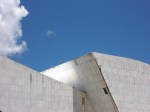
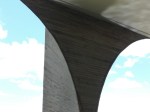
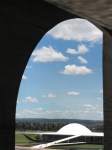
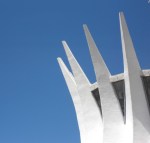
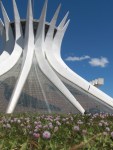
Not surveillance-related, but here’s some of the many, many pictures that I took whilst getting very sunburnt walking around the big open spaces under the huge skies of Brasilia last week. There are a couple more pictures of the Parliament complex in my report from my meeting there last week. My first set of photos of Niemeyer’s work from Sao Paulo can be found here.

Newcastle University CCTV comment

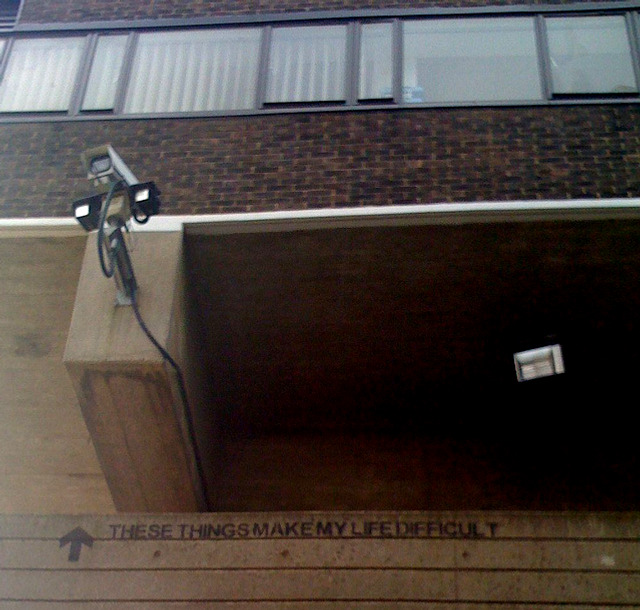
Not a million miles away from my office at Newcastle University, back in the UK, this stencil has appeared (“nothing to do with me, guv, I was in Brazil, honest…”)

Claremont Bridge, camera and comment (photo: Jon Swords)

At the Camara dos Deputados

I had a great meeting at the architecturally stunning Camara dos Deputados (the Brazilian equivalent of the British House of Commons or the House of Representatives in the USA), which almost made up for the fact that it was the only one of the three scheduled interviews that I had arranged that actually went ahead… it really does look like I will have to come back.

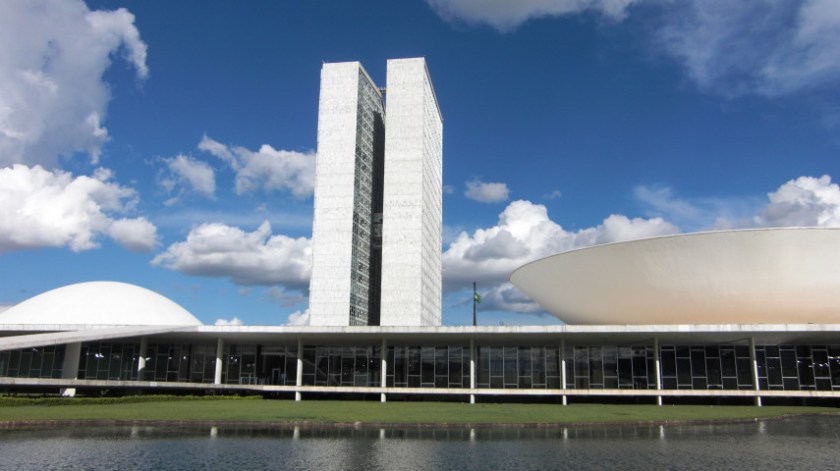
The parliamentary buildings in Brasilia, originally laid out by Lucio Costa. The Camara dos Depuados, by Oscar Niemeyer, is to the left.
The parliamentary buildings in Brasilia, originally laid out by Lucio Costa. The Camara dos Deputados, by Oscar Niemeyer, is to the right.

This meeting took place in the Comissao de Direitos Humanos e Minorias (the Commission for Human Rights and Minorities) and was with Federal Deputy and committee member, Pompeo de Mattos, the secretary of the Commission, Marcio Marques de Araujo, and Hebe Guimareas-Dalgaard, who works in the International Relations office and who served as translator.

The meeting covered all sorts of background issues around security in Brazil, and concentrated on Deputado de Mattos’s specialities in this area, which are in justice and drug-trafficking issues. Again, I won’t do more than summarize a few immediately important things here. There was a lot of talk of police corruption and some hair-raising stories of the ways in which military police officers in particular has become involved in selling equipment and ammunition, and of course the autodefesas communitarias that I have mentioned before. Interestingly though, it was the deputy’s opinion that the military police, despite having a ‘culture of violence’ inherited from their role as enforcers of the military dictatorship, were less corrupt (in an everyday way) than the civil police. The latter are even lower down the police food-chain and correspondingly more poorly paid and equipped.

The inadequacies of the civil police has led many Mayors of larger towns and cities to introduce so-called ‘Municipal Guards’ – basically private security given some official status. They have few powers but are basically there to increase the visibility of security, a kind of prophylactic community policing. The problem is however that the official police and the massive private security sector are thoroughly intermixed already. Many officers moonlight as private security guards, which leads to all kinds of conflicts of interest.

Deputado de Mattos was certainly not obsessed with the inadequacies of the police however. Serious and organized crime associated with drug-trafficking paralyzes the everyday life of poorer areas of large cities in Brazil. Despite the fears of the rich over crime, it is the poorest that suffer most. He described the drug gangs as being the major obstacle to any positive change in Brazilian cities. However he didn’t see any militaristic solution – fighting a war against the drug gangs would only lead to more violence. The only solution to the problems of both crime and the poverty from which it emerges is social inclusion. The favelados must be provided with the same opportunities and infrastructure as everyone else. The need schools, hospitals, transport, and so on. Programs like Bolsa Familia, however well-intentioned, make no fundamental difference, he argued – contradicting, as most people with whom I have talked have done, the assessment of external organisations like the World Bank.

However providing such opportunities is not easy, and not just because of the costs. The drug-gangs actively resist any attempt by the state to introduce services, to the extent of intimidating or even killing construction workers. And this shouldn’t be in any way romanticized as some kind of popular resistance of the poor to the imposition of unwanted state interference – this is an attempt to maintain the rule of fear and violence. Somehow, one can never get away from the security issue in Brazil.

Leaving the Camara dos Deputados, looking past the parliamentary buildings up towards the Esplanada dos Ministerios, with all the government Ministries lined up in identical blocks.

(Thanks to Deputado Pompeo de Mattos, who as you will see if you check out his website is quite a character. He is fiercely proud of his southern ‘gaucho’ roots, and writes poetry to that effect. He is also – and I don’t say this very often of politicians – a genuinely nice guy. Thanks also to Marcio Marques de Araujo and to Hebe Guimares-Dalgaard without whom the meeting would have been impossible).

In Brasilia: monumental space and… hip-hop?

I am now in Brasilia, where I have a number of interviews with parliamentarians, and officials from government Ministries and the federal police. The hotel I am staying in is right off the main monumental axis, in the northern hotel district. It is in some ways, the total opposite of where I was in Sampa, being masterplanned, spacious and with visible greenery. But it is a masterplan typical of Le Corbusier and his acolytes, that seems totally lacking in any flexibility or consideration for people not traveling by what they thought would be mankind’s liberation: the private car. So it is almost impossible to walk to a decent bar or cheap restaurant in the evening. You have to get a cab (or a bus if you know where you are going), to another ‘district’ for such things. The spaces are large and clearly designed to be monumental, but actually they fail in both being genuinely impressive and in being accessible. That is not to say that there are not some amazing buildings – of course there are many of Oscar Niemeyer’s greatest creations – but it is a place that looks better from the godlike view of the plan, or the selective gaze of the tourist brochure, than being within it as an ordinary person.

The taxi from the airport took a route through some of the contemporaneously planned and built residential districts. If it wasn’t for the semi-tropical vegetation, it could have been the Netherlands… long lines of similar 60s housing blocks, broken into neighbourhoods, each with its own little row of shops and restaurants, and divided by little parks and other community facilities. The blocks show quite a lot of variation in design and are certainly not all exactly the same, nor are they so large that they become inhuman in scale. With all the trees, and the facilities within walking distance, this really did seem like it wouldn’t be a bad – if not really an exciting – place to live. Which is exactly what I feel about many places in the Netherlands! For today, calm and unexciting is exactly what I need!

Strangely enough however, almost the first thing I came across when I got here was a local-government organised (and state petrochemicals company, Petrobras-sponsored) hip-hop festival, right on the main axis in the shadow of the TV Tower. So as the sun went down (if we could have seen it through the clouds) and the lights of the city blinked behind the hemispheres and towers of the Parliament building, I was getting down (well, tapping my feet) to some phat beats and conscious lyrics about the hardship and violence of life in the ‘periferia’ from the likes of Liberdade Condicional, and other favela stars. This, if nothing else so far, made me feel rather more hopeful for the future. For this evening only, the periferia had come right into the centre and was, symbolically at least, at the heart of Brazilian democracy.

Leaving Sao Paulo

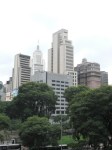
It’s my last morning here in Sao Paulo. I have to say that, with the greatest respect to my friend and Sao Paulo native, Rodrigo, I am not going to be sorry to leave. A lot of what I thought when I arrived here hasn’t changed. This is big, dirty, noisy, exhilarating city with an unapologetic commercial drive, and all the divisions and human debris that this creates. In many ways, it reminds me of Osaka in Japan, but the extremes are greater. The problem is that the huge divisions can’t be ignored if you are in any way sensitive to human suffering, and the suffering here cries out from every raw-smelling homeless man sleeping on the street, from the ragged kids sorting through rubbish at night, from the women selling themselves in the parks, stations – well, everywhere. Certainly, these things are part of city life in many places in the world, and there are many far, far poorer places, but there is something profoundly saddening, depressing, about the gulf between the helicopter-chauffeured elite and the people on the street in O Centro, and especially in the ignorance and indifference – which I have not only been told about but have seen. By the end of just one week, during which I have tried to be as much a part of the place as I could, when I have spent time talking to everyone from human rights groups to people in ordinary bars, I feel like retreating, curling into a ball in the corner of my room.

So thank-you, Sampa, but I am not sorry to be leaving. Here are some pictures of the hundreds I took, of aspects booth good and bad…

Gentrification and Control in the Old Centre of Sao Paulo

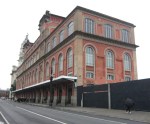
Yesterday, I met up with Brazilian surveillance researcher, Marta Kanashiro, and she showed me around the Luz area of the old centre of Sao Paulo, where she has been working. Luz was once a grand colonial district around the railway station designed by British architect, Charles Driver, in brick and iron, but it lost its importance in the mid-Twentieth Century as the station ceased to be the terminal for the coffee trade. The area acquired notoriety as home to a police headquarters where opponents of the dictatorship where tortured, and as a centre for prostitution, violence and drugs.

In more recent years there has been a real effort by the city authorities to reclaim the area which, despite being in many ways a laudable project, has been controversial both for its effects on the poor, and for its treatment of memory and the particular history of the place. On one side of Parque da Luz, the formal gardens in front of the station, is the Museum of Portuguese language, yet on other side of the station, all memory of the victims of police oppression and torture has been erased with the restoration of the police building.

In the park itself, the park authorities installed CCTV (the story of which can be read in Marta’s article in Surveillance & Society), but they haven’t tried to drive out the prostitutes, many of whom were still standing forlornly under the tall trees in the driving rain as we visited. However, according to Marta, they have tried to persuade the women to dress more respectably in keeping with the desired new image of the the neighbourhood! At one point the prostitute’s union was more involved in the management of the park, as were other community organisations, however the building in the centre of the park where these groups used to meet is now closed for refurbishment and it is unclear whether it will still be available in the same way afterwards. Another building in the corner of the part, next to the rather ramshackle security rooms, has already been restored, and where once the plans and documents about the park were on public display, now the place is prettier but empty.

The Luz regeneration has plenty in common with revanchist redevelopment in many other big cities around the world, and there are big questions about what happens to the already excluded population of the area as the regeneration spreads. There are two contrasting visions for the centre from two different but very similar-sounding organisations: Viva O Centro and Forum Centro Vivo. Both want regeneration – everyone does – but they have entirely different approaches to how it should be done. The former is an association of mainly businesses and police, similar to the Business Improvement Districts (BIDs) which are common in US and British city centres. It is behind a lot of the current redevelopment and has the ear of the city authorities. The latter is a group of academics and community activists who want a more democratic and participatory process, and who hold a lot of local events, cultural and political. They also accuse Viva O Centro of either actively or tacitly encouraging intimidation and violence (which has certainly taken place) against the poor population of the area. It is another reason why the attempt to erase of the memory of the brutality of the dictatorship is so important: it is a memory that needs to be constantly refreshed as the actions are echoed and repeated.

(A very big ‘thank-you’ to Marta Kanashiro for her time and patience! All mistakes in this account, as usual, are my own…)

Oscar Niemeyer’s Brazilian Modernism (1)

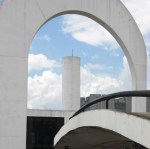
As a fan of utopian urbanism, I couldn’t very well come to Brazil without checking out some of the great Oscar Niemeyer’s work. Next week I will be in Brasilia, but this week in Sao Paulo, I took a few hours out to visit the Memorial da America Latina, a cultural complex built on an old factory site. The overall plan is not that impressive and the whole complex looks a little worn out, but the it was the detail of Niemeyer’s individual buildings that fascinated me, and the external detail at that. The interiors are cool and compelling, but in some you are not allowed to take pictures, and most of the others are filled with ‘stuff’ that reduces the impact of the space.