Surveillance image of the week 2: camera catches man stealing camera

Just how postmodern can contemporary surveillance get?

Well, after the irony of numerous recent CCTV thefts in the USA – after all, if you’re going to put lots of shiny new cameras up in public places they are bound to be a target themselves – now another layer has been added in Bakersfield, California, with a video surveillance camera thief caught on the camera system he was stealing. Of course, some thieves don’t seem to realise that the camera isn’t the place the data is stored… either that or they just aren’t put off by CCTV at all. Say it ain’t so…

A clear demonstration of the deterrent effect of video surveillance in action... not.

Automation and Imagination

Peter Tu writes over on Collective Imagination, that greater automation might prevent racism and provide for greater privacy in visual surveillance, providing what he calls ‘race-blind glasses’. The argument is not a new one at all, indeed the argument about racism is almost the same proposition advanced by Professor Gary Marx in the mid-90s about the prospects for face-recognition. Unfortunately, Dr Tu does several of the usual things: he argues that ‘the genie is out of the bottle’ on visual surveillance, as if technological development of any kind is an unstoppable linear force that cannot be controlled by human politics; and secondly, seemingly thinking that technologies are somehow separate from the social context in which they are created and used – when of course technologies are profoundly social. Although he is more cautious than some, this still leads to the rather over optimistic conclusion, the same one that has been advanced for over a century now, that technology will solve – or at least make up for – social problems. I’d like to think so. Unfortunately, empirical evidence suggests that the reality will not be so simple. The example Dr Tu gives on the site is one of a simple binary system – a monitor shows humans as white pixels on a black background. There is a line representing the edge of a station platform. It doesn’t matter who the people are or their race or intent – if they transgress the line, the alarm sounds, the situation can be dealt with. This is what Michalis Lianos refers to as an Automated Socio-Technical Environment (ASTE). Of course these simple systems are profoundly stupid in a way that the term ‘artificial intelligence’ disguises and the binary can hinder as much as it can help in many situations. More complex recognition systems are needed if one wants to tell one person from another or identify ‘intent’, and it is here that all those human social problems return with a vengeance. Research on face-recognition systems, for example, has shown that prejudices can get embedded within programs as much as priorities, in other words the politics of identification and recognition (and all the messiness that this entails) shifts into the code, where it is almost impossible for non-programmers (and often even programmers themselves) to see. And what better justification for the expression of racism can there be that a suspect has been unarguably ‘recognised’ by a machine? ‘Nothing to do with me, son, the computer says you’re guilty…’ And the idea that ‘intent’ can be in any way determined by superficial visualisation is supported by very little evidence which is far from convincing, and yet techno-optimist (and apparently socio-pessimist) researchers push ahead with the promotion of the idea that computer-aided analysis of ‘microexpressions’ will help tell a terrorist from a tourist. And don’t get me started on MRI…

I hope our genuine human ‘collective imagination’ can do rather better than this.

Towards Open-Circuit Television

The era of Closed-Circuit Television (CCTV) surveillance may be coming to an end. Surprised? Unfortunately, this does not mean that we are likely to see less surveillance, and cameras being torn down any time soon – quite the contrary. Instead a number of developments are pointing the way to the emergence of more Open-Circuit Television (OCTV) surveillance. These developments include technological ones, like wireless networking, the move to store data via ‘cloud’ computing, participatory locative computing technologies like CityWare, and the increasing affordability and availability of personal surveillance devices (for example, these plug and play mini-cameras unveiled at DemoFall 09). However they also include changes in the way that video surveillance is monitored and by whom.

Back in 2007, a pilot scheme in Shoreditch in London, which enabled residents to watch CCTV cameras on a special TV channel, was canned. However the project had proved to be incredibly popular amongst residents. Now The Daily Telegraph reports that an entrepreneur in Devon, Tony Morgan has set up a company, Internet Eyes, which is marketing what is calls an ‘event notification system’. They plan to broadcast surveillance footage from paying customers on the Internet, with the idea that the public will work as monitors. They won’t just be doing this for nothing however: the whole thing is set up like a game, where ‘players’ gain points for spotting suspected crimes (three if it is an actual crime) and lost points for false alarms. To back this up, there are monthly prizes (paid for out of the subscriptions of the organisations whose cameras are being monitored) of up to 1000 GBP (about $1600 US). Their website claims that a provisional launch is scheduled for November.

Mark Andrejevic has been arguing, most recently in iSpy, that those who watch Reality TV are engaging in a form of labour, now we see the idea transferred directly to video surveillance in ‘real reality’ (a phrase which will make Bill Bogard laugh, at least – he’s been arguing that simulation and surveillance are increasingly interconnected, for years). This idea might seem absurd, indeed ‘unreal’ but it is an unsurprising outcome of the culture of voyeurism that has been engendered by that combination of ever-present CCTV on the streets and Reality TV shows that came together so neatly in Britain from the early 1990s. It certainly raises a shudder too, at the thought of idiots and racists with time on their hands using this kind of things to reinforce prejudices and create trouble.

But is it really so bad? At the moment, UK residents are asked to trust in the ‘professionalism’ of an almost entirely self-regulating private security industry or the police. Neither have a particularly good record on race-relations for a start. Why is it intrinsically worse, if there are to be cameras at all (which I am certainly not arguing that there should be) to have cameras that are entirely open to public scrutiny? Is this any different from watching public webcams? Wouldn’t it actually be an improvement if this went further? If say, the CCTV cameras in police stations were open to public view? Would it make others, including the powerful, more accountable like a kind of institutionalised sousveillance?

In Ken Macleod‘s recent novel, The Execution Channel, the title refers to an anonymous but pervasive broadcast that shows the insides of torture chambers and prison cells, which functions as a device of moral conscience (at least for literary purposes) but also a Ballardian commentary on the pervasive blandness of what used to be the most outrageous atrocity. Accountability is in the end as far from this project as it is from Internet Eyes. Set up like a game, it will be treated like a game. It strips out any consequence or content from reality and leaves just the surfaces. What is ‘seen’ is simply the most superficial – and seen by the most suspicious. Participatory internet surveillance is Unreality TV. In any case, I don’t think it will either be successful in terms of crime-control (other such participatory surveillance schemes, like that on the Texas-Mexico border, have so-far proved to be failures) or useful in social terms, and may also be illegal without significant safeguards and controls anyway.

And there is nothing to stop multiple people signing up with multiple aliases and just messing the system up… not that I’d suggest anything like that, of course.

(Thank-you to Aaron Martin for badgering me with multiple posts pointing in this direction! Sometimes it just takes a little time to think about what is going on here…)

New York City expanding surveillance infrastructure

The New York Times reports that $24M US has been assigned from the Department of Homeland Security to expand the city’s CCTV camera system from downtown to midtown Manhattan (the area between 30th and 60th Streets). This of course is justified by Mayor Bloomberg on the grounds of security, with a large number of iconic buildings in the midtown area. However, it bears repeating that firstly, the 9/11 attacks did not come from the streets, and secondly, London already had a comprehensive CCTV system at the time of the 7/7 attacks and whilst they provided lots of pictures for the news media afterwards, they did not in any way prevent the attacks, and it is difficult to see how such a system could prevent any determined attacker. It may make people feel safer, at least temporarily, however even at that symbolic level, there’s likely to be as many people who feel uneasy about the idea of constant monitoring or the loss of privacy (although from my experience of the UK, the actual monitoring is far from constant or comprehensive, and most people also get used to that too). But, whatever the people of New York do feel – and there will many different reactions – they shouldn’t get the impression that they are getting actual ‘security’ (whatever that is) here. This isn’t a message many people like to hear, it seems, least of all those in government…

India plans ‘world class’ electronic surveillance for Commonwealth Games

The Times of India reports on the Indian government’s plans to implement comprehensive surveillance for the 2010 Commonwealth Games. One aim seems to be to create the kind of ‘island security’ with which we have become so familiar at these kinds of mega-events: vehicle check-points with automatic license-plate recording and recognition; x-ray machines and other scanners for vehicles (and perhaps people too). They will also massively expand CCTV systems and not just in the actual Games area, but throughout the city of Delhi.There are also, as usual plans to use more experimental surveillance and control techniques (as with the use of sub-lethal sonic weapons in Pittsburgh the other day), in this case a drone surveillance airship,” capable of taking and transmitting high-density visual images of the entire city.”

However, this is not just about the temporary security of the games. As with many other such mega-events, the Indian government appears to be planning to use the Delhi games as a kind of Trojan Horse for the rolling out of similar and more permanent measures in big cities across the country. The Times article claims that the Ministry of Home Affairs intends to expand the measures and “soon the same model is planned to be replicated across the country,” and in particular on use of airships, “similar airships would be launched in other big and vulnerable cities like Mumbai, Bangalore, Kolkata and Chennai.” And there will be an infrastructure too, apparently “the IB [Intelligence Bureau] is silently working to create a command center to monitor all-India intelligence and surveillance.”

Of course the threat of ‘terror groups’ is the justification, and there’s no doubt there is a threat to Indian cities from such groups, particularly those based in Pakistan. However, the Indian public shouldn’t assume that anything done in the name of ‘anti-terrorism’ will: 1. actually work (in the sense of preventing terrorism); or 2. be used for those purposes anyway. This same trend happened  in the UK during the early 1990s, when the threat of the Provisional IRA was the justification, and before most people in Britain had even noticed, a massive (and it seems ever-expanding) patchwork of CCTV camera systems had been created, which were joined by further repressive measures even before 9/11. And did this massive number of cameras stop London being attacked by terrorists? No, it didn’t.  7/7 still happened. But of course we had lots of good pictures after the event for the media… and they are very expensive and don’t even do much to stop regular crime, as a recent meta-study has shown. What would be more effective would be peace and co-operation with Pakistan, a move away from both chauvinistic Hindu and Muslim nationalisms and extremisms which only generate resentment and hatred, and old-fashioned targeted intelligence work on those very few people who are actually planning terrorism – not mass surveillance and the gradual erosion of civil liberties of the entire population based on state fears that some of them might be guilty.

Finally, this is about globalization. The whole way this is promoted by the Indian government is as if there is some international competition to install as much CCTV and security as possible. But the global spread of the surveillance standards and expectations of the rich western elite is a self-fulfilling logic that benefits only the massive global security-industrial complex.

Another day, another ‘intelligent’ surveillance system…

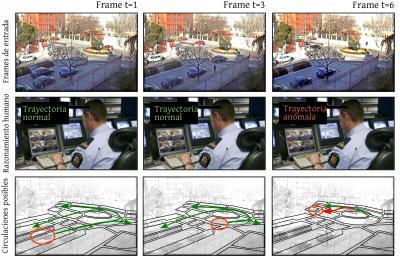
Yet another so-called ‘intelligent’ surveillance system has been announced. This one comes from Spain and is designed to detect abnormal behaviour on and around pedestrian crossings.

Comparison between the reasoning models of the artificial system and a theoretical human monitor in a traffic-based setting. (Credit: ORETO research group / SINC)

The article in Science Daily dryly notes that it could be used “to penalise incorrect behaviour”… Now, I know there’s nothing intrinsically terribly wrong with movement detection systems, but the trend towards the automation of fines and punishment, nor indeed of everyday life and interaction more broadly, is surely not one that we should be encouraging. I’ve seen these kinds of systems work in demonstrations (most recently at the research labs of Japan Railways, more of which later…) but, despite their undoubtedly impressive capabilities and worthwhile potential, they leave me with a sinking feeling, and a kind of mourning for the further loss of little bits of humanity. Maybe that’s just a personal emotion, but I don’t think we take enough account of both the generation and loss of emotions in response to increasing surveillance and control.

Further Reference: David Vallejo, Javier Albusac, Luis Jiménez, Carlos González y Juan Moreno. (2009) ‘A cognitive surveillance system for detecting incorrect traffic behaviors,’ Expert Systems with Applications 36 (7): 10503-10511

Surveillance cameras in the favelas…

Well, my fears have it seems, been vindicated already. Earlier this year, as part of my case-study on surveillance in Brazil, I visited the community of Santa Marta, a favela (informal settlement) in Rio de Janeiro. Santa Marta is interesting because of the amount of investment and effort that has been expended in occupying, pacifying and developing the place, by the new gubernatorial administration of Eduardo Paes, who has simultaneously cancelled Favela Bairro, the widely praised and more extensive favela development programs of his predecessor, Cesar Maia.

Leading the new Community Police efforts in Santa Marta was Capitao Pricilla, an indomitable and well-liked young female officer of the Military Police, one of several rising female officers with a new approach, and we heard from residents how trust was being rebuilt between police and community because of her. At the same time, there were storm clouds on the horizon as the city administration was insistent on cracking down still further with its policies of choque de ordem (the shock of order), which involved harassing illegal street vendors from the favelas, and demolishing illegally-built buildings, and also building walls along the edges of some favelas. The word ‘ghetto’ was mentioned on more than one occasion by our interviewees and in more casual conversations.

Now, just last month, the Military Police have decided to install seven CCTV cameras in Santa Marta, in different areas of the community. This has prompted complaints of invasion of privacy, an there have already, my sources report, been protests about this in he favela, but it seems that this is coming from further up the chain of command than Capitao Pricilla and the community police. She isn’t mentioned at all by the article in O Globo, despite being a bit of a PR star, and instead the justification for the cameras is given by one Coronel José Carvalho, who also stated that there are plans to put cameras into the other two areas currently being targeted for development, the famous Cidade de Deus, and the much less well-known and more distant favela of Batan. This also contradicts what I was being told by the Commnder of the police central CCTV control room we visited, which is quoted as being one of the places where the cameras will be monitored. What is interesting is the cameras seem to be being treated by police almost as a tool of urban warfare: a Major Orderlei Santos talks about their experimental use for determine the deployment of officers in the favela.

Could the old macho, male, approach to policing as a war on the poor be trumping the new trust being developed by community policing? I hope not, but everything points that way.

(thanks once again to Paola and David for keeping me in touch…)

Kabukicho Renaissance?

Kabukicho is a place that is hard to love. A seedy, crime-infested dive full of ‘massage parlours’, ‘aesthetic salons’, ‘image bars’ and other thinly-disguised forms of brothel. Tokyo has had red-light disticts since the Edo period, of course, and the Yoshiwara was only the most famous. Shinjuku was always one of them, and since the failure of the threatre initiative that gave the neighbourhood its name, Kabukicho has been the best known. Kabukicho is interesting though for many reasons. It had a radical political and cultural history in the 60s and 70s. It was the epicentre of changes that occurred in organised crime in the 80s and 90s, with Chinese gangs replacing the Yakuza as the biggest ‘threat’. And it is now the centre of efforts by the Shinjuku authorities to clean up its image, with the Kabukicho Renaissance policy, and the new Town Manager, and by Tokyo police to crack down on illegal immigration.

Community Safety in Suginami

Following our meeting with the Mayor the other day, we went back to Suginami-ku to talk to the community safety people, who are part of the Disaster Management section. Suginami is interesting because, as far back as 2004, it was the first Local Authority in Japan to introduce a special bohan kamera jourei (security camera ordinance) which is based in part at least on principles of data protection and privacy. And until neighbouring Setegaya-ku introduced their own ordinance last year, they were, so far as I know, the only such authority. The ordinance followed public consultation which showed that although people generally thought CCTV was effective (95%), a significant minority of 34% were concerned about privacy, and 72% thought that regulation was needed. These figures seem to be significantly more in favour of privacy and regulation of CCTV than the nationwide survey done by Hino Kimihiro, however he asked different questions leading to answers that are not directly comparable.

Suginami is one of the areas of Tokyo that has the other kind of CCTV system introduced by the Tokyo Metropolitan Police after 2002, help points where people press a button if they feel in danger and speak to someone from the police. The help points have both CCTV camera and an alarm / red flashing light if the caller says it is an emergency.

However the Suginami community safety officers said that these cameras have not proved very effective and in fact they cause a lot of problems, because children tend to press the button for fun, and run away – meaning that there are many false alarms.

Suginami has some of the same kind of array of ‘blue-light’ volunteer patrols as Arakawa-ku. In Suginami, there is a fleet of mini-patoka (mini patrol cars) and motorbikes, used by 15 retired police officers. These are mainly about visibility leading to deterrence and increased community confidence, as the volunteers ex-officers have no special powers nor do they carry side-arms or handcuffs or any other conventional ‘police’ equipment. Suginami does not have the small community safety stations like Arakawa-ku, although they do also have the same problem of local koban (police boxes) being closed. However where Suginami really stands out is in the sheer number of volunteers they have involved in their community patrols, organised through the local PTAs, shoutenkai (shopkeepers’ associations) and choukai (community associations). There are 140 groups with 9600 people actively involved in one way or another in community safety just in Suginami.

Suginami is a relatively wealthy ward and the kinds of problems that concern Arakawa (mainly minor street crime and snatch-thefts) are not such big issues here.  The main concern in this ward seems to be burglary and furikomi – the practice of gangsters and other criminals calling old people and pretending to be a relative or representative of a relative and persuading them to transfer money to a particular ATM (which you can do in Japan – it would be impossible in the UK). Furikomi is a very interesting phenomenon in that it seems to be a product of family, social and technological changes. Many older people who would have lived with family in traditional Japanese society are now living alone. They are lonely and miss the intimacy of family contact, so they tend to welcome unexpected calls from relatives who may now be living almost anywhere in Japan. These older people are also technologically literate and able to use mobile phones, ATMs and computers. The combination of this technological skill, dispersed families, and psychological vulnerability makes for a ripe target for fraudsters, and Suginami estimate that 40% of all crime in the ward is some form of furikomi.

In many ways, increasing concern for privacy is also a product of this change in lifestyles and family structure, as well as building techniques – western-style walls and better sound insulation mean that you can’t always know what is going on in the next room anymore, let alone in your neighbours’ apartments or houses. This also makes burglary rather easier, as once the thief has got past the initial walls or doors, no-one can hear or see very much. The intense and intimate ‘natural surveillance’ that used to characterise ordinary Japanese communities is disappearing. But the Suginami community safety officers see the possibility of revitalising such natural surveillance, and protecting privacy, without going down the route of impersonal, technologically-mediated surveillance. In many ways, this is quite heartening – if, of course, you are of a communitarian mindset. Such supportive, mutually monitored and very inward-looking communities can be stifling to those who do not fit and exclusionary to those from outside… and, not coincidentally, one of our last interviews was with a leading support group for foreign migrants in Japan, who have a very different perspective on all of these developments. That will be in my next post, which may not be until Saturday as we’re going off to Kansai for a couple of days…

(Thank-you to the Disaster Management section for their time and patience).

Moon protest highlights wider border surveillance issues

The mass mooning of the US balloon camera owned by Sierra Nevada Corporation went ahead, but the irony was that the system had already been disabled by the weather. Apparently a large thunderstorm cause a gash in the fabric of the balloon last week which, if nothing else, should prove rather more effective than the protest in making sure that the US government does not invest in it.

However the wider issue of the US surveillance of the border with Canada remains (not mention that of the Mexican border, already a major concern) and whilst this particular technology and the appropriately ridiculous protest, has attracted most attention in the media, let’s not forget that camera towers have been erected and the USA is flying UAVs along the border. Surely President Obama should realise that the paranoid policies of his predecessor do nothing apart from damage relationships (and trade) with a close neighbour?