Watching Downtown Tokyo

So, I’m back in Tokyo until next April, revisiting the areas which I examined in 2005-6, where surveillance cameras have been installed by the Tokyo Metropolitan Police, and the wards where I did case-study research on community safety development in 2009 (see my posts in this blog from July to September 2009).

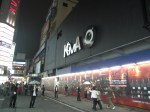
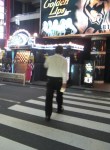
One initial impression is that the progress of video surveillance has not perhaps been as rapid as I would have thought, but it may be that this impression is mistaken. Certainly, the numbers of cameras deployed by the TMP have not increased rapidly. While I looked initially at Shinjuku’s Kabukicho district, where cameras were first introduced in 2002 and Shibuya and Ikebukuro (2004), they were also introduced in Ueno (2006) and Roppongi (2007). The numbers of cameras in these areas and the technologies in use have not changed greatly since their introduction: Kabukicho has 55; Shibuya, 20;  Ikebukuro, 49; Ueno, 12; and Roppongi, 44. The cameras are all in areas associated with the night economy – pink or ‘red line areas’, or what in the UK would be called ‘red light districts’ or places strongly associated with gang-related nightlife activities.

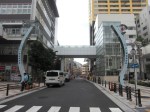
From then there was a gap and nothing happened until this year, when the TMP introduced a small number of cameras into an area they seem to have previously overlooked: the so-called ‘Kabukicho of the East’ – it’s even referred to in this way by tourist guides – Kinshicho in Sumida ward, still very much a rough, working class area. Kinshicho is apparently known for two things: gambling (on horse-racing – it’s not coincidentally the HQ of  the Japan Racing Association) and ‘gaijin bars’ (or hostess bars staffed by foreign hostesses). But, if one examines the crime maps produced by the TMP, Kinshicho is not a particularly high crime area especially compared to its western counterpart, Kabukicho, and there are other areas of dubious repute in Tokyo, so what’s behind this particular move at this time?

AJ201205130014M
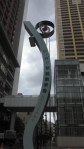
CCTV cameras at the Tokyo Sky Tree Tower (Hirotaka Kawakami)

This is simply speculation on my part, and I will be talking to police and others about this in the next few months, but Sumida ward is gentrifying. In 2006, the massive new Olinas shopping complex was built in the Kinshicho area, and then in 2012, the Tokyo Sky Tree Tower, the new communications tower for Tokyo, complete with associated shopping and entertainment complex, landed in Oshiage, just to the north. Shitamachi (literally ‘low city’ – or downtown) areas have become fashionable now and not just among tourists. But this nostalgic search for an older, ‘authentic’ Tokyo, usually that of the post-WW2 period, is limited to safe images of craftsmen, small shops, stand-up bars, street food, hard-work and propriety. Frankly, Kinshicho seems to be seen as an embarrassing throwback to a shadow image of the ‘bad old days’ of the shitamachi of gangs, gambling and the sex trade, that the authorities at least do not want associated with the new and more pleasant presentation they are seeking to create.

But the TMP cameras are only a small part of the story of public space video surveillance in Tokyo, and if one sticks to the police numbers, one would get a very misleading impression. For example, the Sky Tree Tower has been the focus of a major introduction of video surveillance through the main mechanism for public space surveillance in Tokyo, the 2003 Anzen Anshin Machizukuri Jourei (Community Safety Ordinance). This empowers neighbourhood and shopkeepers’ associations to introduce camera systems with support from ward governments and the Tokyo Metropolitan Government. In Oshiage, a very large and locally controversial 77 camera-system was introduced from 2012, with most of the cameras (66) directly around the Sky Tree. Kinshicho also has its TMP cameras supplemented by an even larger number of non-TMP cameras – the Asahi article above claims 47 but it’s unclear whether that includes the TMP cameras or not.

The progress of community safety development is the main focus of my research here this time, so I’ll be visiting Oshiage and Kinshicho in the near future. And I’ll be writing much more about this method of crime control through development planning, as it will no doubt be a key feature of how preparations for the 2020 Olympics are made.
Research News

This is just a quick personal update to say that my long-time collaborator, Kiyoshi Abe of Kwansei Gakuin University, and I, have been successful in winning a Japan Society for the Promotion of Science (JSPS) Fellowship, for my project, Public Safety and Surveillance in the Global City: The Case of Tokyo. I’ll be heading to Japan for ten months from mid-June this year, where I will be based in Tokyo, and working with Kiyoshi (who is down in Kobe) and hopefully also with some great people from Meiji University. That’s when this blog will return to being much more of a research diary for my fieldwork again – it’s been a while!

Kabukicho Renaissance?

Kabukicho is a place that is hard to love. A seedy, crime-infested dive full of ‘massage parlours’, ‘aesthetic salons’, ‘image bars’ and other thinly-disguised forms of brothel. Tokyo has had red-light disticts since the Edo period, of course, and the Yoshiwara was only the most famous. Shinjuku was always one of them, and since the failure of the threatre initiative that gave the neighbourhood its name, Kabukicho has been the best known. Kabukicho is interesting though for many reasons. It had a radical political and cultural history in the 60s and 70s. It was the epicentre of changes that occurred in organised crime in the 80s and 90s, with Chinese gangs replacing the Yakuza as the biggest ‘threat’. And it is now the centre of efforts by the Shinjuku authorities to clean up its image, with the Kabukicho Renaissance policy, and the new Town Manager, and by Tokyo police to crack down on illegal immigration.

The new Japanese ‘jury’ system

The Guardian Comment is Free site asked me to do a (very quick) comment piece on the new Japanese ‘jury’ system and it’s now online here. I had to cut my original down to around 600 words and they edited it a little more to fit, and added an awful photo (where on earth they got it I am not quite sure…). Here’s the full version…

Disorder in the Court

Japan’s courts are not usually the subject of massive popular interest in the country. Salacious details of criminal cases fill the pages of the popular weekly magazines and provide fodder for cheap TV shows, but the court system itself is seen as distant, formal and, above all, dull.

The courts have long been seen as a a rubber-stamping exercise for cases already decided by confession in police cells. Japan’s 95% confession rate has been attributed to a cultural sense of shame, or to the thorough and minutely detailed dossiers of public prosecutors, but according to Amnesty International, the psychological pressure of up to 23 days of isolation and constant questioning (not to mention intimidation and physical violence) might provide a better explanation. In recent years, the issue of coerced confessions has been increasingly recognised in Japan, and the most recent example was the freeing in June this year of Toshikazu Sugaya, a man who DNA evidence has now shown could not have been guilty of the killing of a 4-year old girl, a crime that he confessed to in police cells and of which he was consequently convicted of in 1990.

Added to this is a growing feeling that the courts were too remote from people. So in 2004, a new law was passed to introduce a new method of adjudication for some criminal trials beginning in May 2009. Now the first trial using this new system, a case of murder involving elderly neighbours, has just started in Tokyo. Some have characterised this saiban-in as a ‘jury’ system, but it is actually a ‘lay-judge’ system. Whereas in the UK, twelve ordinary people are called by the courts to hear evidence and make a judgement on the guilt of the accused, in the new Japanese system six citizens join three professional judges. They not only hear evidence, but are also able to question witnesses and help decide the sentence. Verdicts are majority decisions but have to include at least one of the professional judges.

It seems an onerous task. So it is not surprising that many who were originally short-listed for lay-judge duty but did not make the final six for the first trial, are relieved to have escaped not because, as is so common in the UK, they found it inconvenient, but because of the burden of responsibility they felt. This has particular cultural components. Strongly-stated opinions and absolutes are not favoured in Japan, and people like to keep options open. The selection process itself was remarkably complex and involved summoning an initial 100 candidates, some of which were excused on grounds of infirmity or age, and more were then deselected after detailed questioning on their views and attitudes. Even court officials are now admitting that they may have overdone it.

But why this particular, strange, hybrid system? The answer is that it had form. Japan had an almost identical system from 1928 to 1943. During the Taisho period that saw a brief flowering of a more democratic culture in Japan, progressives had tried to introduce a full Anglo-American style twelve-person jury, however, judges, and conservative and nationalist politicians opposed this initiative and forced a compromise: the saiban-in system.However according to research by Takashi Maruta, the lay-judges still actually challenged the professional judges in many serious cases refusing to accept the confession and dossiers of evidence and preferring to rely on oral testimony of the accused and witnesses in court. Even in its compromised form such a volatile system offended traditionalist judges (who like many state representatives saw their power as deriving from the Emperor and therefore ultimately, divine sources), lawyers and was hardly suited to the militarist regime that gained control in the 1930s, and was eventually stopped.

But opposition seems rather different this time around. In the UK, civil libertarians have been fighting to defend jury systems, but in Japan civil liberties arguments have been marshalled by protestors against the new system. Opponents argue that the selection process violates privacy by forcing citizens’ personal views to be exposed, and is also authoritarian because citizens cannot refuse to serve unless they have health reasons. Some have even likened the system to a lynch-mob, because of course Japan still uses the death penalty.

However dig deeper, and underlying these arguments are reactionary and conservative concerns and the once-again rising influence of nationalists, in other words very similar conditions to those of the late 1920s: defence of the ‘professionalism’ of judges, and the arguments about the quasi-sacred integrity and necessary distance of courts from popular influence. More generally though, even though this system is the result of a bill passed five years ago, it seems part of an air of populist desperation from the increasingly unpopular ruling Liberal Democratic Party that faces defeat for the first time in decades in the general election at the end of this month.

However, if nothing else, the controversy over the system has excited Japanese people about the court system, and not just in bloody tales of murder and mayhem, and whatever happens in the future, any disorder in the court that results in interest and engagement in criminal justice has to be a good thing.

CCTV and urban regeneration in Nippori

The link between urban regeneration or redevelopment and the introduction of video surveillance has been well documented by many different authors in Britain, in particularly Roy Coleman in Reclaiming the Streets. It seems that the link is strong in Tokyo too. This new CCTV scheme in the front of Nippori railway station in Arakawa-ku is not only clearly part of the social and spatial restructuring of this area, it is an essential part of the new image, with the new entranceway celebrating the security cameras as much as the area’s name. This is the area we were told by Shinjuku officials had only three cameras, whereas in fact it has the princely total of ten! In retrospect the Shinjuku people seemed to be rather condescending towards Arakawa-ku.

Planning and protest in central Tokyo

Tokyo is a constantly changing stew of styles and forms, but don’t be fooled into thinking this is just ‘organic’ change. The capital of Japan is a playground for capital, local and global, and there isn’t much in the way of planning law or practice to stop the developers doing exactly what they want. It’s worth reading Andre Sorensen’s The Making of Urban Japan for a good account in English of why this is.

Inasmuch as the traditional morphology of machi (neighbourhoods) survive, it is largely due to either the unfashionable character of the area putting off developers, temporary lulls in the property market, or the sheer stubbornness of residents in refusing to being intimidated into selling land or putting up with the serial replication of blocks of manshon (typical 5+ storey apartment complexes). Strong property rights and small traditional plots do at least mean that it is more difficult to put together the land in what is called tochi kukaku seiri (land readjusment) to make really large developments which, as a result, tends to be restricted to whole sites that come on the market through things like the privatisation of Japan Railways (although some private developers like Mori Building Co. have managed private massive land readjustment projects like Roppongi Hills that I have researched on previous visits).

Of course the building regulations that do exist tend to favour development too, as they regard any old building as inherently unsafe (because of susceptibility to fire and earthquake) and it is thus very difficult, for example, to get traditional wooden houses repaired let alone new ones built. In addition, since the Edo period regulations have sought to open fire-breaks in the urban structure and increase the width of roads and alleyways – and again, the traditional and wonderfully characterful narrow roji (lanes) are very difficult to maintain as any new building has to be set back to newer road standards. This in turn tends to make the backstreets more accessible to faster-moving traffic and thus gradually dehuamanize and desocialize these places.

So communities have a lot to contend with and, despite the 196os environmental movements and machizukuri (community development) and the 1980s craze for ‘amenity’ (which included the promulgation of a ‘sunlight ordinance’ that was supposed to stop the construction of taller buildings that would block out the sun from neighbouring plots), the developers continue to try to squeeze in unwanted and inappropriately massive structures wherever they can.

We came across this small example of a local neighbourhood campaign to stop a new manshon being built at the edge of the historic (but much damaged) Yanaka district. It might not loo very exciting but you add these developments up all over the city and it goes a long way to explaining why Tokyo is gradually losing the remaining historic and social character that makes it a surprisingly human place to live, despite its size…

At the Tokyo Metropolitan Police HQ

The Tokyo Metropolitan Police HQ in Chiyoda-ku

We had an enlightening interview, which will give me much to analyse later, with three senior officers from the Seikatsu Anzen Bu (literally, ‘Everyday Life Safety Division’) of the Keisicho (Tokyo Metropolitan Police). Interestingly, this division that was created as a result of the Seikatsu Anzen Jourei (Governor Ishihara’s 2003 Tokyo Metropolitan Government ordinance) and which deals with all the community security and safety initiatives, including CCTV, is separate from the Chiki Bu (the community division) that is responsible for the koban neighbourhood police box system.

Like almost everyone in authority we have met here, the police were convinced that they were not doing surveillance in using the cameras. They also confirmed that almost all of the CCTV systems operated by shoutenkai (shopkeepers’ associations) are not monitored and are simply recorded. They also stressed their deep concern for privacy and the rights of citizens and said that data from the police-operated cameras – of which there are around 150 in Shinjuku (the largest system with 50 cameras in the Kabukicho entertainment district), Shibuya, Ikebukuro, Roppongi and Ueno – was only kept for 7 days unless there was a specific reason to retain it. This is a legal requirement not just a police guideline. The police cameras are monitored both in local stations and in a central control room, but we were told that it was strictly forbidden for us to visit (unlike every other city in which I have done research) as everyone who enters has to be pre-enrolled in the police iris-scan security database.

We talked a lot about the history of the development of CCTV and of community safety initiatives in Tokyo, and Governor Ishihara’s absolutely central role in backing video surveillance became very clear (it’s a shame he has so far refused an interview with us!). What was also particularly interesting was that the police themselves did not think that apparently obvious ‘trigger events’ were as important as it might seem. For example, they claim that the police only really began considering the use of CCTV cameras not after the Aum Shinrikyo sarin gas attacks on the Tokyo underground but because of the influence of G8 summit security. One officer specifically mentioned the Gleneagles summit (which was just starting when terrorists attacked the London transport system), but this was in 2005, well after the TMG had already introduced CCTV, and after which the Tokyo police have not introduced a lot more cameras. So I don’t quite understand their point. It may become clearer once I have the complete transcripts… They also claimed that it was the Tokyo police rather than Japan Railways themselves or the Tokyo Metro authority who insisted on installing CCTV in the Tokyo transport network after the Aum attacks.

The officers talked a lot about community involvement. They dismissed the objections to their public space CCTV systems for several reasons, not least as I have already mentioned that they were not doing ‘surveillance’, but more importantly because they claimed to have done extensive consultation with local community groups, businesses etc. The claimed that they could not do anything without this support. This may have been true for Kabukicho, which was undoubtedly afflicted by an influx of Chinese gangs in the 1990s, but we heard from the local government of another ward that is being lined up for one of the new volunteer-based child safety camera systems being introduced from 2010 that they were given no choice by the police, and that local people were not happy about it. The problem is that this local authority don’t want to be interviewed further about this as they are in a rather delicate position over this new system.

(Thank-you very much to the officers from the Seikatsu Anzen Bu for giving us their time)

Death of the dojunkai apartments

As I mentioned the other day, after the Kanto daishinsai (Great Kanto Earthquake) of 1923, there were many changes to planning and architecture in Tokyo, in particular a series of experiments with introducing western-style elements into the city, including wider streets to accommodate trams (streetcars), and new concrete mass housing influenced by the modern movement.

Dojunkai, a special organisation under the Interior Ministry, was set to provide such things. Between 1924 and 1936, this agency built 16 apartment blocks out of ferroconcrete and wood in Tokyo and Yokohama. The best known were those in Daikanyama (near Shibuya) and on Omotesando Avenue in Aoyama. The latter were controversially demolished in 2003 by the Mori Building Company Ltd to make way for their soulless Omotesando Hills shopping complex.

Much less celebrated however, were the Dojunkai appartments in Nippori (not Minowa as most people seem to think) in Aarakawa-ku, just round the corner from where I am staying. They’ve been empty and crumbling for a while, but now the writing is very literally on the wall, saying that they will be demolished too. It’s a sad moment: another episode in the slow death of the utopian urban ideal of the Twentieth Century. It’s also a reflection of the very high land prices in Tokyo and relative lack of value in what is on the land at any time (see this article for a good summary of the difficulty of any architectural preservation in Tokyo).

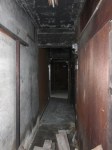
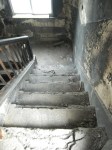
Anyway, not only are they valuable historical buildings, they are also degenerating rather stylishly so, at the very least, I thought I should get in and take some pictures before it was too late. So I did – much to the surprise of a crew of local authority workers who were surveying the place as I came out. Here are some of the shots. I didn’t (yet) go into any of the indvidual apartments – all those I tried were locked and some chained too – though I might try to in the early morning this week before anyone is around.

Community Safety in Arakawa

Far from the skyscrapers and bright lights of Shinjuku, where we had our last interview on community security and safety development (anzen anshin machizukuri), Arakawa-ku is a defiantly shitamachi (‘low-town’ or working class) area to the north-east of Tokyo just north of Ueno and outside the Yamanote-sen JR railway loop line that has for much of the last 40 years defined the boundaries of the richer parts of the city.

Bordering the Ara river and split by the Sumida river, it was traditionally a marshy place liable to flooding. It was also a place with a large buraku (outcaste) population and Minowa (in the north of the ward) contains the mournful Jokan-ji (or Nagekomi – ‘thrown-away’) temple, where prostitutes who died in the Yoshiwara pleasure district were cremated. The place has been hit hard by disaster. It was levelled twice in the the Twentieth Century, first by 1923 Kanto daishinsai (Great Kanto Earthquake) and then again by the firebombing in the last years of WW2.

Nevertheless, its rough, industrious, hardworking spirit has continued, and these days, despite the march of secure manshon (high-rise housing) down the post-war avenues, it remains a place full of small industrial units, especially recycling businesses and clothing wholesalers and manufacturers in Nippori, small bars and family restaurants, and lots of ordinary housing, even some of the last remaining dojunkai (early concrete public housing) constructed after the earthquake. It’s also the starting point of the last remaining tramway (streetcar line) in Tokyo, the Toden Arakawa-sen. I like it a lot and it’s where my wife and I have lived in Tokyo in the past, and where we still stay when we return (there will be more pictures in a later post).

It was natural then to turn our attention to the place as a case-study area, mainly because it is so different from Shinjuku and the other areas that have gained so much attention from the Tokyo Metropolitan Government’s recent initiatives. We met with three officials from the Community Safety section of the local administration: the boss and two guys who had been seconded from the city police and the fire service respectively. The boss was full of enthusiasm for the direction that Arakawa-ku has taken, which although they don’t use the term ‘machizukuri‘ is far more about real community involvement than some places that do.

The HQ of Arakawa community safety

Arakawa has no comprehensive CCTV strategy, although the police do consult with the developers of large new buildings on its installation. That’s not to say that they don’t have a certain degree of ‘CCTV envy’ of those places with the latest high-tech gadgets that Arakawa can’t afford, but they are not dazed by the glamour of cameras and are realistic about both the limitations of CCTV and the appropriateness of such systems for their city. Instead they concentrate on using and enhancing the natural surveillance capacities of the local communities. They make a great deal of use of volunteers, retired police officers and ordinary local people, who do their own patrols, including the delightful wan-wan (‘woof-woof’) patrol which, judging from the posters, involves mainly older female residents and very small dogs! Participation in the various community initiatives is encouraged through the use of techniques like professional rakugo (traditional comic monologue) performances in schools and community centres. They also run community patrols in miniature versions of police patoka (patrol cars), which not only look more friendly but unlike the US-style police cars can get through much narrower streets.

The cute community patrol cars

However these diverse community projects are being stitched together in quite an innovative way, with the use of small anzen anshin sutashion (security and safety stations), which are a bit like community versions of the police koban, the miniature two-person police boxes which dot the city. Indeed the officials referred to them as minkan koban (‘people’s koban’). These small help stations, staffed mainly by ex-police don’t just provide ‘security’ information, they also deal with social security in the broader sense, offering help for older people with benefits, for example. In almost all cases, they have replaced koban that were closed by the police. So one could argue that this is essentially the local authority being forced to pick up the bill for services that used to be provided by the police and at the same time is actually losing real police service. However, the strategy overall is a valiant attempt to make ‘community safety’ less an issue of exclusionary security and more one of inclusivity and community development, more a natural and intimate part of everyday life that does not involve new forms of external control.

Of course, crime isn’t really a massive issue here anyway. Arakawa has consistently had the second or third lowest crime rates of all the 23 Tokyo wards. But even since the introduction of these initiatives, crime has fallen still further from the relative high point it reached a few years ago. And hardly a CCTV camera in sight…

Tokyo Brandscaping and the SuiPo system

Brandscaping is a term used in marketing to describe the metaphorical landscape of brands (either for a particular brand, company or sector), however it is also being used by some researchers, including me, to describe the way in which brands are being infiltrated into urban landscapes, with the ultimate aim of being ‘inhabitable’ perhaps even 24/7 (see for example Disney’s move into urban development with Celebration in Florida).

Contemporary brandscaping makes use of new ambient intelligence, pervasive or ubiquitous computing technologies (‘ubicomp’) and ubiquitous wireless communications to create a landscape in which the consumer is targeted with specific messages directing them to certain consumption patterns. Such communication cans of course be two-way and provide corporations with valuable and very personal data on consumption patterns. As I’ve argued in many presentations over the last few years, ubicomp is necessarily also ubiquitous surveillance (what I call ‘ubisurv’ – hence the name of this blog!) because to work it requires locatability and addressability. Japan, and Tokyo in particular, has been the site for a number of cutting edge experiments in this regard, including the ‘Tokyo Ubiquitous Technology Project’ which embedded 1000 RFID tags which can communicate with RFID-enabled keitai (mobile phones) in upscale Ginza as well as several other pilot schemes around Ueno Park and Shinjuku.

TUTP is not all about marketing surveillance however, part of the scheme has involved ‘Universal Design’ (UD) principles, with one experiment to embed chips in the yellow tactile tiles designed to help guide sight- and mobility-impaired people around the city so that useful access information could be passed through specially-enabled walking sticks. I’m very interested in such experiments as they indicate an alternative direction for ubicomp environments which are about genuinely enabling people who are currently disabled by social and architectural norms, and creating a richer sensory landscape. They show that both surveillance and ‘scary’ technology like RFID chips can be humanised.

Unfortunately in our consumer-capitalist world (and Tokyo is the exemplary city of hyper-consumption), marketing and building brandscapes tends to take priority over enabling the excluded and the disadvantaged. But there are different ways of doing this too, which can be more or less intrusive and consensual. The other day I was talking about the growth in functionality of the Suica smart travel card system. Suica-enabled keitai can now, be used buying all sorts of things and since 2006 there have been a growing number of ‘SuiPo’ (short for ‘Suica Poster’) sites, Suica-enabled advertising hoardings that will, on demand send information to your mobile e-mail address with on particular advertising in which you are interested if you pass your Suica card or phone over a scanner placed next to the poster (see photos below)

The difference between SuiPo and the Ginza RFID scheme however is that it with SuiPo is that it is the consumer who makes the choice whether to activate any particular poster’s additional information system. In this sense it is a development of the i-Mode system in which many keitai can read information from special barcodes embdedded in magazine advertisements. It doesn’t automatically call your phone every time you pass an enabled poster, once you have signed up. Not as high-tech but slightly more consensual. However this will, of course, lead to the accumulation of a lot of data on consumption interests. This potentially generates a massive consumer surveillance tool, because it can be linked up travel patterns (your registered Suica card sends information back on where you go – I was wrong about the absolute differences between London’s Oyster and Tokyo’s Suica systems the other day) and information about consumption.

So will this potential become reality? The page on privacy and data protection on the SuiPo website (as usual the link is hidden away at the bottom of the front page!), is pretty standard stuff except for the legitimate purposes for which the data can be used once you sign up. They are, for those who don’t read Japanese, for:

  1. Sending the specific requested information to you;
  2. Improving services;
  3. Data processing and analysis;
  4. JR East’s promotional marketing; and
  5. JR East customer questionnaires.

Purposes 2 and 3 pretty much allow JR to do anything it likes with the data once you have signed up, and there is no statement as to what can or cannot be done with data once it has been ‘mined’ – analysed and transformed into more useful to the company or other organisations (corporate or state) which might want to buy or access such knowledge. ‘Ubisurv’ indeed…