India plans ‘world class’ electronic surveillance for Commonwealth Games

The Times of India reports on the Indian government’s plans to implement comprehensive surveillance for the 2010 Commonwealth Games. One aim seems to be to create the kind of ‘island security’ with which we have become so familiar at these kinds of mega-events: vehicle check-points with automatic license-plate recording and recognition; x-ray machines and other scanners for vehicles (and perhaps people too). They will also massively expand CCTV systems and not just in the actual Games area, but throughout the city of Delhi.There are also, as usual plans to use more experimental surveillance and control techniques (as with the use of sub-lethal sonic weapons in Pittsburgh the other day), in this case a drone surveillance airship,” capable of taking and transmitting high-density visual images of the entire city.”

However, this is not just about the temporary security of the games. As with many other such mega-events, the Indian government appears to be planning to use the Delhi games as a kind of Trojan Horse for the rolling out of similar and more permanent measures in big cities across the country. The Times article claims that the Ministry of Home Affairs intends to expand the measures and “soon the same model is planned to be replicated across the country,” and in particular on use of airships, “similar airships would be launched in other big and vulnerable cities like Mumbai, Bangalore, Kolkata and Chennai.” And there will be an infrastructure too, apparently “the IB [Intelligence Bureau] is silently working to create a command center to monitor all-India intelligence and surveillance.”

Of course the threat of ‘terror groups’ is the justification, and there’s no doubt there is a threat to Indian cities from such groups, particularly those based in Pakistan. However, the Indian public shouldn’t assume that anything done in the name of ‘anti-terrorism’ will: 1. actually work (in the sense of preventing terrorism); or 2. be used for those purposes anyway. This same trend happened  in the UK during the early 1990s, when the threat of the Provisional IRA was the justification, and before most people in Britain had even noticed, a massive (and it seems ever-expanding) patchwork of CCTV camera systems had been created, which were joined by further repressive measures even before 9/11. And did this massive number of cameras stop London being attacked by terrorists? No, it didn’t.  7/7 still happened. But of course we had lots of good pictures after the event for the media… and they are very expensive and don’t even do much to stop regular crime, as a recent meta-study has shown. What would be more effective would be peace and co-operation with Pakistan, a move away from both chauvinistic Hindu and Muslim nationalisms and extremisms which only generate resentment and hatred, and old-fashioned targeted intelligence work on those very few people who are actually planning terrorism – not mass surveillance and the gradual erosion of civil liberties of the entire population based on state fears that some of them might be guilty.

Finally, this is about globalization. The whole way this is promoted by the Indian government is as if there is some international competition to install as much CCTV and security as possible. But the global spread of the surveillance standards and expectations of the rich western elite is a self-fulfilling logic that benefits only the massive global security-industrial complex.
Another day, another ‘intelligent’ surveillance system…

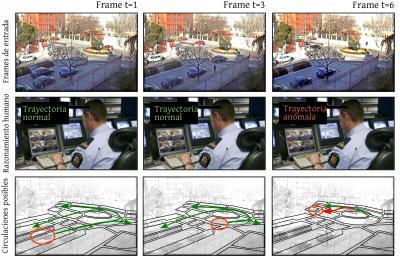
Yet another so-called ‘intelligent’ surveillance system has been announced. This one comes from Spain and is designed to detect abnormal behaviour on and around pedestrian crossings.

Comparison between the reasoning models of the artificial system and a theoretical human monitor in a traffic-based setting. (Credit: ORETO research group / SINC)

The article in Science Daily dryly notes that it could be used “to penalise incorrect behaviour”… Now, I know there’s nothing intrinsically terribly wrong with movement detection systems, but the trend towards the automation of fines and punishment, nor indeed of everyday life and interaction more broadly, is surely not one that we should be encouraging. I’ve seen these kinds of systems work in demonstrations (most recently at the research labs of Japan Railways, more of which later…) but, despite their undoubtedly impressive capabilities and worthwhile potential, they leave me with a sinking feeling, and a kind of mourning for the further loss of little bits of humanity. Maybe that’s just a personal emotion, but I don’t think we take enough account of both the generation and loss of emotions in response to increasing surveillance and control.

Further Reference: David Vallejo, Javier Albusac, Luis Jiménez, Carlos González y Juan Moreno. (2009) ‘A cognitive surveillance system for detecting incorrect traffic behaviors,’ Expert Systems with Applications 36 (7): 10503-10511

Surveillance cameras in the favelas…

Well, my fears have it seems, been vindicated already. Earlier this year, as part of my case-study on surveillance in Brazil, I visited the community of Santa Marta, a favela (informal settlement) in Rio de Janeiro. Santa Marta is interesting because of the amount of investment and effort that has been expended in occupying, pacifying and developing the place, by the new gubernatorial administration of Eduardo Paes, who has simultaneously cancelled Favela Bairro, the widely praised and more extensive favela development programs of his predecessor, Cesar Maia.

Leading the new Community Police efforts in Santa Marta was Capitao Pricilla, an indomitable and well-liked young female officer of the Military Police, one of several rising female officers with a new approach, and we heard from residents how trust was being rebuilt between police and community because of her. At the same time, there were storm clouds on the horizon as the city administration was insistent on cracking down still further with its policies of choque de ordem (the shock of order), which involved harassing illegal street vendors from the favelas, and demolishing illegally-built buildings, and also building walls along the edges of some favelas. The word ‘ghetto’ was mentioned on more than one occasion by our interviewees and in more casual conversations.

Now, just last month, the Military Police have decided to install seven CCTV cameras in Santa Marta, in different areas of the community. This has prompted complaints of invasion of privacy, an there have already, my sources report, been protests about this in he favela, but it seems that this is coming from further up the chain of command than Capitao Pricilla and the community police. She isn’t mentioned at all by the article in O Globo, despite being a bit of a PR star, and instead the justification for the cameras is given by one Coronel José Carvalho, who also stated that there are plans to put cameras into the other two areas currently being targeted for development, the famous Cidade de Deus, and the much less well-known and more distant favela of Batan. This also contradicts what I was being told by the Commnder of the police central CCTV control room we visited, which is quoted as being one of the places where the cameras will be monitored. What is interesting is the cameras seem to be being treated by police almost as a tool of urban warfare: a Major Orderlei Santos talks about their experimental use for determine the deployment of officers in the favela.

Could the old macho, male, approach to policing as a war on the poor be trumping the new trust being developed by community policing? I hope not, but everything points that way.

(thanks once again to Paola and David for keeping me in touch…)

Kabukicho Renaissance?

Kabukicho is a place that is hard to love. A seedy, crime-infested dive full of ‘massage parlours’, ‘aesthetic salons’, ‘image bars’ and other thinly-disguised forms of brothel. Tokyo has had red-light disticts since the Edo period, of course, and the Yoshiwara was only the most famous. Shinjuku was always one of them, and since the failure of the threatre initiative that gave the neighbourhood its name, Kabukicho has been the best known. Kabukicho is interesting though for many reasons. It had a radical political and cultural history in the 60s and 70s. It was the epicentre of changes that occurred in organised crime in the 80s and 90s, with Chinese gangs replacing the Yakuza as the biggest ‘threat’. And it is now the centre of efforts by the Shinjuku authorities to clean up its image, with the Kabukicho Renaissance policy, and the new Town Manager, and by Tokyo police to crack down on illegal immigration.

Moon protest highlights wider border surveillance issues

The mass mooning of the US balloon camera owned by Sierra Nevada Corporation went ahead, but the irony was that the system had already been disabled by the weather. Apparently a large thunderstorm cause a gash in the fabric of the balloon last week which, if nothing else, should prove rather more effective than the protest in making sure that the US government does not invest in it.

However the wider issue of the US surveillance of the border with Canada remains (not mention that of the Mexican border, already a major concern) and whilst this particular technology and the appropriately ridiculous protest, has attracted most attention in the media, let’s not forget that camera towers have been erected and the USA is flying UAVs along the border. Surely President Obama should realise that the paranoid policies of his predecessor do nothing apart from damage relationships (and trade) with a close neighbour?

Vehicle tracking in Japan: N-system

Back in February, I reported from Brazil about the progress of a proposed RFID-based vehicle tracking system, SINIAV. Of course RFID is not at all necessary for tracking. In the UK, the police have used Automatic Numberplate Recognition (ANPR) systems based on roadside cameras since 1993 in London – following the Provisional IRA bombings of the City and Docklands (see the account in my erstwhile collaborator, Jon Coaffee‘s book, Terrorism, Risk and the City – and since 2005, this has been in the process of being expanded into a nationwide network (see also the official Press Release from the Association of Chief Police Officers concerning the launch here).

What is rather less well-known to the outside world is that Japan developed such an automated camera system far earlier, from the early 1980s. The so-called N-system thereafter was gradually expanded to cover almost all major expressways and strategic urban locations in Tokyo and Osaka. Kabukicho, the entertainment district in Shinjuku, which I have spent some time studying over the last few years and will write about more tomorrow, is surrounded by N-system cameras and it is, I estimate, impossible to drive into this area without your license plate being recorded. These cameras are in addition to the 50 CCTV cameras that cover just about every street within the district. N-system is supposed to have played a major role on snaring suspects from the apocaylptic cult, Aum Shinrikyo, which carried out the Sarin gas attacks on the Tokyo underground in 1995, and who also assassinated top policemen and judges. Aum, now renamed ‘Aleph’, has been under official state surveillance ever since.

The Japanese police are not very forthcoming about N-system, let alone the details of how long data is kept and what it is used for. However one particular lawyer’s office in Tokyo did a very good investigation of the constitutional, legal and practical aspects of N-system back in the late 90s, and the updated pages are available here, including a nice little animation explaining how the system works.

We will hopefully be talking to them before we leave Tokyo. We still have time for a few more interviews here including the East Japan Railways security research lab, the Japanese consumers’ association, the organisation for the welfare of foreign workers, and the Suginami ward community safety people. And I will also just about have time to shoot down to Kobe to talk to Professor Kiyoshi Abe, a friend and collaborator, who is also one of the leading surveillance researchers here.

Japanese surveillance studies researchers

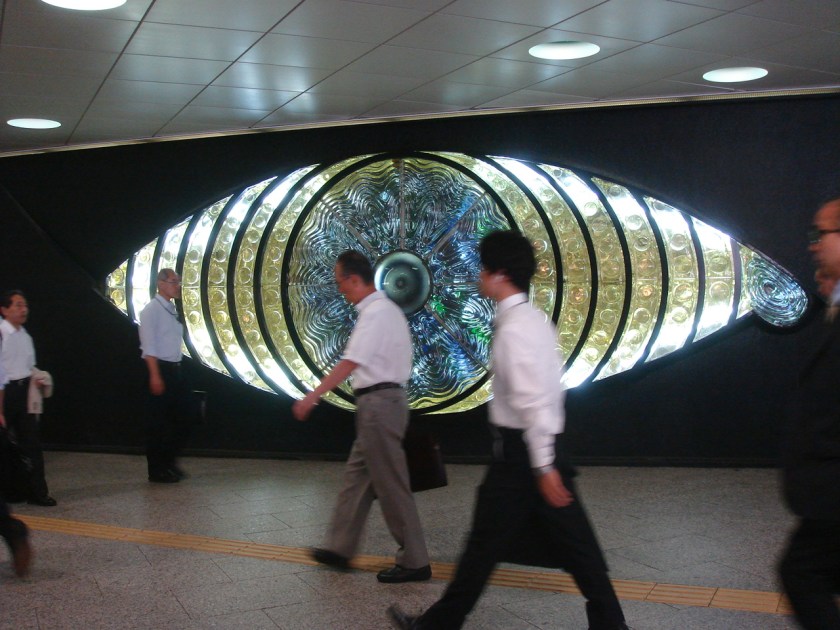
Somebody's watching you... office workers walk past an installation in Shinjuku station, Tokyo

We’ve met with several Japanese surveillance studies researchers whilst out here this time. I mentioned Ogura Toshimaru already the other day, but we also had a long meeting the week before with Hino Kimihiro, a researcher into bohan machizukuri (community security development), and government advisor on security planning. Dr Hino has been carrying out a number of research projects on both ‘designing out crime’ and on the effectiveness and public acceptability of CCTV in Japan. I hadn’t come across this research before as my contacts here were mainly in social sciences and law and Dr Hino tends to publish in urban planning journals and is not connected to other Japanese surveillance researchers. His work is very interesting and reminiscent of that of Martin Gill or Farrington and Welsh in the UK. It is a shame, that just like those researchers who have carried out analyses of CCTV for the UK Home Office, his assessments tend to be ignored by the government. Dr Hino’s latest project is to assess the trials of a new movement recognition system in Kawasaki city. I hope he can come to the January Camera Surveillance workshop at Queen’s University, Ontario, or the April Surveillance & Society conference in London (details coming soon!).

I also met today with Tajima Yasuhiko, a professor of media law in the School of Journalism at Jochi (Sophia) University in Tokyo. Professor Tajima has been one of the most important critical voices in the debate about surveillance in Japan, and has bridged the academic and activist world, being involved with legal action against juki-net and Google StreetView. We had a productive conversation about the politics of surveillance in Japan and the prospects for critical voices to be heard. He wasn’t optimistic that they would be, and neither am I after our meeting at the Prime Minister’s IT Strategic JQ the other day, however I am also convinved that in many ways Japan has not yet gown as coordinated and centralised a route on issues of security and surveillance as has the UK. There is, so far as I can see, no real attempt to link up things like juki-net or other databases and the anshin anzen (or bohan) machizukuri agenda, and i-Japan, national and local police, and wider community security agendas do not really coordinate at all. This is due to the lack of an obvious ‘threat’ like that of terrorism in the UK, around which such coordination can occur. The government half-heartedly tries to get people worried about North Korea, but really they aren’t, and ‘ageing society’, whilst a phrase used to justify almost anything (including central databases) is a worry, it does not generate the fear that comes with the war on terror.

We also considered the relative weakness of Japanese civil liberties organisations and the failure of the mainstream media to pick up on issues of privacy and surveillance. There seems to be some effort now to try to coordinate various organisations to push for an explicit constitutional protection for privacy (rather than the rather vague inclusion of such an idea in a wider notion of the ‘pursuit of happiness’), but whilst I can see that being happily accepted after the government has got its central database(s), I can’t see it being done in time to alter either this trajectory or the way in which the database(s) are built.

Why Japan is a surveillance society

We met yesterday with member of the Campaign Against Surveillance Society (AKA Kanshi-No!) a small but active organisation formed in in 2002 in response to the Japanese government’s jyuminkihondaichou network system (Residents’ Registry Network System, or juki-net). plans and the simultaneous introduction of police video surveillance cameras in Kabukicho in Tokyo. We had a long and detailed discussion which would be impossible to reproduce in full here, but I did get much more of a sense of what in particular is seen as objectionable about past and current Japanese government actions in this area.

The main thrust of the argument was to do with the top-down imposition of new forms of control on Japanese society. This they argued was the product of the longtime ruling Liberal Democratic Party’s neo-liberal turn and has thus been some time in the making. It is not a post-9/11 phenomenon, although they were also clear that the G-8 summit held in Hokkaido in 2008 used many of the same forms of ‘community action’ in the name of preventing terrorism as are used in the name of anzen anshin (safety) or bohan (security) from crime in Japanese cities everyday.

However, they argued that this might be a product of neo-liberalism, but the forms of community security were drawn from or influenced by a much older style of governance, that of the Edo-period mutual surveillance and control of the goningumi (five family groups). (this is actually remarkably similar to the argument that I, David Lyon and Kiyoshi Abe made in our paper in Urban Studies in 2007!). Thus the mini-patoka and wan-wan patrol initiatives in Arakawa-ku were seen as as much a part of an imposed state ordering process as the more obviously externally-derived CCTV-based form of urban governance going on in Shunjuku.

Underlying all this was the creation of an infrastructure for the surveillance society, juki-net. They were certainly aware of the way that juki-net had been limited from the original plans, and indeed they regarded these limits as being the major success of the popular campaign against the system, however they argued that the 11-digit unique number now assigned to every citizen was the most important element of the plans and this remained and could therefore serve as the foundation for future expansion and linking of government databases. They pointed to the way that the passport system had already been connected.

Kanshi-no! were also concerned, in this context, about the development of plans for experimental facial recognition systems to be used in Tokyo (at a location as yet unrevealed). This would imply the development of a national database of facial images, and a further extension of the personal information held by central government on individuals.

So was this all in the name of puraibashi (privacy) or some wider social concerns of something else? Certainly, privacy was mentioned, but not as much as one would expect in an interview with a British activist group on the same issues. I asked in particular about the decline of trust and community. The argument here was that community and any lingering sense of social trust had already been destroyed and that CCTV cameras and other surveillance measures were not responsible in themselves. However, from an outside perspective it does seem that there is more of a sense of social assurance and community, even in Tokyo than there is in the UK. I do wonder sometimes when people (from any country) refer back to some time when some idealised ‘trust’ or ‘community’ existed, when exactly it was! Rather than a  particular time, it seems to be a current that either asserts itself or is suppressed of co-opted into the aims of more powerful concerns in particular times and places.

I asked at one point what immediate change or new laws Kashi-no! would want, and the answer was quite simple: no new laws, just for the state to respect the constitution which they said already made both CCTV cameras and juki-net illegal (although of course the Supreme Court recently disagreed).

(Thank-you to the two members of Kanshi-no! for their time and patience with my questions)

CCTV and urban regeneration in Nippori

The link between urban regeneration or redevelopment and the introduction of video surveillance has been well documented by many different authors in Britain, in particularly Roy Coleman in Reclaiming the Streets. It seems that the link is strong in Tokyo too. This new CCTV scheme in the front of Nippori railway station in Arakawa-ku is not only clearly part of the social and spatial restructuring of this area, it is an essential part of the new image, with the new entranceway celebrating the security cameras as much as the area’s name. This is the area we were told by Shinjuku officials had only three cameras, whereas in fact it has the princely total of ten! In retrospect the Shinjuku people seemed to be rather condescending towards Arakawa-ku.

At the Tokyo Metropolitan Police HQ

The Tokyo Metropolitan Police HQ in Chiyoda-ku

We had an enlightening interview, which will give me much to analyse later, with three senior officers from the Seikatsu Anzen Bu (literally, ‘Everyday Life Safety Division’) of the Keisicho (Tokyo Metropolitan Police). Interestingly, this division that was created as a result of the Seikatsu Anzen Jourei (Governor Ishihara’s 2003 Tokyo Metropolitan Government ordinance) and which deals with all the community security and safety initiatives, including CCTV, is separate from the Chiki Bu (the community division) that is responsible for the koban neighbourhood police box system.

Like almost everyone in authority we have met here, the police were convinced that they were not doing surveillance in using the cameras. They also confirmed that almost all of the CCTV systems operated by shoutenkai (shopkeepers’ associations) are not monitored and are simply recorded. They also stressed their deep concern for privacy and the rights of citizens and said that data from the police-operated cameras – of which there are around 150 in Shinjuku (the largest system with 50 cameras in the Kabukicho entertainment district), Shibuya, Ikebukuro, Roppongi and Ueno – was only kept for 7 days unless there was a specific reason to retain it. This is a legal requirement not just a police guideline. The police cameras are monitored both in local stations and in a central control room, but we were told that it was strictly forbidden for us to visit (unlike every other city in which I have done research) as everyone who enters has to be pre-enrolled in the police iris-scan security database.

We talked a lot about the history of the development of CCTV and of community safety initiatives in Tokyo, and Governor Ishihara’s absolutely central role in backing video surveillance became very clear (it’s a shame he has so far refused an interview with us!). What was also particularly interesting was that the police themselves did not think that apparently obvious ‘trigger events’ were as important as it might seem. For example, they claim that the police only really began considering the use of CCTV cameras not after the Aum Shinrikyo sarin gas attacks on the Tokyo underground but because of the influence of G8 summit security. One officer specifically mentioned the Gleneagles summit (which was just starting when terrorists attacked the London transport system), but this was in 2005, well after the TMG had already introduced CCTV, and after which the Tokyo police have not introduced a lot more cameras. So I don’t quite understand their point. It may become clearer once I have the complete transcripts… They also claimed that it was the Tokyo police rather than Japan Railways themselves or the Tokyo Metro authority who insisted on installing CCTV in the Tokyo transport network after the Aum attacks.

The officers talked a lot about community involvement. They dismissed the objections to their public space CCTV systems for several reasons, not least as I have already mentioned that they were not doing ‘surveillance’, but more importantly because they claimed to have done extensive consultation with local community groups, businesses etc. The claimed that they could not do anything without this support. This may have been true for Kabukicho, which was undoubtedly afflicted by an influx of Chinese gangs in the 1990s, but we heard from the local government of another ward that is being lined up for one of the new volunteer-based child safety camera systems being introduced from 2010 that they were given no choice by the police, and that local people were not happy about it. The problem is that this local authority don’t want to be interviewed further about this as they are in a rather delicate position over this new system.

(Thank-you very much to the officers from the Seikatsu Anzen Bu for giving us their time)