Europe’s new security-industrial complex

neoconopticonThere is a superb and chilling new report out today that utterly demolishes the European Union’s claims to be in any way an  ethical or progressive leader on issues of security and surveillance. The report written by Ben Hayes for the Transantional Institute and Statewatch, documents in some detail the new vision for security in the EU, which the authors describe as a ‘neo-con-opticon.’ The report confirms a lot of things that have been concerning me about the direction and emphasis of EU security research and the increasingly unnacountable and behind closed-doors ways in which security policy is being developed. I asked back in January in an editorial in Surveillance & Society whether surveillance was becoming the new ‘baroque arsenal’, Mary Kaldor’s famous phrase to describe the huge, intricate and complex technocentric security structures of the second Cold War. This report answers that question with a resounding ‘yes’.

The press release quotes from the introduction:

“Despite the often benign intent behind collaborative European research into integrated land, air, maritime, space and cyber-surveillance systems, the EU’s security and R&D policy is coalescing around a high-tech blueprint for a new kind of security. It envisages a future world of red zones and green zones; external borders controlled by military force and internally by a sprawling network of physical and virtual security checkpoints; public spaces, micro-states and mega events policed by high-tech surveillance systems and rapid reaction forces; peacekeeping and crisis management missions that make no operational distinction between the suburbs of Basra or the Banlieue; and the increasing integration of defence and national security functions at home and abroad.

It is not just a case of sleepwalking into or waking up to a surveillance society, as the UK’s Information Commissioner famously warned, it feels more like turning a blind eye to the start of a new kind of arms race, one in which all the weapons are pointing inwards. Welcome to the NeoConOpticon.”

But don’t stop there. You can (well, you must) read the full report here: NeoConOpticon – The EU Security-Industrial Complex

And whilst you are at it, download Tony Bunyan’s equally superb report, The Shape of Things to Come – the EU Future Group, on the EU’s thoroughly undemocratic attempt to bypass public debate and hand internal security and surveillance policy over to the transnational security companies and the police and intelligence services.

(thanks to Rosamunde van Brakel for passing this on)
2nd Surveillance in Latin America Symposium

Following the success of the first Surveillance Studies symposium in Brazil last year, here is the call for the next one, this time in Mexico next year.

SIMPOSIO MEXICO

Introduction

In modern societies, identification systems have been used as an important mechanism to govern, manage, classify and control populations; in other words, to surveil them. This has meant the employment of certain technologies (passports, national identity letters, RFID, among others), providing interconnected data base systems with information according to specific institutional protocols. In this way, we define identification as visibility and verification of specific details of people’s lives. Likewise, these identification systems have responded to various functions: security, migration control, goods and service administration, as well for territory, space and group access.

The historical, social and politic contexts shape the particular purposes to which each identification system responds. Large-scale surveillance systems to identify the population have been installed in Latin America after decades of colonial, military and single-party governments In addition they have been prompted by increasing multiculturalism in cities, Population growth, migration rates, the perceived rise in terrorism, public security and health risks, as well as the creation of public policies (to aid poverty and unemployment) and globalization.

These conditions have caused the harmonization and articulation of corporations, institutions, technologies and specific protocols for citizen identification in Latin American countries, , depending on each country or region’s particular situation, and its relationship with other regions worldwide. Nevertheless, the Latin American environment allows us to consider the construction of privacy, identities, forms of government and the possibility of resistance policies.

Paper Proposals

In line with this analytic framework, the University of the State of Mexico, Faculty of Politics and Social Studies, hereby invites scholars, analysts and activists in Latin America and worldwide, interested in identification and surveillance, in relation to such matters as cultural or ethnic identities, privacy and data protection, new identification technologies (biometrics, RFID, etc), public policies, security, communication, ethics, law, or modes of critique or resistance; to participate in the International Symposium “Identification, identity and surveillance in Latin America”, by sending a lecture proposal.

Please send an abstract, 300-500 words long, Arial 12, space line 1.5, to the following e-mail: surveillance.studies.mexico@gmail.com, before October 30th 2009. Due to the nature of this event, the abstracts and papers are to be accepted in Spanish, Portuguese and English.

Note: There is no registration fee for this event. All participants are expected to seek their own funding for travel and accommodation. A number of rooms will be reserved with reasonable rates in a nearby hotel. More details to follow.

Main subjects

1. Governmental and corporative policies of identification

2. New technologies for identification and surveillance.

3. Purposes of identification systems in Latin America.

4. Communication and information technologies.

5. Privacy and transparency.

6. Identification, identities and subjectivities.

7. Relationship between global and local, in identification systems.

8. Postcolonial logics and political regimes.

9. Identities, surveillance and resistance.

10. Identification, identity and surveillance in Latin America: new theories?

Important Dates

Call for Papers Publication: July 30th 2009.

Abstract reception deadline: October 30th 2009.

Accepted lectures list publication: December 15th 2010.

Complete paper remittance deadline: February 15th 2010.

Complete program publication: February 28th 2010.

Second Symposium on surveillance in Latin America: March 16th, 17th y 18th 2010. University of the State of Mexico, Faculty of Politics and Social Studies. Toluca, México.

Organizing Committee

Nelson Arteaga Botello

Roberto J. Fuentes Rionda

Faculty of Politics and Social Studies, University of the State of Mexico

Rodrigo Firmito

Postgraduate Program in Urban Management, Pontifical Catholic University of Parana, Curitiba, Brazil

Fernanda Bruno

Postgraduate School of Communication, Federal University of Río de Janeiro, Brasil

Marta Kanashiro

Further Studies Laboratory of Journalism and Knowledge, Technology and Market Group, University of the State of Campinas (UNICAMP), Campinas, Brasil.

Danilo Doneda

De Campos Faculty of Law, Rio de Janeiro, Brasil

André Lemos

Federal University of Bahia, Brasil

With the support of:

David Lyon

David Murakami Wood

Department of Sociology, Queen’s University, Kingston, Ontario, Canada

Proposal reception, Information and Contact

surveillance.studies.mexico@gmail.com

Surveillance cameras in the favelas…

Well, my fears have it seems, been vindicated already. Earlier this year, as part of my case-study on surveillance in Brazil, I visited the community of Santa Marta, a favela (informal settlement) in Rio de Janeiro. Santa Marta is interesting because of the amount of investment and effort that has been expended in occupying, pacifying and developing the place, by the new gubernatorial administration of Eduardo Paes, who has simultaneously cancelled Favela Bairro, the widely praised and more extensive favela development programs of his predecessor, Cesar Maia.

Leading the new Community Police efforts in Santa Marta was Capitao Pricilla, an indomitable and well-liked young female officer of the Military Police, one of several rising female officers with a new approach, and we heard from residents how trust was being rebuilt between police and community because of her. At the same time, there were storm clouds on the horizon as the city administration was insistent on cracking down still further with its policies of choque de ordem (the shock of order), which involved harassing illegal street vendors from the favelas, and demolishing illegally-built buildings, and also building walls along the edges of some favelas. The word ‘ghetto’ was mentioned on more than one occasion by our interviewees and in more casual conversations.

Now, just last month, the Military Police have decided to install seven CCTV cameras in Santa Marta, in different areas of the community. This has prompted complaints of invasion of privacy, an there have already, my sources report, been protests about this in he favela, but it seems that this is coming from further up the chain of command than Capitao Pricilla and the community police. She isn’t mentioned at all by the article in O Globo, despite being a bit of a PR star, and instead the justification for the cameras is given by one Coronel José Carvalho, who also stated that there are plans to put cameras into the other two areas currently being targeted for development, the famous Cidade de Deus, and the much less well-known and more distant favela of Batan. This also contradicts what I was being told by the Commnder of the police central CCTV control room we visited, which is quoted as being one of the places where the cameras will be monitored. What is interesting is the cameras seem to be being treated by police almost as a tool of urban warfare: a Major Orderlei Santos talks about their experimental use for determine the deployment of officers in the favela.

Could the old macho, male, approach to policing as a war on the poor be trumping the new trust being developed by community policing? I hope not, but everything points that way.

(thanks once again to Paola and David for keeping me in touch…)

Moving on

Queen's University, Ontario

I’ve just got back from a very productive research trip to Japan and it’s only a couple of days to go until I leave again, this time permanently, which means I should at last say something about my new job. It also means I won’t be posting here much over the next week.

From September 1st, I will be Canada Research Chair (Tier 2) Associate Professor of Surveillance Studies in the Department of Sociology at Queen’s University in Kingston, Ontario, Canada. My new boss will be a longtime colleague and one of the people I admire most in the world of surveillance studies, David Lyon.

It’s a big move and probably, for both personal and professional reasons, the last big move I will make. I have been in various parts of Newcastle University in the UK since my Masters back in 1996-7. I originally moved to the School of Architecture, Planning and Landscape (APL) to work with the brilliant Professor Steve Graham who was running the innovative Centre for Urban Technology (CUT). I didn’t realise then that CUT was already on the verge of disappearing and was soon merged into the new, larger Global Urban Research Unit (GURU), and that Steve would leave to take up a Chair in Human Geography at Durham. However, that did mean that, having finished my postdoc, I could take over his teaching, which eventually led to a permanent lectureship. I’d wanted to move to Canada for a while though, and having got married to Kayo (that’s where the ‘Murakami’ comes from…), who also wanted the same things, we started looking and waiting for the right opportunities. It’s a bit odd leaving just after I’ve got the promotion I’d wanted, but you have to take the opportunities when they arise. It’s no judgement on Newcastle as a university or as a city (there isn’t a better one in England), but a life decision. My time at Newcastle has been great and there’s a number of people from the University I would like to thank in person and in public here:

Phillip Lowe from the Centre for Rural Economy, and Neil Ward (now Dean of Social Sciences at UEA) for giving me a break right at the start;

Rachel Woodward, previously of CRE and now in Geography, who was the perfect PhD supervisor;

Ella Ritchie from Politics, who gave me a job when I needed one in what was then the Department of Politics;

Steve Graham for mentoring me through a difficult period;

Geoff Vigar for being a great friend and latterly also, a most supportive Director of GURU;

and all the friends and colleagues in GURU, APL, and beyond, with whom I’ve shared both good times and intellectual stimulation over the years, in particular Alex Aurigi (who’ll soon be the new Head of the School of Architecture and Design at Plymouth), Andrew Ballantyne, Carlos Calderon, Stuart Cameron, Jon Coaffee (just appointed Chair of Spatial Planning at Birmingham!), Nathaniel Coleman, Lorna Dargan (now in the Careers Service), Anne Fry, David Haney, Jean Hillier, Marian Kyte, Rose Gilroy, Sara Gonzalez (now at Leeds Geography), Zan Gunn, Claire Haggett (now at Edinburgh Geography), Patsy Healey, Peter Kellett, Andy Law, Kim McCartney (the best administrator it has ever been my pleasure to work with), Ali Madanipour, Abid Mehmood, Frank Moulaert (now in Leuven), John Pendlebury, Neil Powe, Maggie Roe, Tim Shaw (now retired), Mark Shucksmith (OBE!), both Suzanne and Lucy Speak, Bill Tavernor, Ian Thompson, Graham Tipple, Tim Townshend, Bernadette Williams and Ken Willis. There’s others who I never got to know as well as I would have liked to have got to know better but there just hasn’t been the time – in particular, both Paolas, Martyn, and Armelle and Daniel. And apologies if there’s anyone else I’ve missed.

Finally, and most importantly of all, I’d like to thank our best friends and future godparents to our baby boy who’s due in December: Andrew Donaldson and Jane Midgley. Andrew, in particular, has been the person with whom I have probably shared most since we shared an office during our PhDs, and is in no small part responsible for any intellectual and personal progress I’ve made since that time.

Kabukicho Renaissance?

Kabukicho is a place that is hard to love. A seedy, crime-infested dive full of ‘massage parlours’, ‘aesthetic salons’, ‘image bars’ and other thinly-disguised forms of brothel. Tokyo has had red-light disticts since the Edo period, of course, and the Yoshiwara was only the most famous. Shinjuku was always one of them, and since the failure of the threatre initiative that gave the neighbourhood its name, Kabukicho has been the best known. Kabukicho is interesting though for many reasons. It had a radical political and cultural history in the 60s and 70s. It was the epicentre of changes that occurred in organised crime in the 80s and 90s, with Chinese gangs replacing the Yakuza as the biggest ‘threat’. And it is now the centre of efforts by the Shinjuku authorities to clean up its image, with the Kabukicho Renaissance policy, and the new Town Manager, and by Tokyo police to crack down on illegal immigration.

Controlling the outsiders

One of the most interesting meetings we had in our last week here in Japan was with two representatives from the Japan Civil Liberties Union (JCLU) and the association to defend the rights of foreign migrant workers. One thing that has always been clear to me from being a gaikokujin (or more casually, just gaijin – foreigner) in Japan is how distinct is this status. I’m a white, western European and therefore at the top of the list of acceptability in foreigners in Japan, but even so I’ve had some interesting experiences, including having two police squad cars and 5 officers deal with the matter of my ‘suspicious’ bicycle (an experience that practically all resident foreigners have had at one time or another), and just the other day I was stopped at the train station by two plain-clothes police officers, who started off quite strong, but then backed down and started mumbling apologies about ‘looking for someone’ when they realised my (Japanese) wife was just behind me. It was pretty obvious that they were conducting an immigration sweep – i.e. just stopping anyone who ‘looked foreign’ to check their immigration status.

This gave me just a tiny taste of what life can be like here for those whose immigration status is problematic. And, as the campaigners told us, this is an increasing number of people who have come to Japan because of the wealth and opportunities and because, whisper it, Japan needs immigrants. Like so many advanced industrial nations, Japan is a hyper-ageing society, with an increasingly unbalanced population pyramid. There are not enough working age Japanese people to support the increasing number of retirees, and government schemes to encourage people to have more children simply haven’t worked. The problem is that successive Japanese governments have refused to recognise the implications. The rules now make provision for ‘skilled’ immigrants, but not for those who are ‘unskilled’ and it is actually those in this latter category that Japan needs. In practice this is demonstrated by the increasing numbers of foreign delivery and construction workers in Tokyo as well as those working in the shadier areas of the ‘night economy’ – doormen, bar staff, masseurs, prostitutes etc.. The same politicians who deny the need for immigrants are probably having their personal ‘needs’ serviced by Filipino or Vietnamese women and this hypocrisy colours all the mainstream political debate about the place of foreigners in Japan, especially in Tokyo where Mayor Ishihara has never disguised his nationalist views in this area.

So, whilst the politicians refuse to deal with reality, the police are enforcing the law as it is. We have spent some time, whilst we are here (and I have gathered data on previous visits) in the night city of Kabukicho in Shinjuku. This time I was taken out to bars in the old post-war neighbourhood of Golden Gai by Professor Tonoma, who formerly led both Shinjuku-ku and Tokyo city planning bodies, and we also talked to Shinjuku community safety officers, and to the Kabukicho Town Manager, who runs the day-to-day operations of the body trying to improve Kabukicho’s image, Kabukicho Renaissance.

Kabukicho of course is famous as the first place that the Tokyo police installed CCTV, ostensibly to deal with Chinese gangs, but according to what we learned from these visits and from talking to the campaigners, as crime has declined (as it has nationally – it’s probably nothing to do with the cameras), the cameras and intensive policing (raids etc.) have been used largely to curb illegal migrant workers. And the authorities seem to make no distinction between the gangsters and the mainly South-east Asian women who work in the bars and massage parlours. They are all visa-overstayers. There is no attempt to treat the women as people in need of help and support at all. Of course this all inflates the crime figures and makes it easy to paint what the police always term ‘foreign crime’ (whatever the exact nature or seriousness of the crime) as a growing threat, as it becomes proportionally a larger part of shrinking crime rates (which were already low by global standards to begin with).

Now there is a new threat to this already massively targeted population. The inclusion of foreigners on the jyuminhyo (residents’ registry), combined with the digitisation and networking of this registry through juki-net, means that the authorities will be able to correlate residency and immigration status much more easily – the residency information for foreigners will be linked to the Houmusho (Ministry of Justice), which has entry records, and now fingerprints and facial photos too, following post-9/11 reforms. Of course, resident skilled foreigners wanted to be in the residents’ registry. They argued that not being on it was itself a form of discrimination and meant further difficulties in terms of things like buying property. However the inclusion of foreigners now opens up new forms of discriminatory practice against those who are already the most disadvantaged in Japanese society, the kinds of foreigners who more high-status ‘official’ foreigners do not generally recognise as kin to them at all.

Japan’s surveillance society, like most, is therefore a profoundly uneven one. Every society has its Others, and surveillance is deployed both to distinguish those Others and to control them. In each of the cities I have been studying the Others are different populations. In London, the Others are (at the moment) the resident Muslim community (or more particularly, ‘radicalised’ young Muslims). Here the surveillance combines repression and ‘caring’ programs to bring the disaffected back into the mainstream. In Rio de Janeiro, the Others are the urban poor, the favelados. They are largely simply excluded – walls protect the rich in their homes, and now walls are being built around the poor communities. In Tokyo, the Others are foreigners, but there are gradations of Otherness, and effectively still aping the western ‘scientific racism’ that it acquired during the Meiji period modernisation at the end of the nineteenth century, Japan’s Others are poor Blacks and Asians (for many on the right here, the Japanese are not ‘Asian’ at all, but something unique). Just as the British state is struggling with the legacy of its particular colonial and post-colonial approach to immigration, and the Brazilian state with a history of years of differentiated citizenship, the Japanese state has still not yet really come to terms with the prospect of the mixing of people at all.

Community Safety in Suginami

Following our meeting with the Mayor the other day, we went back to Suginami-ku to talk to the community safety people, who are part of the Disaster Management section. Suginami is interesting because, as far back as 2004, it was the first Local Authority in Japan to introduce a special bohan kamera jourei (security camera ordinance) which is based in part at least on principles of data protection and privacy. And until neighbouring Setegaya-ku introduced their own ordinance last year, they were, so far as I know, the only such authority. The ordinance followed public consultation which showed that although people generally thought CCTV was effective (95%), a significant minority of 34% were concerned about privacy, and 72% thought that regulation was needed. These figures seem to be significantly more in favour of privacy and regulation of CCTV than the nationwide survey done by Hino Kimihiro, however he asked different questions leading to answers that are not directly comparable.

Suginami is one of the areas of Tokyo that has the other kind of CCTV system introduced by the Tokyo Metropolitan Police after 2002, help points where people press a button if they feel in danger and speak to someone from the police. The help points have both CCTV camera and an alarm / red flashing light if the caller says it is an emergency.

However the Suginami community safety officers said that these cameras have not proved very effective and in fact they cause a lot of problems, because children tend to press the button for fun, and run away – meaning that there are many false alarms.

Suginami has some of the same kind of array of ‘blue-light’ volunteer patrols as Arakawa-ku. In Suginami, there is a fleet of mini-patoka (mini patrol cars) and motorbikes, used by 15 retired police officers. These are mainly about visibility leading to deterrence and increased community confidence, as the volunteers ex-officers have no special powers nor do they carry side-arms or handcuffs or any other conventional ‘police’ equipment. Suginami does not have the small community safety stations like Arakawa-ku, although they do also have the same problem of local koban (police boxes) being closed. However where Suginami really stands out is in the sheer number of volunteers they have involved in their community patrols, organised through the local PTAs, shoutenkai (shopkeepers’ associations) and choukai (community associations). There are 140 groups with 9600 people actively involved in one way or another in community safety just in Suginami.

Suginami is a relatively wealthy ward and the kinds of problems that concern Arakawa (mainly minor street crime and snatch-thefts) are not such big issues here.  The main concern in this ward seems to be burglary and furikomi – the practice of gangsters and other criminals calling old people and pretending to be a relative or representative of a relative and persuading them to transfer money to a particular ATM (which you can do in Japan – it would be impossible in the UK). Furikomi is a very interesting phenomenon in that it seems to be a product of family, social and technological changes. Many older people who would have lived with family in traditional Japanese society are now living alone. They are lonely and miss the intimacy of family contact, so they tend to welcome unexpected calls from relatives who may now be living almost anywhere in Japan. These older people are also technologically literate and able to use mobile phones, ATMs and computers. The combination of this technological skill, dispersed families, and psychological vulnerability makes for a ripe target for fraudsters, and Suginami estimate that 40% of all crime in the ward is some form of furikomi.

In many ways, increasing concern for privacy is also a product of this change in lifestyles and family structure, as well as building techniques – western-style walls and better sound insulation mean that you can’t always know what is going on in the next room anymore, let alone in your neighbours’ apartments or houses. This also makes burglary rather easier, as once the thief has got past the initial walls or doors, no-one can hear or see very much. The intense and intimate ‘natural surveillance’ that used to characterise ordinary Japanese communities is disappearing. But the Suginami community safety officers see the possibility of revitalising such natural surveillance, and protecting privacy, without going down the route of impersonal, technologically-mediated surveillance. In many ways, this is quite heartening – if, of course, you are of a communitarian mindset. Such supportive, mutually monitored and very inward-looking communities can be stifling to those who do not fit and exclusionary to those from outside… and, not coincidentally, one of our last interviews was with a leading support group for foreign migrants in Japan, who have a very different perspective on all of these developments. That will be in my next post, which may not be until Saturday as we’re going off to Kansai for a couple of days…

(Thank-you to the Disaster Management section for their time and patience).

Hille Koskela’s new book

pelkoTop Finnish surveillance studies academic, Hille Koskela, has a new book out, Pelkokierre – pelon politiikka, turvamarkkinat ja kamppailu kaupunkitilasta (‘The Spiral of Fear. Politics of Fear, Security Business, and the Struggle over Urban Space’). It looks like a fine addition to the literature on fear, security and surveillance, but unfortunately I can’t read it – as it’s in Suomi. Great cover though!

It should of course be translated into English and made available by an English-language publisher, but I doubt this will happen. Publishers don’t like to take what they consider to be a risk by publishing academic work from foreign countries, so unless the author is very famous or dead (or preferably both) it doesn’t happen. We tried very hard to get Michalis Lianos’s very important French book on control society published by an English-language publisher, with many supporting letters and so on, but there was no real interest.

Anyway, Hille has sent me a translation of the table of contents, which are:

1. The paradoxes of security

2. Birth of the security society
Relevant theories in sociology, social policy, geography, architecture, media studies, law and IR

3. The ontology of fear
The social production of fear, the spatial and temporal patterns, fear  as a commodity, streetwise semiotics

4. Fear in everyday life
Housing, workplaces, SUVs, public transport, tourism, child rearing,  ‘threatening’ teenagers, high school massacres

5. The architecture of fear
The classic ideas of Jacobs and Newman, contemporary architecture in public and private spaces, gating, surveillance

6. The politics of fear
Legislation (the public order act etc.), national and local security strategies, urban security politics, ‘the war’ on graffiti

7. The economy of fear
Security services, technology and other security products, images of place, crime and fear in the media

8. Towards a culture of tolerance

Vehicle tracking in Japan: N-system

Back in February, I reported from Brazil about the progress of a proposed RFID-based vehicle tracking system, SINIAV. Of course RFID is not at all necessary for tracking. In the UK, the police have used Automatic Numberplate Recognition (ANPR) systems based on roadside cameras since 1993 in London – following the Provisional IRA bombings of the City and Docklands (see the account in my erstwhile collaborator, Jon Coaffee‘s book, Terrorism, Risk and the City – and since 2005, this has been in the process of being expanded into a nationwide network (see also the official Press Release from the Association of Chief Police Officers concerning the launch here).

What is rather less well-known to the outside world is that Japan developed such an automated camera system far earlier, from the early 1980s. The so-called N-system thereafter was gradually expanded to cover almost all major expressways and strategic urban locations in Tokyo and Osaka. Kabukicho, the entertainment district in Shinjuku, which I have spent some time studying over the last few years and will write about more tomorrow, is surrounded by N-system cameras and it is, I estimate, impossible to drive into this area without your license plate being recorded. These cameras are in addition to the 50 CCTV cameras that cover just about every street within the district. N-system is supposed to have played a major role on snaring suspects from the apocaylptic cult, Aum Shinrikyo, which carried out the Sarin gas attacks on the Tokyo underground in 1995, and who also assassinated top policemen and judges. Aum, now renamed ‘Aleph’, has been under official state surveillance ever since.

The Japanese police are not very forthcoming about N-system, let alone the details of how long data is kept and what it is used for. However one particular lawyer’s office in Tokyo did a very good investigation of the constitutional, legal and practical aspects of N-system back in the late 90s, and the updated pages are available here, including a nice little animation explaining how the system works.

We will hopefully be talking to them before we leave Tokyo. We still have time for a few more interviews here including the East Japan Railways security research lab, the Japanese consumers’ association, the organisation for the welfare of foreign workers, and the Suginami ward community safety people. And I will also just about have time to shoot down to Kobe to talk to Professor Kiyoshi Abe, a friend and collaborator, who is also one of the leading surveillance researchers here.

Japanese surveillance studies researchers

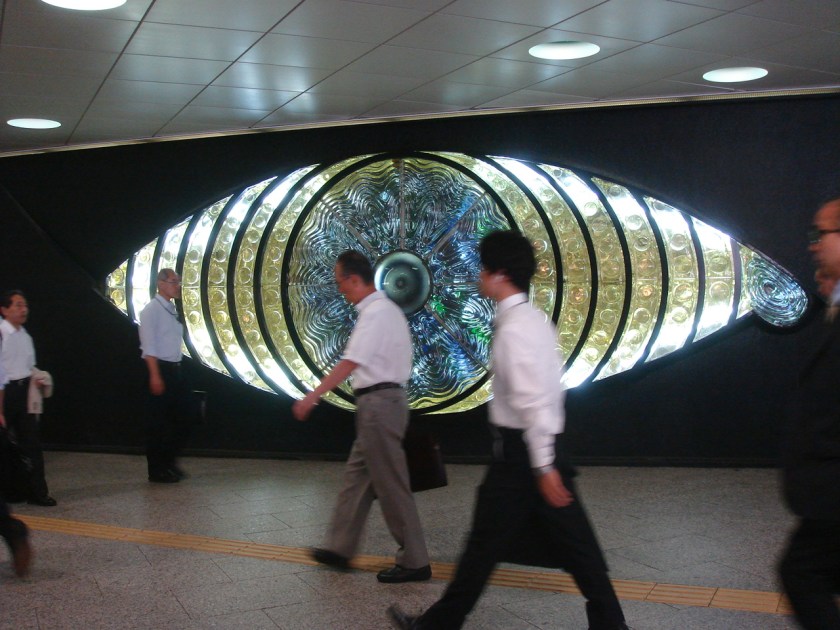
Somebody's watching you... office workers walk past an installation in Shinjuku station, Tokyo

We’ve met with several Japanese surveillance studies researchers whilst out here this time. I mentioned Ogura Toshimaru already the other day, but we also had a long meeting the week before with Hino Kimihiro, a researcher into bohan machizukuri (community security development), and government advisor on security planning. Dr Hino has been carrying out a number of research projects on both ‘designing out crime’ and on the effectiveness and public acceptability of CCTV in Japan. I hadn’t come across this research before as my contacts here were mainly in social sciences and law and Dr Hino tends to publish in urban planning journals and is not connected to other Japanese surveillance researchers. His work is very interesting and reminiscent of that of Martin Gill or Farrington and Welsh in the UK. It is a shame, that just like those researchers who have carried out analyses of CCTV for the UK Home Office, his assessments tend to be ignored by the government. Dr Hino’s latest project is to assess the trials of a new movement recognition system in Kawasaki city. I hope he can come to the January Camera Surveillance workshop at Queen’s University, Ontario, or the April Surveillance & Society conference in London (details coming soon!).

I also met today with Tajima Yasuhiko, a professor of media law in the School of Journalism at Jochi (Sophia) University in Tokyo. Professor Tajima has been one of the most important critical voices in the debate about surveillance in Japan, and has bridged the academic and activist world, being involved with legal action against juki-net and Google StreetView. We had a productive conversation about the politics of surveillance in Japan and the prospects for critical voices to be heard. He wasn’t optimistic that they would be, and neither am I after our meeting at the Prime Minister’s IT Strategic JQ the other day, however I am also convinved that in many ways Japan has not yet gown as coordinated and centralised a route on issues of security and surveillance as has the UK. There is, so far as I can see, no real attempt to link up things like juki-net or other databases and the anshin anzen (or bohan) machizukuri agenda, and i-Japan, national and local police, and wider community security agendas do not really coordinate at all. This is due to the lack of an obvious ‘threat’ like that of terrorism in the UK, around which such coordination can occur. The government half-heartedly tries to get people worried about North Korea, but really they aren’t, and ‘ageing society’, whilst a phrase used to justify almost anything (including central databases) is a worry, it does not generate the fear that comes with the war on terror.

We also considered the relative weakness of Japanese civil liberties organisations and the failure of the mainstream media to pick up on issues of privacy and surveillance. There seems to be some effort now to try to coordinate various organisations to push for an explicit constitutional protection for privacy (rather than the rather vague inclusion of such an idea in a wider notion of the ‘pursuit of happiness’), but whilst I can see that being happily accepted after the government has got its central database(s), I can’t see it being done in time to alter either this trajectory or the way in which the database(s) are built.