Many approaches to developing cities as automated environments, whether this be for robotics, for augmented reality or ubiquitous computing tend to take as their premise the addition of items, generally computing devices, to the environment. Thus, for example, RFID chips can be embedded in buildings and objects which could (and indeed in some cases, already do) communicate with each other and with mobile devices to form networks to enable all kinds of location-based services, mobile commerce and of course, surveillance.
But for robots in the city, such a complex network of communication is not strictly necessary. Cities already contain many relatively stable points by which such artificial entities can orient themselves, however not all of them are obvious. One recent Japanese paper, mentioned in Boing Boing, advocates the use of manhole covers, which tend to be static, metallic, quite distinctive and relatively long-lasting – all useful qualities in establishing location. The shape of manhole covers could be recorded and used as location-finding data with no need for embedded chips and the like.
It isn’t mentioned in the article, but I wonder whether such data could also be used for other inhabitants of the city with limited sensory capabilities: impaired humans? Could one equip people with devices that read the same data and use this to help sensorially-impaired people to navigate the city more effectively? On the less positive side, I also wonder whether such data would prove to be highly desirable information for use in urban warfare…
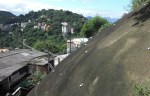
One of the things I noted this time last year when I visited Rio de Janeiro was the perilous situation of the poorest areas of informal housing, the favelas or morros when it comes to flooding and landslides. Just in the last 24 hours, huge amounts of rain has caused land and debris slides that have killed around 100 in the state according to the BBC, and in particular 13 people have been killed in Morro dos Prazeres, a favela I visited with my colleague Paola, according to The Guardian*. The centre of the city is deep in water. My thoughts are with all the people I met last year in Rio, and all the communities affected by this disaster.
A really stimulating article by Matt Jones over at Future Metro, my new favourite site, which I have only just discovered thanks to David Barnard-Wills. This manages to combine several of my interests: urban futures, surveillance, security, ubicomp, SF and comics, into one tasty package – I’ll have to check out Matt’s own blog too.
Kabukicho is a place that is hard to love. A seedy, crime-infested dive full of ‘massage parlours’, ‘aesthetic salons’, ‘image bars’ and other thinly-disguised forms of brothel. Tokyo has had red-light disticts since the Edo period, of course, and the Yoshiwara was only the most famous. Shinjuku was always one of them, and since the failure of the threatre initiative that gave the neighbourhood its name, Kabukicho has been the best known. Kabukicho is interesting though for many reasons. It had a radical political and cultural history in the 60s and 70s. It was the epicentre of changes that occurred in organised crime in the 80s and 90s, with Chinese gangs replacing the Yakuza as the biggest ‘threat’. And it is now the centre of efforts by the Shinjuku authorities to clean up its image, with the Kabukicho Renaissance policy, and the new Town Manager, and by Tokyo police to crack down on illegal immigration.
Tokyo is a constantly changing stew of styles and forms, but don’t be fooled into thinking this is just ‘organic’ change. The capital of Japan is a playground for capital, local and global, and there isn’t much in the way of planning law or practice to stop the developers doing exactly what they want. It’s worth reading Andre Sorensen’s The Making of Urban Japan for a good account in English of why this is.
Inasmuch as the traditional morphology of machi (neighbourhoods) survive, it is largely due to either the unfashionable character of the area putting off developers, temporary lulls in the property market, or the sheer stubbornness of residents in refusing to being intimidated into selling land or putting up with the serial replication of blocks of manshon (typical 5+ storey apartment complexes). Strong property rights and small traditional plots do at least mean that it is more difficult to put together the land in what is called tochi kukaku seiri (land readjusment) to make really large developments which, as a result, tends to be restricted to whole sites that come on the market through things like the privatisation of Japan Railways (although some private developers like Mori Building Co. have managed private massive land readjustment projects like Roppongi Hills that I have researched on previous visits).
Of course the building regulations that do exist tend to favour development too, as they regard any old building as inherently unsafe (because of susceptibility to fire and earthquake) and it is thus very difficult, for example, to get traditional wooden houses repaired let alone new ones built. In addition, since the Edo period regulations have sought to open fire-breaks in the urban structure and increase the width of roads and alleyways – and again, the traditional and wonderfully characterful narrow roji (lanes) are very difficult to maintain as any new building has to be set back to newer road standards. This in turn tends to make the backstreets more accessible to faster-moving traffic and thus gradually dehuamanize and desocialize these places.
So communities have a lot to contend with and, despite the 196os environmental movements and machizukuri (community development) and the 1980s craze for ‘amenity’ (which included the promulgation of a ‘sunlight ordinance’ that was supposed to stop the construction of taller buildings that would block out the sun from neighbouring plots), the developers continue to try to squeeze in unwanted and inappropriately massive structures wherever they can.
We came across this small example of a local neighbourhood campaign to stop a new manshon being built at the edge of the historic (but much damaged) Yanaka district. It might not loo very exciting but you add these developments up all over the city and it goes a long way to explaining why Tokyo is gradually losing the remaining historic and social character that makes it a surprisingly human place to live, despite its size…
As I mentioned the other day, after the Kanto daishinsai (Great Kanto Earthquake) of 1923, there were many changes to planning and architecture in Tokyo, in particular a series of experiments with introducing western-style elements into the city, including wider streets to accommodate trams (streetcars), and new concrete mass housing influenced by the modern movement.
Dojunkai, a special organisation under the Interior Ministry, was set to provide such things. Between 1924 and 1936, this agency built 16 apartment blocks out of ferroconcrete and wood in Tokyo and Yokohama. The best known were those in Daikanyama (near Shibuya) and on Omotesando Avenue in Aoyama. The latter were controversially demolished in 2003 by the Mori Building Company Ltd to make way for their soulless Omotesando Hills shopping complex.
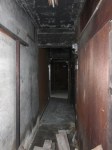
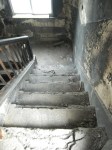
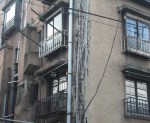
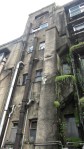
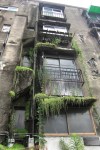
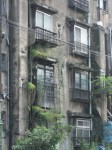
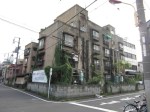
Much less celebrated however, were the Dojunkai appartments in Nippori (not Minowa as most people seem to think) in Aarakawa-ku, just round the corner from where I am staying. They’ve been empty and crumbling for a while, but now the writing is very literally on the wall, saying that they will be demolished too. It’s a sad moment: another episode in the slow death of the utopian urban ideal of the Twentieth Century. It’s also a reflection of the very high land prices in Tokyo and relative lack of value in what is on the land at any time (see this article for a good summary of the difficulty of any architectural preservation in Tokyo).
Anyway, not only are they valuable historical buildings, they are also degenerating rather stylishly so, at the very least, I thought I should get in and take some pictures before it was too late. So I did – much to the surprise of a crew of local authority workers who were surveying the place as I came out. Here are some of the shots. I didn’t (yet) go into any of the indvidual apartments – all those I tried were locked and some chained too – though I might try to in the early morning this week before anyone is around.
Pretty much as predicted, the LDP lost badly in the Assembly elections for Tokyo. They ended up with only 38 seats to the Democratic Party of Japan’s (DPJ) 54. The LDP will continue to be part of the largest bloc in the Assembly thanks to the 22 seats held by the Komeito, the party of the Soka Gakkai, a lay organisation of the large Nichiren Shoshu evangelical Buddhist sect. The Komeito have almost single-handedly kept the LDP in power in Japan for years now, and seem to have no point to their existence at all, apart from ensuring that laws on religious organisations are kept as light as possible. Nevertheless, even as a bloc, the LDP / Komeito no longer have a majority in the 127-seat Assembly.
Under pressure, unpopular LDP Prime Minister, Aso Taro, has now called elections to the national Diet for August 30th. Normally one would expect a wipe-out of the LDP, but that’s not how Japanese politics works. With very strong rural and regional support, the LDP will most likely win again, but a different faction will get their man (and it will most probably be a man) into the PM’s office. There has been a non-LDP government before, but it happens so infrequently as to be almost unheard of…
Whilst Aso is unpopular and LDP’s response to the recession has been both predictably unimaginative and unsustainable (in short, “more concrete!”), this wasn’t just about national issues, despite what LDP spokespeople in Tokyo would have us believe. There are some serious economic and urban development issues in Tokyo. More people seem to have lost patience with long-standing Governor Ishihara, who is backed by the LDP on the whole, and in particular the almost collapse of Ishihara’s subsidies for Tokyo banks affected by the global collapse of financial services, and the latest mega-scheme to free up land for private sector redevelopment, the proposed move of the famous Tsukiji fishmarket from its convenient and historic location at the edge of fashionable and expensive Ginza to some remote toxic waste dump in the middle of nowhere. 20 years ago, even 5 years ago, such ridiculous schemes to aid private capital were routinely forced through, but in the current climate, this may not be possible. Finally, like Rio de Janeiro, where I was earlier in the year, Tokyo is candidate city for the 2016 Olympics with all the financial (and social and security) implications that bidding for and hosting such a mega-event implies, and people are starting to wonder whether the city can afford it.
Still, the relentless march of redevelopment continues elsewhere: the old Koma Theatre in Kabukicho, which I predicted would be targeted by developers as soon as they started trying to secure the area with CCTV cameras and intensified policing a few years back, is now almost demolished (pictures soon)… apparently Shinjuku’s red light district is now officially safe for more mainstream and less obviously dirty forms on capitalism.
Following in the footsteps of leading urbanists like Mike Davis and Michael Sorkin, is a project led by Dr Jeremy Nemeth, an assistant professor at University of Colorado. which traces the degradation, securitization and privatization of what we used to optimistically refer to as ‘public space’. This project aims to map and quantify the space in three contemporary cities (New York, Los Angeles and San Fransisco) now restricted in the name of security. The website is online now, and their findings are summarized on the front page:
“Even before [the 9/11] terror attacks, owners and managers of high-profile public and private buildings had begun to militarize space by outfitting surrounding streets and sidewalks with rotating surveillance cameras, metal fences and concrete bollards. In emergency situations, such features may be reasonable impositions, but as threat levels fall these larger security zones fail to incorporate a diversity of uses and users.
Utilizing an innovative method developed by our interdisciplinary team, we find that over 17% of total space within our three study sites is closed entirely or severely limits public access. The ubiquity of these security zones encourages us to consider them a new land use type.”
(thanks to Dr Nemeth for the corrections to my original misattribution of his excellent project)
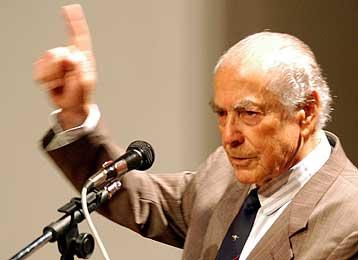
One question that has been preoccupying my thoughts recently has been the question of why the simple things are not being done in Rio to address the problems of the favelas: sanitation, education, healthcare etc… many of the people we have talked to look back to the regime of Leonel Brizola, the Governor of the State of Rio de Janeiro from 1983 to 1987 and then again from 1991 to 1994. Brizola was a left-progressive populist, a social democrat and a former opponent of the dictatorship who had had to live in exile for much of the 1970s. Sadly he died in 2004, but we had the opportunity this week to talk to his former Secretary of State for Public Security, and also briefly Governor himself from 1994-5, Nilo Batista.
We met Professor Batista in the Instituto Carioca de Crimonologia (ICC), an independent research organisation, which he runs (and funds from his legal work), along with his wife, sociologist, Vera Malaguti Batista. The Institute is housed in a sleek modern building up in the hills of Santa Teresa, from whose picture windows the city below is all but invisible and the bay appears almost as it was when Europeans first arrived. However, the concerns of the Institute are very much with the reality of the city today.
We had a long and wide-ranging conversation, which would be impossible to recount in detail here, but the basis of it was an understanding of Brazilian society, and in particular that of Rio, based on the ongoing legacies of the past, in particular slavery and authoritarianism. Vera Malaguti’s book, O Medo na Cidade do Rio de Janeiro: dois tempos de uma historia (Fear in the City of Rio de Janeiro: one story in two periods) examines previous periods of revolt by Africans in Brazil and argues that the often unspoken elite fear of the africanisation of Brazil. They argue that repressive public security strategies today are founded in this same fundamental fear, driven by the media that serves the powerful middle classes who aspire to elite values and lifestyles.
In opposition they place Brizola and that brief (and they argue, unrepeated) period at the end of the dictatorship when social justice and in particular, education, were priorities and favelas were provided with services in the same way as any other neighborhood. The security strategy of Brizola and Batista was effectively one of anti-stigmatisation. They argue that since then, media-driven fear and repression has been far more the norm and this had undermined the progress made under Brizola.The current public security-based strategy of the Governor Cabral and the ‘choque de ordem’ of Giuliani-wannabe Mayor Eduardo Paes, is one example. By concentrating on ‘pacifying’ one or two places as examples (Santa Marta and Cidade de Deus at present) without being able to afford the same strategy elsewhere, it constitutes simply a public relations exercise, and elsewhere repression without development continues as normal.
The Batistas are passionate and well-motivated, but there are many who argue that this picture of a progressive Brizola regime subsequently undermined by repressive policies is at the very least, a limited view. It was, after all, under Brizola that the traffickers grew in power and acquired weapons; the mid-eighties was the key period here as the cocaine trade grew from almost nothing to being the driving force of gang activity in Rio. This isn’t just a view held by political opponents: whilst he certainly does not (and could not with any justification) claim that the rise of the cocaine trade was anything to do with Brizola, Enrique Desmond Arias in Drugs and Democracy in Rio de Janeiro, argues that the personalist populism of Brizola undermined the leadership of the Community Associations in the favelas and left them open to co-option by drug gangs. When we visited the office of the current Secretary of State for Security, Jose Mariano Beltrami, and talked with his representative, it was quite strongly argued that Brizola neglected the issue of the growing arming and violence of drug traffickers, and also did nothing to solve the massive problem of police corruption (on which I will write more later). The current longer-term strategy is now to recruit a lot more Military Police, in the hope that numbers will do what force has not, and enable the gangs to be beaten.
We also visited the office of a leading critic of human rights abuses, Alessandro Mollon, a Deputy in the State parliament. He said that Beltrami is actually shifting, without ever having admitted to it, from a very macho and repressive approach when he first arrived from the southern state of Rio Grande do Sul, to a more considered (but hardly progressive) strategy now, of which the emphasis on police officers on the streets, rather than invasions, is one aspect.
Former Mayor of Rio, Cesar Maia
The claim that Brizola was the last real progressive figure to lead Rio also neglects some others, particularly those who have held the office of the Mayor. Under Cesar Maia (1993-7; 2001-2008), the ‘Favela Bairro’ program had much in common with what Brizola did in social terms. Indeed when we asked the leader of the Morro dos Prazeres Community Association what would be the one thing she wanted above all else, it was ‘more Favela Bairro’. In Dona Marta they also had some time for the former governor, Anthony Garotinho (1999-2002) a frankly quite foolish evangelical populist, currently under investigation for corruption, as is his wife, Rosinha, who was Governor from 2003-7. However, we heard from others that the things that they attribute to Garotinho were actually planned or initiated under previous administrations and just did not see the light until his.
What is certainly the case is that Brizola had a better attitude to the favelados as people, than other administrations, regardless of his mistakes. The current regime certainly seems to be more driven far more by middle-class fears than by social progress, but it is also the constant undermining of the progress of previous administrations like Brizola’s and then later Maia’s terms as Mayor by new waves of media-courting repression that is so depressing in Rio. It happens in every democratic country, but here in Brazil there is the most blatant inequality of any wealthy country still crying out to be addressed. If it was, then most of the issues of ‘crime’ and ‘insecurity’ would start to disappear. It would, as Deputado Mollon also pointed out, be a lot cheaper than the massive amounts of money now going into the hands or private security companies – who, as Professor Batista noted are often run by the families of senior police officers, who therefore have no actual interest in reducing crime and every reason to want to see fear continue to grow.
(With thanks to Nilo Batista, Vera Malaguti Batista, Alessandro Mollon and the staff of the office of Jose Mariano Beltrami for their time and patience. In particular, I hope to return to the Instituto Carioca de Criminologia sometime in the future to talk about the findings of this project, and to submit something to their excellent journal, Discursos Sediciosos: crime, direito e sociedade)
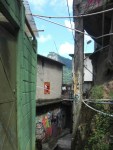
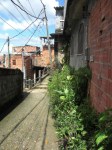
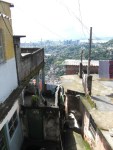
One of our most interesting visits last week was to the favela of Morro dos Prazeres, north-west of Santa Teresa. Prazeres has one of the most astonishing views of Rio of any neighbourhood, with an almost 360 degree panorama of the city, it’s perspective to the south only interupted by the statue of Christ the Redeemer, which is hardly a bad view in itself! You might think that the last thing that favelados would care about was the view but they are well aware of the beauty of their location – the assumption that the poor an desperate would not care about such things is a rather patronising misconception. Elisa, the leader of the community association, at least, seems most proud of this asset and says that like many people she wouldn’t want to live anywhere else even if she won the lottery!
But Prazeres does have serious problems. For a start, it is a ‘hot’ favela, occupied by drug traffickers, who control ‘law and order’ in the place. There is therefore no ongoing police presence, although as with many such communities, the community association does have a relationship of sorts with local military police commanders through organised coffee mornings at which problems are discussed. Luckily, despite or because of the almost complete control of a particular gang which is well integrated into the community (i.e.: they are relatives of the more law-abiding members), there are not many problems with violence and the police, ‘thank God’ (says Elisa), have not raided the favela recently, as they have many others.
In fact, as we were visiting Prazeres, as the taxi driver rather anxiously pointed out as he dropped us a safe distance away, BOPE (military police special operations) were ‘invading’ two other favelas next to it, the very hot Morro de Correoa, and Sao Carlos. The operations left eight dead, and we think what we had assumed initially were fireworks was probably the sound of small arms fire in the Sao Carlos operation. However, when we asked a PM at a nearby police post whether Prazeres was safe to enter, he seemed rather blase and relaxed about the whole thing…
Elisa was another very impressive woman. In the absence of men – who, in the favelas are in many cases, either involved in the gangs, working outside, or unemployed and alcoholic – it seems that a whole generation of strong, courageous women has emerged to try to develop their communities from the bottom up. In the past they have benefited from various attempts by previous mayors to provide development for the favelas. Unlike some places, Prazeres does not have a school built during the regimes of populist left-wing Governor, Leonel Brizola (who seems to be fondly recalled in by almost all those we have talked to in the poorer communities). However there was a lot of intervention as part of the Favela Bairro (Favela Community) program of former Mayor, Cesar Maia, and it is this normalisation or the favelas through infrastructure, social and economic development, education, health and social services that Elisa said are the only long-term solution to the problems of Prazeres. The creche in particular is a source of continual delight to her, and her face lit up whenever it is mentioned.
With social development and education, Elisa argued, eventually the ‘cold’ and uncaring gangs will recruit fewer kids, and they will wither slowly away. Confrontation however, only strengthens them by driving more young people to support the ‘insider’ traffickers against the ‘outsider’ police. They must, she said, work like little ants, with lots of small efforts adding up together to long-term success… then perhaps the anthill of Prazeres will function as a normal community.

























 ubisurv